· 18 min read · Gibby, StreetLegal Editorial
What This Guide Covers
- ✅ Step-by-step launch checklist from idea to first sale
- ✅ Every permit you'll need — health, fire, business license, food handler
- ✅ Full cost breakdown by category (truck, permits, commissary, insurance)
- ✅ How to find a commissary kitchen
- ✅ Location strategy: events, pods, street vending, corporate accounts
- ✅ City-specific guides for all 13 major US food truck markets
How to Start a Food Truck Business in 2026: The Complete Guide
If you want to start a food truck business in 2026, plan on a total first-year budget of roughly $45,000 to $140,000, an 8-12 week permit timeline in most cities, and a required stack of licenses that usually includes a health permit, business license, sales tax registration, food safety certifications, insurance, and a commissary kitchen agreement.
There are about 35,000 food trucks operating in the United States as of 2026. The industry generates over $2.7 billion in annual revenue, and it's been growing at roughly 7% per year. The barrier to entry is lower than a brick-and-mortar restaurant, but "lower" doesn't mean simple — and the operators who fail usually do so because they underestimated the permit process, overestimated foot traffic, or ran out of working capital before they found their audience.
This guide is the one we wish existed when we started StreetLegal. It doesn't pull punches about what's hard, what's expensive, or what most permit guides get wrong. Read the whole thing before you spend a dollar.
To start a food truck business, you need a viable menu, a legal business entity, a compliant truck, a commissary kitchen, required permits and inspections, insurance, and enough working capital to survive the approval period before your first sale.
Step 1: Concept & Menu Planning
Before you look at trucks or permits, you need a viable concept. The food truck graveyard is full of operators who picked a cuisine they personally loved but didn't validate whether their target market would pay $12–$18 per meal for it consistently.
What makes a good food truck concept:
- Speed: Can you make it in under 3 minutes? Street food lines kill customer patience fast.
- Margin: Food cost should be 28–35% of menu price. Lobster rolls are delicious but require premium pricing.
- Portability: Can customers eat it standing up, without utensils if necessary?
- Differentiation: Why you, not the truck next door? "Best tacos in the city" is not differentiation.
- Equipment fit: Does your concept fit in a 16–22 foot truck kitchen without a $50K custom build?
Test before you build: Do a pop-up at a farmers market, food hall, or local event before investing in a truck. Many cities allow temporary food vendor permits for $50–$150 per event. Sell 200 portions at an event — if you can't sell out, you need to rethink the concept before spending $80,000.
Step 2: Business Structure & Registration
You need a legal business entity before you can get most licenses. The options:
- LLC (most common): $50–$200 to register with your state Secretary of State. Provides liability protection. Recommended for most operators.
- Sole Proprietorship: No registration required, but zero liability protection. Not recommended.
- S-Corp: Tax advantages at higher income levels, but more administrative overhead. Worth discussing with a CPA once you're profitable.
After forming your LLC:
- Get an EIN (Employer Identification Number) from IRS.gov — free, takes 10 minutes online
- Open a dedicated business bank account (separate from personal finances — non-negotiable)
- File a DBA ("doing business as") if your truck name differs from your LLC name — typically $25–$75
- Register for state sales tax / business privilege license in your operating state
Step 3: Buying or Renting Your Truck
The truck is usually your biggest capital expense. New trucks from custom builders cost $80,000–$175,000. Used trucks from reputable dealers run $30,000–$80,000. A used truck that already has a health inspection history can save you weeks on the permit process.
New vs. Used:
| Factor | New Truck | Used Truck |
|---|---|---|
| Cost | $80K–$175K | $30K–$80K |
| Customization | Fully custom | May need modifications |
| Permit history | None — start fresh | May have inspection records |
| Equipment age | New warranty | Unknown wear |
| Lead time | 3–6 months build time | Available now |
| Best for | Serious long-term investment | Getting to market faster |
⚠️ Get a Pre-Purchase Inspection
Before buying any used truck, hire a commercial kitchen inspector or food truck specialist to inspect it. Used trucks can hide failing refrigeration compressors, propane line corrosion, water heater issues, and electrical problems that cost $5,000–$20,000 to fix. A $300 pre-purchase inspection could save you from a financial disaster.
Financing options: SBA 7(a) loans (up to $5M, 10–25 year terms), equipment financing from specialty lenders (rates vary 6–12%), Accion Opportunity Fund (CDFI lender friendly to food entrepreneurs), or seller financing on used trucks.
Step 4: Securing a Commissary Kitchen
In almost every US city, your health department requires you to operate from a licensed commissary kitchen — a commercial kitchen where you prep food, clean equipment, and dispose of grease and wastewater. You can't prep raw ingredients at home, even if you have a nice kitchen.
What a commissary provides:
- Licensed prep space with commercial-grade surfaces and equipment
- Three-compartment sink for equipment washing
- Grease trap and wastewater disposal
- Commercial refrigeration and dry storage
- Signed commissary agreement for your health department application
Typical costs: $200–$900/month depending on city, hours of access, and what's included. NYC and LA skew high ($700–$1,200/month). Pittsburgh and Phoenix skew low ($200–$500/month).
How to find one:
- Search "commissary kitchen for rent [your city]" on Google Maps
- Ask your city's health department — they often have a list of approved commissaries
- Check with local restaurant incubators, commercial kitchen co-ops, and food halls
- Use StreetLegal's commissary marketplace (available in Pittsburgh and Philadelphia now, more cities coming)
For a deeper dive, read our complete guide: Food Truck Commissary Kitchen: What It Is, Why You Need It, How to Find One. You should also review food truck permit costs in 2026 before you commit to a truck budget.
Step 5: Permits & Licenses
Every food truck needs a stack of licenses, not just one permit. Here's every layer you'll encounter. If you're still comparing markets, our Pittsburgh guide, NYC guide, and Chicago guide show how much the rules change by city.
5a. Mobile Food Unit (MFU) Health License
This is your primary permit. It's issued by your county or city health department after a truck inspection. Every food truck in the country needs this (under different names by jurisdiction).
- Typical cost: $200–$800/year (varies by city, risk level)
- Inspection covers: Sinks, refrigeration, food surfaces, waste handling, commissary agreement
- Renewal: Annual, with unannounced inspections throughout the year
5b. City Business License
Separate from your health license. Most cities require you to register as a business before operating within city limits.
- Typical cost: $30–$150/year
- Notes: If you operate in multiple cities, you may need a license in each one (especially true in large metro areas like DFW, LA, Miami)
5c. State Sales Tax / Business Registration
Every state requires you to collect and remit sales tax. You need a sales tax permit or business registration with your state Department of Revenue before you sell a single item.
- Typical cost: $0–$50 (most states issue this for free)
- Filing frequency: Monthly or quarterly depending on volume
5d. Food Handler & Manager Certifications
All food-contact employees need food handler cards. At least one manager needs a Certified Food Manager (CFM) designation from an accredited program (ServSafe being the most common).
- Handler cards: $10–$25 per employee
- CFM certification: $100–$150 per manager
- Note: Some states have state-specific requirements (Oregon, for example). Check your state's requirements.
5e. Special Event Permits
If you vend at a farmers market, festival, or any organized event, you typically need a Temporary Food Establishment (TFE) permit for that specific event. Some events include this in your vendor fee; others require you to pull it yourself.
- Cost: $25–$100 per event
- Lead time: Apply at least 2 weeks before the event
Step 6: Fire Safety & Insurance
Fire Safety
Any truck with commercial cooking equipment needs a fire suppression system (Ansul Class K). This is the chemical suppression hood over your cooking line — it's inspected by your local fire marshal and requires semi-annual professional service.
- Ansul system installation (new): $1,500–$3,000
- Semi-annual service: $150–$300 per service = $300–$600/year ongoing
- Fire marshal inspection fee: $75–$200
Insurance (Non-Negotiable)
You need multiple types of insurance. This is not optional — most events and commissaries require proof of insurance before you can operate.
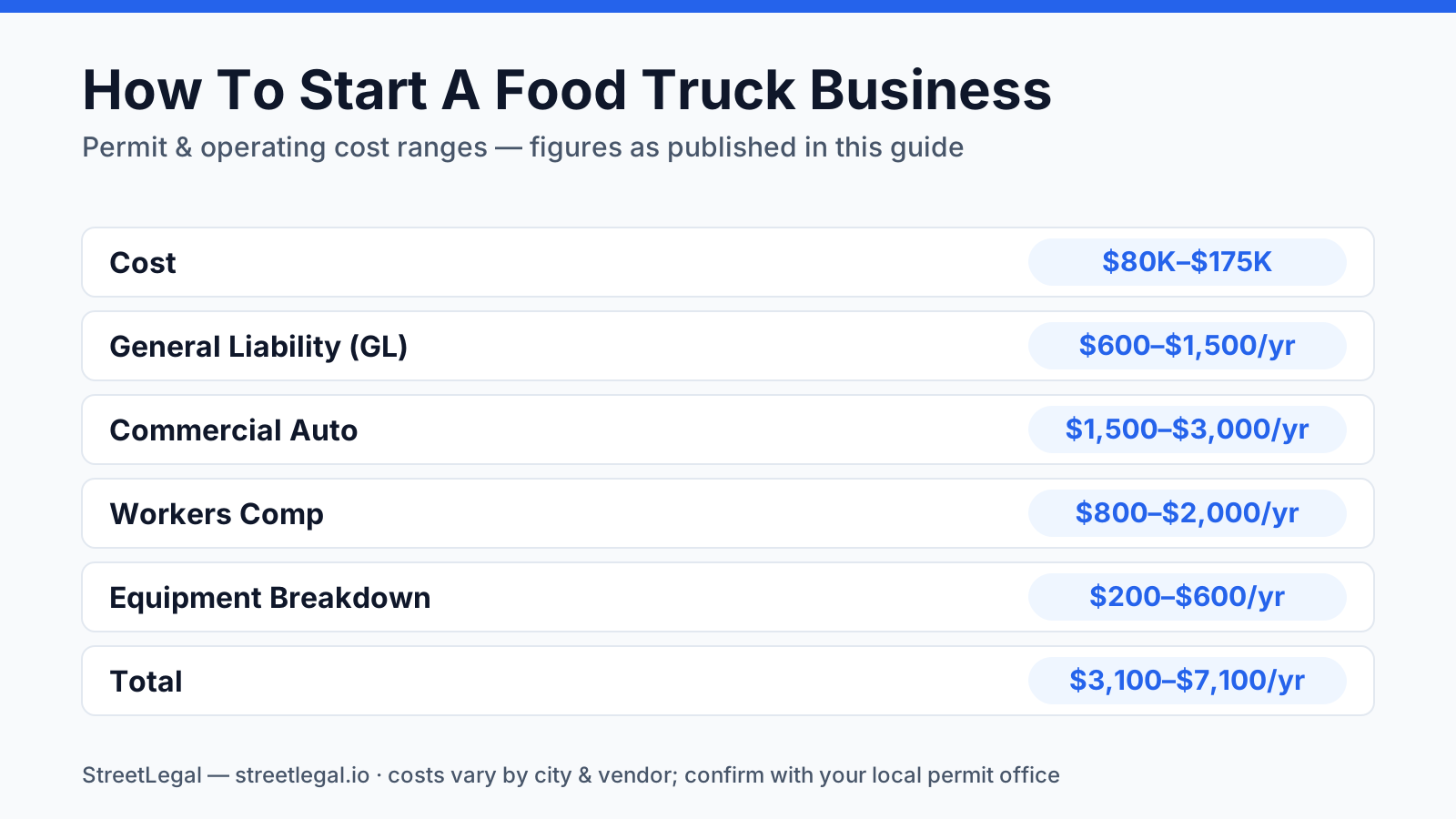
| Coverage Type | Annual Cost | Notes |
|---|---|---|
| General Liability (GL) | $600–$1,500/yr | Minimum $1M per occurrence |
| Commercial Auto | $1,500–$3,000/yr | Required for the truck as a vehicle |
| Product Liability | Often bundled with GL | Covers food contamination claims |
| Workers Comp | $800–$2,000/yr | Required if you have employees |
| Equipment Breakdown | $200–$600/yr | Covers fryer, fridge, generator failures |
| Total | $3,100–$7,100/yr | Gets cheaper as your history builds |
Specialist insurers: Markel Food Truck Insurance, Next Insurance, Hiscox, and Philadelphia Insurance Companies all write food truck policies. Get quotes from at least three. If you want the full breakdown, see our separate guide on food truck insurance requirements.

Step 7: Full Cost Breakdown
| Category | Low Estimate | High Estimate | Notes |
|---|---|---|---|
| Truck (used) | $30,000 | $80,000 | New: $80K–$175K |
| Equipment modifications | $2,000 | $15,000 | If used truck needs upgrades |
| Health permit (MFU) | $300 | $800 | Annual |
| Plan review fee | $150 | $350 | One-time |
| Business license(s) | $100 | $400 | Per city/state |
| LLC formation + DBA | $100 | $250 | One-time |
| Fire inspection + Ansul | $1,800 | $4,000 | First year (install + inspection) |
| Food manager cert | $100 | $150 | One-time per manager |
| Food handler cards | $30 | $75 | Per 2–3 employees |
| Commissary (12 months) | $2,400 | $10,800 | $200–$900/month |
| Insurance (full package) | $3,100 | $7,100 | Annual |
| POS system | $0 | $800 | Square is free to start |
| Working capital (3 months) | $5,000 | $15,000 | Fuel, supplies, payroll buffer |
| Branding + signage | $500 | $3,000 | Wrap, logo, menus |
| First-Year Total | $45,580 | $137,725 | Highly variable by city and truck |
💡 The Hidden Cost Most People Miss
Most startup guides show you the permit fees but skip the working capital requirement. A food truck doing $400K/year in revenue still has weeks where weather, events cancel, or equipment breaks — and you need 2–3 months of operating expenses in reserve. Don't launch without it.
Step 8: Location Strategy
Your location strategy is your marketing strategy. A great truck in a bad location fails; a decent truck in front of 500 hungry office workers at lunch thrives. Here are the four main location models:
1. Event Catering (Highest Margin)
Weddings, corporate events, festivals, and private parties. You know the headcount in advance, you can prep precisely, and you often charge a premium. Build a portfolio of 20+ corporate clients and your revenue becomes predictable. Downside: takes time to build pipeline.
2. Corporate Lunch Routes
Set up agreements with office parks, industrial campuses, hospital complexes. Show up Tuesday and Thursday at 11:30 AM, sell out, leave. Revenue is stable and doesn't depend on weather or foot traffic. Requires relationship-building — call the facilities manager, offer a free lunch day, build from there.
3. Farmers Markets & Recurring Events
Consistent foot traffic with built-in marketing from the market organizer. Downside: booth fees ($150–$500/day), competitive selection process, often seasonal. Best as a supplement to other income streams, not your primary strategy.
4. Street Vending (Highest Uncertainty)
Daily location scouting, weather dependence, and variable foot traffic. Works best in dense urban cores. Many cities require you to move every 30 minutes or have specific vending zone permits. Don't rely on street vending as your primary revenue model until you have proven location data.
Step 9: First 90 Days
Days 1–30 (Soft Launch):
- Operate at 1–2 guaranteed locations — don't go wide yet
- Track every sale, every menu item, every slow moment
- Get your first 100 Instagram followers (food content is free marketing)
- Post your schedule on social media every week, consistently
- Ask customers for Google reviews from day one
Days 31–60 (Iterate):
- Cut the bottom 2 menu items by sales — simplify your line
- Start pitching 3 corporate lunch accounts per week
- Identify your busiest location and add another day there
- Get your first Yelp and Google Business listing fully set up
Days 61–90 (Stabilize):
- Lock in at least 2 recurring weekly accounts
- Book your first 3 catering events
- Review your cost of goods — if you're above 35%, fix the menu before you scale
- Decide whether to hire your first part-time help or stay solo
City-by-City Permit Guides
Every city has different requirements, fees, and quirks. We've built in-depth guides for the 13 biggest US food truck markets:
AI-powered filing available · ~6 weeks · $1,200–$3,500/yr
🗽 PhiladelphiaAI-powered filing available · ~8 weeks · $1,500–$4,000/yr
🗽 New York CityComplex · 10–16 weeks · $2,000–$8,000/yr
🌬️ ChicagoGPS tracking required · ~8 weeks · $1,800–$5,000/yr
🌴 Los AngelesCounty + city layers · ~10 weeks · $2,500–$7,000/yr
🤠 HoustonOperator-friendly · ~5 weeks · $800–$2,500/yr
🎸 AustinPopular market · ~6 weeks · $1,200–$3,500/yr
📋 Austin City Permit GuideQuick reference: fees, deadlines, contacts
⭐ Dallas–Fort WorthMulti-city licensing · ~8 weeks · $1,500–$4,500/yr
🏔️ DenverAltitude adjustments needed · ~5 weeks · $1,100–$3,200/yr
☔ SeattleTight commissary market · ~7 weeks · $1,400–$4,000/yr
🌊 MiamiState + county + city layers · ~7 weeks · $1,500–$5,000/yr
☀️ PhoenixValley-wide licensing · ~6 weeks · $1,200–$3,800/yr
🌲 PortlandFood cart pod culture · ~5 weeks · $1,000–$3,500/yr
Starting a food truck is genuinely achievable. The operators who succeed are the ones who do the research before they spend money, validate their concept before building a full truck, and build a financial cushion for the first 90 days. If you've made it this far, you're already ahead of 80% of people who say they want to start a food truck.
Last updated: June 10, 2026. We recommend checking your local health department and city licensing office before submitting any application, since permit fees and timelines change often.
Answers to the most common permit questions — costs, timelines, commissary rules, and more.
Find city-level permit guides for every state we cover — compare costs and requirements.
More from the blog
Jefferson County, MO Food Truck Permit Guide
Complete guide to food truck permits, fees, and requirements in Jefferson County, MO.
City GuidesSt. Charles County, MO Food Truck Permit Guide
Complete guide to food truck permits, fees, and requirements in St. Charles County, MO.
City GuidesSt. Louis County, MO Food Truck Permit Guide
Complete guide to food truck permits, fees, and requirements in St. Louis County, MO.
Buyer's GuideFood Truck POS Systems 2026: Square, Toast, Clover & Avocado
Compare 2026 food truck POS systems by pricing, hardware costs, offline mode, and contract terms for Square, Toast, Clover, and Avocado.