· Updated · 12 min read · Gibby, StreetLegal Editorial
How to Start a Food Truck in Pittsburgh, PA: Complete Permit Guide 2026
Updated: June 11, 2026. Reviewed for Pittsburgh permit sequencing, county-state overlap, market-fit, and operator access reality.
Pittsburgh is a much more manageable food truck city than New York, Chicago, or Philadelphia — but it is not a one-permit town. You are dealing with a city vending license, Allegheny County health approval, state food licensing, food safety certification, insurance, and location-specific operating rules.
This guide covers the full Pittsburgh stack: what each permit does, what it costs, where operators get delayed, how commissary and inspection requirements actually work, and what to watch before you park in the Strip, Market Square, Oakland, or event-heavy public spaces.
Pittsburgh Disclaimer
Pittsburgh food truck compliance runs through overlapping city, county, and state lanes. Street vending rules, event access, and health requirements can change based on where you operate. Always verify current requirements with Pittsburgh PLI, ACHD, and the Pennsylvania agencies before filing.
The Pittsburgh Food Truck Licensing Landscape
Pittsburgh looks simple from the outside because the city is smaller than the giant food truck markets. In practice, operators still get squeezed by a multi-step process: city vending approval, county health inspection, state licensing, insurance, and site-by-site operating constraints.
- City of Pittsburgh PLI — your mobile food vendor license and city operating rules
- Allegheny County Health Department (ACHD) — your food safety inspection and mobile unit approval
- Pennsylvania state agencies — food establishment licensing and sales tax registration
The good news: Pittsburgh is still faster and cheaper than the most punishing cities. The bad news: the process is easy to slow down if your commissary paperwork, inspection prep, or proposed vending locations are weak.
What Permits Do You Need for a Pittsburgh Food Truck?
Pittsburgh food truck operators usually need six core approvals or documents before operating cleanly. Some event setups or sidewalk/table use cases add more. If you sequence them well, Pittsburgh is manageable. If you do them out of order, it drags fast.
Pittsburgh food truck operators typically need five to seven permits and licenses, depending on your menu, location, and whether you sell alcohol. Here's the full list:
1. City of Pittsburgh Mobile Food Vendor License
This is your primary operating license from the city. Without it, you can't park and sell anywhere in city limits.
- Fee: $300–$500/year depending on vehicle size
- Issued by: City of Pittsburgh Department of Permits, Licenses, and Inspections (PLI)
- Timeline: 2–4 weeks from application to approval
- Renewal: Annually, typically due January 31
You'll need to submit your vehicle registration, proof of insurance (minimum $1M general liability), and a commissary kitchen agreement.
2. Allegheny County Health Department Food Safety Permit
This is non-negotiable. The Allegheny County Health Department (ACHD) inspects your truck before you can serve a single taco.
- Fee: $225–$350 for initial inspection + permit
- Timeline: Schedule inspection 3–6 weeks in advance
- Requirements: Proper hot/cold holding equipment, handwashing station, food-grade surfaces, waste water tank
- Renewal: Annual reinspection required
Pro tip: The ACHD publishes a pre-inspection checklist. Use it. Operators who review the checklist before scheduling pass at a significantly higher rate on first inspection.
3. Pennsylvania Department of Agriculture Food Establishment License
In addition to your county health permit, the state requires its own license for any food establishment — including mobile ones.
- Fee: $62–$162 (based on gross food sales)
- Issued by: PA Dept. of Agriculture, Bureau of Food Safety
- Timeline: 2–3 weeks
- Apply at: agriculture.pa.gov
4. ServSafe Food Handler Certification (or Equivalent)
At least one person on your truck must hold a current food safety certification. Pennsylvania accepts ServSafe, ANSI-accredited programs, and several others.
- Fee: $15–$180 (online courses start at $15; in-person ServSafe Manager runs ~$180)
- Validity: 5 years for ServSafe Manager; 3 years for basic handler
5. Pennsylvania Sales Tax License
You need to collect and remit PA sales tax (6% statewide + 1% Allegheny County surcharge = 7% total in Pittsburgh). The license itself is free.
- Fee: Free
- Apply at: PA Department of Revenue — revenue.pa.gov
- Timeline: Instant if applying online
6. Commercial Vehicle Registration & Insurance
Your truck needs commercial plates and a minimum of $1,000,000 in general liability insurance. Most event organizers and commissary kitchens will ask for a Certificate of Insurance (COI) naming them as additional insured.
- Insurance cost: $2,000–$4,000/year depending on coverage and driving record
- Vehicle registration: Varies by weight class
7. Optional: Sidewalk Café / Special Event Permits
If you want to set up tables or operate at city events, additional permits may be required. These are issued per-event or per-season by PLI.
Pittsburgh Commissary Kitchen Requirements
Pittsburgh food truck operators must use an approved commissary kitchen — a licensed commercial kitchen used for food prep, storage, equipment cleaning, and wastewater disposal. The Allegheny County Health Department (ACHD) requires proof of a commissary agreement before it will issue your health permit. The City of Pittsburgh PLI requires the same before issuing your vendor license.
If you show up without a valid commissary agreement, neither application moves forward.
What Makes a Valid Pittsburgh Commissary
- Must hold its own ACHD food facility permit or equivalent health permit
- Must have adequate space and equipment for your prep, storage, and cleaning needs
- Your signed commissary agreement must specify access frequency and services provided
- Some kitchens rent time by the hour or month — confirm they accommodate food truck operators and wastewater dumping
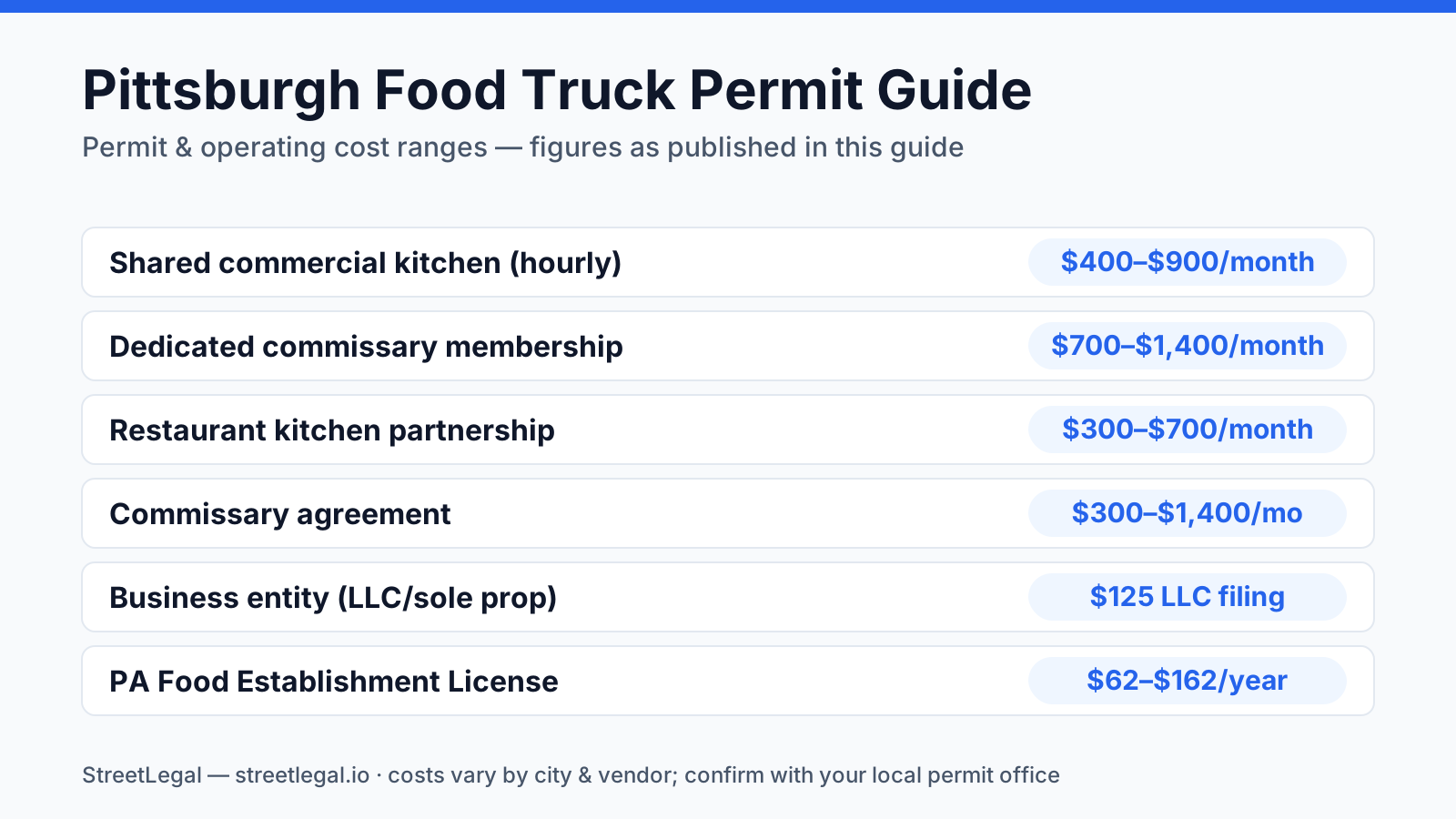
Pittsburgh Commissary Cost Estimates
| Commissary type | Monthly cost (estimate) | Notes |
|---|---|---|
| Shared commercial kitchen (hourly) | $400–$900/month | Pay per hour or block; good for lower-volume operators |
| Dedicated commissary membership | $700–$1,400/month | More reliable access; needed for high-volume trucks |
| Restaurant kitchen partnership | $300–$700/month | Off-hours access; requires their own permit + written agreement |
| Church or licensed facility | Varies | Must confirm ACHD permit status before signing anything |
Key mistake to avoid: Many operators sign a commissary agreement and then discover the facility's own permit has lapsed or it does not cover the services they need. Verify the commissary's permit status directly with ACHD before submitting your application.
Fire, Hood, and Safety Inspection in Pittsburgh
Pittsburgh food trucks with open-flame cooking equipment are subject to fire safety review. This layer is separate from your ACHD food safety inspection and is often missed by first-time operators planning their stack.
What Triggers Fire Review
- Any truck with a commercial griddle, deep fryer, wok range, or open-flame cooking appliance producing grease-laden vapors must have a compliant hood and suppression system
- The City of Pittsburgh Bureau of Fire and the state both have jurisdiction depending on your setup and where you operate
- Event organizers and private venues increasingly require fire safety documentation as part of their vendor onboarding
Required Fire Safety Items
| Item | Requirement | Notes |
|---|---|---|
| Commercial exhaust hood | Required for grease-producing cooking appliances | Must meet NFPA 96 standards; often built to spec during truck build |
| Wet chemical suppression system (Ansul or equivalent) | Required with grease hood | Must be inspected and tagged by certified tech every 6 months |
| Class K fire extinguisher | Required in cooking area | For grease and oil fires; tagged annually by certified inspector |
| ABC extinguisher | Recommended in cab/driver area | General-purpose; most lenders and events also require this |
| Annual suppression system inspection | Required | Inspection tag must be current; expired tags get flagged at events |
Real-World Impact
Beyond compliance, your suppression system and extinguisher documentation will be checked by:
- Event organizers at major Pittsburgh festivals and brewery events before you can vend
- Private venues as part of their vendor onboarding or COI requirements
- Commissary kitchens that run their own safety checks for liability reasons
An expired or missing suppression inspection tag has knocked operators off event rosters even when all their city and health permits were current. Treat it as a time-sensitive operational item, not just a build-time checkoff.
Pittsburgh Food Truck Permit Snapshot (2026)
Here is the full Pittsburgh permitting stack in one view — who issues it, what it costs, how long it takes, and when you need it in sequence:
| Permit / License | Issuing agency | Cost | Timeline | Sequence step |
|---|---|---|---|---|
| Commissary agreement | Private kitchen | $300–$1,400/mo | Before all else | Step 1 — required before applications are accepted |
| Business entity (LLC/sole prop) | PA DOSI / IRS | $125 LLC filing | 1–2 weeks | Step 2 |
| PA Food Establishment License | PA Dept. of Agriculture | $62–$162/year | 2–3 weeks | Step 3 — parallel with city |
| PA Sales Tax License | PA Dept. of Revenue | Free | Same day (online) | Step 3 — parallel |
| ServSafe / Food Safety Certification | ServSafe / ANSI accredited | $15–$180 | 1–3 weeks | Step 3 — parallel |
| ACHD Food Safety Permit | Allegheny County Health Dept | $225–$350 | Schedule 3–6 weeks out | Step 4 — book inspection early |
| City of Pittsburgh Vendor License | Pittsburgh PLI | $300–$500/year | 2–4 weeks after ACHD | Step 5 |
| Commercial vehicle insurance (COI) | Commercial insurer | $2,000–$4,000/year | Before any operation | Step 5 — required by PLI + events |
| Fire suppression inspection tag | Certified fire tech | $150–$400 | Biannual | Required for grease-cooking trucks; event access depends on it |
Critical note: Do not start with the city vendor application. Start with your commissary agreement and your ACHD inspection scheduling — those two steps drive the real timeline in Pittsburgh.
Full First-Year Cost Breakdown
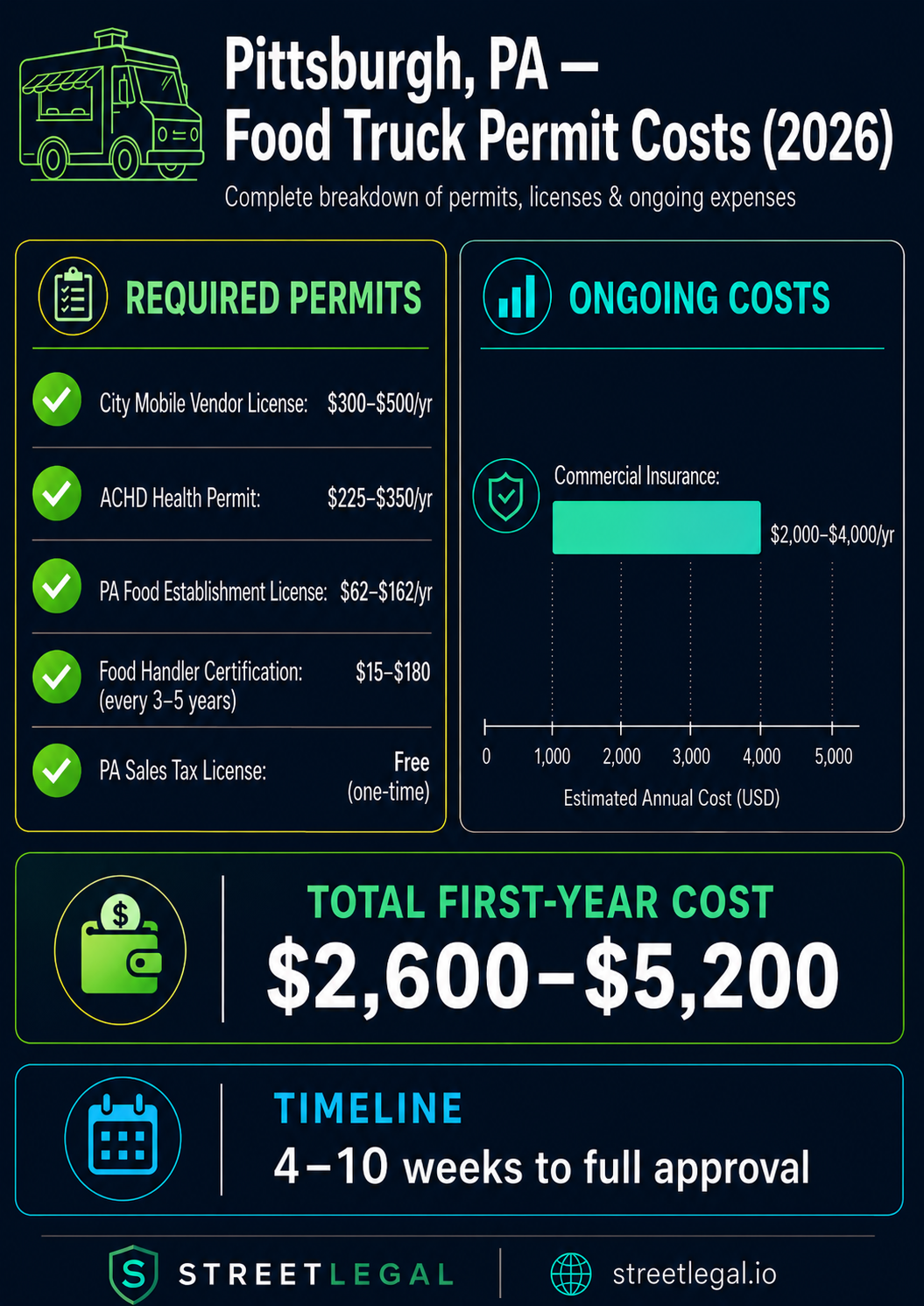
| Permit / License | Cost | Frequency |
|---|---|---|
| City Mobile Vendor License | $300–$500 | Annual |
| ACHD Health Permit | $225–$350 | Annual |
| PA Food Establishment License | $62–$162 | Annual |
| Food Handler Certification | $15–$180 | 3–5 years |
| PA Sales Tax License | Free | One-time |
| Commercial Insurance | $2,000–$4,000 | Annual |
| Total Year 1 | $2,600–$5,200 |

Realistic Timeline to Launch in Pittsburgh
If you're starting from scratch, here's a realistic timeline:
- Weeks 1–2: Form your business entity (LLC recommended), get your EIN, open a business bank account
- Week 2: Apply for PA Sales Tax License (instant online) and PA Food Establishment License
- Weeks 2–3: Complete food handler certification
- Weeks 3–4: Secure a commissary kitchen agreement — you'll need this for your city license and ACHD permit
- Weeks 3–6: Schedule and pass your ACHD inspection
- Weeks 4–8: Apply for your City of Pittsburgh Mobile Vendor License
- Week 8+: Start operating!
Realistic total timeline: 6–10 weeks from first application to full legal operation. Delays usually happen at the health inspection stage — book your inspection as early as possible.
5 Pittsburgh-Specific Tips Most Guides Miss
- Do not treat Point State Park or Market Square as blanket permission. High-traffic zones often involve separate event control, location rules, or organizer permission layers.
- Build your commissary packet before you apply. A weak or vague commissary agreement is one of the easiest ways to stall city and health review.
- Plan around weather and seasonality. Pittsburgh's winter slows foot traffic and compresses event opportunities. A delayed spring approval can cost you your best revenue window.
- Be precise about where you intend to vend. "Anywhere downtown" is weaker than naming likely private lots, event partners, or neighborhood targets.
- Renew before festival season, not during it. Summer event calendars are when paperwork mistakes hurt the most.
Most Common Pittsburgh Permit Mistakes
Most Pittsburgh permit delays are not random. They usually come from a small set of preventable misses:
- Submitting a weak commissary agreement — missing signatures, missing access details, or unclear licensed kitchen status
- Treating the ACHD inspection like a basic checklist — operators underestimate how documentation and equipment setup get reviewed together
- Confusing city approval with total approval — Pittsburgh city paperwork does not replace county health or state requirements
- Assuming a good location is automatically legal — busy foot traffic does not equal vending permission
- Letting insurance or renewal dates drift — event access often depends on current COIs and current permit status
Best Food Truck Types for Pittsburgh
Pittsburgh is not a universal fit for every truck format. The city rewards operators who can handle lunch density, event surges, hills, narrow parking realities, and cold-weather shoulder seasons without needing huge prep crews or complicated curb setups.
Strong Pittsburgh fits: smash burgers, tacos, coffee and breakfast, barbecue, pierogi or comfort-food concepts, and compact event-friendly trucks that can work breweries, campuses, sports traffic, and neighborhood festivals.
- Best all-around format: a compact standard step van with a focused menu and fast ticket times.
- Best for downtown lunch: high-throughput sandwich, taco, rice bowl, or burger builds that can serve office crowds fast.
- Best for breweries and neighborhood events: comfort food, barbecue, pizza, or hybrid pub-food menus with strong evening demand.
- Best weather hedge: coffee, breakfast, soup, and handheld comfort-food concepts that still move in colder months.
- Higher-friction setup: oversized specialty rigs that need long setup windows, unusual utility needs, or a giant parking footprint.
| Truck setup | Best Pittsburgh fit | Why it works | Main caution |
|---|---|---|---|
| Compact step van | Downtown lunch + brewery rotation | Easy to park, faster setup, strong all-around flexibility | Smaller menu/storage ceiling |
| Mid-size grill truck | Sports/event traffic + private lots | Handles line volume without the footprint of a giant rig | Watch fuel, generator noise, and event spacing |
| Coffee / breakfast truck | Commuter nodes + campuses + cold months | Weather resilience and strong morning windows | Can need a second service channel for peak speed |
| Trailer setup | Private property and planned events | Good for destination service and lower truck cost | Harder for tight urban parking and quick relocations |
If you are still choosing a rig, Pittsburgh usually favors mid-size trucks over giant custom buses. Easier parking, easier private-lot partnerships, lower fuel burn, and better flexibility across Strip District, Oakland, brewery pop-ups, and seasonal events make them the safer operating bet.
Pittsburgh vs. Philadelphia: Which Pennsylvania Market Is Easier?
Pittsburgh and Philadelphia sit under the same Pennsylvania state umbrella, but they behave like two different launch markets. Pittsburgh is usually the easier first Pennsylvania city for a founder who wants a manageable private-lot, brewery, and event-driven operating model. Philadelphia is the higher-density market, but it brings more permit layers, more curb friction, and more competition for obvious lunch and downtown lanes.
| Market factor | Pittsburgh | Philadelphia | What it means for founders |
|---|---|---|---|
| Permit stack friction | Moderate | High | Pittsburgh is usually easier for a first truck launch. |
| Best first revenue lane | Breweries, private lots, neighborhood events | Dense lunch zones, events, private sites | Pittsburgh favors partnership-driven operators; Philly rewards stronger urban throughput. |
| Best first truck type | Compact or mid-size step van | Fast-service lunch truck or event-capable van | Pittsburgh usually punishes oversized builds less on competition and more on parking reality. |
| Weather / seasonality pressure | Higher | Moderate | Pittsburgh operators need a stronger cold-weather menu and offseason plan. |
| Launch recommendation | Better first PA city for many founders | Better second-step expansion market | If you want a simpler Pennsylvania entry point, start with Pittsburgh and expand later. |
For the full state-level comparison across Pittsburgh, Philadelphia, fees, timelines, and operating-lane realities, use the Pennsylvania food truck permit hub. If Philadelphia is your target instead, compare this guide with the Philadelphia food truck license guide before you pick your first truck build and first launch lane.
Where Can You Actually Operate in Pittsburgh?
Pittsburgh is not a free-for-all parking market. Foot traffic exists, but legal access still depends on event permissions, street rules, private property consent, and how PLI treats your setup. A permit gets you legal approval; it does not automatically get you a profitable lane.
| Operating lane | Permit alone enough? | Access reality | Best truck fit |
|---|---|---|---|
| Breweries and neighborhood private lots | No | Usually the cleanest repeatable lane once the host approves your setup and COI | Compact step vans, burgers, tacos, barbecue, comfort food |
| Downtown lunch and office clusters | No | Demand is real, but property control, loading rules, and short service windows matter | Fast-ticket lunch trucks and coffee/breakfast concepts |
| Sports, festivals, and stadium-adjacent events | No | Organizer packets, deadlines, and event-specific approval usually control access more than your base permit | Mid-size event trucks with strong throughput |
| Campus and hospital-adjacent service | No | Works when the institutional or property relationship is already in place | Coffee, bowls, sandwiches, breakfast, compact lunch trucks |
| Speculative public-street parking | Rarely | Weak first strategy because obvious foot-traffic areas often have extra enforcement, conflicts, or event control | Usually not the best launch model |
Pittsburgh neighborhood demand snapshot
| Area | Demand | What helps | What blocks operators |
|---|---|---|---|
| Strip District | Strong weekends | Private-lot permission and known event partners | Curb friction and high competition for obvious spots |
| Oakland | Reliable academic-year lunch | Campus-adjacent office/lab demand | Congestion, loading limits, university-adjacent controls |
| Downtown / Market Square | High visibility | Strong weekday foot traffic and events | More regulation than many operators assume |
| North Shore / stadium events | Big event spikes | Sports and festival traffic | Organizer control and access timing |
| Lawrenceville / brewery circuits | Solid evening demand | Venue partnerships and repeat neighborhood traffic | Speculative street parking is weaker than direct partnerships |
Important: permit approval is not the same thing as location approval. A fully permitted truck can still get blocked from a specific plaza, lot, event, or private parcel if the property/operator layer is missing.
Each location may have additional requirements such as event permits, time restrictions, or written owner permission, so check with PLI and the site/operator before you park.
Renewals: What to Track
Pittsburgh operators should treat renewals like part of operations, not admin cleanup. Missing one renewal can knock out events, commissary access, or your ability to legally vend.
- City vendor license: track renewal 60 days early
- ACHD permit / inspection cycle: confirm annual timing and inspection scheduling windows
- State food licensing: verify annual status and filing deadlines
- Insurance: renew before event season so COIs stay usable
- Commissary agreement: keep current signed proof on hand
Pittsburgh Food Truck Permit FAQ
How many permits do I really need to run a food truck in Pittsburgh?
What slows down Pittsburgh approvals the most?
Do I need a commissary kitchen in Pittsburgh?
How much should I budget for year one?
The Bottom Line
Getting permitted in Pittsburgh is very doable, but the city rewards operators who prepare their packet like a project, not a quick errand. Budget roughly $2,600–$5,200 for year one, give yourself 6–10 weeks, and lock down your commissary, inspection prep, and likely vending locations before you assume you are close.
Pennsylvania food truck operators
Pittsburgh is one of two major PA food truck markets — each with its own permitting agency. See the full state hub for Pittsburgh vs. Philadelphia comparisons, PA DOA licensing, and all city guides.
Open Pennsylvania state hub →More Pittsburgh & Pennsylvania reading
🏛️ Official Resources — Verify Current Requirements
- Allegheny County Health Dept (ACHD) — food safety permits + pre-inspection checklist
- City of Pittsburgh PLI — business licenses and vehicle permits
- PA Department of Agriculture — state food facility license
- PA Department of Revenue — sales tax license (Vendor's License)
Fees and timelines shown above reflect 2026 figures. Always confirm current requirements before filing.
People also ask about Pittsburgh food truck permits
How much does a food truck permit cost in Pittsburgh?
How long does it take to get a food truck permit in Pittsburgh?
Do I need a commissary kitchen to operate a food truck in Pittsburgh?
What documents do I need for a Pittsburgh food truck permit?
Answers to the most common permit questions — costs, timelines, commissary rules, and more.
Find city-level permit guides for every state we cover — compare costs and requirements.
More from the blog
Jefferson County, MO Food Truck Permit Guide
Complete guide to food truck permits, fees, and requirements in Jefferson County, MO.
City GuidesSt. Charles County, MO Food Truck Permit Guide
Complete guide to food truck permits, fees, and requirements in St. Charles County, MO.
City GuidesSt. Louis County, MO Food Truck Permit Guide
Complete guide to food truck permits, fees, and requirements in St. Louis County, MO.
Buyer's GuideFood Truck POS Systems 2026: Square, Toast, Clover & Avocado
Compare 2026 food truck POS systems by pricing, hardware costs, offline mode, and contract terms for Square, Toast, Clover, and Avocado.