· Updated · 11 min read · Gibby, StreetLegal Editorial
How to Start a Food Truck in Los Angeles: Complete Permit Guide 2026
Los Angeles is arguably the food truck capital of the United States. The city has over 5,000 active mobile food vendors, a thriving street food culture, and events like SoCal Off-Road Expo, Grand Park Food Truck Fest, and dozens of weekly gatherings that draw thousands of hungry customers.
But getting permitted in LA is notoriously complicated — you're dealing with the City of LA, Los Angeles County (LACDPH), the Department of Transportation, and sometimes the State of California all at once. Many operators make expensive mistakes because the rules aren't explained clearly anywhere in one place.
This guide changes that. Here's exactly what you need, what it costs, and how to get through the LA permit process in 2026 without losing your mind (or your savings).
nUpdated June 3, 2026 — permit fees, timelines, operating-lane guidance, California market comparison, and best-truck-type recommendations reviewed for all major Los Angeles County jurisdictions.
The Big Picture: LA Food Truck Permits
Running a food truck legally in Los Angeles requires permits from multiple agencies. The core set looks like this:
- Los Angeles County Public Health Permit — Health and safety compliance (LACDPH)
- City of Los Angeles Business Tax Registration Certificate (BTRC) — Your basic business license to operate in LA
- Mobile Food Facility (MFF) Permit — Issued by LACDPH, covers your specific vehicle
- California Seller's Permit — Required by the CA Department of Tax and Fee Administration (CDTFA) to collect sales tax
- Commissary Letter of Agreement — Required to operate; you must have an approved base kitchen
If you operate in multiple cities within LA County (Pasadena, Long Beach, Santa Monica, etc.), you may also need permits from those individual cities. This guide focuses on the City of LA and unincorporated LA County — the two most common jurisdictions.
Los Angeles permit snapshot (2026)
| Step | Agency | Permit / Requirement | Fee Range | Timeline | Sequence |
|---|---|---|---|---|---|
| 1 | Private commissary | Commissary agreement (LA County-approved) | \–\,500/mo | 1–2 weeks | Start here |
| 2 | LA County Dept of Public Health | Mobile Food Facility Permit (Class A or B) | \–\,060/yr | 6–10 weeks | Requires commissary letter |
| 3 | City of LA Office of Finance | Business Tax Registration Certificate (BTRC) | \/bin/zsh–\/yr | 1–3 weeks | Parallel with health permit |
| 4 | California CDTFA | Seller's Permit (sales tax collection) | \/bin/zsh (free) | 1–2 weeks | Before first sale |
| 5 | LAFD (if open flame) | Fire inspection + Class K extinguisher | \–\ setup | 2–4 weeks | Before final health sign-off |
| 6 | Insurance carrier | General liability insurance (usually \M–\M) | \,200–\,000/yr | 1–2 weeks | Before launch; some venues require proof |
Step 1: Los Angeles County Public Health Permit
This is the cornerstone permit — without it, you cannot legally sell food from a vehicle in LA County.
Mobile Food Facility (MFF) Classifications
LACDPH classifies mobile food facilities into categories based on what you sell and how you prepare it:
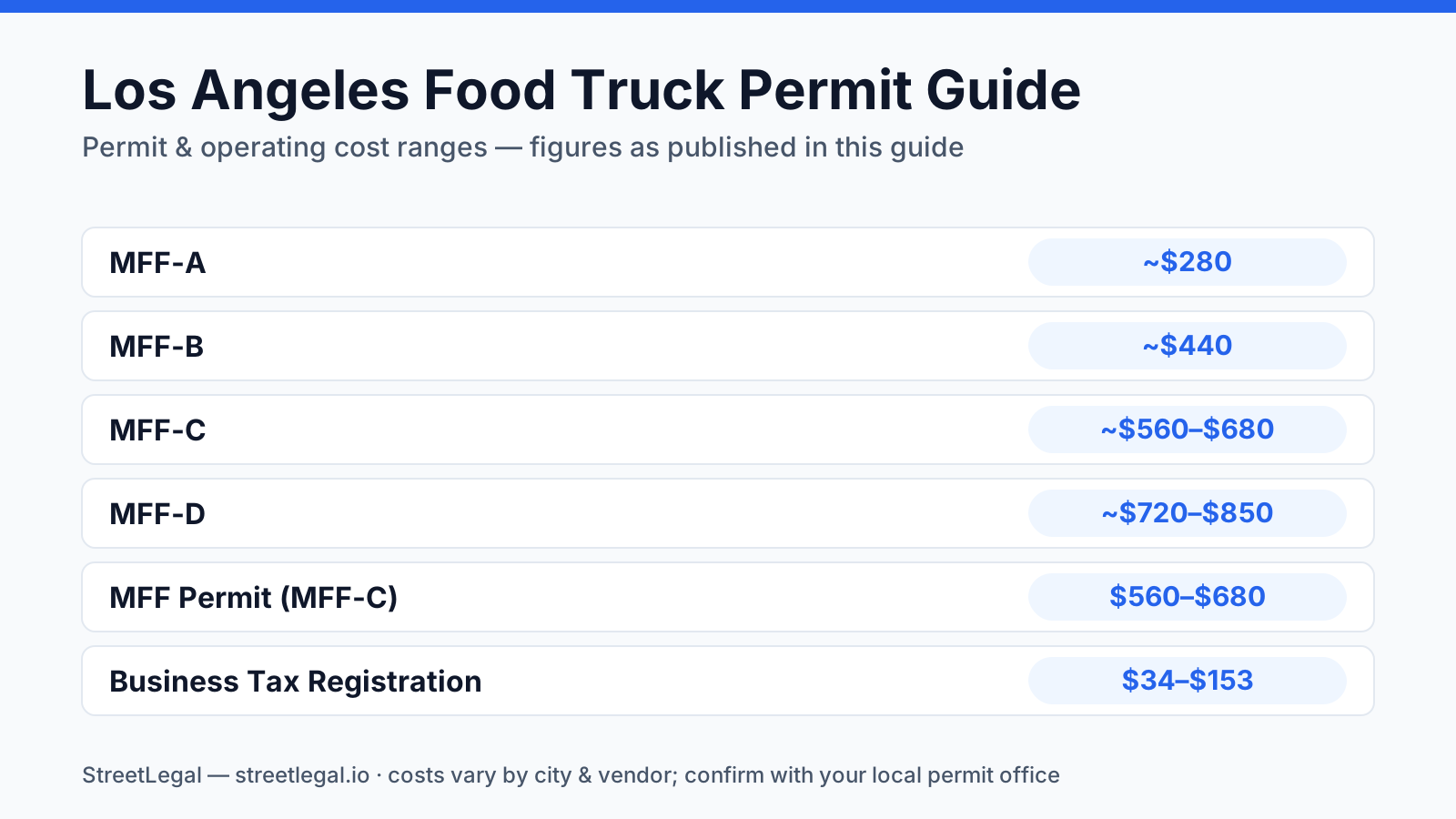
| Type | Description | Annual Fee (2026) |
|---|---|---|
| MFF-A | Prepacked only (no cooking or food handling) | ~$280 |
| MFF-B | Limited prep — reheating, hot dogs, coffee, smoothies | ~$440 |
| MFF-C | Full cooking and food prep (most food trucks) | ~$560–$680 |
| MFF-D | Complex operations — multiple cooking methods, hood suppression required | ~$720–$850 |
Most food trucks with a grill, fryer, or full kitchen fall into MFF-C. If you're doing complex operations (multiple fryers, hood suppression systems), you may be bumped to MFF-D.
How to Apply
- Submit your application online via LA County Environmental Health's eHservices portal
- Provide your vehicle information, commissary agreement, and menu
- Pass a pre-operational inspection — inspector checks your truck in person
- Pay the fee and receive your permit decal
The inspection covers: food storage temperatures, water tank adequacy, hand-washing facilities, grease trap, fire suppression (if applicable), and overall sanitation. Plan 2–4 weeks from application to approval.
Annual Renewal
MFF permits renew annually. LA County sends renewal notices 60–90 days before expiration, but it's your responsibility to keep track. Missing renewal = your permit lapses = you can't operate legally.
StreetLegal tip: Set automated reminders 90, 30, and 7 days before your renewal date. We handle this automatically in the dashboard so you never miss a deadline.
Step 2: Commissary Kitchen Agreement (Non-Negotiable)
Every food truck operating in LA County is required to operate out of a licensed commissary kitchen. This isn't optional — it's a hard requirement for your MFF permit.
A commissary kitchen is an LACDPH-licensed commercial kitchen where you:
- Store and prep food before service
- Clean, sanitize, and restock your truck daily
- Dump gray water and waste
- Refill fresh water tanks
Your commissary must be within a reasonable distance of your operating area — inspectors may ask. You'll need a signed Commissary Letter of Agreement from the facility owner, which becomes part of your LACDPH permit application.
What to Look for in an LA Commissary
- LACDPH approval (ask to see their permit)
- Adequate storage for your volume
- Accessible dump station and water fill
- Reasonable hours — some kitchens lock you out at night
- Insurance requirements and liability terms
Typical LA commissary cost: $400–$1,200/month depending on usage, location, and storage space. East LA and Southeast LA tend to be cheaper; West LA and the Westside run higher.
Step 3: City of LA Business Tax Registration Certificate
If you're operating within the city limits of Los Angeles (not just LA County), you need a BTRC from the City's Office of Finance.
- Apply: Office of Finance Online Portal
- Fee: Varies by gross receipts — typically $34–$153/year for small operations
- Renewal: Annual, by February 28
If you mostly operate in unincorporated LA County or other cities (Culver City, Burbank, etc.), check those cities individually — they have their own business license requirements.
Step 4: California Seller's Permit
Any food truck selling taxable goods (most prepared food in CA is taxable) needs a Seller's Permit from the California Department of Tax and Fee Administration (CDTFA).
- Cost: Free (no fee)
- Apply: CDTFA Online Registration
- What it does: Authorizes you to collect and remit California sales tax
- Sales tax rate in LA: 10.25% (combined state + county + local)
You'll need this number before you can complete other permit applications. Get it first.
Where Can You Park and Sell in LA?
This is where most operators run into trouble. LA has strict rules about where food trucks can vend — and the rules differ block by block.
The 100-Foot Rule (Sort Of)
LA Municipal Code prohibits parking within certain distances of businesses, schools, and residential areas for extended periods. Practically, this means:
- You can park on public streets for up to 1 hour in most commercial zones
- You cannot park within 100 feet of a restaurant's main entrance without permission
- You cannot vend within 500 feet of a school during school hours
- Special event permits may allow longer stays and blocked-off zones
Private Property
Most successful LA food trucks operate primarily on private property — office parks, breweries, shopping centers, event venues. This sidesteps the street parking rules entirely and often guarantees foot traffic. You'll typically need a vendor agreement with the property owner.
Food Truck Parks
LA has dozens of established food truck parks and recurring events where you pay a spot fee to a promoter/organizer. These venues handle the permitting overhead. Examples: Smorgasburg LA (Sundays in ROW DTLA), Food Truck Fridays in various locations, private brewery lots. Spot fees range from $50–$300/day.
Special Events
Events — festivals, concerts, block parties — require a Temporary Food Facility (TFF) permit through LACDPH for each event. Fee: ~$200–$400 per event depending on duration and complexity. The event organizer often handles this, but you should confirm in writing who pulls the permit before showing up to work.
Where you can actually operate in Los Angeles (permit vs access reality)
| Operating Lane | Permit Alone Enough? | Access Reality | Best Truck Fit |
|---|---|---|---|
| Private Events | Yes (+ insurance COI) | Direct booking, contract required, best first revenue lane in LA | 24ft step van (brand + volume) |
| Brewery/Winery Residencies | Yes (+ venue agreement) | Partnership/schedule required, steady weekly revenue, competitive in LA | 18-20ft trailer (flex parking) |
| Public Street Parking (LA City) | No | Time limits apply (usually 1-2 hours max), cannot block traffic or park within 100ft of schools during school hours, enforcement varies by neighborhood | Any truck (follow posted limits) |
| Farmers Markets | No | Separate market vendor application required, limited spots, waitlists common | Compact truck/cart (space limited) |
| Office Parks / Tech Campuses | No | Requires property owner approval or catering contract, steady lunch revenue, competitive | 16-20ft truck (service speed focus) |
| Venice Beach / Santa Monica | No | Additional local city permits required, strict parking/vending rules, competitive but high-traffic | Smaller trucks (parking tight) |
| Private Lot Agreements | Yes (+ property agreement) | Best control and consistency, requires property owner partnership, rent/revenue share common | Any truck (depends on lot size) |
LA permit reality: your LA County Mobile Food Facility Permit and City BTRC clear you for legal operation, but most high-revenue locations require separate property agreements, event contracts, or local permits. Private events and brewery residencies are the fastest first-revenue lanes because they only require your core permits plus insurance COI. Street parking and farmers markets are harder to monetize consistently in LA due to time limits, competition, and access barriers.
Fire Department Requirements
If your truck has cooking equipment — especially open flame, propane, or deep fryers — LAFD may need to sign off.
- Hood suppression system: Required if you have Type I cooking equipment (grills, fryers, ranges). Must meet NFPA 17A standards. Inspection required before operation.
- Propane/LP gas: Tanks must be properly secured, and connections inspected. Annual inspection by an authorized inspector or LAFD.
- Fire extinguisher: Class K extinguisher required for grease fires; mounted within 10 feet of cooking equipment.
- LAFD permit fee: ~$300–$600 depending on system type and equipment
Don't skip the fire inspection. LAFD inspectors do spot checks at food truck events — a failed inspection means you stop service immediately.
Best food truck types for Los Angeles market fit (2026)
| Truck Type | LA Market Fit | Commissary Pressure | Event Flexibility | Why It Works in LA |
|---|---|---|---|---|
| 24ft Step Van (Taco Truck) | Excellent | High (full menu, raw prep) | High (fits most venues) | LA's iconic truck format — brand presence, high volume, scales for events and street spots |
| 18-20ft Trailer | Very Good | Medium-high | Very High (detach + park) | Lower build cost, brewery/winery residency flex, easier parking storage between events |
| Gourmet/Premium Truck (16-18ft) | Excellent | Very High (premium prep) | Medium (smaller footprint limits throughput) | LA's premium food culture, private events, tech campus catering, Instagram brand-building |
| BBQ Trailer (24-28ft) | Good | Medium (long cook times reduce daily commissary dependence) | Medium (size limits some venues) | Strong LA BBQ culture, weekend events, corporate catering, competitive but scalable |
| Dessert/Coffee Cart (10-14ft) | Good | Low (minimal prep) | Very High (fits anywhere) | Lower barrier, farmers markets, beach/park circuits, faster permitting (often Class A) |
| Box Truck Conversion (14-16ft) | Medium | Medium | Medium-High | Lower upfront cost, scrappy brand story, works for ethnic/specialty menus, harder to scale |
For LA specifically: if you're optimizing for brand and scale, start with a 24ft step van (most LA operators do). If you're optimizing for flexibility and lower risk, start with an 18-20ft trailer so you can test multiple venues without full-truck commitment. Avoid very small carts unless you're targeting low-volume niche markets — LA's event culture rewards throughput and presence.
Full Cost Breakdown: LA Food Truck Permits 2026
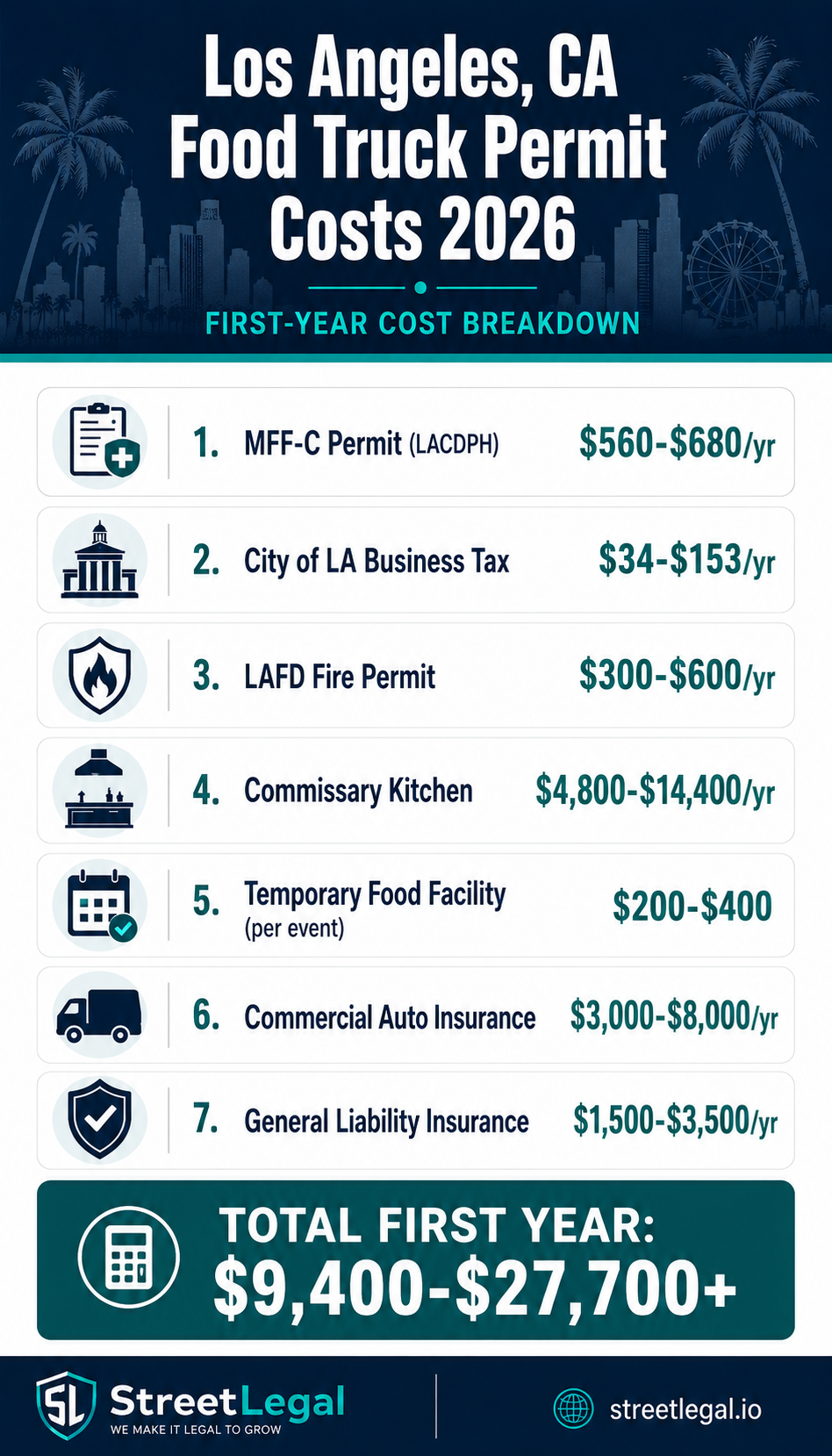
| Permit/Item | Issuing Agency | Approximate Cost | Frequency |
|---|---|---|---|
| MFF Permit (MFF-C) | LACDPH | $560–$680 | Annual |
| Business Tax Registration | City of LA | $34–$153 | Annual |
| California Seller's Permit | CDTFA | Free | One-time |
| LAFD Fire Permit | LAFD | $300–$600 | Annual |
| Commissary Kitchen | Private | $4,800–$14,400/yr | Monthly |
| Temporary Food Facility (per event) | LACDPH | $200–$400 | Per event |
| Commercial Auto Insurance | Private | $3,000–$8,000/yr | Annual |
| General Liability Insurance | Private | $1,500–$3,500/yr | Annual |
Total first-year permit cost (not including truck or equipment): $9,400–$27,700+
The commissary is usually the biggest recurring expense. Operators who find a cost-effective commissary that's well-located can significantly reduce their overhead.
Realistic Timeline to Launch
Plan for 6–10 weeks from application start to first service day, assuming no major complications:
- Week 1–2: Register business entity (LLC or sole prop), get EIN, register with CDTFA for Seller's Permit
- Week 2–3: Sign commissary agreement, finalize menu, prepare truck for inspection
- Week 3–5: Submit LACDPH MFF permit application, schedule pre-operational inspection
- Week 4–6: LAFDPH inspection, any re-inspection if corrections needed
- Week 5–7: Apply for City of LA BTRC, LAFD fire inspection
- Week 7–10: All permits in hand → launch
Common delays: commissary not yet approved by LACDPH, truck equipment doesn't pass inspection, fire suppression system needs certification. Budget extra time for each of these.
The 5 Biggest Mistakes LA Food Truck Operators Make
1. Signing a commissary lease before checking LACDPH approval
Your commissary must be LACDPH-approved. If you sign a lease at an unapproved facility, you'll need to find a new one — often at significant cost. Always verify approval status before signing anything.
2. Vending on public streets without understanding the time limits
Many operators think "I can park anywhere for free." The 1-hour limit on most commercial streets, the 100-foot restaurant rule, and parking enforcement mean you can get ticketed heavily if you don't know the rules. Study the LAMC parking code for your specific neighborhoods.
3. Not pulling a TFF permit for events
Event organizers don't always communicate clearly about who's responsible for the Temporary Food Facility permit. If LACDPH shows up and you're operating without a TFF at an event, your truck shuts down and you lose the day's revenue. Confirm in writing before every event.
4. Letting the LACDPH permit lapse before renewal
LACDPH sends renewal notices, but if your address on file is wrong or the notice goes to spam, you might not know until your permit expires. Set your own reminders 90, 30, and 7 days out — or use StreetLegal to automate this.
5. Skipping the fire inspection or using DIY suppression
Non-compliant fire suppression systems are a serious safety risk and a near-certain citation. LAFD inspectors are thorough. Don't attempt to self-certify or skip this step — it will catch up with you at the worst possible moment.
How StreetLegal Helps LA Food Truck Operators
StreetLegal is built specifically for food truck operators who are tired of juggling permit deadlines, renewal reminders, and paperwork across multiple agencies.
- 📋 Upload your LACDPH permit → AI extracts dates and sets automatic renewal reminders
- 📅 Dashboard tracking → See all your permits (MFF, BTRC, fire, TFF) in one place with status and expiry
- 🔔 Email reminders → 90, 30, 14, 7, and 1 day before every expiration
- 🗺️ Multi-city support → Track LA, Pasadena, Long Beach, and every other city you operate in
- 🤖 AI form filling → Auto-fill renewal applications using your stored business data
Free plan available. No credit card required to start.
Official Resources
- LACDPH eHservices — Permit Portal
- City of LA Office of Finance — Business Tax Registration
- CDTFA — California Seller's Permit Registration
- LAFD — Fire Prevention & Business Inspections
- LACDPH Commissary Lookup Tool
FAQ: LA Food Truck Permits
Do I need a permit for every city in LA County I operate in?
Your LACDPH MFF permit covers you throughout LA County. However, individual cities within the county (Pasadena, Long Beach, Burbank, etc.) may require their own business licenses or vendor permits for street vending within their jurisdiction. Always check with the specific city if you plan to operate there regularly.
Can I park on any public street in LA and sell food?
Generally yes, but with significant restrictions: 1-hour time limits in most commercial zones, 100-foot restriction from restaurant entrances, 500-foot school zone restrictions during school hours, and general traffic/parking laws. Many operators focus on private property to avoid these complications.
How long does the LACDPH MFF permit take?
Plan 3–6 weeks from application submission to permit issuance. The pre-operational inspection is the main bottleneck — inspectors are often booked 2–3 weeks out. Submit your application as early as possible.
What if I only sell at private events and never on public streets?
You still need the LACDPH MFF permit and commissary agreement. Private property doesn't exempt you from food safety regulations. For each event, you'll need a TFF permit unless the event organizer is pulling a blanket permit — confirm before you show up.
Is a food truck in LA profitable?
Yes, but margins are tighter than people expect. Average gross revenue for an active LA food truck: $200,000–$400,000/year. After commissary ($6,000–$14,000/year), permits (~$5,000–$10,000/year), insurance ($5,000–$11,000/year), labor, COGS, and spot fees, net margins typically run 10–20% for well-managed operations.
California market comparison: LA vs other major markets (2026)
| Market | Launch Friction | Best First Revenue Lane | Best First Truck Fit | Why This Market Matters |
|---|---|---|---|---|
| Los Angeles | Medium (multi-agency stack, commissary tight) | Private events + brewery residencies first | 24ft step van — scale + brand presence | 5,000+ trucks, highest event volume, best revenue ceiling in CA, strong cultural credibility |
| San Francisco | High (SFDPH slow, commissary expensive) | Tech campus catering + FiDi lunch | 16-18ft compact truck — tight streets, fast service | Tech worker lunch demand, premium price tolerance, smaller footprint required |
| San Diego | Low-medium (faster county approval) | Beach/boardwalk spots + brewery circuits | 20-22ft trailer — tourist + local mix, flex parking | Beach tourism + military/family demo, easier permitting than SF/LA |
| San Jose | Medium (Santa Clara County health + city) | Tech campus partnerships + downtown lunch | 18ft step van — service speed + ethnic menu flex | Silicon Valley tech demand, ethnic food culture, less saturated than SF |
| Sacramento | Low (faster permitting, lower commissary cost) | State worker lunch + festival circuits | 16-20ft trailer — lower build cost, easier parking | State capital steady lunch demand, lower operating costs, family-friendly events |
LA offers the highest revenue ceiling and strongest brand-building opportunity in California, but requires more capital, patience, and operational discipline than Sacramento or San Diego. If you're optimizing for fastest launch and lowest friction, start in Sacramento or San Diego and expand into LA once you have proof of concept. If you're optimizing for scale and cultural credibility from day one, LA is the right first market despite the complexity.
Related City Guides
Have more questions about food truck permits?
Check out our complete FAQ for answers on costs, timelines, commissary requirements, and how StreetLegal can help.
People also ask about Los Angeles food truck permits
How much does a food truck permit cost in Los Angeles?
How long does it take to get a food truck permit in Los Angeles?
Do I need a commissary kitchen to operate a food truck in Los Angeles?
What documents do I need for a Los Angeles food truck permit?
Answers to the most common permit questions — costs, timelines, commissary rules, and more.
Find city-level permit guides for every state we cover — compare costs and requirements.
More from the blog
Jefferson County, MO Food Truck Permit Guide
Complete guide to food truck permits, fees, and requirements in Jefferson County, MO.
City GuidesSt. Charles County, MO Food Truck Permit Guide
Complete guide to food truck permits, fees, and requirements in St. Charles County, MO.
City GuidesSt. Louis County, MO Food Truck Permit Guide
Complete guide to food truck permits, fees, and requirements in St. Louis County, MO.
Buyer's GuideFood Truck POS Systems 2026: Square, Toast, Clover & Avocado
Compare 2026 food truck POS systems by pricing, hardware costs, offline mode, and contract terms for Square, Toast, Clover, and Avocado.