· 12 min read · Gibby, StreetLegal Editorial

Portland Quick Stats
- 🏛️ Primary permit: Multnomah County EHS Mobile Food Unit (MFU) License
- 💰 MFU fee: $300–$700/year (risk-based tier)
- 🏭 Commissary required: Often not — Portland allows self-contained units more readily than most cities
- ⏱️ Timeline: 4–7 weeks from application to operating
- 📍 Unique feature: Food cart pod system — fixed-location carts with shared zoning, very common here
How to Start a Food Truck in Portland: Complete Permit Guide 2026
Updated June 28, 2026
Portland is the undisputed food cart capital of the United States. The city has operated a thriving street food culture since the 1990s, centered on its famous food cart pods — clustered outdoor food markets that have been duplicated in cities across the country but never quite replicated.
The regulatory environment here is notably more operator-friendly than cities like NYC or Chicago. Portland's Bureau of Development Services and Multnomah County Environmental Health both take a pragmatic approach, and the self-contained truck standard is applied reasonably. That said, the layers are still real — county health, state licensing, city business license, fire, and food cart pod agreements all stack up.
This guide covers every license you need for a mobile food truck or a fixed food cart pod operation in Portland, what each costs, and what makes Portland's scene genuinely different from every other city.
🚚 Trucks vs. Carts: Portland Has Both
Portland distinguishes between mobile food trucks (drive to locations daily) and food carts (semi-permanent, often in pods). Both fall under the same health licensing system, but cart pods operate under different zoning rules. This guide covers both — look for the 🛒 icon for cart-specific notes.
1. Multnomah County Environmental Health — Mobile Food Unit License
Whether you're a truck or a cart, your primary permit comes from Multnomah County Environmental Health (EHS). They issue Mobile Food Unit licenses and conduct all routine health inspections.
License fees (2026):
- Risk Class 1 (prepackaged foods only) — $300/year
- Risk Class 2 (limited food prep, no raw proteins) — $450/year
- Risk Class 3 (full cooking, complex menu, raw meat) — $700/year
Most food trucks in Portland fall into Class 2 or Class 3. Macaroni and cheese? Probably Class 2. Raw protein with temp-sensitive sauces? Class 3.
Plan review: Required for new units. Fee is approximately $200–$350. You submit your truck layout, equipment specs, and menu. EHS reviews for code compliance before scheduling your inspection.
What they inspect:
- Three-compartment sink with hot water
- Dedicated handwashing sink
- Refrigeration at or below 41°F
- Food-safe surfaces, no cracks or gaps
- Proper waste water handling
- Commissary agreement (if not self-contained)
💡 Portland's Self-Contained Standard
Portland is one of the few cities where self-contained status is genuinely achievable for well-equipped trucks. If your unit has adequate fresh and wastewater capacity, prep surfaces, and a fully functional cooking and cold storage setup, Multnomah County EHS may approve you without requiring a commissary agreement. Bring your complete equipment list and spec sheets to your pre-application meeting.
2. Oregon Department of Agriculture (ODA) — Temporary License
If you operate at farmers markets, seasonal events, or temporary locations (not from a fixed base), you may also need an Oregon Department of Agriculture Temporary Restaurant License.
- Temporary License: $70–$100 per event (for events outside your normal jurisdiction)
- Not always required: If you're operating from a fixed pod or commissary base with an active Multnomah County MFU license, the county license generally covers you
- Required when: Operating at events in counties outside Multnomah (Washington County, Clackamas County, etc.)
Most Portland operators don't need ODA licensing as a regular matter unless they're doing multi-county event circuits.
3. City of Portland Business License (PBA)
Anyone operating a business within Portland city limits needs a Portland Business License issued by the Revenue Division.
- License fee: $100/year for businesses with gross receipts up to $50,000 (sliding scale above)
- Arts Tax: $35/year per employee (all Portland businesses with employees)
- Registration: Online at portland.gov/revenue
- Required before: First day of operation in Portland
The PBA license also registers you for Portland's Business License Tax — a gross receipts tax on income above $50,000 (4.0% of gross). For food trucks starting out, you'll likely stay under the threshold, but track carefully.
4. Oregon State Business Registration
Your LLC or business entity must be registered with the Oregon Secretary of State.
- LLC registration fee: $100 one-time
- Annual renewal: $100/year
- DBA filing: $50 one-time (if operating under a trade name different from your LLC)
5. Fire Safety Inspection
The Portland Fire & Rescue requires inspection of any mobile unit with open flame cooking equipment.
- Inspection fee: $75–$150
- Ansul Class K system: Required for commercial fryers, charbroilers, ranges
- Semi-annual Ansul service: $150–$275 per service = $300–$550/year ongoing
- Propane compliance: LP tanks must meet NFPA 58 standards; regulators and hoses inspected
6. Food Handler and Manager Certifications
Oregon requires a Certified Food Manager on-site during operation, plus food handler cards for all food-contact employees.
- Oregon Food Handler Card: $10–$15 per employee (Oregon-specific, not just ServSafe)
- Certified Food Manager (CFM): $100–$150 (ServSafe or equivalent)
- Handler card renewal: Every 3 years
🛒 Food Cart Pod Operations
If you're starting as a food cart in a pod (rather than a mobile truck), the licensing structure is the same, but your location situation is different. Here's how pods work:
- Pod operator holds the land use approval and utility connections (power, water, waste)
- Cart operator subleases space from the pod operator — typically $400–$900/month
- Your county MFU license still applies — you get your own license regardless of the pod's status
- Zoning clearance: Pod operator handles this; you don't need a separate location permit
- Shared restrooms: Most pods have restroom facilities; you're not responsible for providing them
⚠️ Portland Pod Market Has Tightened
Classic Portland pods in close-in neighborhoods (Mississippi, Alberta, Division) have become significantly more competitive. Many are full with waitlists. Emerging opportunities exist in the East Burnside corridor, Cully neighborhood, and near new MAX line stops. If you want a pod spot, start inquiring 6–9 months before your target launch date.
Portland Food Truck Cost Table (2026)
| Permit / Item | Low | High | Notes |
|---|---|---|---|
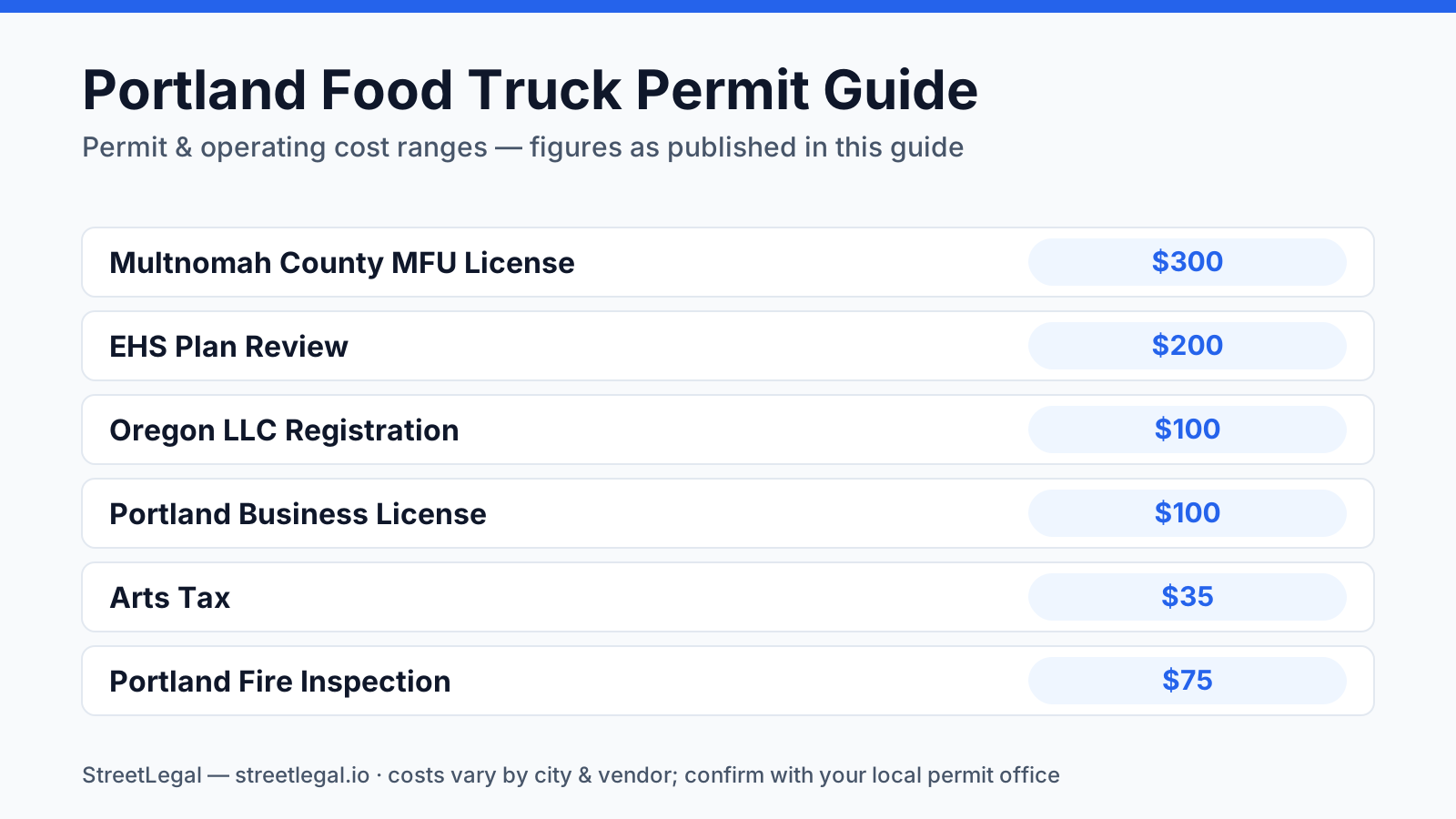
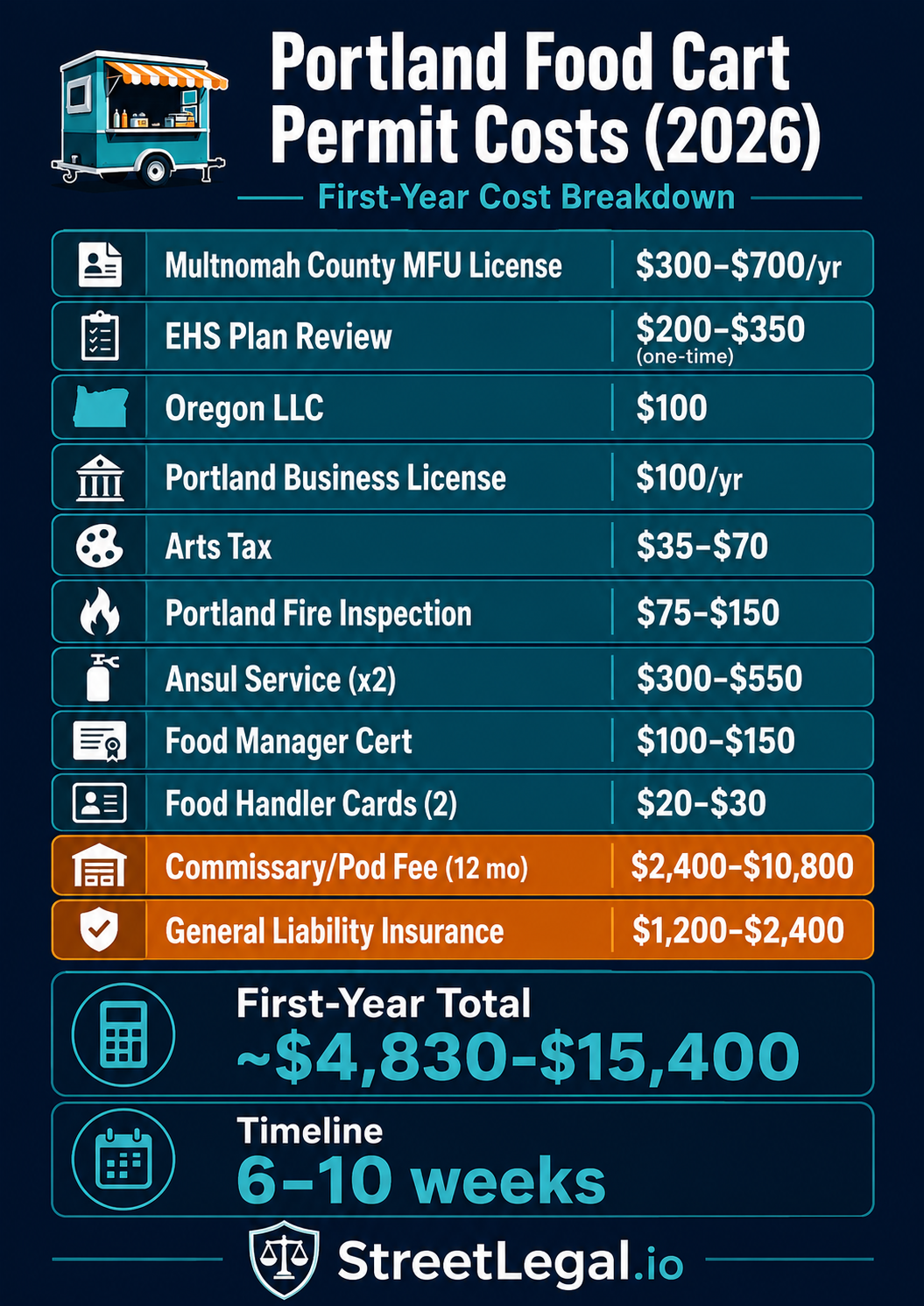
| Multnomah County MFU License | $300 | $700 | Annual, risk-based |
| EHS Plan Review | $200 | $350 | One-time, new units |
| Oregon LLC Registration | $100 | $100 | One-time + $100/yr renewal |
| Portland Business License | $100 | $100 | Annual |
| Arts Tax | $35 | $70 | $35/employee/year |
| Portland Fire Inspection | $75 | $150 | Annual |
| Ansul Semi-Annual Service (×2) | $300 | $550 | Annual ongoing |
| Food Manager Certification | $100 | $150 | Every 5 years |
| Food Handler Cards (2 staff) | $20 | $30 | Every 3 years |
| Commissary or Pod Fee | $2,400 | $10,800 | $200–$900/month depending on setup |
| General Liability Insurance | $1,200 | $2,400 | Annual |
| First-Year Total | $4,830 | $15,400 | Wide range: truck vs. pod |
Portland Food Truck Permit Timeline
| Week | Task |
|---|---|
| Week 1–2 | Register Oregon LLC with Secretary of State; get EIN from IRS |
| Week 2 | Contact Multnomah County EHS for pre-application meeting; clarify self-contained vs. commissary |
| Week 2–3 | Secure commissary agreement OR food cart pod sublease agreement |
| Week 3 | Submit EHS MFU plan review application with truck drawings and equipment specs |
| Week 4–5 | Plan review processing (2–3 weeks); respond to any EHS compliance notes |
| Week 5 | Schedule and pass Multnomah County EHS truck inspection; receive MFU license |
| Week 5–6 | Apply for Portland Business License via portland.gov/revenue |
| Week 6 | Schedule Portland Fire & Rescue inspection; certify Ansul system |
| Week 6–7 | Complete food manager certification, Oregon food handler cards for staff |
| Week 7 | First day of legal operation — welcome to the best food city on the West Coast |
5 Portland-Specific Insights
1. Oregon Food Handler Card vs. ServSafe — They're Different
Oregon has its own state-specific food handler card requirement. The Oregon Food Handler Card is issued through STATEFOODSAFETY.COM or approved providers and is specifically required for Oregon operations. A generic ServSafe Food Handler certificate from another state does not satisfy Oregon's requirement. Make sure your staff gets Oregon-specific cards.
2. Division Street and Mississippi Have the Highest Foot Traffic — and Highest Competition
Portland's most iconic food corridors are also the most saturated. SE Division Street, North Mississippi, and the Pearl District have deep audiences but very few open pod spots. New operators often find faster success by targeting underserved east Portland neighborhoods, the suburban ring (Beaverton, Lake Oswego, Gresham), or event catering before trying to break into the close-in pods.
3. Rainy Season Is Year-Round Revenue Strategy
Portland sees meaningful rain from October through May. Street-level food cart pods deal with this reality differently — some have covered seating structures, others are purely open air. If you're going into a pod, negotiate canopy or awning rights. If you're a mobile truck, build covered event catering into your business model for wet months. Don't plan on foot traffic in a December downpour.
4. Washington County and Clackamas County Are Separate Jurisdictions
Beaverton is in Washington County, not Multnomah. Lake Oswego is in Clackamas. These counties have their own health departments and you'll need to license separately if you operate there regularly. Washington County EHS MFU license is approximately $350–$650/year — similar to Multnomah but a separate application.
5. Portland's Tax Structure Has Changed — Know Your Obligations
Portland now layers three separate local taxes: the Portland Business License Tax (4% on gross receipts above $50K), the Metro Supportive Housing Services Tax (1% personal income tax), and the Multnomah County Preschool for All Tax (1.5% personal income tax on income above $125K). As your business grows, these stack up. Consult an Oregon CPA before year two — the Oregon tax structure is genuinely complex by food truck standards.
People also ask about Portland food truck permits
How much does a food truck permit cost in Portland?
How long does it take to get a food truck permit in Portland?
Do I need a commissary kitchen to operate a food truck in Portland?
What documents do I need for a Portland food truck permit?
Answers to the most common permit questions — costs, timelines, commissary rules, and more.
Find city-level permit guides for every state we cover — compare costs and requirements.
More from the blog
Las Cruces, NM Food Truck Permit Guide
Complete guide to food truck permits, fees, and requirements in Las Cruces, NM.
City GuidesGrand Junction, CO Food Truck Permit Guide
Complete guide to food truck permits, fees, and requirements in Grand Junction, CO.
City GuidesKey West, FL Food Truck Permit Guide
Complete guide to food truck permits, fees, and requirements in Key West, FL.
City GuidesNew Haven, CT Food Truck Permit Guide
Complete guide to food truck permits, fees, and requirements in New Haven, CT.