· 9 min read · Ben, Co-founder of StreetLegal
Food Truck Permit Costs: What to Actually Budget in 2026
Food truck permit costs in 2026 usually land around $400-$2,500 in direct government fees, but your real first-year compliance budget is often much higher — usually $8,000-$25,000+ once you include commissary rent, insurance, certifications, and inspection-ready truck upgrades.
Here's what nobody tells you when you start researching food truck permit costs: the fees themselves are usually not the expensive part.
A city vendor license might be $300. A state food establishment permit might be $100. Your health inspection might be $250. Add it all up and you're looking at maybe $1,000–$2,000 in actual government fees. That's manageable.
If you're budgeting for a food truck, treat permit fees as only one slice of the compliance budget. In most markets, commissary and insurance cost more than the licenses themselves.
What gets people is everything adjacent to the permits: the commissary kitchen you're required to have before they'll issue a permit, the insurance minimums set by the city, the vehicle modifications you need to pass the health inspection, and the two or three months of operating costs you'll burn through before you're approved to serve a single customer.
I've talked to hundreds of food truck operators while building StreetLegal. Let me give you the real picture.
The Actual Government Permit Fees
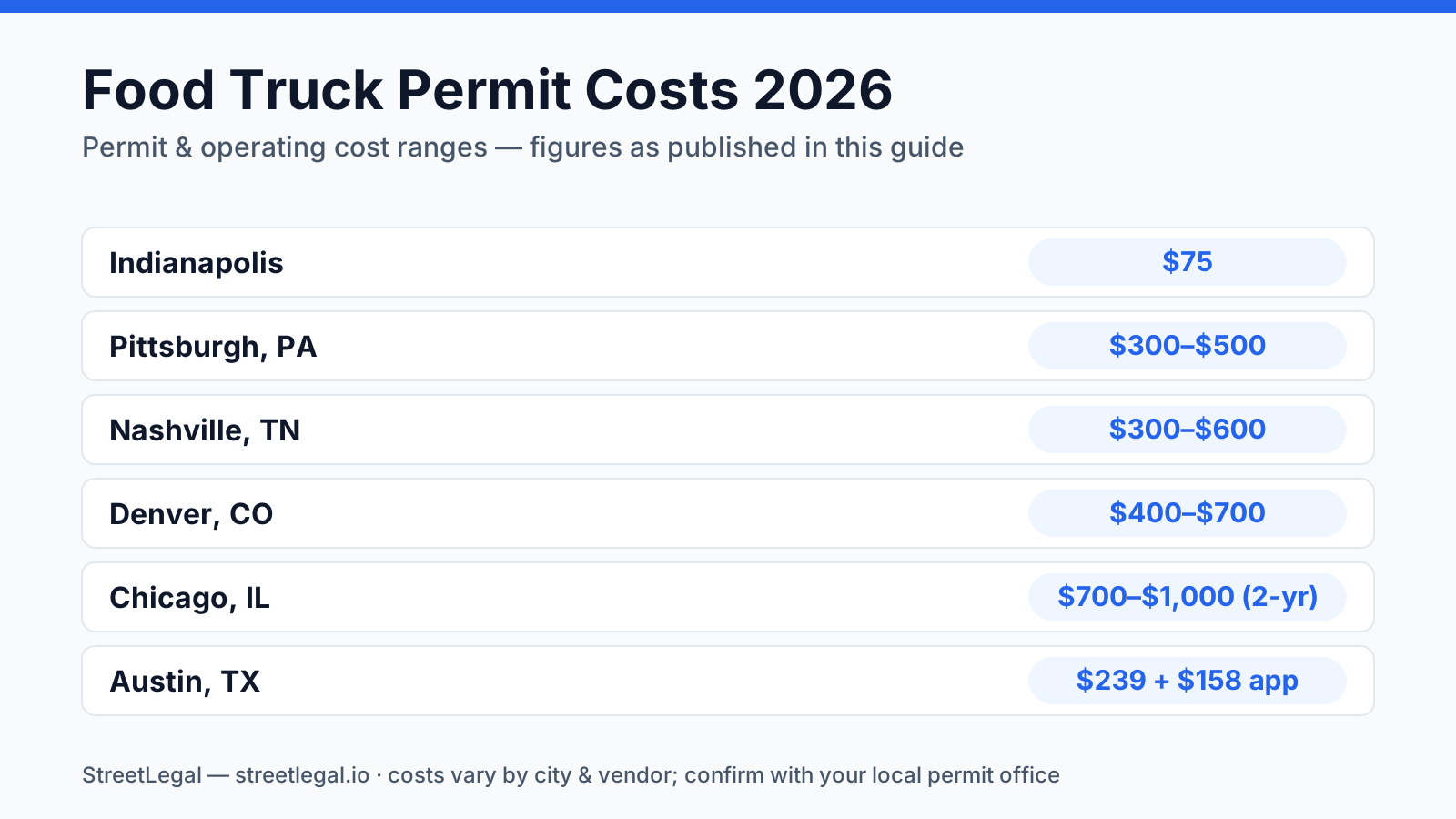
These are the fees you'll pay directly to city and state agencies. They vary significantly by market:
| City | Vendor/Operating License | Health Permit | State License | Total Fees Est. |
|---|---|---|---|---|
| Indianapolis | $75 | $200 | $60–$100 | ~$400–$600 |
| Pittsburgh, PA | $300–$500 | $225–$350 | $62–$162 | ~$600–$1,100 |
| Nashville, TN | $300–$600 | $200–$400 | $75–$150 | ~$600–$1,200 |
| Denver, CO | $400–$700 | $300–$500 | $50–$150 | ~$800–$1,500 |
| Chicago, IL | $700–$1,000 (2-yr) | Included in inspection | $100–$200 | ~$900–$1,400 |
| Austin, TX | $239 + $158 app | $258 (state) | Included | ~$700–$1,000 |
| Seattle, WA | $500–$1,000 | $400–$800 | $200–$400 | ~$1,200–$2,400 |
| Philadelphia, PA | $300–$600 | $250–$400 | $62–$162 | ~$650–$1,200 |
| NYC | $50–$150 (MFVL) | $200–$500 (unit permit) | Free (tax cert) | ~$300–$700 in fees* |
| San Francisco | $900–$2,500 | $500–$1,000 | $200–$500 | ~$2,000–$5,000 |
*NYC fees are low — the real cost is leasing a citywide permit informally, which runs $15,000–$25,000/year if you want full street vending access. See our NYC permit guide for the full picture.
If you're still in planning mode, pair this with our guide on how to start a food truck business so you budget the truck, timeline, and working capital correctly too.
The True First-Year Permit Cost (Including Everything)
This is the number most articles don't give you, because it requires adding up categories that aren't traditionally called "permit costs" — but that you cannot operate without.
Commercial Insurance: $2,000–$7,000/year
Every city that issues a food truck permit requires proof of commercial liability insurance — typically $500K–$1M minimum. This is non-negotiable. Budget at least $2,500/year in a smaller market, $4,000–$7,000 in NYC, Chicago, or LA. Shop multiple providers; rates vary significantly for food trucks.
Commissary Kitchen: $500–$3,000/month
Your single biggest ongoing compliance cost. Required by virtually every health department in the country before they'll approve your permit. For a year of commissary access, budget $6,000–$36,000 depending on your market and what services you need. A full-service commissary in NYC with truck parking can run $2,500–$3,500/month. A basic kitchen rental in Columbus, OH might be $400/month.
Food Safety Certifications: $150–$400 one-time
ServSafe Manager certification (~$150–$200) plus food handler cards for any additional staff ($15–$40 each). These are permit prerequisites in most jurisdictions, so budget them as part of your compliance costs, not operational costs.
Vehicle Modifications to Pass Inspection: $0–$10,000+
This is the wildcard. If your truck already meets health department specs (proper sinks, handwashing station, NSF-certified equipment, grease trap, etc.), your modification cost is zero. If you're buying a used truck that needs work — or getting a build custom-spec'd — expect to spend $3,000–$10,000 getting the truck up to code before it passes inspection.
The most common modification costs I've seen operators underestimate:
- Adding a three-compartment sink: $800–$2,500 installed
- Adding or upgrading a handwashing station: $300–$800
- Grease trap installation: $500–$2,000
- Upgrading to NSF-certified prep surfaces: $400–$1,500
- Fire suppression system installation: $1,500–$4,000
Real First-Year Compliance Budget: City by City
This combines government fees + insurance + commissary + certifications. It does not include your truck purchase, equipment, or operating costs.
| City | Govt Fees | Insurance | Commissary (12 mo) | Certs | Total Year 1 |
|---|---|---|---|---|---|
| Pittsburgh, PA | $700–$1,100 | $2,500–$4,000 | $6,000–$12,000 | $200–$400 | $9,400–$17,500 |
| Austin, TX | $700–$1,000 | $2,500–$4,000 | $5,000–$10,000 | $200–$400 | $8,400–$15,400 |
| Chicago, IL | $900–$1,400 | $3,000–$5,000 | $6,000–$15,000 | $300–$500 | $10,200–$21,900 |
| Nashville, TN | $600–$1,200 | $2,000–$3,500 | $5,000–$10,000 | $200–$400 | $7,800–$15,100 |
| NYC | $300–$700 | $4,000–$7,000 | $12,000–$36,000 | $200–$400 | $16,500–$44,100 |
| Seattle, WA | $1,200–$2,400 | $3,000–$5,000 | $7,000–$18,000 | $200–$400 | $11,400–$25,800 |
| San Francisco | $2,000–$5,000 | $4,000–$7,000 | $10,000–$24,000 | $200–$400 | $16,200–$36,400 |
Where Your Money Actually Goes
Based on the numbers above, here's how to think about where the compliance budget goes:
- ~50–60%: Commissary kitchen (the biggest line item nobody budgets for)
- ~25–35%: Commercial insurance
- ~10–15%: Government permit fees
- ~3–5%: Certifications and training
The implication: if you're trying to reduce compliance costs, the leverage is in negotiating your commissary agreement and shopping your insurance — not in agonizing over permit fee differences.
Hidden Costs Nobody Mentions
The "Getting Approved" Period
Your permit timeline is 6–14 weeks depending on city. During that time, you're paying for your commissary agreement (required before application), your insurance (required to submit with application), and possibly your truck's storage and vehicle costs — while generating exactly zero revenue. Budget 3 months of compliance costs before you ever serve a customer.
Failed Inspection Re-Fees
Many cities charge re-inspection fees when you fail. Chicago charges a reinspection fee. Most Texas cities charge $50–$150. Seattle charges for every additional inspection beyond the first. Pass on your first try and you'll never notice this. Fail once or twice and it adds up.
Event-Specific Permits
Want to work a food festival, a farmer's market, or a private event? Most cities require separate temporary event permits on top of your base operating license. Budget $50–$300 per event depending on jurisdiction.
Annual Renewals Aren't Always the Same Price
Some permits renew at the same rate. Others have fee structures tied to gross sales or inflation adjustments. Don't assume your Year 2 renewal costs match Year 1 fees.
How to Reduce Your Compliance Costs
Actual strategies that work:
- Negotiate your commissary agreement. Many commissary kitchens have monthly rates, but also offer better hourly rates if you can commit to off-peak hours. If you don't need truck parking, ask for a kitchen-only rate — it can cut your commissary bill in half.
- Shop commercial insurance with food-truck-specialist brokers. General insurance brokers often quote food trucks incorrectly. Find brokers who specialize in mobile food vendors. The rate difference can be $1,000–$2,000/year.
- Pass health inspections on the first try. Attend the free pre-inspection consultation (available in Chicago, Austin, and many other cities) before your real inspection. This is free money — use it.
- Track renewal deadlines early. Late renewals almost always incur penalties. A $500 penalty on a $300 permit is painful. Set calendar reminders at 90 days, 60 days, and 30 days before each expiration.
- Share a commissary. If you know other operators in your market, ask whether they'd split a full-service commissary membership. Many commissaries will negotiate a lower per-person rate for multiple trucks from the same organization.
Is It Worth It? Honest Take.
Food trucks in good markets generate $250,000–$500,000+ in annual revenue. Your full compliance budget — permits, insurance, commissary — runs $10,000–$30,000 depending on where you operate. That's 4–10% of revenue. For a business with the right margins and the right market, it's very worth it.
The operators who fail aren't usually failing because the permits cost too much. They're failing because they didn't budget for the compliance costs upfront, burned their cash reserve during the approval period, and launched undercapitalized.
Know the real numbers before you start. Plan for the full timeline. And once you're operating, automate the renewal tracking so you never pay a late fee. That's really all there is to it.
Permit Cost FAQ
How much do permits cost?
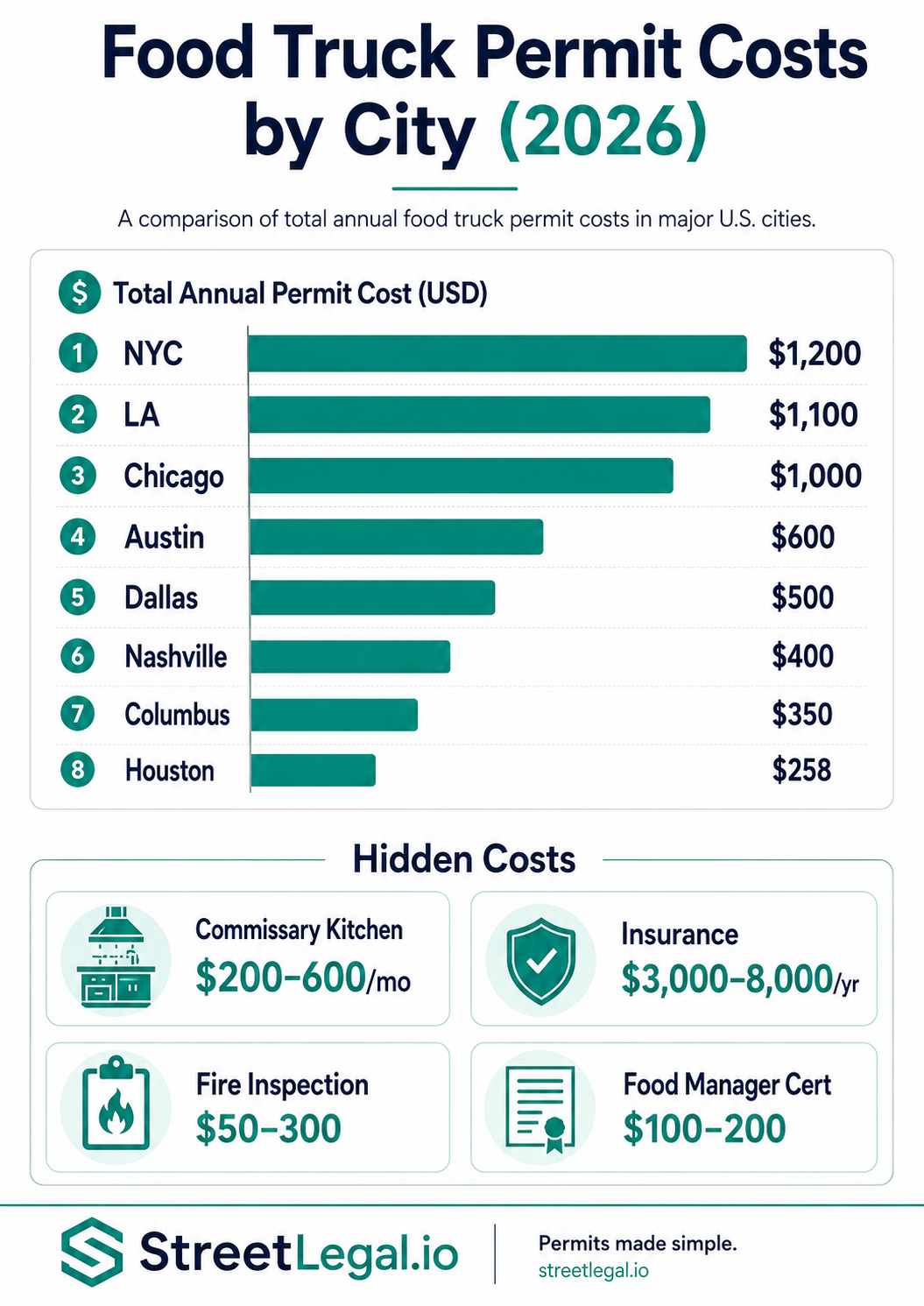
Low-cost cities: $500-$1,200. Mid-tier: $1,500-$4,000. High-cost (NYC/LA/Chicago): $5,000-$10,000+. Insurance and commissary often exceed the permit fee itself.
What costs the most?
Commercial insurance ($3,000-$8,000/yr) and commissary kitchen agreements ($200-$600/mo) are usually the largest line items.
Do I need a commissary?
In most US cities, yes. Required before your health permit is issued. Monthly cost: $200-$600.
How long does permitting take?
6-12 weeks. Main variable: inspection scheduling (often 2-4 weeks out). Apply early and schedule your inspection immediately.
City Permit Guides
Houston, TX →
COHD MHFD permit, ~$713 first year
New Orleans →
LDH state permit + DBIA city permit
Charlotte, NC →
MCEH Mobile Food Unit permit
Miami, FL →
Florida DBPR MFDV statewide license
Phoenix, AZ →
Maricopa County MFU + city biz license
Austin, TX City Guide →
APH permit + Austin Fire Dept inspection, ~$700–$1,000/yr
Birmingham, AL City Guide →
JCDH mobile food unit permit, ~$200–$300/yr
Boston, MA →
ISD Mobile Food Vendor License
Last updated: April 3, 2026. Permit fees, commissary pricing, and inspection requirements vary by city and can change without much notice, so confirm the latest numbers with your local agencies before applying.
Go Deeper on Costs
Answers to the most common permit questions — costs, timelines, commissary rules, and more.
Find city-level permit guides for every state we cover — compare costs and requirements.
More from the blog
Jefferson County, MO Food Truck Permit Guide
Complete guide to food truck permits, fees, and requirements in Jefferson County, MO.
City GuidesSt. Charles County, MO Food Truck Permit Guide
Complete guide to food truck permits, fees, and requirements in St. Charles County, MO.
City GuidesSt. Louis County, MO Food Truck Permit Guide
Complete guide to food truck permits, fees, and requirements in St. Louis County, MO.
Buyer's GuideFood Truck POS Systems 2026: Square, Toast, Clover & Avocado
Compare 2026 food truck POS systems by pricing, hardware costs, offline mode, and contract terms for Square, Toast, Clover, and Avocado.