· Updated · 10 min read · Gibby, StreetLegal Editorial

How to Start a Food Truck in Austin, TX: Complete Permit Guide 2026

Austin has more food trucks per capita than any major US city — an estimated 2,000+ permitted mobile food vendors in Travis County alone. The city practically invented the modern food trailer park concept. But getting legal here has its own distinct set of rules, and Austin's rapid growth has brought tighter enforcement.
This guide covers the Austin Public Health (APH) mobile food vendor permit, fire safety requirements, the unique Austin "food trailer park" model, commissary rules, and the full cost breakdown for 2026.
Updated August 12, 2026
Austin's Advantage
Austin is one of the most food-truck-friendly major cities in the US. No permit caps, reasonable fees, and a culture that genuinely embraces mobile food. The permitting process is more straightforward than NYC, Chicago, or LA.
Austin's Food Truck Ecosystem
Austin's food truck scene is unique in the US for a few reasons:
- Food trailer parks: Semi-permanent lots where multiple trailers operate together — Austin pioneered this model and it's deeply embedded in the city's food culture (South Congress, East 6th, Mueller, North Loop)
- Trailers vs. trucks: Many Austin "food trucks" are actually stationary trailers (no drive train), which affects permitting and operational flexibility
- Travis County dual system: Austin city limits (Austin Public Health) vs. unincorporated Travis County (separate system) — similar to the Houston city/Harris County issue
- No zoning for trailers: Austin's land development code allows food trailers on most commercially-zoned lots without a conditional use permit
What Licenses Do You Need in Austin?
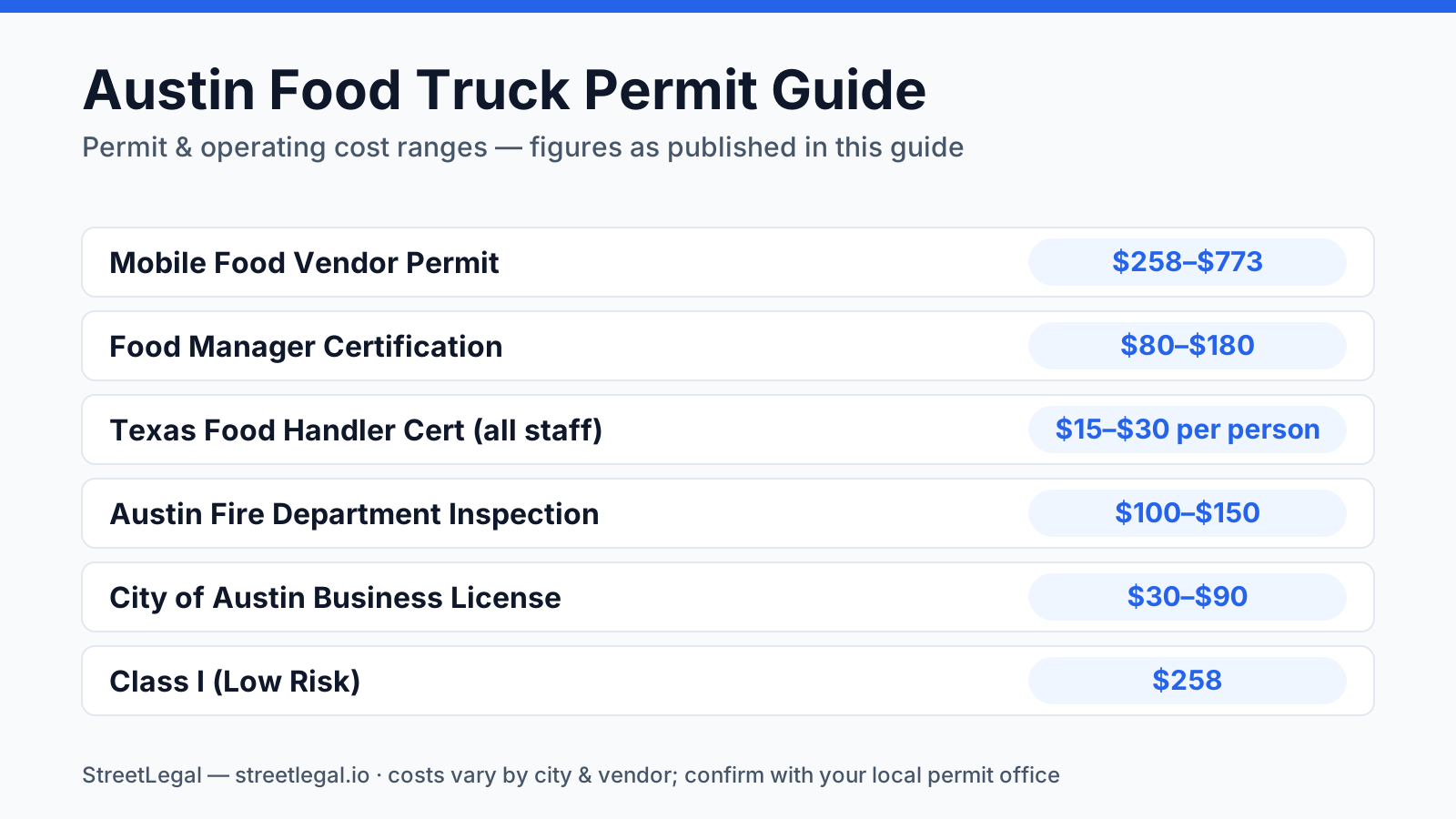
| License / Permit | Issuing Authority | Fee | Renewal |
|---|---|---|---|
| Mobile Food Vendor Permit | Austin Public Health | $258–$773 | Annually (May 31) |
| Food Manager Certification | TXDSHS-accredited | $80–$180 | Every 5 years |
| Texas Food Handler Cert (all staff) | TXDSHS-accredited | $15–$30 per person | Every 2 years |
| Austin Fire Department Inspection | Austin Fire Dept | $100–$150 | Annually |
| Texas Sales Tax Permit | Texas Comptroller | Free | Permanent (file returns) |
| City of Austin Business License | City of Austin | $30–$90 | Annually |
The Austin Public Health Mobile Food Vendor Permit
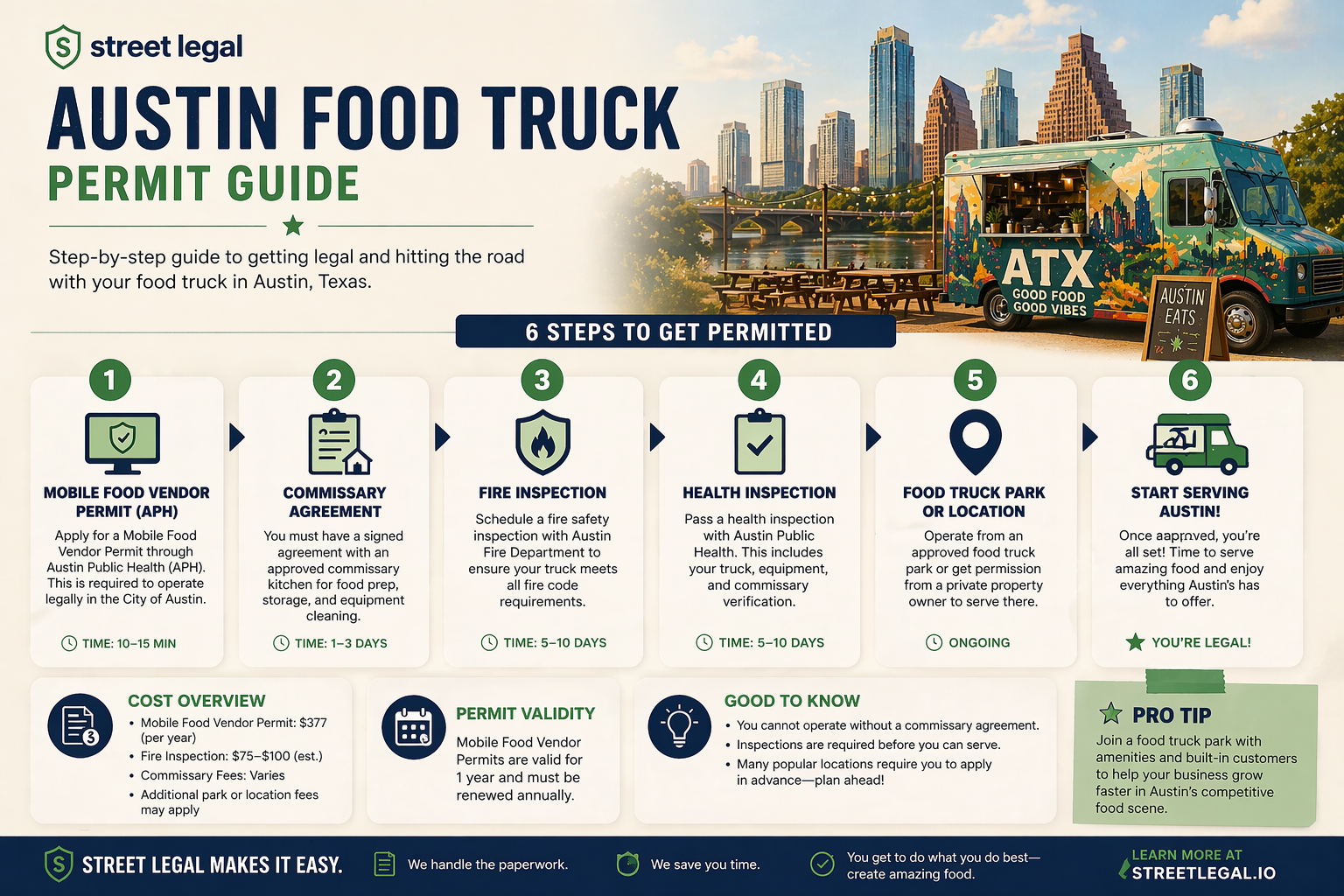
Austin Public Health (APH) issues Mobile Food Vendor permits for all food trucks, trailers, and carts operating within Austin city limits. The permit fee is tiered by risk category:
| Risk Category | Food Type | Annual Fee |
|---|---|---|
| Class I (Low Risk) | Pre-packaged foods, drinks only | $258 |
| Class II (Medium Risk) | Hot food, limited menu, basic preparation | $386 |
| Class III (High Risk) | Full cooking, complex menu, multiple PHFs | $513 |
| Class IV (Highest Risk) | Full-service, extensive cooking, catering | $773 |
Most full-service food trucks fall into Class III or IV. Budget $513–$773 for your APH permit.
What APH Inspectors Check
- Fresh water tank (minimum 30 gallons for Class III/IV), wastewater tank (1.5x fresh water capacity)
- Handwashing station — separate from three-compartment sink, with soap and single-use towels
- Three-compartment sink: wash, rinse, and sanitize — NSF-approved sanitizer concentrations
- Temperature control: hot-holding 135°F+, cold-holding 41°F or below; calibrated probe thermometer on hand
- Commissary agreement: signed letter with facility name, permit number, and access hours
- Food manager and food handler certificates for all workers
- Pest exclusion: no gaps larger than 1/8 inch, all doors screened or closed
- Ventilation and hood system (if cooking with open flame or producing grease vapors)
Commissary Requirements in Austin
Austin Public Health requires a commissary agreement for all Class II, III, and IV permits. The commissary is where you prep, store ingredients, clean equipment, and dump wastewater.
🔑 Austin Trailer Park Exception
Some Austin food trailer parks have on-site commissary facilities. If your park has an APH-permitted commissary attached, you may be able to use the park's commissary agreement rather than finding your own. Confirm this with the park operator AND with APH before assuming it applies to you.
Austin Commissary Kitchen Costs (2026)
- Hourly rental: $18–$28/hour (most facilities require a monthly minimum)
- Monthly membership: $400–$800/month for reasonable weekly access
- Annual all-in: $4,800–$9,600 for a typical food truck operation
Austin has many shared commissary kitchens due to the density of food trucks — competition keeps prices more reasonable than in cities with fewer facilities.
Austin Fire Department Inspection
If you use propane, natural gas, or open flame equipment, the Austin Fire Department (AFD) must inspect your vehicle before your APH permit can be issued. AFD checks:
- UL-300 compliant hood suppression system: Required for fryers, grills, and open-top burners
- Propane storage: Tanks must be secured, not stored inside the vehicle cab, with manual shutoff accessible from outside
- K-class fire extinguisher: Mounted, charged, inspection tag within 12 months
- Flexible connectors: Properly rated, no kinks or abrasion
- CO detectors: Required in enclosed cooking spaces
Austin's Food Trailer Parks: The Real Model
Austin invented the modern food trailer park concept and it's still the dominant way food trucks operate here. A trailer park is a semi-permanent lot with multiple vendors, shared seating, and often a bar or beverage vendor. Why trailers over trucks?
- Lower equipment costs: A trailer can cost $15,000–$40,000 vs. $50,000–$150,000 for a converted truck
- Lower overhead: No engine maintenance, no commercial driver requirements
- Easier permitting: Semi-permanent trailers don't need a fresh COF (Certificate of Fitness) every time they move
- Built-in customer traffic: Good parks aggregate foot traffic better than solo locations
What to Know About Joining a Trailer Park
- Park fees: Typically $800–$2,000/month for a spot; some parks take a revenue percentage (8–15%)
- Commissary: Some parks include commissary access in their fee; others don't — verify before signing
- Utilities: Parks usually provide electricity (30-amp or 50-amp hookup); water and gray water may be extra
- Zoning: The park operator handles the land use permit; verify before committing that the park has current permits
- Contract length: Many parks require 6-month minimums; negotiate an out-clause in case the park changes ownership or closes
Full First-Year Cost Breakdown (Austin)
| Cost Item | Low | High | Notes |
|---|---|---|---|
| APH Mobile Food Vendor Permit | $258 | $773 | Risk class I–IV |
| AFD Fire Inspection | $100 | $150 | If using open flame |
| Food Manager Cert | $80 | $180 | ServSafe or equivalent |
| Food Handler Certs (3 staff) | $45 | $90 | $15–$30 per person |
| City Business License | $30 | $90 | City of Austin |
| Commissary Kitchen (12 months) | $4,800 | $9,600 | If not included in trailer park |
| TX LLC Formation | $300 | $300 | TX SOS filing fee |
| Commercial Insurance | $1,800 | $3,600 | GL + vehicle + product liability |
| Total First Year | ~$7,413 | ~$14,783 | Before food trailer park spot fee |
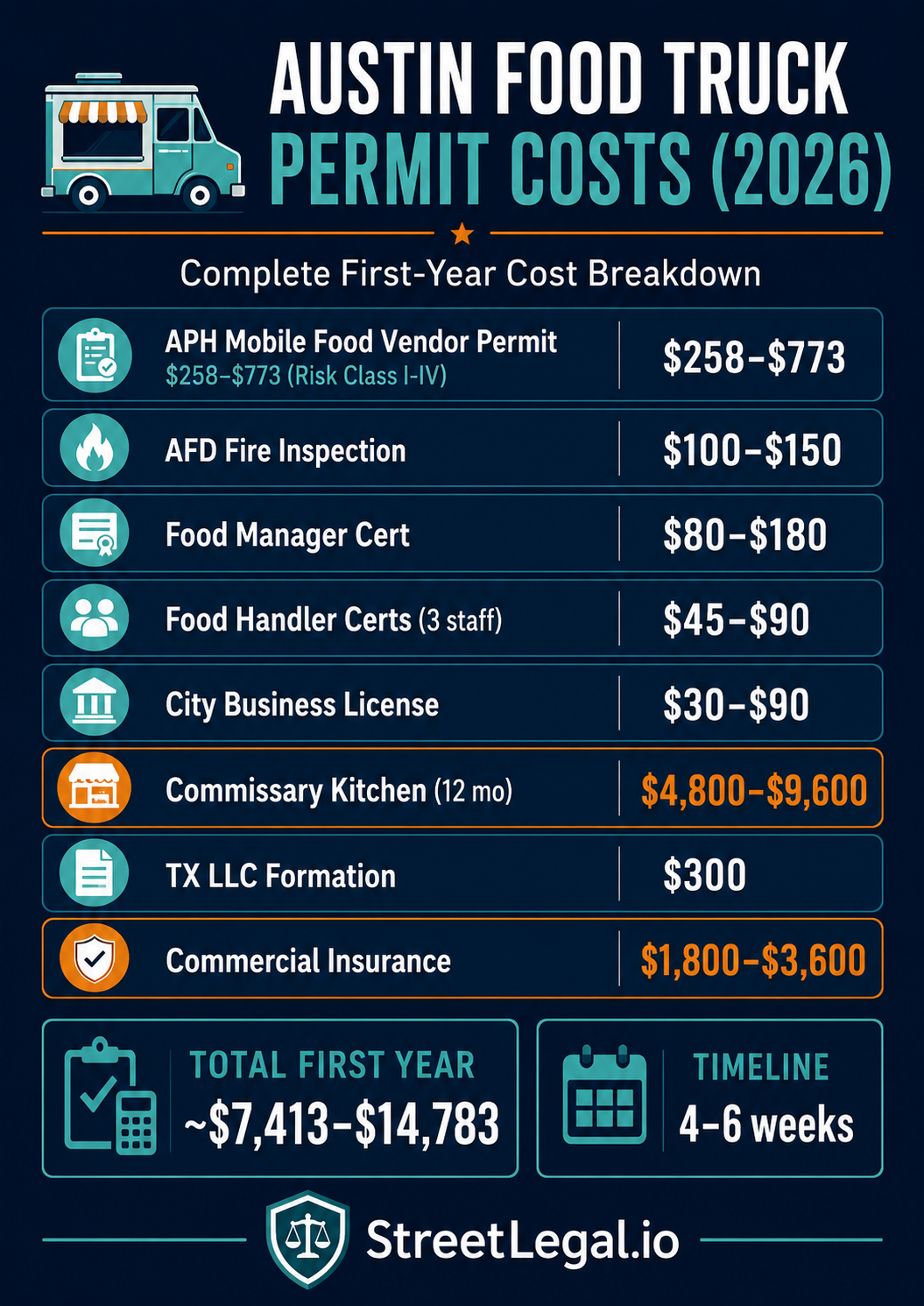
Note: If you rent a spot in a food trailer park, add $9,600–$24,000/year for the park spot fee. Some parks include commissary access.
Austin Launch Timeline
Week 1–2: Foundation
File TX LLC ($300). Get Texas Sales Tax permit (free, same day online). Get everyone food handler certified ($15–30 each). Book and pass Food Manager exam (ServSafe, ~$80–180).
Week 2–3: Secure Your Spot & Commissary
Find a trailer park spot or a private lot, and sign a commissary agreement. Get copies of both for your APH application.
Week 3–4: Submit APH Application
Submit online through Austin's eTRAKit system. Pay permit fee. Schedule APH and AFD inspections simultaneously — don't wait for one to finish before scheduling the other.
Week 4–6: Inspections
APH site inspection + AFD fire safety inspection. APH usually turns around approvals within 5–7 business days after a passing inspection.
Week 6–7: Open for Business
Permits in hand, insurance active, location secured. Austin's food culture is welcoming — build your reputation fast by showing up consistently and engaging on social media.
Austin Permit Launch Snapshot (2026)
Here is the full Austin permit stack at a glance — agencies, fees, and the recommended sequence for your first launch:
| Agency | Permit / Requirement | Est. Fee | Processing Time | Sequence |
|---|---|---|---|---|
| Texas Secretary of State / County Clerk | TX LLC or DBA filing | $300 LLC / $25 DBA | 1–3 days online | Step 1 — do this first |
| Texas Comptroller | Texas Sales and Use Tax Permit | Free | Same day online | Step 1 — concurrent with LLC |
| TXDSHS-accredited provider | Food Manager Certification (ServSafe or equiv.) | $80–$180 | 1–5 days | Step 2 — required before APH app |
| Licensed commissary kitchen | Commissary agreement (APH-permitted kitchen) | $400–$1,200/month | 1–2 weeks to secure | Step 2 — required before APH app |
| Austin Public Health (APH) | Mobile Food Vendor Permit (Class I–IV based on risk) | $258–$773/yr | 3–6 weeks after filing | Step 3 — core city permit |
| Austin Fire Department (AFD) | Fire safety inspection (propane, hoods, suppression) | $100–$150 | Schedule with APH — 2–4 weeks | Step 3 — concurrent with APH |
| City of Austin | City of Austin Business License / registration | $30–$90/yr | 1–5 days | Step 3 — concurrent or after APH |
| Venue / park / property owner | Trailer park lease or private-lot operating agreement | $800–$2,500/month | 1–4 weeks to negotiate | Step 4 — secure before launch |
Fees and timelines as of 2026. Verify current rates with APH at Austin Public Health before filing.
5 Austin-Specific Tips
1. Renew Before May 31
Austin APH permits all expire on May 31 each year — regardless of when you originally got them. If you apply in November, you still need to renew by May 31. This creates a massive renewal rush in April and May. Submit your renewal in March to avoid inspection backlogs.
2. SXSW Is Both Opportunity and Compliance Risk
South by Southwest (March) brings 300,000+ visitors and massive food truck revenue. But APH ramps up inspections during SXSW. Make sure your permits are current, your commissary log is clean, and your food handler certs are up to date before March 1.
3. eTRAKit Is Your Friend
Austin uses the eTRAKit online system for permit applications, renewals, and inspection scheduling. Set up an account early and save your vehicle and business info — it makes the annual renewal process significantly faster.
4. Electricity Matters More in Austin Than Most Cities
Austin's heat (100°F+ for months) means AC for food storage and worker comfort is practically necessary, not optional. If you're at a trailer park, verify the electrical capacity before committing. Undersized hookups are one of the most common trailer park disputes.
5. Don't Ignore the Neighborhood
Austin neighborhoods have become more assertive about enforcing nuisance regulations against trailer parks (noise, late hours, parking). East Austin and South Congress have seen parks shut down after neighbor complaints. Know your neighborhood before signing a 12-month spot lease.
Annual Renewal Checklist
Everything renews on May 31. Start this process in March:
- APH Mobile Food Vendor permit — submit renewal via eTRAKit with updated commissary agreement
- AFD fire inspection — schedule annually; Ansul re-inspection required
- Food handler certs — check expiry dates for every employee; certs are 2-year in Texas
- Food Manager cert — 5-year cycle, but confirm yours hasn't lapsed
- City business license — renew annually with City of Austin
- Vehicle/trailer inspection — Texas annual inspection sticker
- Commissary agreement — if yours is a 1-year agreement, renew 30 days early
Austin Food Truck FAQ
Is a food trailer treated the same as a food truck in Austin?
Can I operate at multiple locations with one Austin permit?
What happens if my permit expires during the busy season?
Do I need a permit to do private catering events in Austin?
Related City Guides
People also ask about Austin food truck permits
How much does a food truck permit cost in Austin?
How long does it take to get a food truck permit in Austin?
Do I need a commissary kitchen to operate a food truck in Austin?
What documents do I need for a Austin food truck permit?
Answers to the most common permit questions — costs, timelines, commissary rules, and more.
Find city-level permit guides for every state we cover — compare costs and requirements.
More from the blog
Jefferson County, MO Food Truck Permit Guide
Complete guide to food truck permits, fees, and requirements in Jefferson County, MO.
City GuidesSt. Charles County, MO Food Truck Permit Guide
Complete guide to food truck permits, fees, and requirements in St. Charles County, MO.
City GuidesSt. Louis County, MO Food Truck Permit Guide
Complete guide to food truck permits, fees, and requirements in St. Louis County, MO.
Buyer's GuideFood Truck POS Systems 2026: Square, Toast, Clover & Avocado
Compare 2026 food truck POS systems by pricing, hardware costs, offline mode, and contract terms for Square, Toast, Clover, and Avocado.