· 6 min read · StreetLegal Team
Top 5 Food Truck Permit Mistakes That Cost Operators Thousands
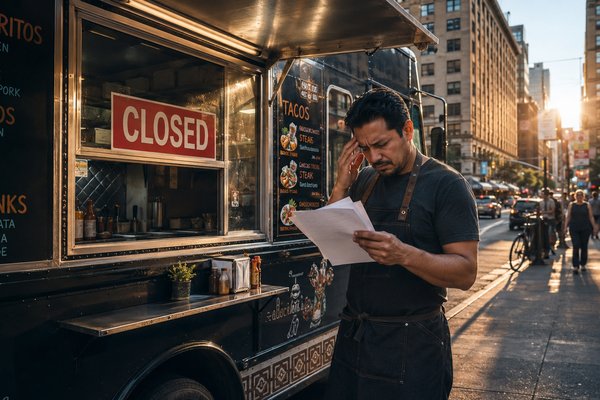
We've talked to dozens of food truck operators across the country, and the same permit mistakes come up again and again. Some cost operators hundreds in fines. Others cost them entire seasons of revenue.
We pulled actual fine data from 10 major U.S. cities to show you exactly what these mistakes cost — and how to avoid every one of them.
Mistake #1: Starting the Permit Process Too Late
This is the most expensive mistake on the list. New operators assume they can get fully permitted in a week or two. The reality? 6–10 weeks is standard in most major cities, and spring backlogs can push that to 12+ weeks.
In New York City, the timeline is even worse: the city caps the number of mobile food vending permits, creating a waitlist that can stretch 3–12+ months. Many NYC operators end up buying permits on the secondary market for $10,000–$25,000.
What it actually costs
If you're planning to launch for the summer season (May–September), you need to start your permit process no later than early March. Operators who wait until April or May miss the busiest weeks of the year — easily $3,000–$8,000 in lost revenue during peak season.
- Austin / Houston: 3–6 weeks (fastest)
- Pittsburgh / Denver / Seattle / Atlanta: 4–8 weeks
- Philadelphia / Chicago / Los Angeles: 6–12 weeks
- New York City: 3–12+ months (permit cap + waitlist)
How to avoid it
- Start 3 months before your target launch date. This gives you buffer for delays, failed inspections, and resubmissions.
- Schedule your health inspection first. This is the longest lead-time item in most cities. Get it on the calendar before anything else.
- Use a permit checklist. StreetLegal generates a personalized checklist based on your city, so you know exactly what to apply for and when.
Mistake #2: Letting Permits Expire Without Realizing It
Different permits expire at different times. Your city vendor license might renew in January, your health permit in June, and your state food establishment license in October. Keeping track of all these dates manually is a recipe for disaster.
What it actually costs
Operating with an expired permit triggers some of the steepest penalties in food truck enforcement:
- Philadelphia: $100–$500/day
- NYC: $1,000 standard; $2,000 default if unpaid
- Chicago: $500–$2,500 + possible vehicle impoundment
- LA: $100–$250 per offense (infraction baseline)
- Denver: $500–$1,000
- Atlanta: $250–$500
Beyond fines, an expired permit can void your liability insurance — putting your personal assets at risk. And many cities charge higher fees for lapsed permits vs. timely renewals.
How to avoid it
- Create a master calendar of every permit, license, and insurance policy with their expiration dates.
- Set reminders at 60, 30, and 14 days before expiry. Many renewal applications take 2–4 weeks to process.
- Automate it. StreetLegal sends automatic reminders at 30, 14, and 7 days before any deadline — so nothing slips through the cracks.
Mistake #3: Not Securing a Commissary Kitchen Agreement First
A missing commissary agreement is the #1 reason for permit denial across all 10 cities we surveyed. Yet many operators leave this as one of the last items on their list, creating a bottleneck that delays everything else.
What it actually costs
- Your city vendor license application won't be accepted without a commissary agreement
- Your health inspection may not be scheduled without proof of a commissary
- Good commissary spots fill up during peak season — waiting means less selection and higher prices ($3,000–$8,000/year)
- In Chicago, commissary fees alone run $6,000+/year — the single biggest line item in the city's $7,000–$9,500 first-year permit costs
How to avoid it
- Make commissary selection your first task. Even before applying for anything else, find and sign with a licensed commissary kitchen.
- Visit the facility in person. Check for cleanliness, available equipment, storage space, and accessibility during the hours you need.
- Negotiate terms. Many commissaries offer month-to-month agreements, part-time rates, or shared arrangements.
- Use a marketplace. StreetLegal's kitchen marketplace lets you compare commissary options by location, price, amenities, and health scores.
Mistake #4: Submitting Incomplete Applications
Incomplete applications are returned without processing — often with a 2–4 week delay before you can resubmit. In Houston alone, 4,300+ serious violations were logged between January 2024 and February 2025 — and many started with paperwork issues that cascaded into enforcement actions.
Top reasons applications get rejected
- Missing signatures on multi-page forms
- Expired insurance certificate — your COI must be current at time of submission
- Wrong form version — agencies update forms periodically; old versions trigger automatic rejection
- Missing supporting documents — commissary agreement, food handler cert, or vehicle registration
- Equipment failures at inspection — missing handwashing sink (the #1 inspection failure in Houston with 991 cases), improper refrigeration, or no fire suppression system
How to avoid it
- Double-check every field before submitting. A second pair of eyes catches mistakes your brain auto-corrects.
- Create a submission checklist. For each application, list every required document and verify each one is attached, current, and correctly filled out.
- Use AI to reduce errors. StreetLegal's AI auto-fills permit applications from your uploaded documents, dramatically reducing errors.
Mistake #5: Operating Outside Your Permit Scope
Your permits specify exactly what you can do and where you can do it. Operating outside those boundaries — even unknowingly — triggers some of the most aggressive enforcement actions in the industry.
Common scope violations and their penalties
- Wrong location: Chicago enforces a 200-foot rule from restaurants — violations run $1,000–$2,000. LA can impound your vehicle for operating in restricted zones.
- Unapproved menu items: Health permits are tied to a specific menu. Adding a new item (especially one requiring different equipment) may require a permit amendment.
- Restricted hours: Philadelphia doubled fines for curfew and zone violations in 2025, pushing penalties to $1,000/day.
- Different vehicle: Your permit is tied to a specific truck/VIN. Swapping vehicles — even temporarily — requires a permit amendment in most cities.
In Austin, operating in the right-of-way without authorization triggers immediate shutdown plus citation. In September 2025, Philadelphia food truck owners alleged city retaliation through increased citations after they publicly opposed a new business curfew ordinance.
How to avoid it
- Read your permit terms carefully. They specify locations, hours, menu items, and vehicle information.
- Notify your licensing agency before making any changes. Adding menu items, changing vehicles, or operating in new locations may require a permit update.
- Keep records. Log your operating locations and hours. If you're ever challenged, consistent compliance records work in your favor.
The Real Cost of Permit Mistakes
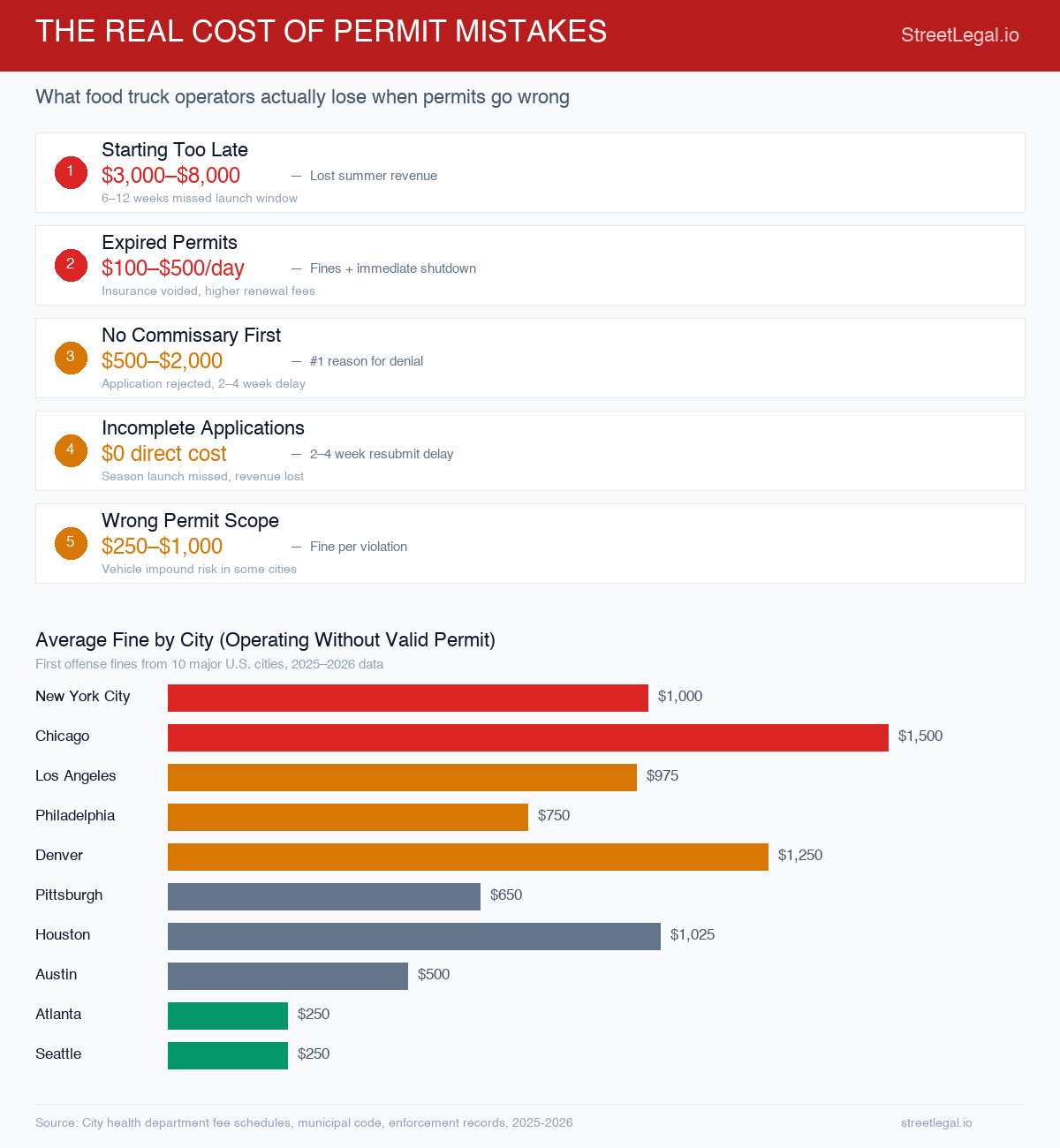
We compiled fine data from 10 major U.S. cities to show what these mistakes actually cost. The range is staggering — from $250 in Seattle to $2,500+ in Chicago, and that's before you factor in lost revenue, legal fees, and reapplication costs.
City-by-City: What a No-Permit Fine Actually Looks Like
Operating without a valid permit is the single most expensive mistake a food truck operator can make. Here's what it costs in 10 major U.S. cities (2025–2026 data):
$1,000
$2,000 default if unpaid. DOHMH can close on the spot.
$450–$1,500
Up to 3x permit fee. Vehicle impound possible.
$500–$2,500
Vehicle impoundment authorized. 500+ citations in 2024.
$500–$1,000/day
Zone violations doubled in 2025. Lottery for Center City.
$500–$2,000
Vehicle impoundment reported. CO food code overhaul 2025.
$300–$1,000/day
Allegheny County ordinance. Separate county health permit.
$50–$2,000
4,300+ serious violations Jan 2024–Feb 2025.
Citation + shutdown
TX statewide permit launching July 2026.
$250
Historically unenforced. King County acknowledged zero citations issued.
$250 (1st)
Escalates to $1,000. Equipment confiscation possible.
Data compiled from city health department fee schedules, municipal code, and enforcement records (2025–2026). Fines shown are for first offenses unless otherwise noted.
First-Year Permit Costs: What to Actually Budget
Beyond avoiding fines, knowing the real cost of getting permitted helps you plan your first year without surprises. Here's what operators actually spend in 10 major markets:
- Austin: $500–$700 (permits + food handler certs) — cheapest major market
- Pittsburgh: $500–$1,200
- Houston: $600–$1,500 (simplifying under SB 1008, effective Sept 2025)
- Atlanta: $600–$1,200
- Seattle: $700–$1,200 (King County + Seattle licenses both needed)
- Denver: $800–$1,500
- Philadelphia: $800–$2,000 in fees; $8,000–$20,000 all-in with insurance and commissary. Add $2,750 for Center City lottery zone.
- Los Angeles: $1,200–$3,000 (county + city permits required separately)
- Chicago: $7,000–$9,500 all-in (permit $350 + commissary $6,000 + insurance $3,500)
- New York City: $10,000–$25,000 — official fee is only $303, but permits must be bought on the secondary market due to the cap
These are permit and fee costs only. Budget an additional $2,000–$4,000 for insurance and $3,000–$8,000/year for commissary fees in most markets. Realistic all-in first-year costs for most major cities: $8,000–$20,000.
Bonus: The Meta-Mistake — Going It Alone
The permit process is manageable, but it's complex enough that small mistakes compound. Operators who try to handle everything manually — tracking dates in their head, filling out forms by hand, keeping paper files — are the ones most likely to make every mistake on this list.
That's why we built StreetLegal. Not to replace your judgment, but to handle the tedious, error-prone parts of permit management so you can focus on making great food and running your business.
- Personalized permit checklists based on your city
- Automated deadline reminders at 30, 14, and 7 days
- Commissary kitchen marketplace with pricing and health scores
- AI-powered form filling from your uploaded documents
- All your permits and documents in one secure dashboard
Start your free permit check →
Related City Guides
Get the full permitting breakdown for your city — costs, timelines, requirements, and local tips:
- Pennsylvania Food Truck Permit Costs
- Philadelphia Food Truck Permits
- Pittsburgh Food Truck Permits
- Houston Food Truck Permits
- Chicago Food Truck Permits
- Austin Food Truck Permits
- Los Angeles Food Truck Permits
- New York City Food Truck Permits
- Denver Food Truck Permits
- Seattle Food Truck Permits
- Atlanta Food Truck Permits
Answers to the most common permit questions — costs, timelines, commissary rules, and more.
Find city-level permit guides for every state we cover — compare costs and requirements.
More from the blog
Flagstaff, AZ Food Truck Permit Guide
Complete guide to food truck permits, fees, and requirements in Flagstaff, AZ.
City GuidesTulsa, OK Food Truck Permit Guide
Complete guide to food truck permits, fees, and requirements in Tulsa, OK.
City GuidesElgin Food Truck Permit Guide 2026 | StreetLegal
Elgin, IL food truck permit guide 2026: Kane County mobile vendor fees, Elgin business license, commissary rules, inspections, parking limits, and launch checklist.
City GuidesElk Grove Food Truck Permit Guide 2026 | StreetLegal
Elk Grove food truck permits in 2026: Sacramento County health permit, city business license, fire review, commissary paperwork, costs, timeline, and launch checklist.