· 11 min read · Gibby, StreetLegal Editorial
Informational only — not legal advice. Confirm requirements with the city before you apply. See our Disclaimer.
How to Start a Food Truck in Denver: Complete Permit Guide 2026
Denver Food Truck Permitting Overview
Denver is a top-tier food truck market — outdoorsy population, strong craft food culture, warm summers, and a downtown core full of hungry office workers and events. The city's Mobile Retail Food Establishment (MRFE) permit system is reasonably streamlined compared to East Coast cities, but the requirements are real and the commissary rule is non-negotiable.
Most Denver food truck operators need:
- Denver EHD Mobile Retail Food Establishment permit
- Commissary agreement with an approved kitchen
- Denver Fire Department permit (if using open flame/fryers)
- Denver Business License
- Colorado Sales Tax License
Denver EHD: Mobile Retail Food Establishment (MRFE) Permit
The primary permit for food trucks in the City and County of Denver is the Mobile Retail Food Establishment (MRFE) permit, issued by Denver Environmental Health (EHD).
Who Needs an MRFE Permit?
Any person selling food or beverages from a vehicle or cart in the City and County of Denver. This includes fully-equipped food trucks, trailer setups, and pushcarts. Coffee carts and beverage-only operations are also covered.
MRFE Requirements
- Commissary agreement — Required. Must be signed by both you and an EHD-approved commissary facility.
- Pre-operation inspection — An EHD inspector must inspect your vehicle before the permit is issued
- Equipment standards — Must meet Colorado Department of Public Health & Environment (CDPHE) Retail Food Establishment Rules
- Colorado Food Handler certification — Required for all employees who handle unpackaged food
- Food Manager certification — At least one person must hold a nationally-accredited Food Protection Manager certification (ServSafe, NRFSP, etc.)
- Hot/cold holding equipment — Properly calibrated for altitude; Denver's altitude means water boils at 202°F, affecting steam tables and calibration
- 3-compartment sink or warewashing agreement — Must be accessible (usually handled at the commissary)
- Handwash sink — On the truck, with hot water
- Potable water supply — Fresh water tank; minimum 30-gallon capacity recommended
- Wastewater tank — Must be 15% larger than fresh water tank per state rules
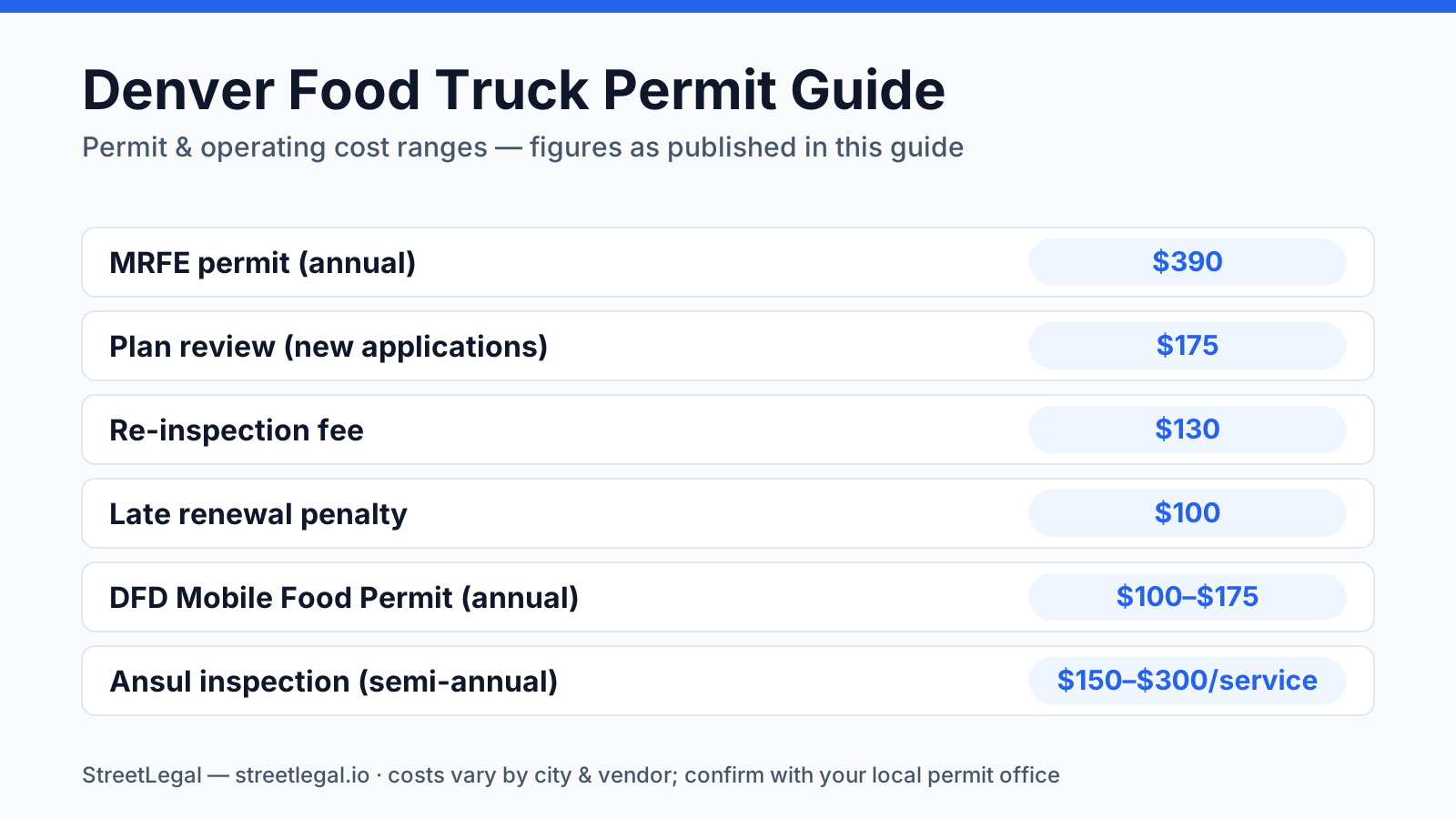
MRFE Permit Costs
| Fee Item | Cost |
|---|---|
| MRFE permit (annual) | $390 |
| Plan review (new applications) | $175 |
| Re-inspection fee | $130 |
| Late renewal penalty | $100 |
Permit year: MRFE permits expire December 31 each year. If you start in October, you still pay the full year's fee — but your permit only covers Oct–Dec. Renewal for the next year is due by January 1 (or before operations resume).
Denver Fire Department Permit
Any food truck that uses open flame, LP gas, or frying equipment needs a Denver Fire Department (DFD) permit. This is separate from the health permit.
- DFD inspection — Inspector checks propane connections, suppression system, fire extinguisher, and ventilation
- Ansul or equivalent suppression system — Required if you have fryers or high-heat cooking equipment
- Type I hood — Required over all cooking equipment producing grease-laden vapors
- LP gas compliance — Denver is strict about propane; tanks must be properly secured and regulators inspected
- Annual Ansul service — Required every 6 months for most systems (annual in some cases)
Denver Fire Permit Costs
| Item | Cost |
|---|---|
| DFD Mobile Food Permit (annual) | $100–$175 |
| Ansul inspection (semi-annual) | $150–$300/service |
| Fire extinguisher annual inspection | $25–$50 |
Denver Business License & Sales Tax
You'll also need:
- Denver Business License — $100–$200 depending on entity type; required before you can operate commercially in the city
- Colorado Sales Tax License — Free from the Colorado Department of Revenue; required to collect and remit sales tax
- Denver Occupational Privilege Tax — Denver has a local "head tax" of $5.75/month per employee; applies to your staff
- Colorado LLC or corporation filing — ~$50 Colorado Secretary of State filing fee (very low compared to other states)
Commissary Kitchen Requirements in Denver
Denver EHD requires all food trucks to operate from an approved commissary. The commissary must:
- Hold a valid Denver or CDPHE retail food establishment permit
- Have a 3-compartment sink accessible to your operation
- Provide fresh water filling and wastewater dump stations
- Have adequate refrigeration and dry storage for your operation
- Have your commissary agreement on file with Denver EHD
Denver Commissary Cost Ranges
| Type | Monthly Cost |
|---|---|
| Basic water/dump/storage access | $250–$500/mo |
| Shared prep kitchen (daytime hours) | $600–$1,200/mo |
| Premium commissary with storage locker | $1,000–$1,800/mo |
| Restaurant commissary partnership | $400–$900/mo |
Denver tip: Denver has several food truck-specific commissary hubs (kitchen incubators like Pilotworks-era facilities). These are ideal because they're designed for mobile operators, have truck bays, and understand the EHD requirements. Search for "commercial kitchen rental Denver" to find current options.
Where Can You Park & Vend?
Denver has a relatively permissive approach to food truck parking compared to many large cities:
- Private property — Best option. Breweries, office parks, apartment complexes, parking lots, and event venues. Get written permission from the property owner.
- Denver Larimer Square / 16th Street Mall — Popular area with specific vendor agreements managed by property owners
- RiNo (River North Art District) — Food truck-friendly neighborhood; several established spots near breweries
- City park events — Denver Parks & Recreation permits required; competitive for popular events
- Public streets — Allowed in designated zones, must maintain 15-foot setback from building entrances, 50-foot clearance from existing food establishments
- Farmers markets — Require market coordinator approval + your MRFE permit
Denver Setback Rules (Important)
Denver's Street Use & Access regulations require:
- Minimum 15 feet from building entrances
- Minimum 50 feet from brick-and-mortar food establishment entrances (unless property owner agrees)
- No blocking fire hydrants, crosswalks, or accessibility ramps
- Maintain ADA-compliant 5-foot pedestrian pathway at all times
The Altitude Factor: Denver-Specific Equipment Notes
Denver's elevation (5,280 ft — exactly one mile above sea level) genuinely affects your food truck operation in ways operators from other cities don't expect:
- Boiling point — Water boils at ~202°F instead of 212°F. Steam tables, sanitizing rinse temps, and cooking times all need adjustment. The EHD inspector knows this and will verify your equipment is calibrated correctly.
- Propane — LP gas appliances operate less efficiently at altitude. Burners may need altitude-adjusted orifices (usually done at the manufacturer level but verify with your equipment dealer).
- Deep fryers — Food cooks slightly differently at altitude due to moisture/boiling effects. Expect to adjust cooking times.
- Refrigeration — AC-cooled equipment works fine; just ensure your compressor is rated for high-altitude operation (most commercial equipment is).
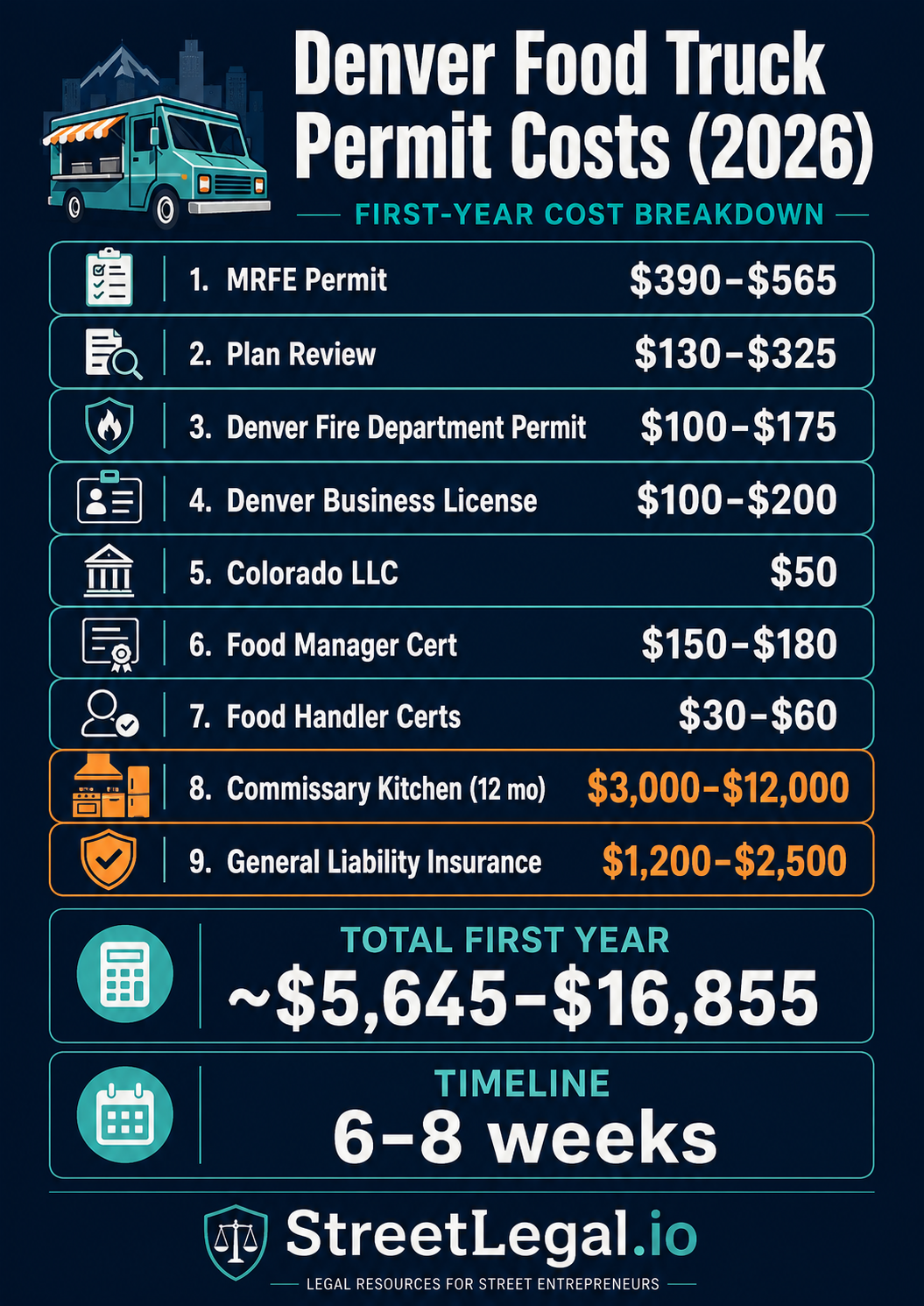
Full Denver Food Truck Cost Breakdown
| Item | Low | High |
|---|---|---|
| MRFE Permit (annual) | $390 | $565 |
| EHD plan review (first year) | $175 | $175 |
| Denver Fire Department Permit | $100 | $175 |
| Ansul inspection (semi-annual ×2) | $300 | $600 |
| Denver Business License | $100 | $200 |
| Colorado LLC registration | $50 | $50 |
| Colorado Sales Tax License | $0 | $0 |
| Food Manager certification (ServSafe) | $150 | $180 |
| Food Handler certs (avg 2 employees) | $30 | $60 |
| Commissary kitchen (annual) | $3,000 | $12,000 |
| General liability insurance (annual) | $1,200 | $2,500 |
| Vehicle registration | $150 | $350 |
| TOTAL (first year) | $5,645 | $16,855 |
Lower end assumes shared commissary, basic fire setup, single employee.
Denver Permitting Timeline
- Week 1: Register Colorado LLC (~$50, online, fast); get EIN; Colorado Sales Tax License
- Week 1–2: Find and sign commissary agreement (start here — commissaries book up)
- Week 2–3: Complete Food Manager certification + food handler certs
- Week 3–4: Submit MRFE application to Denver EHD with commissary paperwork
- Week 4–5: Truck inspection scheduled by EHD; Fire Department inspection if applicable
- Week 6–8: Permits issued; get Denver Business License; begin operations
Best-case: 5–6 weeks. Realistic average: 7–10 weeks if there are inspection delays or equipment issues found during the inspection.
5 Denver-Specific Tips
- Apply before December if possible. MRFE permits expire December 31. If you get your permit in November, you'll pay full price but only operate for 2 months before needing to renew. Aim to open in January–September to get maximum value from your first permit year.
- RiNo is your playground. River North Art District has a strong food truck culture, supportive brewery neighbors, and hungry pedestrian traffic. It's the best neighborhood to establish your initial rotation.
- Get the altitude calibration right on your equipment. This is the #1 thing new-to-Denver operators overlook. Your fryer timer, your steam table temps, your sanitizer dispenser — all need to be verified for 5,280 ft. An EHD inspector will ask about this.
- Snowstorm season (Oct–April) affects revenue significantly. Unlike Houston or Austin, Denver has real winter. Most successful Denver food trucks have indoor revenue strategies or catering contracts for Q4–Q1. Plan your cash flow accordingly.
- Farmers markets are gold, but book early. The Boulder Farmers Market, Denver Farmers Market (Union Station), and several neighborhood markets welcome food trucks — but spots are filled months in advance. Apply to markets 3–6 months before the season opens (usually May).
Official Denver Resources
- Denver Environmental Health (EHD)
- Denver Fire Department
- Colorado Sales Tax License
- Colorado Secretary of State — Business Registration
Questions about Denver food truck permitting? Ask our team — we're building out Denver-specific AI support for 2026.
Related City Guides
People also ask about Denver food truck permits
How much does a food truck permit cost in Denver?
How long does it take to get a food truck permit in Denver?
Do I need a commissary kitchen to operate a food truck in Denver?
What documents do I need for a Denver food truck permit?
Answers to the most common permit questions — costs, timelines, commissary rules, and more.
Find city-level permit guides for every state we cover — compare costs and requirements.
More from the blog
Jefferson County, MO Food Truck Permit Guide
Complete guide to food truck permits, fees, and requirements in Jefferson County, MO.
City GuidesSt. Charles County, MO Food Truck Permit Guide
Complete guide to food truck permits, fees, and requirements in St. Charles County, MO.
City GuidesSt. Louis County, MO Food Truck Permit Guide
Complete guide to food truck permits, fees, and requirements in St. Louis County, MO.
Buyer's GuideFood Truck POS Systems 2026: Square, Toast, Clover & Avocado
Compare 2026 food truck POS systems by pricing, hardware costs, offline mode, and contract terms for Square, Toast, Clover, and Avocado.