· Updated · 11 min read · Gibby, StreetLegal Editorial
Houston Food Truck Permit Guide 2026: DSHS, Fire, Costs
Houston has one of the most vibrant food truck scenes in the United States — over 1,200 registered mobile food vendors operate across Harris County. But the permit path changed on July 1, 2026: annual mobile food vendor licensing now runs through Texas DSHS, while Houston and Harris County still matter for local inspection, fire, CPF/commissary, parking, and event rules.
This guide covers everything operators are searching for now: Texas DSHS MFV license types and fees, the Houston inspection path, Harris County considerations, Houston Fire Department requirements, CPF/commissary rules, where you can actually park, and the full first-year cost so there are no surprises.
Before you file, use the checklist below alongside StreetLegal's Dallas food truck permit guide, Austin food truck permit guide, and the statewide Texas commissary requirements overview. Houston's fastest path is usually to secure the commissary/CPF agreement first, confirm your DSHS MFV type, schedule fire inspection, then line up Houston food truck events only after the inspection dates are realistic.
Houston permit checklist
- Classify your truck as DSHS MFV Type I, Type II, or Type III based on prep and cooking activity.
- Get a written CPF/commissary agreement before scheduling inspections.
- Keep Texas sales tax registration, food handler cards, menu, vehicle specs, and commissary paperwork in one packet.
- Schedule Houston Fire Department review early if you use propane, fryers, grills, suppression equipment, or generators.
July 2026 Texas licensing update
Beginning July 1, 2026, Texas DSHS licenses mobile food vendors statewide under Chapter 226. Houston says City mobile food unit permits/medallions are no longer valid after June 2026, but local inspection, fire, CPF/servicing, and parking rules still apply. Verify your filing with DSHS and schedule the local inspection path before operating. See the full breakdown of what changed and why.
The Houston Food Truck Licensing Landscape
Houston is the fourth-largest city in the US and it operates without traditional zoning laws — which sounds like a food truck paradise. And in some ways, it is. But the licensing map changed in July 2026. The annual food-vendor license is now statewide through Texas DSHS, while inspection and operating compliance still touch local Houston and Harris County agencies.
- Texas DSHS (TXDSHS) — Statewide Mobile Food Vendor license for Texas food vending vehicles
- City of Houston Health Department (COHD) — Local inspection scheduling, CPF/servicing rules, and Houston health operations
- Harris County Public Health (HCPH) — Local inspection support and rules for unincorporated Harris County
- Houston Fire Department — Fire safety inspections for propane/cooking equipment
The good news: Houston does not have a New York-style permit cap. The hard part is sequencing the DSHS application, pre-licensing inspection, fire inspection, CPF/servicing proof, and operating-site permissions without losing weeks to a missing document.
What Licenses Do You Actually Need in Houston After July 1, 2026?
| License / Permit | Issuing Authority | Fee | Renewal |
|---|---|---|---|
| Texas DSHS Mobile Food Vendor License | Texas DSHS | $309 Type I; $1,018 Type II; $1,376 Type III | Annually |
| Houston / Harris County Pre-Licensing Inspection | Local agency acting for DSHS | Included above for Type II/III pre-licensing fee | Before license issuance |
| Texas Food Handler Certification | TXDSHS-accredited provider | $15–$30 per person | Every 2 years |
| Houston Fire Code Certificate | Houston Fire Department | $89–$194 | Annually |
| Texas Sales Tax Permit | Texas Comptroller | Free | Permanent (file returns) |
| Business Entity Registration (if LLC/Corp) | Texas Secretary of State | $300 (LLC) | Annual franchise tax report |
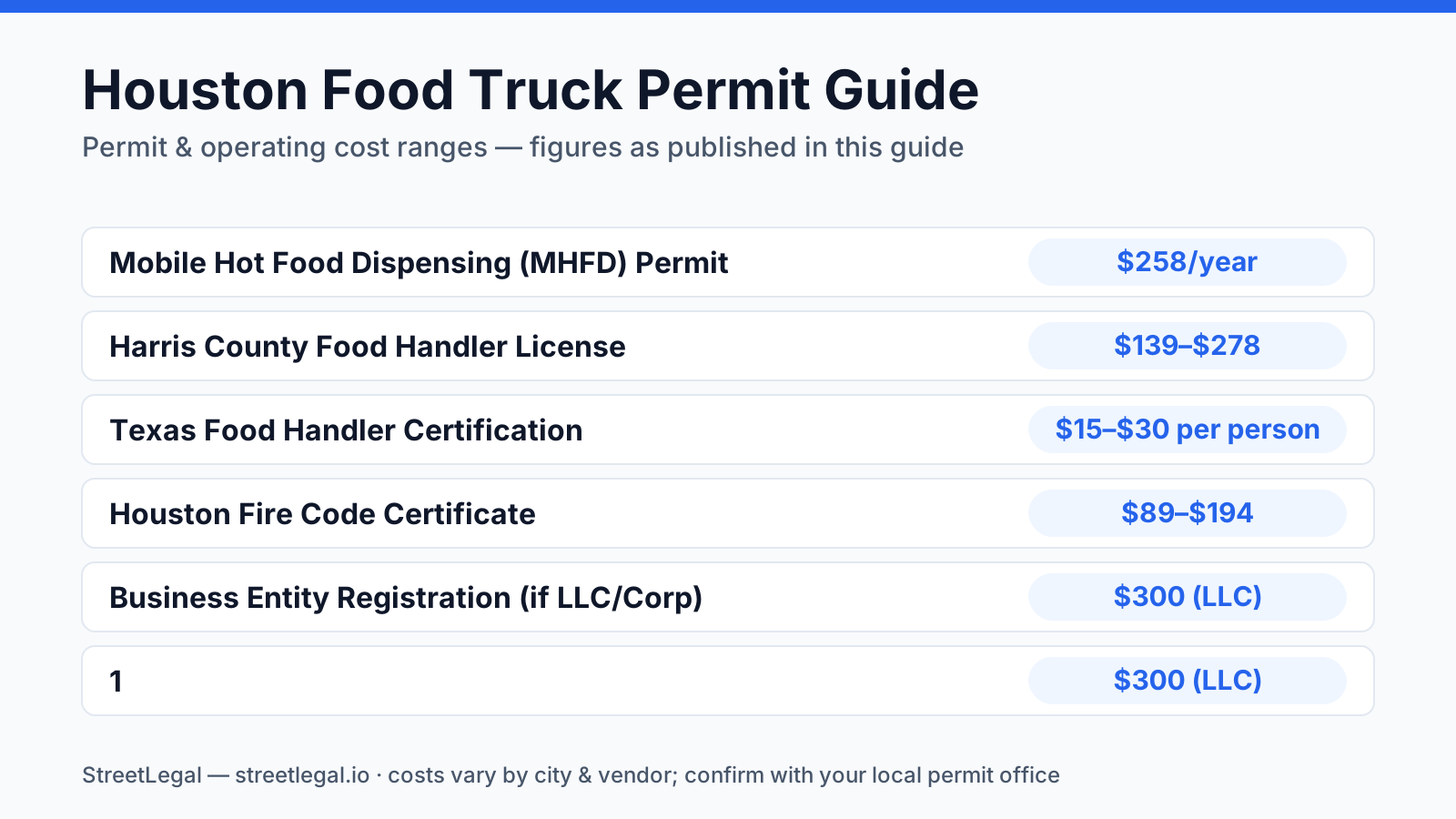
Houston Permit Snapshot: Sequence & Timeline (2026)
Houston's permit stack involves multiple agencies. The order matters — you cannot apply for the MHFD until the commissary agreement and fire clearance are in place. Use this table to plan your sequencing:
| Step | Agency | Permit / Action | Fee | Timeline |
|---|---|---|---|---|
| 1 | Texas Secretary of State | LLC / Business Entity Registration | $300 (LLC) | 1–5 business days |
| 2 | Texas Comptroller | Sales & Use Tax Permit | Free | 2–3 days online |
| 3 | TXDSHS-accredited provider | Texas Food Handler Certification | $15–$30/person | 1–2 days |
| 4 | Private commissary | Commissary Agreement (COHD-approved kitchen) | $400–$800/mo | Secure before applying for MHFD |
| 5 | Houston Fire Department (HFD) | Fire Code / Equipment Inspection | $89–$194 | 1–2 weeks scheduling + inspection day |
| 6 | Texas DSHS + local inspection agency | Texas DSHS MFV License | $309–$1,376 by MFV type | 3–8 weeks (application + pre-licensing inspection) |
| 7 | Harris County Public Health (if applicable) | HCPH Mobile Food Unit Permit (outside city limits) | $139–$278 | 2–4 weeks |
Steps 1–3 can run in parallel. Step 4 must be completed before Step 6. Step 5 (HFD inspection) should be scheduled early — inspectors can be 2–3 weeks out during busy periods.
Step 1: The Texas DSHS Mobile Food Vendor License
The MHFD permit is the primary city-level permit required to operate a food truck within Houston city limits. It covers trucks that prepare and serve hot food (as opposed to pre-packaged goods sellers, who fall under different rules).
What You Need to Apply
- Completed MHFD application form (download from COHD website)
- Proof of commissary kitchen agreement (signed letter, not just a name)
- Vehicle VIN, license plate, and proof of ownership or lease
- Current Texas vehicle inspection sticker
- Certified Food Manager certificate (at least one person on the truck)
- Texas food handler certificates for all employees
- Equipment list with manufacturer specs for all cooking equipment
- Three-compartment sink or NSF-certified equivalent documentation
- Proposed operating locations (can be general, e.g., "downtown Houston")
The Inspection Process
After submitting your application and fee, a COHD inspector will schedule a site visit. They'll check:
- Water supply: fresh water tank (minimum 20 gallons), wastewater tank (1.5x the fresh water capacity)
- Handwashing: dedicated handwash sink with hot water supply
- Three-compartment sink: wash, rinse, sanitize — separate from handwash
- Temperature controls: thermometers, hot-holding equipment, refrigeration (41°F or below)
- Food storage: off-floor shelving, covered containers
- Commissary agreement: inspector will verify you have a valid signed agreement
- Pest prevention: no gaps, sealed storage compartments
What COHD Inspectors Actually Check
During the on-site inspection, COHD evaluates your truck from front to back. These are the areas that trip up first-timers most often:
- Dedicated handwashing sink: Required — separate from food prep sinks, with hot/cold water, soap dispenser, and paper towels accessible at all times
- 3-compartment sink: Wash, rinse, sanitize — with drain boards and correct sanitizer concentration (inspector may test it)
- Temperature control: Cold holding ≤41°F, hot holding ≥135°F; inspectors may take spot readings from your holding units
- Current commissary agreement on the truck: Signed, with COHD permit number — not at home, on the truck
- Water system capacity: Fresh water tank minimum 20–30 gallons for full-service; wastewater tank must be ≥15% larger than fresh
- Food storage: All food 6 inches off floor, covered, labeled with date, FIFO organized
- Menu-to-equipment match: Inspectors verify your equipment can safely produce every item on your submitted menu — don't list raw proteins if you lack the prep surfaces for them
Bring Everything to the Inspection
Bring your commissary agreement, food handler certs, manager cert, and vehicle registration even if not explicitly requested. Inspectors can only evaluate what they see, and missing documentation is a common cause of re-inspection delays.
💡 Pro Tip: Schedule Early
COHD inspection slots fill up 2–3 weeks out, especially in spring. Submit your application and schedule the inspection immediately. Don't wait until your equipment is "perfect" — you can reschedule if needed, but you can't recover a 3-week wait.
Step 2: The Commissary Requirement
Houston requires every food truck to have a licensed commissary kitchen. This is where you prep food before hitting the road, clean and sanitize equipment, and dump wastewater at the end of each day. Without a signed commissary agreement, your MHFD application will not be approved.
What the Agreement Must Include
- Name and address of the commissary kitchen
- Kitchen's City of Houston or Harris County food facility permit number
- Signed by both the kitchen owner and food truck operator
- Statement of access hours and frequency of use
- Confirmation that wastewater disposal facilities are available
Houston Commissary Kitchen Costs
Houston has one of the most competitive commissary kitchen markets in the country, with 60+ licensed commissary kitchens across the metro area:
- Storage-only access: $200–$400/month
- Hourly kitchen rental: $15–$25/hour (minimum 20 hrs/month at most facilities)
- Monthly unlimited membership: $450–$900/month
- Dedicated locker storage: $50–$100/month add-on
Step 3: Houston Fire Department Inspection
If your truck uses any open flame cooking (propane, natural gas, or solid fuel), you need a Houston Fire Code Certificate of Compliance before your MHFD permit can be finalized. The HFD inspects:
- Type I hood and suppression system: Required for any cooking that produces grease-laden vapors (fryers, grills, griddles, woks)
- Propane system: Must comply with NFPA 58; shutoff valve, regulator, and secured tanks
- Fire extinguisher: Minimum K-class (wet chemical) for commercial kitchen; 2A:10B:C for general
- Gas connectors: Flexible connectors no longer than 6 feet; no hidden connections
- Ansul system: Tagged and inspected within the last 6 months
⚠️ Ansul System Required
Most Houston food trucks fail their initial fire inspection because their Ansul (fire suppression) system hasn't been professionally serviced. Budget $150–$350 for a certified inspection and tag. This is non-negotiable.
Operating in Harris County (Outside Houston City Limits)
If you operate in unincorporated Harris County (outside Houston city limits but still within the county), you need a separate Harris County Public Health (HCPH) mobile food unit permit instead of (or in addition to) the City of Houston permit.
HCPH uses a tiered fee system based on volume and risk level:
| Category | Description | Annual Fee |
|---|---|---|
| Mobile Unit — Limited | Pre-packaged foods only, no on-site cooking | $139 |
| Mobile Unit — Standard | Hot food preparation, standard menu | $185 |
| Mobile Unit — Complex | Full-service menu, multiple cooking methods | $278 |
Where Can You Park in Houston?
Houston's lack of traditional zoning is a double-edged sword. On paper, you can operate most anywhere. In practice, you need to navigate property owner permissions, deed restrictions, and neighborhood restrictions:
Legal Parking Locations
- Private lots with owner permission: Most food trucks operate from parking lots of apartments, office buildings, churches, and gyms. Always get written permission.
- Food truck parks: Houston has 20+ dedicated food truck parks (Eado Food Truck Park, Ella Blvd Food Truck Park, etc.) — these handle permits collectively and typically charge 15–20% of daily sales or a flat $50–$150/day fee.
- Special events: Permitted events like festivals, farmers markets, and corporate events — excellent revenue but require event organizer permits too.
- Downtown sidewalks: Allowed with a City of Houston sidewalk vending permit (separate permit, $100/year, zone restrictions apply).
What to Avoid
- Municipal Utility Districts (MUDs) often have their own rules — check before operating in suburban Houston
- Areas with deed restrictions prohibiting commercial activity (common in older Houston neighborhoods)
- Within 300 feet of a school during school hours without special permit
- Public rights-of-way without a special encroachment permit
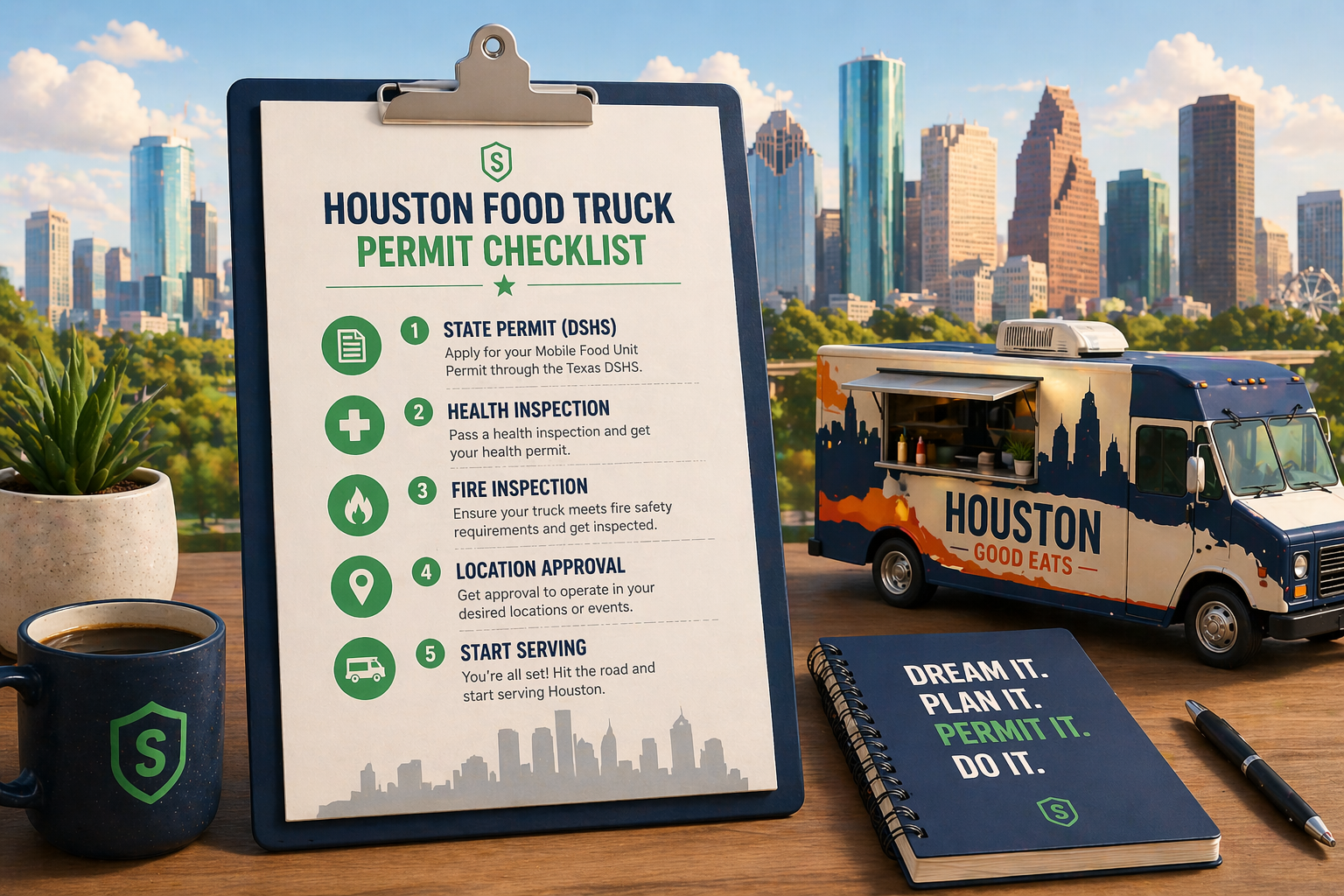
Most Common Houston MHFD Application Mistakes
COHD delays or rejects a significant share of applications for preventable reasons. These are the five that come up most:
Commissary agreement is missing required fields
Must include the commissary kitchen's COHD permit number, be signed by both parties, and specify access hours. A simple lease or informal letter won't pass review.
Ansul system not serviced before fire inspection
The most common fire inspection fail. The suppression system must be tagged by a certified technician within the last 6 months. Book this service before you even submit your MHFD application.
Menu doesn't match truck equipment
Listing raw proteins without adequate prep surfaces triggers a conditional fail. Only submit a menu your current equipment setup can fully support.
Using city MHFD when primary location is in unincorporated Harris County
If you primarily operate in Katy, Pasadena, Sugar Land, or unincorporated Harris County, you need the HCPH permit — not (or in addition to) the Houston city MHFD. Know your jurisdiction before you apply.
Undersized water system
Fresh water tanks under 20 gallons are frequently flagged for full-service operations. Wastewater tanks must be at least 15% larger than fresh water capacity. Get actual measurements before inspection day.
Full First-Year Cost Breakdown
| Cost Item | Low | High | Notes |
|---|---|---|---|
| Texas DSHS MFV license + pre-licensing fee | $309 | $1,376 | Type I low-risk to Type III cooking truck |
| Fire Code Certificate | $89 | $194 | Based on equipment |
| Ansul System Service | $150 | $350 | Required before fire inspection |
| Food Handler Certs (3 staff) | $45 | $90 | $15–$30 per person |
| Certified Food Manager Cert | $80 | $180 | ServSafe or equivalent |
| Commissary Kitchen (12 months) | $2,400 | $10,800 | $200–$900/month depending on usage |
| Business Registration (LLC) | $300 | $300 | TX SOS filing fee |
| Vehicle Inspection | $12 | $40 | Annual TX inspection sticker |
| Commercial Insurance | $1,800 | $3,600 | GL + vehicle + product liability |
| Total First Year | ~$5,134 | ~$15,812 | Varies widely by commissary choice |
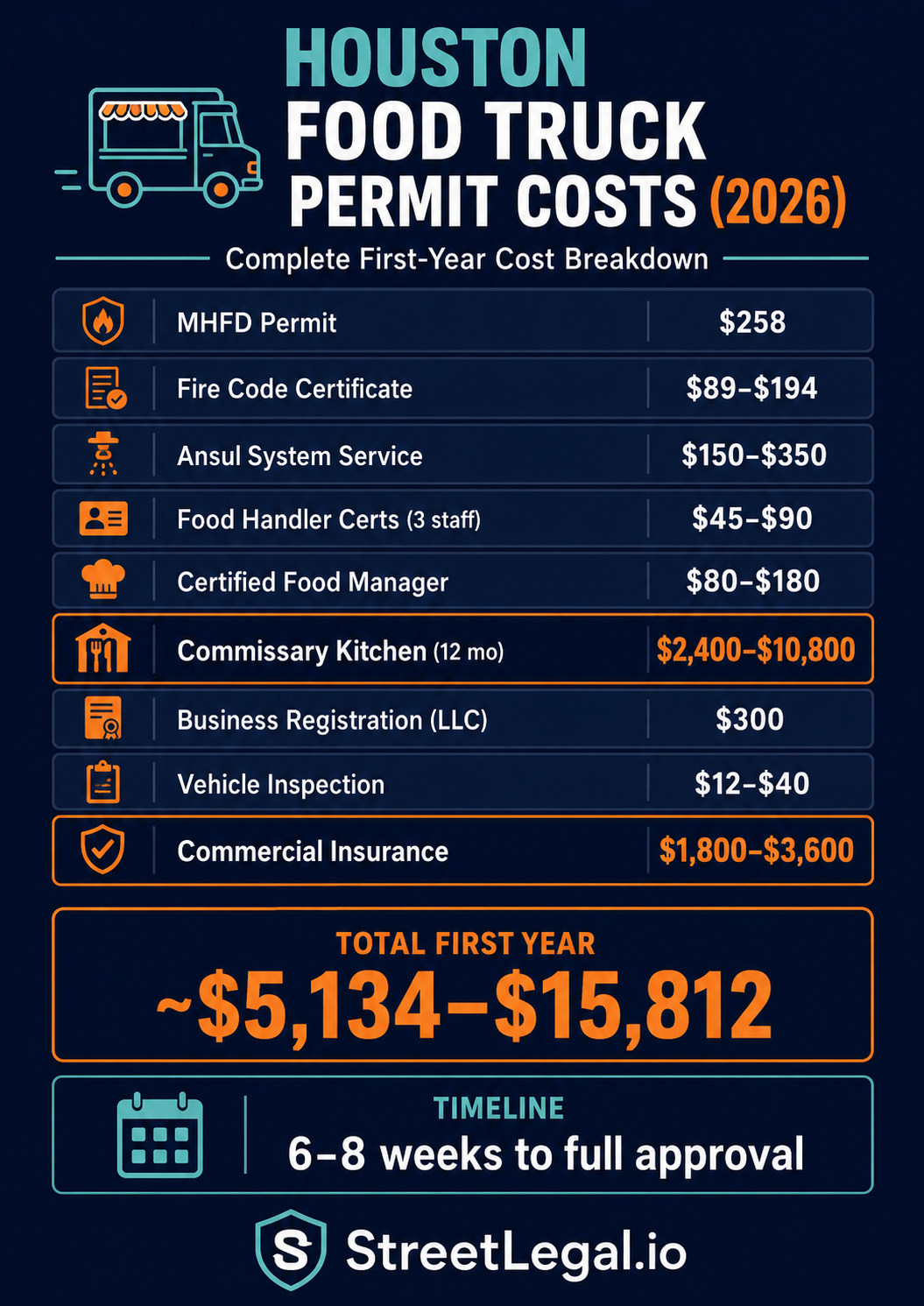
Realistic Timeline to Launch in Houston
Week 1–2: Formation & Food Safety
File LLC with TX SOS ($300). Get your Texas Sales Tax permit (free, online, immediate). Everyone on the truck gets food handler certified ($15–30 each). At least one person gets Certified Food Manager (ServSafe, NRFSP, or Prometric — $80–180).
Week 2–3: Commissary Agreement
Find a licensed commissary kitchen, tour the facility, sign an agreement. Get a copy of their COHD/HCPH permit number for your application.
Week 3: Fire & Equipment Prep
Have Ansul system professionally serviced ($150–350). Gather equipment specs. Submit MHFD application and schedule fire inspection simultaneously.
Week 4–6: Inspections
COHD site inspection (bring all documentation). Houston Fire Department inspection. Allow 1–2 weeks for each — schedule both as soon as application is submitted.
Week 6–8: Licensed to Operate
Both inspections pass, permits issued, insurance active. You're legal. Find your first location and start building your customer base.
5 Houston-Specific Tips Most Guides Miss
1. Check the Food Truck Park Before Committing
Houston's dedicated food truck parks vary wildly in quality and traffic. Visit during lunch rush before signing a contract. Parks with 20+ trucks often feel chaotic and split the customer base. Smaller parks (5–10 trucks) in office districts often have better economics per truck.
2. Hurricane Season = Insurance Review
Houston gets hurricanes. Your standard food truck insurance may not cover flood damage, wind damage to equipment, or business interruption. Ask your broker specifically about Named Storm coverage before June 1 each year.
3. Harris County vs. City of Houston: You May Need Both
If you operate in both the city and the unincorporated county areas, you technically need both the MHFD permit AND the Harris County permit. Many operators get only one and then get fined. Know exactly which jurisdictions you'll operate in before choosing.
4. Deed Restrictions Are the Hidden Trap
Houston's lack of zoning means deed restrictions (private contracts in property deeds) do the work instead. Many older Houston neighborhoods have deed restrictions that prohibit commercial food service. Before securing a lot for regular service, have the property owner check their deed restrictions or consult a TX real estate attorney.
5. Heat Is a Real Food Safety Factor
Houston summers hit 95-100°F+ for weeks. Hot days stress refrigeration systems and accelerate bacterial growth. Inspectors will check your cold-holding temps more rigorously in summer. Pre-chill ingredients more aggressively and have backup refrigeration if your primary unit is showing age.
Renewals: What to Track
Houston permits renew annually. The MHFD permit and fire code certificate are not automatically renewed — you must proactively reapply and pay fees. Missing your renewal means operating without a valid permit, which can result in fines or shutdown.
- MHFD Permit: Renew 60 days before expiration (COHD recommends early to avoid lapses)
- Fire Code Certificate: Renew annually; Ansul system must be re-inspected each year
- Commissary agreement: If it's a 1-year agreement, mark renewal 30 days out
- Food handler certs: Every 2 years (Texas DSHS requirement)
- Vehicle inspection: Annual TX safety inspection sticker
Houston Food Truck Permit FAQ
Can I operate a food truck in Houston without a commissary kitchen?
How long does it take to get a Houston food truck permit?
Do I need a separate permit for each event I attend?
Is the MHFD permit the same as a Texas Mobile Food Unit permit?
How much does it cost to get a food truck permit in Houston?
Where You Can Actually Operate in Houston (Permit vs. Access Reality)
Getting your MHFD permit is the legal baseline — it does not guarantee a revenue-generating spot. Houston's no-zoning structure means private property owners and event organizers are the real gatekeepers for where you can consistently earn.
| Operating Lane | MHFD Enough? | Access Reality | Best Truck Fit |
|---|---|---|---|
| Food truck parks (Midtown, EaDo, Heights) | Yes (for city-limit parks) | Competitive — waitlists at top parks; negotiate % rent + fees | All types; brick-and-mortar builds preferred by parks |
| Private lot / weekday office lunch | Yes | Negotiate directly with property managers; Galleria and Energy Corridor strong | Fast-service builds, efficient menu execution |
| Public streets / sidewalks | Yes, but very limited | Houston's no-zoning city still restricts street vending — private lot model is primary lane | Small carts or limited setups only |
| Events, festivals, concerts | Yes + event org temporary permit often issued | Strong scene: Rodeo, Discovery Green, stadium events — book 3–6 months out | High-volume trucks, trailers, bbq rigs |
| Brewery / bar partnerships | Yes | Very active in Houston — Heights and Midtown breweries actively recruit food trucks | Ethnic concepts, comfort food, wings |
| Harris County unincorporated suburbs | No — need HCPH permit instead | Katy, Sugar Land, Pearland weekend markets; lower competition than city core | Family-friendly concepts, BBQ, desserts |
Best Food Truck Types for the Houston Market (2026)
Houston's diverse population, strong BBQ culture, no-zoning flexibility, and hot climate create a distinct operating environment. Here's how major truck types perform in this market:
| Truck Type | Houston Market Fit | Commissary Load | Best Operating Lane | Notes |
|---|---|---|---|---|
| BBQ / Smoked Meats Trailer | Excellent | Low (smoker self-contained) | Food truck parks, events, suburban weekends | Houston BBQ culture is strong; trailer setups work well at parks that allow them |
| Tex-Mex / Tacos | Excellent | Moderate | Office lunch, food parks, night markets | Highest demand category; competitive but market is large enough to absorb new entrants |
| International / Ethnic Cuisine | Very Strong | Moderate–High | EaDo, Midtown, Westheimer corridor, night markets | Houston is the most diverse US metro by food culture — Vietnamese, Nigerian, Indian, Thai, Salvadoran all thrive |
| Seafood / Gulf Coast | Strong | High (cold storage requirements) | Events, Bayou area, weekend markets | Gulf Coast proximity means fresh supply lines; higher commissary/storage overhead |
| Desserts / Specialty Drinks | Strong | Low–Moderate | Events, brewery spots, food parks | Hot climate year-round drives strong dessert/cold drink demand |
| Upscale / Chef-Driven | Moderate | High | Food parks, corporate catering, events | Works best in Montrose/Heights/Midtown — Houston diners are adventurous but price-sensitive at street level |
Major Houston Food Truck Parks by Area (2026)
Houston has a strong food truck park culture. These are some of the most established and active locations — useful for new operators evaluating where to anchor their operation. All operators still need a valid MHFD permit regardless of which park they join.
| Area | Notable Parks / Corridors | Best For |
|---|---|---|
| Midtown / Montrose | Eats food truck park (Leeland St), Midtown park lots | Nightlife crowds, lunch office workers |
| East Downtown (EaDo) | Navigation Esplanade area, weekend markets | Weekend foot traffic, sports events |
| The Heights / Garden Oaks | White Oak Music Hall grounds, Heights corridor lots | Evening events, neighborhood lunch |
| Galleria / Westheimer | Westheimer commercial corridor weekday lunch spots | Office district lunch rush |
| Downtown / Theater District | Discovery Green area, permitted lots near convention center | Event catering, convention lunch crowds |
| Katy / Sugar Land (Harris County) | Suburban strip lots, brewery partnerships, weekend markets | Suburban families, weekend markets |
Know Your Jurisdiction Before Signing a Park Contract
Parks within Houston city limits require the MHFD permit from COHD. Parks in unincorporated Harris County (many suburban parks) require the HCPH permit instead. Verify which agency has jurisdiction before you apply — applying to the wrong agency delays your launch.
Houston vs. Other Major Food Truck Cities
Thinking about where to launch? Here's how Houston stacks up:
| City | Main Permit Cost | Timeline | Notable Challenge |
|---|---|---|---|
| Houston, TX | $309–$1,376 DSHS MFV | 3–8 weeks | DSHS transition, local inspection, CPF/fire rules |
| NYC | $200 MFVL + unit permit | Months to years | 10-year permit waitlist |
| Chicago | $1,000 MFD or $2,000 MFP | 8–12 weeks | 200-foot rule from restaurants |
| Los Angeles | $812 LA County permit | 6–10 weeks | 31 separate city jurisdictions in LA County |
| Pittsburgh | ~$400 combined | 4–6 weeks | Hillside terrain parking limits |
Houston is one of the more operator-friendly major cities — reasonable fees, no permit caps, and faster timelines than NYC or Chicago. The dual jurisdiction issue (city vs. county) is manageable if you know about it going in.
🏛️ Official Resources — Verify Current Requirements
- Houston Health Department Mobile Food Units — July 2026 DSHS transition, local inspection, CPF, and fire links
- Harris County Public Health — permits for unincorporated areas outside city limits
- Houston Fire Department — Ansul suppression system requirements and fire inspection
- Texas Comptroller — Sales Tax Permit — required before you start selling
Fees and timelines shown above reflect 2026 figures. Always confirm current requirements before filing.
More Texas & Nearby City Guides
Operating across multiple Texas cities? Each city has its own permit requirements. Here are guides for cities near Houston:
People also ask about Houston food truck permits
How much does a food truck permit cost in Houston?
How long does it take to get a food truck permit in Houston?
Do I need a commissary kitchen to operate a food truck in Houston?
What documents do I need for a Houston food truck permit?
Answers to the most common permit questions — costs, timelines, commissary rules, and more.
Find city-level permit guides for every state we cover — compare costs and requirements.
More from the blog
Jefferson County, MO Food Truck Permit Guide
Complete guide to food truck permits, fees, and requirements in Jefferson County, MO.
City GuidesSt. Charles County, MO Food Truck Permit Guide
Complete guide to food truck permits, fees, and requirements in St. Charles County, MO.
City GuidesSt. Louis County, MO Food Truck Permit Guide
Complete guide to food truck permits, fees, and requirements in St. Louis County, MO.
Buyer's GuideFood Truck POS Systems 2026: Square, Toast, Clover & Avocado
Compare 2026 food truck POS systems by pricing, hardware costs, offline mode, and contract terms for Square, Toast, Clover, and Avocado.