· Updated · 12 min read · Gibby, StreetLegal Editorial
How to Start a Food Truck in Dallas–Fort Worth: Complete Permit Guide 2026
Updated June 13, 2026
In This Guide
DFW Food Truck Permitting Overview
Dallas–Fort Worth is a dream market for food truck operators: year-round warm weather, a massive young population, thriving brewery and entertainment districts, and a city government that's generally supportive of street food. However, DFW's sprawling metro means you'll likely operate across multiple jurisdictions — each with its own permit requirements.
The most important thing to understand upfront: your permits depend on where you operate, not just where you're based. A permit from the City of Dallas doesn't let you operate in Fort Worth, Plano, Arlington, or other DFW cities. Many operators get permits in two or three cities simultaneously.
City of Dallas: Mobile Food Establishment (MFE) Permit
If you want to operate a food truck in the City of Dallas, you need a Mobile Food Establishment (MFE) permit from the Dallas Environmental & Health Services Department.
Requirements for MFE Permit
- Commissary agreement — Required. You must operate from a licensed commissary kitchen. The commissary must be approved by Dallas Environmental & Health.
- Vehicle inspection — Dallas health inspector will visit and inspect your truck
- Equipment compliance — Must meet Texas Department of State Health Services (DSHS) standards
- Texas Food Handler certification — All food handlers must be certified
- Food Manager certification — At least one certified Food Protection Manager on staff (ServSafe or equivalent)
- Fire extinguisher — Properly sized and within inspection date
- Grease trap — Required for high-grease operations (burgers, fries, etc.)
Dallas MFE Permit Costs
| Fee Item | Cost |
|---|---|
| MFE Permit (annual) | $300–$450 depending on unit type |
| Late renewal penalty | $75 |
| Re-inspection fee (if failed) | $100 |
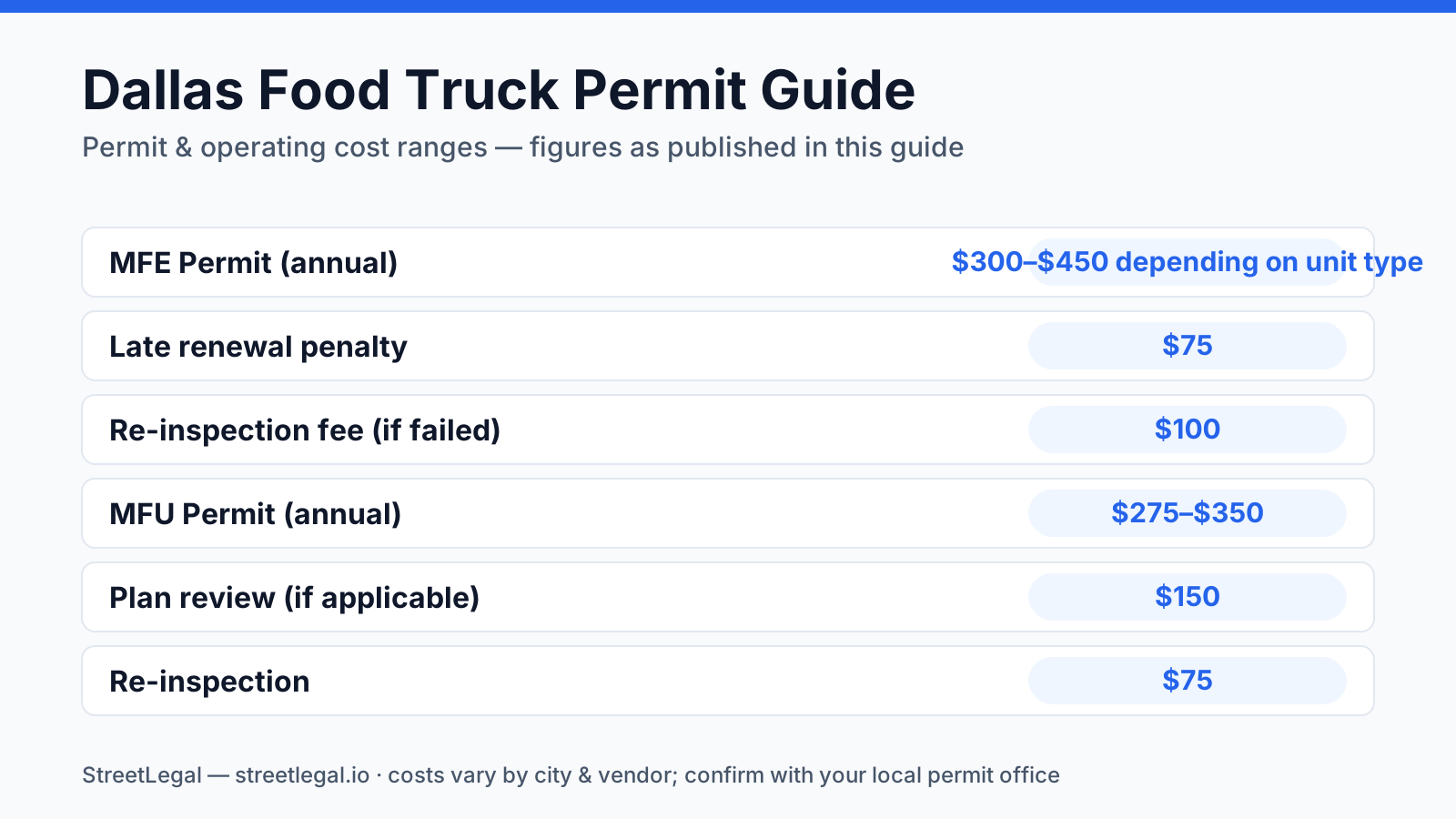
Key timeline: Allow 4–6 weeks for the initial inspection and permit issuance. Renewals are annual and must be completed before the expiration date or you'll pay a late fee and risk being shut down.
City of Fort Worth: Mobile Food Unit (MFU) Permit
Fort Worth uses a similar but separate permitting system through the Fort Worth Public Health Department. The permit is called a Mobile Food Unit (MFU) permit.
Fort Worth MFU Requirements
- Commissary agreement — Required. Must be a Fort Worth-approved commissary or one the city has reviewed
- Pre-operation inspection — Public health inspector visits your unit before issuing the permit
- Texas Food Handler certs — Same state requirement as Dallas
- Food Manager certification — Required for the operator
- Approved water source — Must have approved fresh water supply and wastewater holding
Fort Worth MFU Permit Costs
| Fee Item | Cost |
|---|---|
| MFU Permit (annual) | $275–$350 |
| Plan review (if applicable) | $150 |
| Re-inspection | $75 |
Dallas County & Tarrant County Health Permits
Here's where it gets complicated: if you operate outside city limits but within the county, you need a county health permit instead of a city permit. This applies to many suburban locations — industrial parks, private events, farmers markets in unincorporated areas.
- Dallas County Environmental Health: Permit fee $250/year; food handler and manager certs required
- Tarrant County Public Health: Permit fee $225/year; same certification requirements
Pro tip: Many DFW food truck operators get both a Dallas city MFE permit AND a Dallas County permit to cover more territory. It adds cost but dramatically expands where you can legally operate.
Fire Marshal Inspection & Ansul System
If your food truck uses a fryer, griddle, open flame, or any cooking equipment with grease accumulation, you'll need a fire suppression system inspection from the city fire marshal.
- Ansul R-102 suppression system — Required for most frying/grilling operations
- Annual inspection and tag — Fire suppression must be inspected every 6 months in Dallas (annually in some suburbs)
- Type I hood — Required over all heat-producing commercial cooking equipment
- Fire extinguisher — K-class for kitchen fires, minimum 2.5-gallon
Fire marshal inspection costs in DFW: $75–$150/year plus ~$300–$600 for the semi-annual Ansul service if you use a company. Many operators pay $400–$800/year in fire safety compliance costs alone.
Business License & Sales Tax
You'll also need:
- City of Dallas (or Fort Worth) Business License — Required to operate commercially; ~$50–$100/year
- Texas Sales Tax Permit — Free to obtain from the Texas Comptroller; required before you sell anything
- LLC or business entity registration — Strongly recommended; Texas Secretary of State filing fee ~$300
- EIN — Free from the IRS
Commissary Kitchen Requirements in DFW
Texas law and DFW city codes require all mobile food units to operate from a licensed commissary kitchen. This is the base where you prep food, clean equipment, dump wastewater, and reload fresh water.
Your commissary must:
- Hold a valid health permit from the relevant city/county
- Have a signed commissary agreement (form from the health department) with your truck as the client
- Be inspected and approved before your MFE/MFU permit is issued
- Provide adequate prep space, hot water, 3-compartment sink, and grease trap access
DFW Commissary Cost Ranges
| Type | Monthly Cost |
|---|---|
| Basic storage + water access | $300–$600/mo |
| Shared prep kitchen (4–6 hrs/day) | $600–$1,200/mo |
| Dedicated commissary agreement | $1,000–$2,500/mo |
| Church/community kitchen (informal) | $200–$500/mo (rare; must be health-permitted) |
Where Can You Actually Park?
This is the biggest challenge for DFW food truck operators. Dallas has nuanced rules about where you can vend:
- Private property — With property owner permission, you can vend on most private lots (parking lots, breweries, events). This is the most common model in DFW.
- Public streets — Heavily restricted. Most Dallas city streets require a Street Vending Permit and you must comply with setback rules (typically 20 feet from any building entrance).
- Parks — Require a Parks Permit from Dallas Parks & Recreation; competitive application process for popular parks.
- Special events — Best opportunity; event permits obtained by the event organizer who sponsors your truck
- Fort Worth Magnolia Ave / Cultural District — Popular food truck zones with established spots
- Deep Ellum / Greenville Ave (Dallas) — High foot traffic areas with mixed enforcement
Avoid this mistake: Don't assume a parking lot means free vending. Many strip mall leases prohibit food trucks due to pressure from anchor restaurants. Always get written permission from the property manager, not just a verbal OK from a security guard.
Operating in DFW Suburbs
The DFW metro is enormous — and each municipality runs its own permit process. If you plan to operate in:
- Plano — Environmental Health permit required; ~$200/year; strict food safety rules
- Arlington — City of Arlington Environmental Services; permit ~$175–$250/year; popular for Rangers/Cowboys events
- Frisco / McKinney — Fast-growing suburbs with food truck-friendly zoning; permits ~$150–$250/year
- Irving / Grand Prairie — Near DFW airport corridor; permits ~$150–$200/year
- Garland / Mesquite — Lower-cost suburban markets; permits ~$100–$175/year
If you want a multi-city DFW operation, budget for 2–4 separate municipal permits, each with its own inspection and fee schedule.
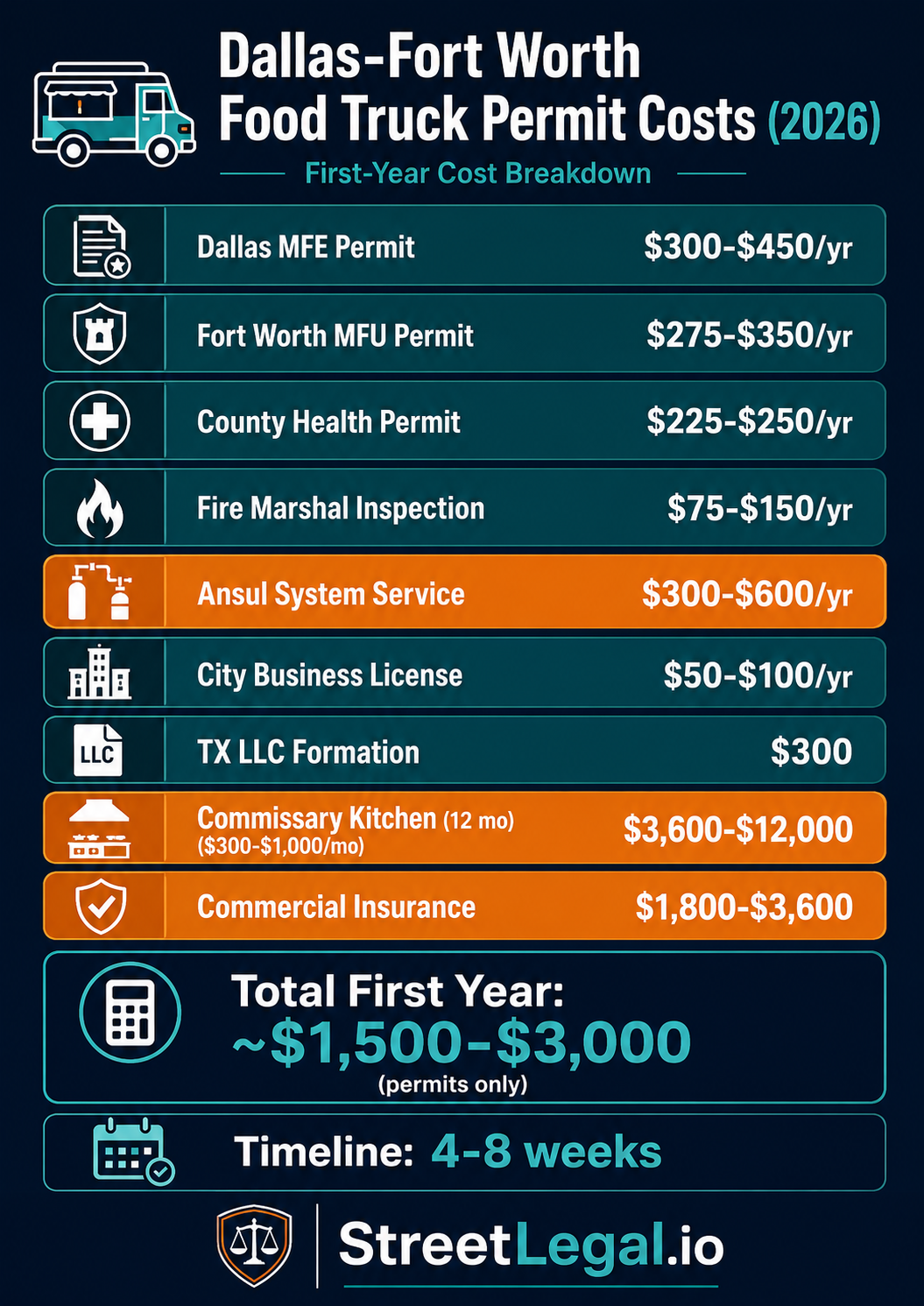
Full DFW Food Truck Cost Breakdown
| Item | Low | High |
|---|---|---|
| Dallas MFE or Fort Worth MFU Permit | $275 | $450 |
| 2nd City Permit (suburbs) | $150 | $275 |
| County health permit | $225 | $250 |
| Fire suppression inspection | $300 | $800 |
| City business license | $50 | $100 |
| Texas LLC registration | $300 | $300 |
| Texas Food Manager cert (ServSafe) | $150 | $180 |
| Food Handler certs (per employee, avg 3) | $45 | $90 |
| Commissary kitchen (annual) | $3,600 | $14,400 |
| General liability insurance (annual) | $1,200 | $2,500 |
| Vehicle registration / tags | $150 | $400 |
| TOTAL (first year) | $6,445 | $19,745 |
Costs vary significantly by commissary type and how many municipalities you operate in.
DFW Permitting Timeline
- Week 1–2: Form LLC, register for Texas Sales Tax Permit, apply for EIN
- Week 2–3: Find and sign commissary agreement (start early — good commissaries fill up)
- Week 3–4: Complete food handler and ServSafe certifications
- Week 4–5: Submit MFE/MFU application with commissary agreement attached
- Week 5–8: Health inspection of your truck scheduled and completed
- Week 6–8: Fire marshal inspection if applicable
- Week 8–10: Permits issued; begin operations
Total: 8–10 weeks from start to first dollar. Can be compressed to 6 weeks if you move fast and the commissary is lined up in advance.
Dallas–Fort Worth permit snapshot
| Layer | Who issues it | Typical cost | Typical timing | Why it matters |
|---|---|---|---|---|
| Dallas MFE permit | City of Dallas Environmental Health | $300–$450 | 4–6 weeks | Core approval if you want Dallas city operations |
| Fort Worth MFU permit | Fort Worth Public Health | $275–$350 | 4–8 weeks | Separate path if you want Fort Worth city operations |
| County permit | Dallas County or Tarrant County | $225–$250 | 2–5 weeks | Important for suburban and unincorporated operating lanes |
| Fire review | Local fire marshal | $75–$150 + suppression service | 1–4 weeks | Critical if you run fryers, grills, or grease-heavy equipment |
| Commissary agreement | Licensed commissary + health reviewer | $300–$2,500/mo | 1–3 weeks | Usually the gate that determines whether your application can move |
| Texas sales tax permit | Texas Comptroller | Free | Usually fast | Required before legal taxable sales |
Best food truck types for Dallas–Fort Worth in 2026
DFW is not one operating model. Dallas often rewards polished private-site and office-lunch execution, while Fort Worth more often rewards community events, brewery nights, and practical repeat locations. That means the right truck build depends on the lane you plan to win first.
| Truck type | Best DFW fit | Why it works | Main watch-out |
|---|---|---|---|
| Mid-size full kitchen truck | Strong across Dallas and Fort Worth | Flexible for office lunch, events, private lots, and broader menus | Higher commissary, generator, and suppression complexity |
| Compact taco / bowl truck | Very strong | Fast service and lower build cost fit brewery and weekday lunch demand well | Can cap ticket size if the menu is too narrow |
| BBQ-focused trailer or truck | Strong in Fort Worth and suburban events | Texas demand is real when smoke, speed, and event logistics are dialed in | Fire, hood, and prep complexity rise fast |
| Dessert / coffee / beverage trailer | Good in selective lanes | Works for office parks, schools, family events, and lower-friction private sites | Usually needs stronger booking volume to hit revenue goals |
| Oversized gourmet truck | Mixed | Can perform at big events and premium bookings | Often overbuilt for the private-lot and repeat-site reality most founders start with |
Where you can actually operate in Dallas–Fort Worth
Permit approval is only part of the DFW launch problem. Real operating access depends on property relationships, event approvals, and matching your build to the venue type.
| Operating lane | Permit alone enough? | Access reality | Best truck fit |
|---|---|---|---|
| Private office lots | No | Property or organizer approval usually matters more than the permit itself | Fast-service branded lunch truck |
| Breweries and taprooms | No | Host relationships, COI requirements, and menu fit drive repeat bookings | Compact savory truck or taco truck |
| Apartment communities | No | Management partnerships and predictable service windows matter | Mid-size truck with broad appeal |
| Festivals and large events | No | Organizer packets, fire tags, and event deadlines are common gatekeepers | Higher-throughput full kitchen truck |
| Public streets | Rarely | Street vending and setback rules make this less reliable than founders expect | Not the best first-lane model |
| Suburban community events | No | Often requires separate suburb permits or county coverage plus host approval | Compact event-flex truck |
Dallas vs Houston vs Fort Worth vs San Antonio: Texas Market Comparison
If you are deciding between Texas markets or expanding across multiple cities, this table compares launch friction, revenue lanes, and truck fit across the strongest Texas markets.
| Market | Launch friction | Best first revenue lane | Best first truck fit | Why this market matters |
|---|---|---|---|---|
| Dallas | Medium | Private office lots, breweries, apartment communities | Mid-size branded lunch truck or compact taco truck | Huge metro, strong private-site demand, multi-jurisdiction expansion potential |
| Houston | Medium-Low | Food truck parks, private property, event circuits | Mid-size truck with broad menu flexibility | Largest Texas city, food truck park infrastructure, diverse neighborhoods |
| Fort Worth | Medium | Breweries, community events, cultural district | Compact savory truck or BBQ trailer | Strong brewery/event culture, practical repeat-location model |
| San Antonio | Low-Medium | Tourist zones, family events, military bases | Tex-Mex or festival-ready truck | Tourism demand, military base access, lower competition than Houston |
| Austin | High | Food truck parks, private lots, festival circuits | Unique concept truck or trailer park anchor | Most competitive Texas market, premium pricing potential, strong trailer park culture |
5 DFW-Specific Tips
- Lock in a commissary before you apply. The permit application requires proof of a commissary agreement. Without it, your application won't move forward. Good commissaries in Dallas/Fort Worth fill up — start looking before you're ready to apply.
- Private property is king in DFW. Breweries, churches, apartment complexes, and corporate campuses all welcome food trucks and provide consistent, stable revenue. Develop relationships with 5–10 spots before you launch.
- Budget for multiple city permits if you want to move around. The DFW metro has 30+ municipalities. If your business model involves chasing events across the region, you'll need permits in multiple cities. Factor this into your annual permit budget.
- Heat is real — prep your truck accordingly. Dallas summers regularly hit 105°F+. Your truck's refrigeration, generator capacity, and staff heat tolerance are operational concerns. A permit doesn't help if your equipment fails at 2 PM on a June Saturday.
- Track renewals across all your jurisdictions. Multi-city operators often miss a renewal somewhere and get hit with fines or temporary shutdown. Use StreetLegal's deadline tracker to manage all permits in one dashboard across Dallas, Fort Worth, and suburbs.
Official DFW Resources
- Dallas Mobile Food Establishment Information
- Fort Worth Public Health
- Dallas County Environmental Health
- Tarrant County Public Health
Questions about DFW food truck permits? Contact our support team — we help operators across Texas navigate multi-city compliance.
Related City Guides
People also ask about Dallas food truck permits
How much does a food truck permit cost in Dallas?
How long does it take to get a food truck permit in Dallas?
Do I need a commissary kitchen to operate a food truck in Dallas?
What documents do I need for a Dallas food truck permit?
Answers to the most common permit questions — costs, timelines, commissary rules, and more.
Find city-level permit guides for every state we cover — compare costs and requirements.
More from the blog
Jefferson County, MO Food Truck Permit Guide
Complete guide to food truck permits, fees, and requirements in Jefferson County, MO.
City GuidesSt. Charles County, MO Food Truck Permit Guide
Complete guide to food truck permits, fees, and requirements in St. Charles County, MO.
City GuidesSt. Louis County, MO Food Truck Permit Guide
Complete guide to food truck permits, fees, and requirements in St. Louis County, MO.
Buyer's GuideFood Truck POS Systems 2026: Square, Toast, Clover & Avocado
Compare 2026 food truck POS systems by pricing, hardware costs, offline mode, and contract terms for Square, Toast, Clover, and Avocado.