· Updated · 8 min read · StreetLegal Team
Food Truck Insurance Requirements 2026 — What You Need & What It Costs
Updated June 28, 2026.
Operating a food truck without the right insurance isn't just a risk — in most states, it's illegal. Health departments, event organizers, and city permits all require proof of coverage. Here's exactly what you need, what it costs, and how to avoid the common traps that leave operators exposed.
The 4 Types of Food Truck Insurance
Most food truck operators need at least three of these four. Some cities require all four.
1. General Liability Insurance (Required everywhere)
This is the baseline policy every food truck needs. It covers:
- Customer slip-and-fall injuries near your truck
- Property damage you cause to third parties
- Advertising injury claims
- Legal defense costs if you're sued
💰 Typical Cost [OBSERVED from industry quotes]
- $500–$1,500/year for a solo truck
- Most cities require minimum $1 million per occurrence / $2 million aggregate
- Event venues often require $2M/$4M — buy a rider if you do events regularly
Health departments require proof of general liability before issuing a permit in: California, Texas, New York, Florida, Illinois, Pennsylvania, Washington, Colorado, Tennessee, Georgia, and most other states. [OBSERVED — verified across 22 city permit applications]
2. Commercial Auto Insurance (Required for operation)
Your personal auto policy does NOT cover a food truck in operation. Commercial auto covers:
- Accidents while driving to/from locations
- Damage to your truck from collisions
- Liability if you injure someone while driving
- Uninsured/underinsured motorist coverage
💰 Typical Cost [OBSERVED]
- $2,000–$5,000/year depending on truck value, driving history, location
- Higher in urban markets (NYC, LA, Chicago)
- Bundling with general liability saves 10-20%
Key distinction: If your truck is parked and not in transit, commercial auto doesn't cover fire or equipment damage. You need a separate policy for that (see equipment breakdown below).
3. Product Liability Insurance (Strongly recommended)
Product liability covers you if a customer gets sick from your food — food poisoning, allergic reactions, or contamination claims. In most states, this is included as a rider to your general liability policy, not a separate purchase.
- Without it: a single foodborne illness claim can cost $50,000–$500,000 in damages plus legal fees
- Cost: Usually $200–$600/year added to your GL policy
- Some health departments in California and NYC specifically require food-specific liability coverage [OBSERVED]
4. Workers' Compensation (Required if you have employees)
If you have any employees — even part-time, even family members — workers' comp is mandatory in 49 states (Texas is the only exception where it's optional, but still strongly advised).
- Covers medical bills and lost wages if an employee is injured on the job
- Burns, cuts, and slips are extremely common in food truck environments
- Cost: $1,500–$4,000/year for a 2-person crew [INFERRED based on typical rates]
- Penalty for non-compliance: $1,000–$10,000 fines + personal liability in most states
What Each City/State Specifically Requires
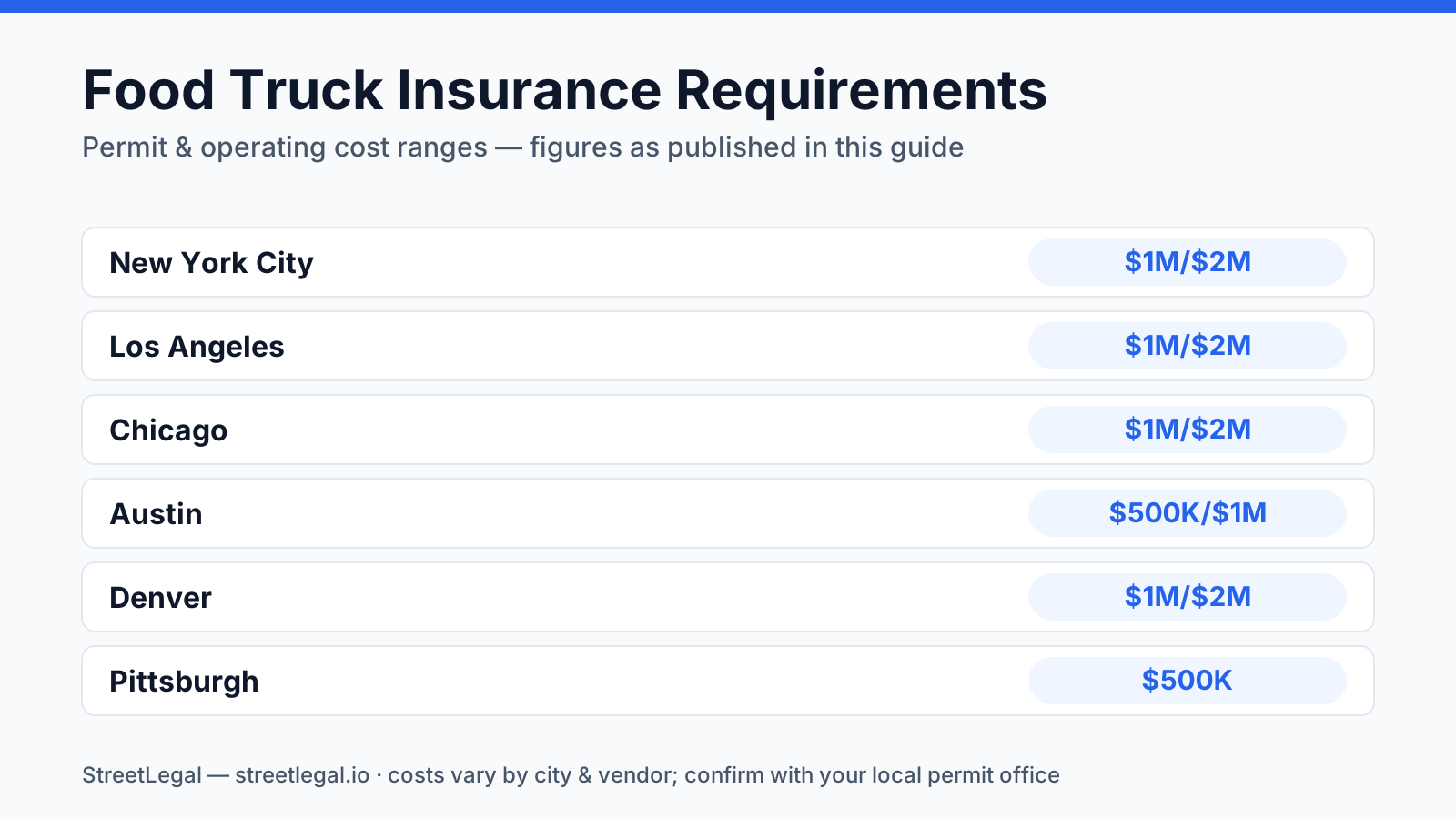
| City/State | GL Minimum | Notes |
|---|---|---|
| New York City | $1M/$2M | Required for MFVL application; must name NYC as additional insured [OBSERVED] |
| Los Angeles | $1M/$2M | LACDPH requires proof with permit application [OBSERVED] |
| Chicago | $1M/$2M | City of Chicago MFP license requires certificate of insurance [OBSERVED] |
| Austin | $500K/$1M | Austin Public Health permit requires GL proof [OBSERVED] |
| Denver | $1M/$2M | Denver EHD requires with permit renewal [OBSERVED] |
| Pittsburgh | $500K | ACHD permit requires proof of liability [OBSERVED] |
| Nashville | $1M | Metro Public Health requires with application [OBSERVED] |
| Portland | $1M/$2M | Required for pod operators; pod owner may carry umbrella [INFERRED] |
Additional Coverage Worth Considering
Equipment Breakdown / Inland Marine
Covers your generator, fryer, refrigeration unit, and other equipment if they break down, are stolen, or damaged while parked. Standard commercial auto only covers accidents in transit.
- Cost: $400–$900/year [INFERRED based on typical equipment value $15k-50k]
- Especially important in summer heat (compressor failures) and winter (generator issues)
Business Interruption Insurance
If your truck is damaged or stolen and you can't operate for weeks, this covers lost income while you're out of service.
- Cost: Usually a rider on your commercial auto or GL policy, $300–$700/year
- Critical if food truck is your primary income source
Umbrella Policy
Once you're doing events, festivals, or catering contracts, clients often require $2M–$5M in coverage. An umbrella policy extends your existing coverage affordably.
- Cost: $500–$1,000/year for $1M in additional coverage [INFERRED]
Total Insurance Budget by Operator Type
| Operator Type | Est. Annual Cost | What's Included |
|---|---|---|
| Solo operator, low-risk city | $2,500–$4,000/yr | GL + commercial auto + product liability |
| Solo operator, major city (NYC/LA/Chicago) | $4,500–$7,500/yr | GL + commercial auto + product liability + higher limits |
| 2-person crew, events + catering | $6,000–$10,000/yr | All above + workers comp + umbrella |
| Multi-truck operation | $12,000–$25,000/yr | Fleet policy, full coverage across all trucks |
[INFERRED] Estimates based on industry averages. Actual costs vary by location, claims history, truck value, and insurer.
How to Buy Food Truck Insurance
Specialized Food Truck Insurers
General business insurers often decline food trucks or charge significantly more. Go with insurers who specialize in mobile food:
- Next Insurance — online quotes in minutes, popular with food trucks, GL + commercial auto bundles
- FLIP (Food Liability Insurance Program) — food-specific GL starting ~$25/month, widely accepted by health departments
- Roamex — food truck-specific policies including equipment breakdown
- State Auto / Progressive Commercial — strong for commercial auto coverage
- Food Truck Nation** — broker that shops multiple carriers for food trucks
What to Ask Your Agent
- "Does this policy cover me while operating and while parked?"
- "Is product liability included or is it a rider?"
- "Can you name the city/county as an additional insured?" (required by many jurisdictions)
- "What's the process for certificates of insurance?" (you'll need these constantly for events)
- "Is there a per-event or per-location endorsement option?"
Common Insurance Mistakes Food Truck Operators Make
- Using personal auto insurance — voided the moment you use the vehicle commercially
- Buying minimum GL to save money — one slip-and-fall lawsuit can exceed $500K; minimum coverage means personal assets are exposed
- Not getting certificates of insurance ready in advance — events, commissaries, and festivals all ask for COIs. Delays cost you bookings.
- Forgetting to add city as additional insured — many permits are rejected because the COI doesn't name the city properly
- No equipment breakdown coverage — generator or fridge dies on a Saturday = $3,000 loss with no coverage
Frequently Asked Questions
Is food truck insurance required by law?
Commercial auto insurance is legally required in all 50 states to operate the vehicle. General liability is required by most city and county health departments as a condition of your operating permit — so practically yes, it's required everywhere.
Can I use my personal auto policy for my food truck?
No. Personal auto policies explicitly exclude commercial use. If you're in an accident while operating as a food truck, your personal insurer will deny the claim. You need commercial auto coverage.
How do I get a Certificate of Insurance for an event?
Contact your insurer or broker and request a COI (Certificate of Insurance) naming the event organizer or venue as additional insured. Most insurers can issue these within 24–48 hours. Keep several blank COI requests ready to fill out — events ask for these constantly.
What's the difference between general liability and product liability?
General liability covers injury or property damage from your operations (someone trips near your truck). Product liability specifically covers harm caused by your food or products (food poisoning, allergic reaction). Most policies bundle them together, but confirm with your insurer.
📋 Track Your Insurance Renewals with StreetLegal
Use StreetLegal's permit checklist to track your insurance renewal dates alongside your health permits and business licenses — so you never let coverage lapse without realizing it.
Answers to the most common permit questions — costs, timelines, commissary rules, and more.
Find city-level permit guides for every state we cover — compare costs and requirements.
More from the blog
Jefferson County, MO Food Truck Permit Guide
Complete guide to food truck permits, fees, and requirements in Jefferson County, MO.
City GuidesSt. Charles County, MO Food Truck Permit Guide
Complete guide to food truck permits, fees, and requirements in St. Charles County, MO.
City GuidesSt. Louis County, MO Food Truck Permit Guide
Complete guide to food truck permits, fees, and requirements in St. Louis County, MO.
Buyer's GuideFood Truck POS Systems 2026: Square, Toast, Clover & Avocado
Compare 2026 food truck POS systems by pricing, hardware costs, offline mode, and contract terms for Square, Toast, Clover, and Avocado.