· 9 min read · StreetLegal Team

Informational only — not legal advice. Confirm requirements with the city before you apply. See our Disclaimer.
How to Start a Food Truck in Charlotte, NC: Complete Permit Guide 2026
Charlotte's food truck scene has grown significantly with the city's broader expansion — but the permitting system is split between multiple agencies that catch first-time operators off guard. This guide covers every permit you need, realistic fees, commissary requirements, and the real rules for where you can set up in the Queen City.
North Carolina Disclaimer
Food truck requirements in Charlotte span both city and county jurisdiction. Mecklenburg County handles health permits; the City of Charlotte handles business and zoning approvals. Always verify current requirements with each agency directly, as fees and rules change.
In This Guide
Use the section headings below to jump through the guide quickly.
The Charlotte Food Truck Licensing Landscape
Operating a food truck in Charlotte means navigating both city and county layers. Charlotte sits mostly in Mecklenburg County, and the county's Environmental Health Department is your first stop — they handle all food establishment inspections and permitting. The city then requires a business license and zoning compliance.
- Mecklenburg County Environmental Health (MCEH) — Food establishment permit and health inspections for all food trucks
- City of Charlotte — Business license/registration and zoning approval for any fixed or regular location
- Charlotte Fire Department — Fire safety inspection for propane and open-flame cooking equipment
- NC Department of Revenue — State sales tax registration
Charlotte does not require food trucks to operate within a fixed geographic zone, but you need zoning compliance for any single location you use regularly. One-off private events and roving operations have more flexibility.
What Licenses Do You Actually Need?
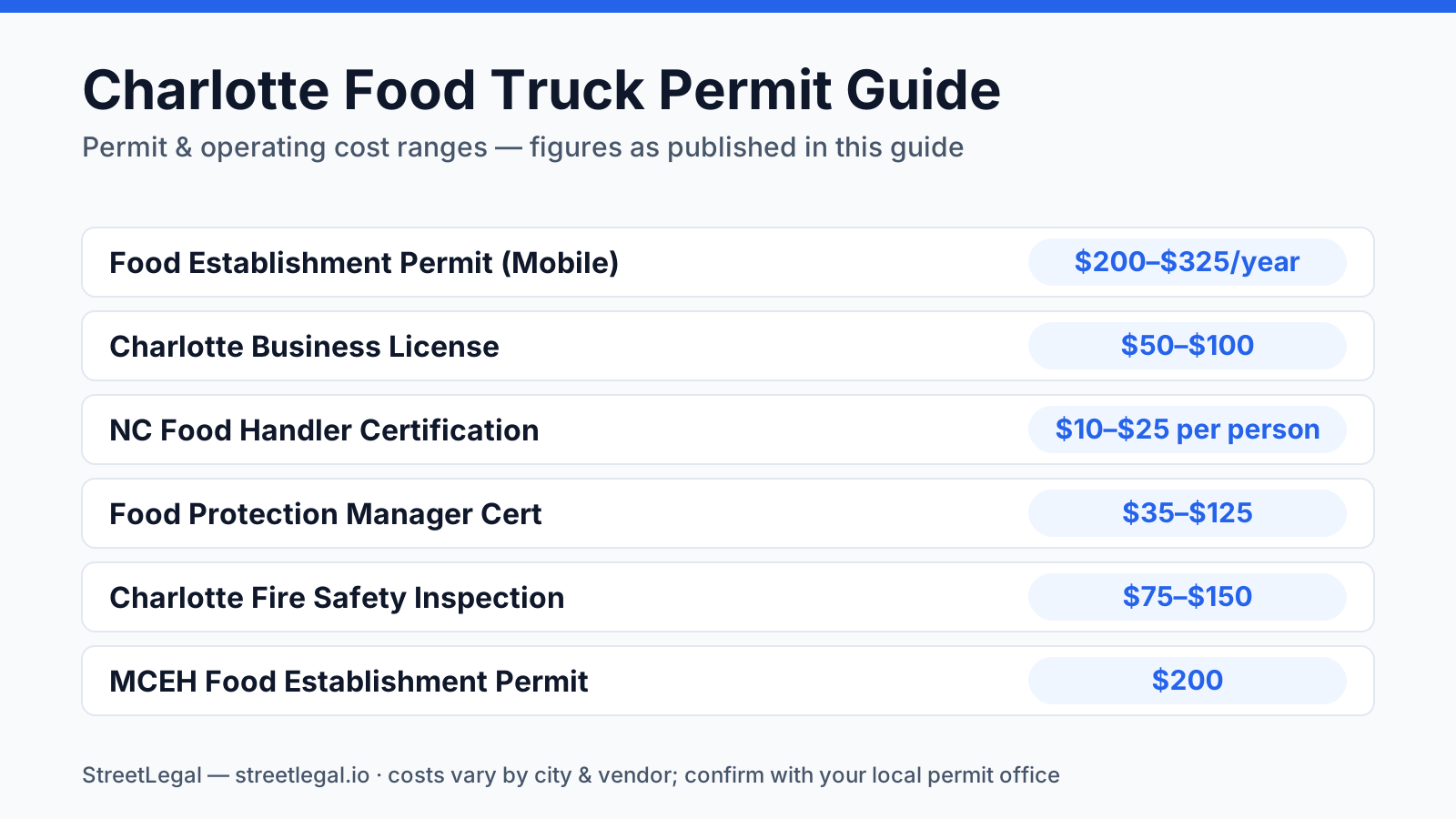
| License / Permit | Issuing Authority | Fee | Renewal |
|---|---|---|---|
| Food Establishment Permit (Mobile) | Mecklenburg County Environmental Health | $200–$325/year | Annually (Jan. 1) |
| Charlotte Business License | City of Charlotte | $50–$100 | Annually |
| NC Food Handler Certification | NCDHHS-approved provider | $10–$25 per person | Every 3 years |
| Food Protection Manager Cert | ANAB-accredited (ServSafe, etc.) | $35–$125 | Every 5 years |
| Charlotte Fire Safety Inspection | Charlotte Fire Department | $75–$150 | Annually (for propane units) |
| NC Sales Tax Registration | NC Department of Revenue | Free | Permanent (file returns) |
Step 1: Get Your Mecklenburg County Food Establishment Permit
This is your primary operating permit. Mecklenburg County Environmental Health classifies mobile food units (MFUs) separately from brick-and-mortar restaurants, but the health standards are the same. Your truck must pass a physical inspection before the permit is issued.
What You Need to Apply
- Completed application (available through Mecklenburg County Environmental Health's online portal)
- Equipment list with manufacturer specifications for all cooking and refrigeration equipment
- Menu — full list of food items you'll prepare and serve
- Commissary kitchen agreement (signed contract with a licensed commissary in Mecklenburg County or an adjacent county)
- Food Protection Manager certificate (at least one person on the truck)
- North Carolina food handler certifications for all employees who handle unpackaged food
The Inspection
After your application is reviewed, an inspector will schedule a physical inspection of your truck. They check handwashing station setup, water supply (potable water tank sizing), wastewater capacity, temperature control, and equipment sanitation. Plan 2–3 weeks for scheduling. If you fail, you'll typically get 10–14 days to correct deficiencies before a re-inspection.
Step 2: Obtain Your Charlotte Business License
Before you can legally operate in Charlotte, you need a business license from the City of Charlotte. This is separate from your Mecklenburg County health permit and must be obtained through the city's business portal.
What You Need
- Registered business entity (LLC or sole proprietorship) — register with the NC Secretary of State if forming an LLC
- Federal Employer Identification Number (EIN) from the IRS — free, takes minutes online
- NC Sales & Use Tax registration with the NC Department of Revenue — free, required before your first sale
- Charlotte business license application submitted through the City of Charlotte's online portal
Business license fee: $50–$100/year
Charlotte business licenses renew annually. Apply before you open — operating without one carries fines. NC sales tax registration is free and permanent; you'll file quarterly returns after that.
If you plan to hire employees, also register for NC withholding tax with the NC Department of Revenue. This step adds a few days but is straightforward.
Step 3: Secure Your Commissary Kitchen
North Carolina requires all mobile food units to operate from a licensed commissary kitchen. The commissary must hold a current Mecklenburg County food establishment permit (or equivalent county permit). Your application is incomplete without a signed commissary agreement.
Commissary requirements in NC
- Must be a licensed food establishment — shared kitchen spaces, restaurant kitchens, or dedicated commissaries all qualify
- Must provide storage space for your truck's supplies and ingredients
- Written commissary agreement is required — verbal arrangements are not accepted
- Commissary must have adequate utilities for cleaning your truck's equipment and disposing of wastewater
Charlotte has a handful of shared commercial kitchens that rent to food truck operators. Expect $250–$500/month for a commissary membership with storage, or $20–$40/hour for occasional use.
Step 4: Pass the Charlotte Fire Department Inspection
If your truck uses propane or has open-flame cooking equipment, the Charlotte Fire Department will conduct an annual inspection. Key items they check:
- Ansul wet chemical fire suppression system (installed and current inspection tag — typically required every 6 months)
- LP gas connections, shutoff valve accessibility, and ventilation
- Class K fire extinguisher for cooking areas, ABC for general use
- Hood and grease-trap setup
- Electrical safety for any onboard generator or shore power connections
Schedule the fire inspection only when your truck is fully built out and all equipment is installed. A failed first inspection typically means a 2–3 week wait for rescheduling.
Where Can Food Trucks Operate in Charlotte?
Best Operating Locations
- Private lots with owner permission: The most reliable model in Charlotte — written permission is required; many operators set up in parking lots of apartment complexes, office parks, and breweries
- Charlotte Food Truck Friday: The city-organized weekly food truck event downtown — rotating vendors, free to attend for customers, apply through the city's event vendor program
- Uptown corridor corporate lunch spots: High demand, but typically private property requiring permission from building management
- Plaza Midwood, NoDa, and South End: High foot traffic neighborhoods where food trucks thrive at breweries and entertainment venues with written permission
- Catering and private events: Corporate events, weddings, and private parties — permits typically covered under your existing food establishment permit; confirm with MCEH if you operate outside Mecklenburg County
Zoning Restrictions
See our full guide to food truck zoning laws for a national overview. In Charlotte specifically:
- Residential-zoned areas are generally off-limits for commercial food truck operations without special approval
- Parking in city rights-of-way requires a right-of-way encroachment permit from the City of Charlotte — these are not routinely issued for food trucks
- Operating at any fixed location regularly may trigger zoning review; check with Charlotte's Zoning Administration before establishing a regular spot
First-Year Cost Breakdown
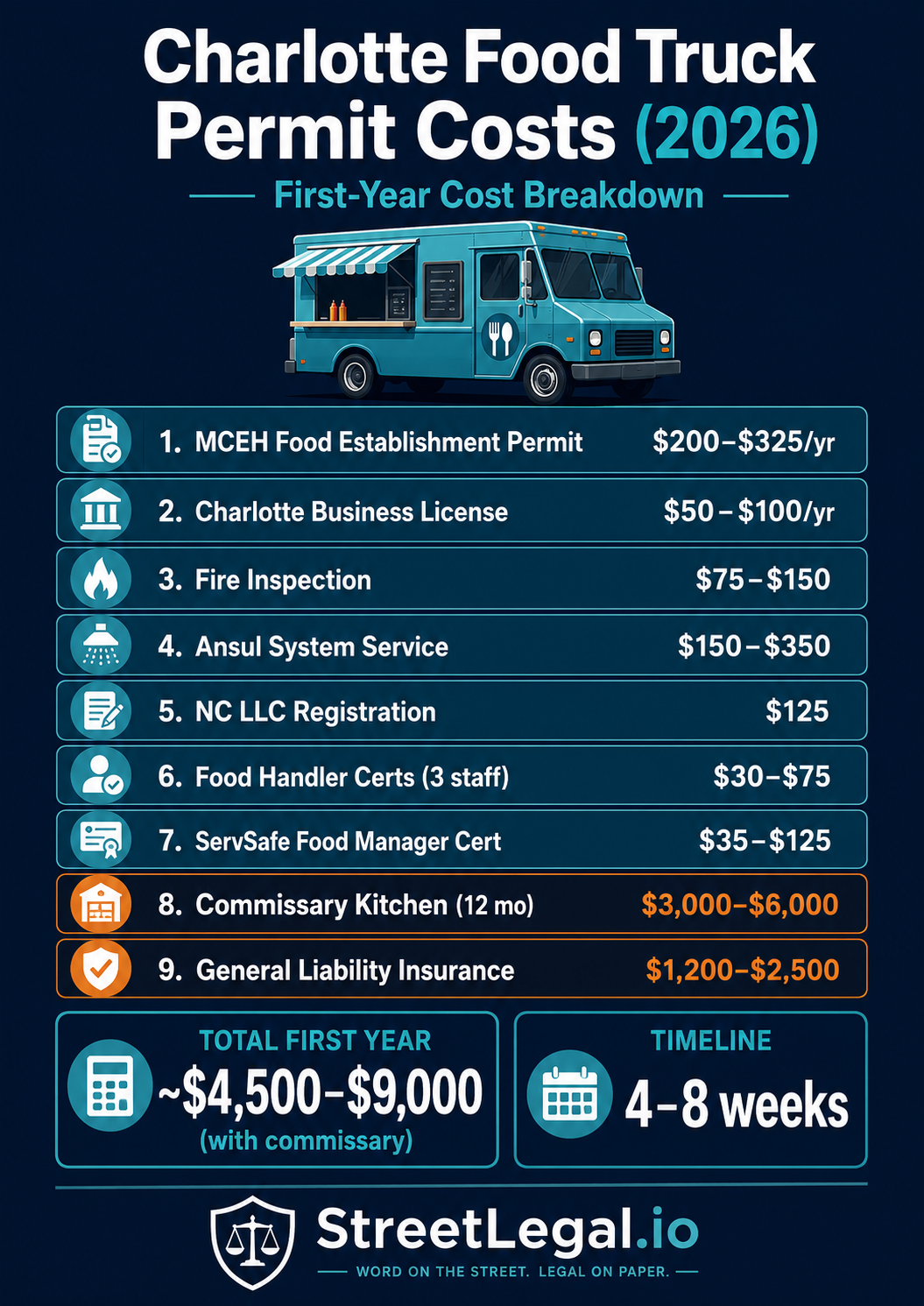
| Cost Item | Low | High | Notes |
|---|---|---|---|
| MCEH Food Establishment Permit | $200 | $325 | Prorated if applying mid-year |
| Charlotte Business License | $50 | $100 | Annual |
| Fire Inspection | $75 | $150 | Plus Ansul service $150–$350 |
| Ansul System Service | $150 | $350 | Required before fire inspection |
| Commissary Kitchen (monthly) | $250/mo | $500/mo | Full membership with storage |
| Food Handler Certs (3 staff) | $30 | $75 | NC-approved online courses available |
| ServSafe Food Manager Cert | $35 | $125 | Required, 5-year validity |
| General Liability Insurance | $700/yr | $1,800/yr | Most venues require $1M policy |
| NC LLC Formation | $125 | $125 | NC Secretary of State filing |
Total first-year estimate (excluding vehicle and commissary): roughly $1,365–$3,050 in permits, licenses, certifications, and insurance. With commissary costs, plan for $4,500–$9,000 in year-one operating overhead before food and labor.
Realistic Timeline
Weeks 1–2: Entity + insurance + commissary
Form your NC LLC ($125, online with SoS), get your insurance binder, and lock in a commissary agreement. You need these before applying for the health permit.
Weeks 2–5: MCEH application and inspection
Submit your Mecklenburg County food establishment permit application. An inspector will schedule your physical truck inspection — often 2–3 week wait.
Weeks 4–6: Charlotte Fire inspection
Schedule fire inspection with Charlotte Fire Department. Service your Ansul system beforehand to avoid a failed inspection and the rescheduling delay.
Week 5–7: Charlotte business license
Apply for your city business license once the health permit is in process. This is typically fast — 1–2 weeks once submitted.
Week 7–10: Operational
With all permits in hand, you're legal to operate. Keep your health permit and business license visibly posted inside the truck.
Key Tips for Charlotte Food Truck Operators
- Renewals all happen on January 1 — the MCEH permit renews at the start of the year regardless of when you first applied. If you start in October, you're paying again in January. Budget accordingly.
- South End is competitive but worth it — the light rail corridor through South End (LYNX Blue Line) brings consistent foot traffic. Competition for good spots is real; build relationships with property owners early.
- Brewery partnerships are a proven model — Charlotte has 50+ breweries, many of which don't have kitchen facilities. A regular brewery spot with a revenue share or flat weekly fee is one of the most stable revenue streams in the market.
- Mecklenburg County requires separate permits if you operate in other counties — if you take an event in Union County or Gaston County, you need those counties' permits too. NC doesn't have statewide reciprocity for mobile food units.
- Keep digital copies of all permits — Charlotte inspectors may check on-site during high-traffic events. Having PDFs on your phone is faster than fumbling for paper.
Charlotte Food Truck Permit FAQ
What permits do I need?
MCEH Mobile Food Unit (health permit), Charlotte Business Privilege License, and NC sales tax permit. Plus MCFD fire inspection and a commissary agreement.
How much does it cost?
MCEH permit: $200-$325/year. Business license: $50-$100. Total first-year: typically $1,500-$2,000 including commissary and setup.
When does the permit renew?
January 1 every year. If you start in October, renewal is due in January. Set a November reminder.
Can I operate in other NC counties?
No — NC has no statewide reciprocity. Each county requires its own health permit.
Related City Guides
People also ask about Charlotte food truck permits
How much does a food truck permit cost in Charlotte?
How long does it take to get a food truck permit in Charlotte?
Do I need a commissary kitchen to operate a food truck in Charlotte?
What documents do I need for a Charlotte food truck permit?
Answers to the most common permit questions — costs, timelines, commissary rules, and more.
Find city-level permit guides for every state we cover — compare costs and requirements.
More from the blog
Jefferson County, MO Food Truck Permit Guide
Complete guide to food truck permits, fees, and requirements in Jefferson County, MO.
City GuidesSt. Charles County, MO Food Truck Permit Guide
Complete guide to food truck permits, fees, and requirements in St. Charles County, MO.
City GuidesSt. Louis County, MO Food Truck Permit Guide
Complete guide to food truck permits, fees, and requirements in St. Louis County, MO.
Buyer's GuideFood Truck POS Systems 2026: Square, Toast, Clover & Avocado
Compare 2026 food truck POS systems by pricing, hardware costs, offline mode, and contract terms for Square, Toast, Clover, and Avocado.