· Updated · 12 min read · StreetLegal Team

The Real Cost of Running a Food Truck: Annual Expenses Breakdown 2026
Updated July 11, 2026
Most food truck cost calculators are wrong. They list the exciting startup costs — the truck build, the wrap, the initial equipment — but skip the boring annual operating costs that actually determine whether you survive year 2. This guide is only about the recurring numbers: what you pay every single year just to keep the lights on and the generator running.
Startup costs are a different conversation entirely. Here we are talking about the annual cost structure that every operator faces from year one forward. Get these numbers wrong in your business plan and you will be undercapitalized by spring of your second year.
The Two Categories Nobody Separates
There are two fundamentally different types of costs in a food truck business, and most guides mix them together in a way that obscures the real picture:
- Startup costs — one-time capital expenses: truck purchase or build-out, initial equipment, the wrap, website, first commissary deposit. You pay these once (or finance them over time).
- Annual operating costs — the recurring expenses that hit you every year, every month, whether or not you are busy. These are what we are covering here.
The reason this distinction matters: new operators often have a funded start, cover year one by running lean, and then get blindsided in year two when all of their renewal cycles overlap and their equipment has its first major failure. Know the annual number before you open, not after.
Annual Permits and Licenses
Permits are not a one-time cost. They renew annually (or on varying cycles) and the fees vary dramatically by city. Here is what you are paying every year just to stay legal:
| Permit / License | Typical Annual Cost | Notes |
|---|---|---|
| Health / Mobile Food Permit | $150–$2,000/yr | NYC is an outlier at the high end. Houston $258, Austin $258–$519, Chicago $1,000–$2,000 |
| Business License | $50–$200/yr | City and/or county; some states do not require a separate annual renewal |
| Fire Inspection / Certificate | $50–$200/yr | Required in most jurisdictions with open-flame cooking equipment |
| Food Manager Certification Renewal | $16–$36/yr (amortized) | $80–$180 every 5 years; at least one certified manager required in most states |
| Food Handler Certs (All Staff) | $15–$30/person every 2 years | Budget per employee; multiply by headcount |
| Vehicle Safety Inspection | $25–$75/yr | State-required in most states; food trucks often face stricter standards than passenger vehicles |
| Total — Permits & Licenses | $500–$3,000/yr | Most operators; higher in Chicago, NYC, SF |
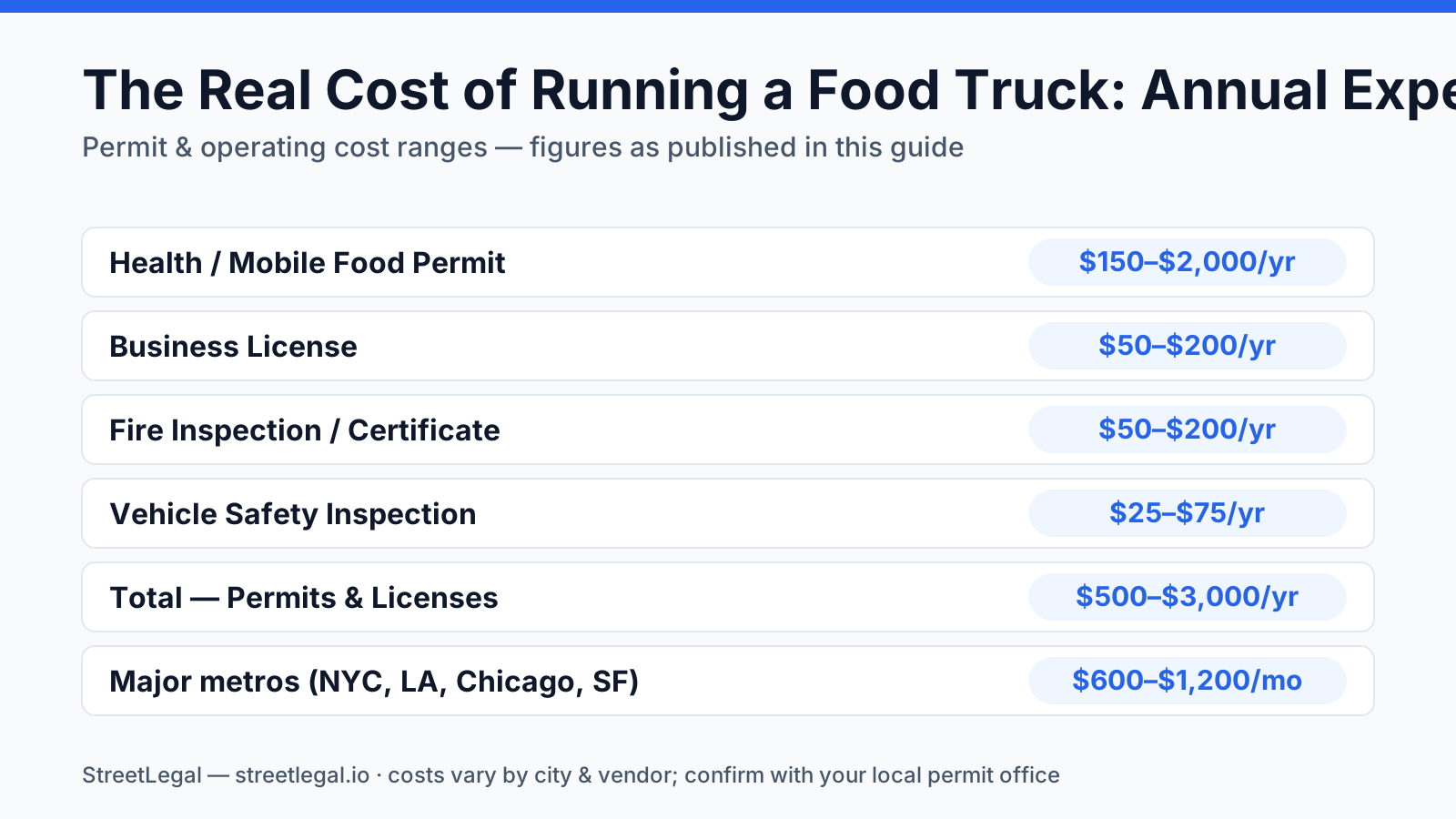
The permit cost alone is not what kills operators. It is the time cost of renewals — every permit has a different expiration date, different renewal window, and different paperwork. Build a calendar reminder system in year one and do not let anything lapse. An expired health permit means you are shut down immediately, and you will still owe your commissary that month.
Commissary Kitchen — The Cost Everyone Underestimates
This is the one that gets people. In almost every state, you cannot operate a food truck without a licensed commissary kitchen — a permitted commercial kitchen where you do your prep, store food, dump greywater, and clean equipment. It is non-negotiable. And it costs money every single month, whether or not you operate.
| Market | Monthly Rate | Annual Cost |
|---|---|---|
| Major metros (NYC, LA, Chicago, SF) | $600–$1,200/mo | $7,200–$14,400/yr |
| Mid-size cities (Houston, Dallas, Austin, Nashville) | $300–$600/mo | $3,600–$7,200/yr |
| Smaller cities and secondary markets | $200–$400/mo | $2,400–$4,800/yr |
What a standard commissary fee covers:
- Prep and storage space (refrigerated and dry)
- Commissary address on your health permit application
- Wastewater/greywater dumping access
- Basic utilities for prep work
What is often extra or negotiated separately:
- Overnight truck parking on the commissary lot (add $50–$200/mo)
- Dedicated cold storage locker beyond the base allotment
- Priority access to shared equipment (tilt skillets, large mixers, steamers)
- After-hours access if the base contract is business-hours-only
Watch Out: Commissary Price Creep
Many commissaries offer attractive intro rates to fill capacity — then raise rates at renewal with little notice. A $350/month contract that becomes $500 at renewal is a $1,800/year hit you did not budget for. Before signing, ask specifically about annual rate increase caps and get them in writing. Operators who fail to do this routinely discover their effective commissary cost in year 2 or 3 is 30–50% higher than what they planned.
Commercial Insurance — The Number That Shocks People
Food trucks are expensive to insure. You are combining a commercial vehicle with a commercial kitchen with a public-facing business — underwriters price all three risks together, and none of them are cheap. Here is what you are actually paying:
| Coverage Type | Annual Cost Range | Notes |
|---|---|---|
| Commercial Auto | $1,200–$2,500/yr | A personal auto policy will not cover a vehicle used for commercial food service — do not make this mistake |
| General Liability | $600–$1,200/yr | Covers customer injury, property damage; most events and parks require $1M minimum |
| Product Liability | Often bundled with GL | Covers foodborne illness claims; usually included in GL policy for food vendors |
| Workers Compensation | $1,500–$4,000/yr | Required in most states if you have employees; varies significantly by state |
| Total — Solo Operator | $1,800–$4,000/yr | No employees; commercial auto + GL |
| Total — With Staff | $3,500–$8,000/yr | Includes workers comp for 1–2 employees |
Why food truck insurance costs more than a standard commercial vehicle: your vehicle is also classified as commercial cooking equipment that operates near crowds. The combination of propane, open flame, fryers, and public food service puts you in a higher-risk underwriting category than a delivery van. Add the fact that food trucks are often parked in crowded event environments and the liability exposure is genuinely higher.
Watch Out: Insurance After a Claim
One at-fault vehicle accident or a credible foodborne illness complaint can triple your annual premium at renewal — and some carriers will non-renew you entirely, forcing you into the surplus lines market at significantly higher rates. Operators who have had one incident often report their premiums jumping from $2,500/year to $7,000+ for the 2–3 year penalty period. The prevention is boring: drive carefully, maintain your equipment, train your staff on food safety.
Vehicle and Equipment Maintenance
A food truck is a high-use commercial vehicle with a kitchen strapped to it. The maintenance costs are real, and operators who do not build a repair reserve fund will be caught by this in year 2 or 3.
| Expense | Annual Cost | Notes |
|---|---|---|
| Oil changes, tires, brakes | $800–$1,500/yr | Food trucks are heavy — tires and brakes wear faster than a standard vehicle |
| Generator maintenance and fuel | $600–$1,500/yr | Service every 100–250 hours; fuel cost depends heavily on operating schedule |
| Propane | $1,800–$4,800/yr | $150–$400/month depending on cooking volume; high-heat concepts burn more |
| Equipment repair / replacement reserve | $1,000–$3,000/yr | Fryers, refrigeration, and generators fail. Budget this even if you do not spend it every year. |
| Ansul / fire suppression system service | $200–$400/yr | Annual service required in most states; non-negotiable for permit renewal |
| Total — Vehicle & Equipment | $4,400–$11,200/yr |
The equipment reserve is the one most operators skip, and then scramble when a $2,800 refrigeration repair hits in August — their busiest month. Fund it every month whether you need it or not. If the year ends and you have not spent it, it becomes next year's operating cushion.
Food and Supplies — The Real Biggest Number
Cost of goods sold is the largest single annual expense in the business, and it is often missing from "permit cost" guides because they are focused on compliance, not operations. That does not make it any less real.
- Food cost target: 30–35% of revenue is considered healthy for a food truck concept
- On $200K annual revenue: that is $60,000–$70,000 per year in ingredients alone
- On $150K annual revenue: $45,000–$52,500 per year
- Operators running above 38–40% food cost are bleeding — tighten your ordering, reduce waste, or reprice your menu
Disposables are a separate line item that adds up quietly:
- Containers, trays, napkins, utensils, gloves: $200–$600/month ($2,400–$7,200/yr)
- Cleaning supplies: $100–$200/month ($1,200–$2,400/yr)
The disposable cost varies significantly by concept. A taco truck with simple boat baskets and foil is on the low end. A gourmet bowl concept with biodegradable branded containers is paying 2–3x more per unit sold.
Labor Costs
If you are a solo operator, your own wages come from whatever is left after every other cost. Most year-one operators drastically undervalue their own time in their business models — make sure your revenue projections actually support paying yourself a living wage.
If you are bringing in help:
- Part-time help (weekends + busy events): $1,000–$3,000/month depending on hours and local minimum wage
- Full-time second person: $35,000–$50,000/yr including payroll taxes (~7.65% employer FICA) and any required benefits
A common operator pattern: start solo, add part-time weekend help around month 6, and evaluate a full-time hire when revenue consistently clears $20,000/month. Adding a full-time employee before you hit that revenue level tends to compress margins to near-zero.
The Honest Annual Total
Here is the full picture in one table. These numbers assume a mid-size city operator, one part-time helper, and $150K in annual revenue for the COGS line:
| Category | Low Estimate | High Estimate |
|---|---|---|
| Permits & licenses | $500 | $3,000 |
| Commissary kitchen | $3,000 | $9,600 |
| Insurance (solo to with staff) | $1,800 | $8,000 |
| Vehicle & equipment | $4,400 | $11,200 |
| Food COGS (on $150K revenue, 30–35%) | $45,000 | $55,000 |
| Disposables & supplies | $3,600 | $9,600 |
| Labor (1 part-time helper) | $12,000 | $24,000 |
| Total Annual Operating Costs | ~$70,300 | ~$120,400 |
The takeaway is uncomfortable but important: you need $150,000–$250,000 in annual revenue to run a healthy food truck after these costs — and to pay yourself a reasonable wage. Below $150K, you are likely working for less than minimum wage once you account for your own hours. Above $250K with controlled costs, you start building real margin.
Run this math before you sign your commissary agreement, not after your second year review.
What Is NOT in This Table
The table above is already sobering, but it still excludes several real costs that many operators carry:
- Truck loan / build financing payments — if you financed your build, add $500–$2,000/month depending on your loan terms. This is often the biggest omission for operators who built new.
- Food truck park spot fees — $300–$1,500/month if you lease a regular spot at an organized food truck park. Parks provide foot traffic but the real estate cost is real.
- Marketing and social media — at minimum, budget $100–$300/month for boosted posts, Yelp management, and basic digital presence.
- Point-of-sale system fees — $50–$100/month for Square, Toast, or similar. Do not try to run a food truck cash-only — you will lose sales and have an accounting nightmare.
- Accounting and bookkeeping — $100–$300/month if you outsource it, which you should at least consider in year one.
- Event vendor fees — many events and farmers markets charge $50–$500 per event on top of your existing permits.
Add these in and a fully loaded annual cost structure — with a financed truck, a park spot, and basic marketing — can easily run $100,000–$150,000 per year before you have paid yourself anything.
The Two Costs That Kill Year-2 Operators
Year one is hard but it has adrenaline carrying it. Year two is when the financial structure of the business either holds or it does not. Two specific cost dynamics account for the majority of year-2 failures:
1. Commissary Price Creep
Many commissaries fill capacity by offering below-market intro rates to new operators. When your contract renews at month 12, the rate goes up — sometimes 20–40%. If you budgeted $350/month and it becomes $500, that is $1,800/year you did not plan for. Multiply this by a few other cost increases and you are suddenly $5,000–$8,000 in the hole vs. your year-one model. The fix: negotiate a rate cap clause before you sign. If the commissary will not accept a cap, factor in a 20% increase when you model year two.
2. Insurance After a Claim
One at-fault vehicle incident or a foodborne illness complaint — even a minor one that results in no payout — can dramatically change your insurance cost at renewal. Some operators report premiums jumping from $2,500/year to $7,000–$8,000/year after a single incident because the carrier either raises rates or non-renews and you end up in surplus lines. There is no easy fix here. The preventive measures are: drive defensively, maintain your equipment meticulously, and train staff on food handling. The reactive measure is to shop multiple carriers before each renewal, not just accept the automatic renewal rate.
Frequently Asked Questions
Annual operating costs for a food truck typically range from $68,000 to $120,000+ per year when you include permits, commissary, insurance, vehicle and equipment maintenance, cost of goods sold, disposables, and at least one part-time employee. Solo operators on the lower end; trucks doing $200K+ in revenue with staff will be at the high end or above. This does not include loan payments on a financed truck build, which can add another $12,000–$24,000/year.
Food cost (cost of goods sold) is the single largest annual expense — typically 30–35% of revenue. On $150K in annual revenue, that is $45,000–$52,500 per year just in ingredients. The second largest is labor if you have employees, followed by commissary kitchen fees at $3,000–$9,600 per year. Permits, which get the most attention from new operators, are actually a relatively small fraction of total annual cost.
In most cases, yes. Commissary agreements are almost always monthly contracts — you pay whether you operate 5 days that month or 25. Some commissaries offer hourly or day-rate access but these tend to be more expensive per session and may not satisfy your health permit's commissary requirement for consistent access. If you plan to operate seasonally, negotiate a pause clause before you sign — much easier to get at the start than after the fact.
The highest-leverage moves: (1) negotiate your commissary contract with a rate cap — this single action can save $1,500–$3,000/year in years 2 and 3; (2) buy a well-maintained used truck to eliminate or reduce loan payments; (3) maintain equipment yourself where possible to cut emergency repair costs; (4) track food cost weekly — most operators running above 38% can find 5–8 points of savings just through tighter ordering and waste reduction. Insurance is hard to reduce but bundling all policies with one carrier often saves 10–15%.
A well-run food truck should target 10–15% net profit margin after all operating costs including a reasonable owner salary. On $200K in annual revenue that is $20,000–$30,000 in net profit. Trucks below $150K in annual revenue often struggle to break even after paying a living wage to the owner. The $250K+ revenue range is where food trucks typically become genuinely profitable businesses. Trucks in the $400K–$600K range — usually achieved through catering, events, or a second truck — can generate $60,000–$90,000 in annual profit.
Related Guides
About the Author
Ben is co-founder of StreetLegal. He has spent the last several years talking to food truck operators across the country about what the business actually costs — not the pitch deck version, the real one. If something in this guide is wrong or outdated, let him know.
Answers to the most common permit questions — costs, timelines, commissary rules, and more.
Find city-level permit guides for every state we cover — compare costs and requirements.
More from the blog
Food Truck POS Systems: Square vs. Toast vs. Clover vs. Avocado (2026)
Real 2026 pricing, hardware costs, offline mode, and contract terms for Square, Toast, Clover, and Avocado — compared specifically for food truck operators.
City GuidesEagan, MN Food Truck Permit Guide
Eagan MN food truck permit guide: MDH mobile food licensing, Dakota County food safety, city peddler rules, commissary records, costs, and launch timeline.
City GuidesBentonville, AR Food Truck Permit Guide
Complete guide to food truck permits, fees, and requirements in Bentonville, AR.
City GuidesBiloxi, MS Food Truck Permit Guide
Biloxi food truck permit guide 2026: licenses, health permit steps, commissary records, inspections, costs, renewal timing, and launch checklist.