· 14 min read · StreetLegal Team
 Verified with City of Fort Worth
Municipal review · Steps checked against city published rules · Updated 2026-09-08
Verified with City of Fort Worth
Municipal review · Steps checked against city published rules · Updated 2026-09-08
Municipal reply evidence
StreetLegal updated this guide from official city, county, or health-department replies received by info@streetlegal.io.
Consumer Health <ConsumerHealth@fortworthtexas.gov> · Tue, 8 Sep 2026 13:31:35 +0000
You would have to reach out to the state our department no longer does mobile permitting. Below is the state information. Phone 512-834-6727<tel:512-834-6727> Email Drugs-FoodSafety@dshs.texas.gov<mailto:Drugs-FoodSafety@dshs.texas.gov> DSHS State Website: https://www.dshs.texas.gov/retail-food-establishments/permits-retail-food-establishments/mobile-food-vendors Thank you, [cid:image001.png@01DD3F6C.11B81F00]<https://www.fortworthtexas.gov/Home> Abby Rodriguez Title SR. Customer Serivce Representative Environmental Services Department Office 817-392-7255 Fax 817-392-3713 100 Fort Worth Trl, Fort Worth, TX, 76102 CONNECT<https://www.fortworthtexas.gov/departments/communications/social> WITH US.<https://www.fortworthtexas.gov/departments/communications/social> [cid:image002.png@01DD3F6C.11B81F00] <https://www.fortworthtexas.gov/departments/communications/social> Make Consumer Health Payme
Source links: official link 1, official link 2, official link 3
How to Start a Food Truck in Fort Worth, TX: Complete Permit Guide 2026
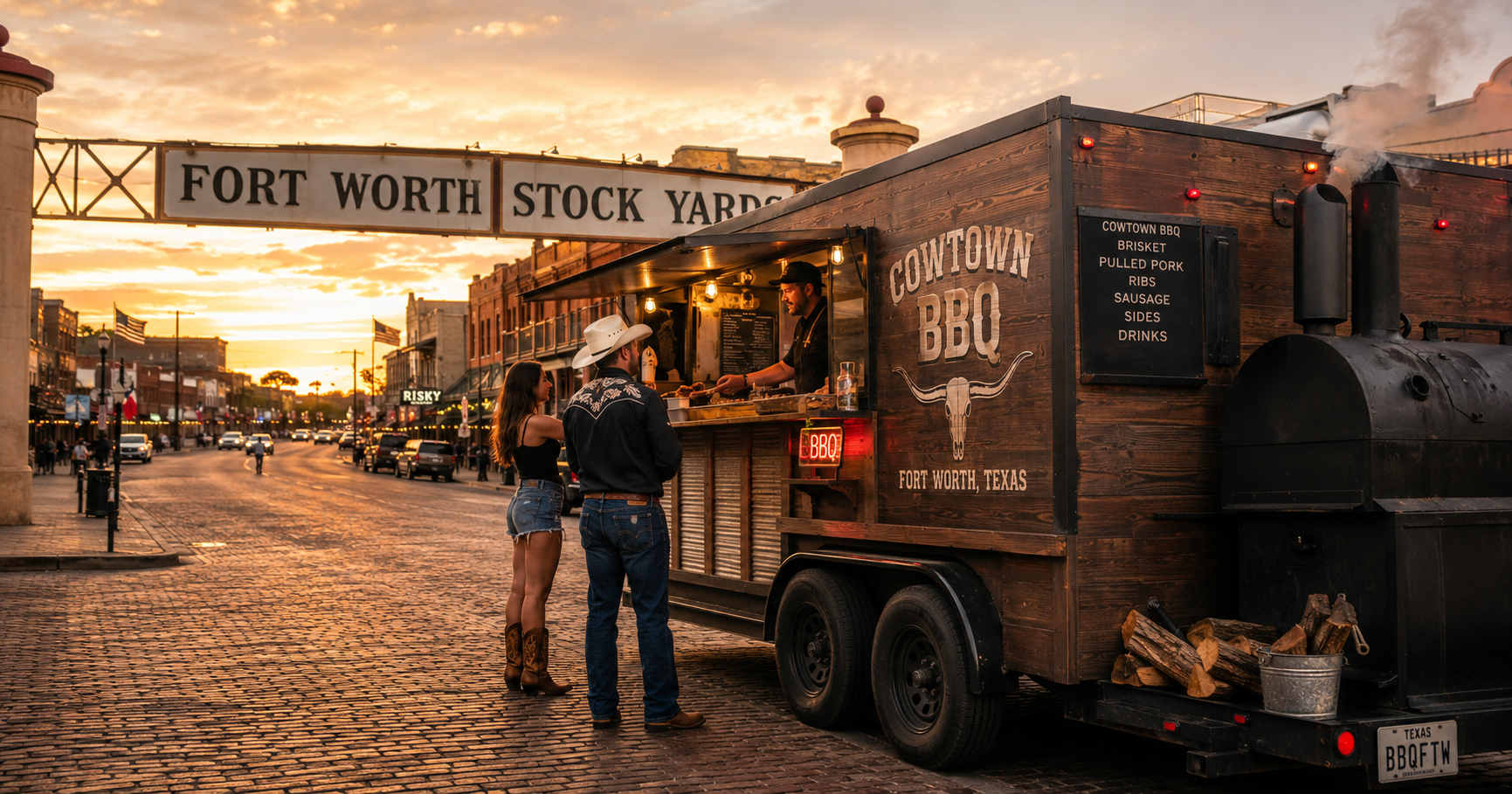
Fort Worth has real opportunity for food truck operators — from the Stockyards and Near Southside to brewery lots, rodeo traffic, and private events. But the approval process is more layered than many first-time founders expect. You are not just getting one city permit and heading out. You usually need city approval, commissary support, food safety coverage, business setup, and sometimes a separate fire review before you are actually launch-ready.
This guide covers the full Fort Worth path: the city mobile food permit, commissary expectations, fire-safety review, where you can realistically operate, and the real first-year cost range — not just the headline permit fee.
Fort Worth permit snapshot for 2026
If you only remember one thing, remember this: Fort Worth is usually easier than Houston or Dallas on paperwork friction, but harder than many founders expect on location access and recurring commissary economics.
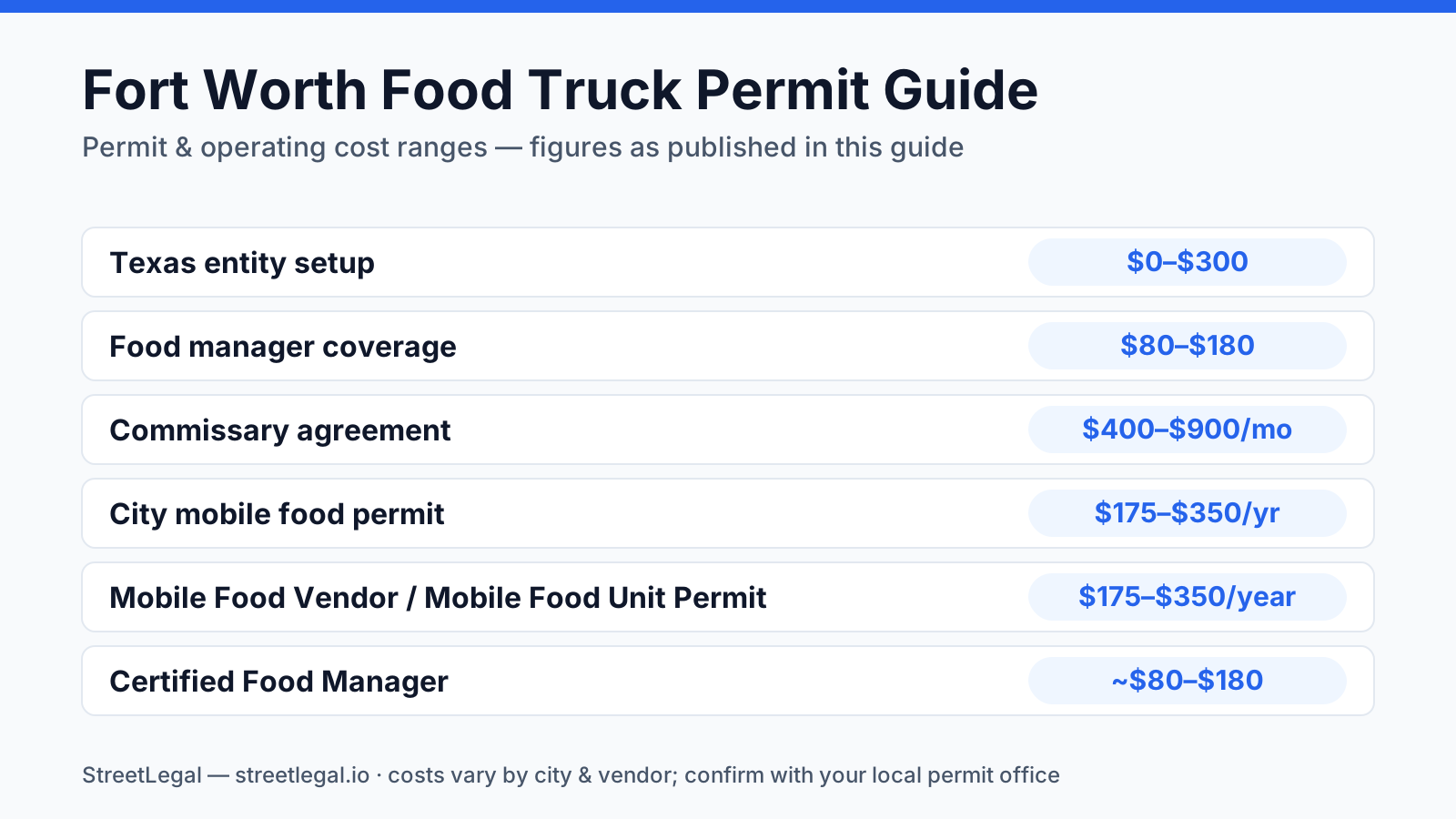
| Step | Agency / layer | Typical cost | Typical timing | Why it matters |
|---|---|---|---|---|
| Texas entity setup | Texas Secretary of State / DBA path | $0–$300 | Same day to 1 week | Needed before insurance, banking, and cleaner permit filing |
| Sales tax permit | Texas Comptroller | Free | Often 1–2 weeks | Required before you legally collect tax |
| Food manager coverage | TX-approved provider | $80–$180 | 1 day to 2 weeks | One of the easiest items to finish early |
| Commissary agreement | Private kitchen / support base | $400–$900/mo | 1 day to 3 weeks | Usually the biggest recurring compliance cost |
| City mobile food permit | Fort Worth Consumer Health | $175–$350/yr | 2–6 weeks after filing | Primary city approval for operating inside Fort Worth |
| Fire review if equipment triggers it | Fort Worth Fire Marshal | Varies | Days to several weeks | Hot-line trucks can stall here if the build is not ready |
| Venue / property approval | Private lot, brewery, event, merchant district | Varies | Ongoing | Permit approval alone does not create revenue access |
Texas Disclaimer
Texas does not have one uniform statewide food truck rulebook. Fort Worth operators still need to verify current city, venue, and state requirements before filing. Private-property and event rules matter here as much as the city permit itself.
The Fort Worth Food Truck Licensing Landscape
Fort Worth is easier to enter than some major cities, but it is not a one-form market. Operators usually deal with multiple overlapping layers:
- City of Fort Worth Consumer Health / Environmental Services — local mobile food approval inside city limits
- Texas DSHS / approved providers — food manager and food handler compliance
- Fort Worth Fire Marshal — fire-safety review for propane, suppression, fryers, hoods, and certain cooking systems
- Private venues, merchants, and event operators — Stockyards, breweries, rodeo events, and private lots often add their own approval layer
The good news: Fort Worth can move relatively fast if you prepare the stack in the right order. Operators who secure commissary support early, match the menu to the real truck, and get inspection-ready before filing usually move much faster than operators treating the permit like a paperwork formality.
What Licenses Do You Actually Need in Fort Worth?
| License / Permit | Issuing Authority | Fee | Renewal |
|---|---|---|---|
| Mobile Food Vendor / Mobile Food Unit Permit | City of Fort Worth | $175–$350/year | Annually |
| Certified Food Manager | TX DSHS-approved provider | ~$80–$180 | Per certification cycle |
| Food Handler Certificates | TX DSHS-approved provider | $15–$30 per person | Every 2 years |
| Fire inspection / suppression signoff | Fort Worth Fire Marshal | Varies by equipment | Often annual or equipment-triggered |
| Texas Sales Tax Permit | Texas Comptroller | Free | Permanent (file returns) |
| Business entity registration (if LLC/Corp) | Texas Secretary of State | $300 (LLC) | Annual franchise / state filings |
Step 1: The Fort Worth Mobile Food Permit
The city mobile food permit is the primary local approval required to operate a food truck inside Fort Worth city limits. It is the permit that ties together your menu, truck, food safety setup, and support base.
What You Need to Apply
- Completed city mobile food application or equivalent filing packet
- Signed commissary agreement or approved support-base documentation
- Menu and process overview
- Vehicle information, VIN, registration, and proof of ownership or lease
- Equipment list with manufacturer details where applicable
- Water and wastewater system information
- Certified Food Manager certificate
- Food handler certificates for staff who need them
- Insurance and business information if requested by the local filing path or venue
What Inspectors Actually Check
- Handwashing setup: dedicated sink, water, soap, and paper towels
- Warewashing capacity: sink or approved equivalent depending on your service model
- Cold and hot holding: refrigeration and temperature control that match your menu
- Water / wastewater logic: the truck must make operational sense for daily service
- Menu-to-equipment match: the menu cannot promise prep your truck cannot safely support
- Commissary support: documentation should be current, specific, and inspection-ready
Bring the Actual Documents
Fort Worth approval moves faster when your commissary agreement, certifications, truck registration, and equipment details are physically ready to show. Weak documentation is one of the easiest ways to create rework.
Step 2: The Commissary Requirement
For most Fort Worth operators, the commissary is the real foundation of the permit stack. It is where prep support, storage, cleaning, resupply, water handling, and wastewater logic all become operationally real.
What the Agreement Should Cover
- Facility name and address
- Proof the facility is licensed for the intended support role
- Signed agreement by both parties
- Access hours and frequency of use
- Storage, cleaning, water, and wastewater expectations
Fort Worth Commissary Cost Reality
The permit fee is not the biggest number in most first-year Fort Worth budgets. Commissary access usually is.
- Basic support / lighter access: roughly $400–$600/month
- Heavier usage or better-equipped kitchens: roughly $600–$900/month
- Extra storage, parking, or premium access: additional cost depending on the facility
Step 3: Fire Review
If your truck uses propane, fryers, griddles, hoods, or suppression systems, the fire layer matters. Even when the city health permit is the main focus, operators get delayed here when the truck is not truly inspection-ready.
- Suppression system: should be current if your cooking setup requires one
- Extinguishers: Class K for grease-heavy cooking, ABC for general safety
- Fuel and propane setup: clean, secure, and ready for review
- Hood / vent logic: should match the cooking method you actually use
⚠️ Fire Review Is a Real Delay Point
A lot of first-time operators think the city permit is the only hard gate. It isn’t. If the cooking setup is not truly ready, the fire layer can become the thing that slows the launch down.
Venue + Event Approval Layer
Fort Worth has high-opportunity operating zones, but many of them sit behind private approval, venue restrictions, or event deadlines. The Stockyards, rodeo traffic, breweries, and private-lot activations all have their own gatekeeping logic.
| Venue Type | What To Expect | Common Risk |
|---|---|---|
| Stockyards / merchant-heavy districts | Separate venue or merchant approval often matters as much as your city permit | Assuming city approval alone gives access |
| Breweries / private lots | Often the cleanest recurring operating model | Weak written permission or unclear rev-share terms |
| Special events / rodeo / markets | Event organizers commonly require separate vendor packets and earlier deadlines | Missing the application window |
Where Can You Operate in Fort Worth?
A permit does not automatically mean unrestricted curb freedom. In practice, Fort Worth operators tend to win by focusing on strong private-property relationships and event-based demand.
Where you can actually operate in Fort Worth
Fort Worth is a good example of why permit approval and revenue access are not the same thing. Many operators get legal, then realize the real game is landing private-property hosts, event slots, and recurring neighborhood lanes that fit the truck they built.
| Operating lane | Permit alone enough? | Access reality | Best truck fit |
|---|---|---|---|
| Breweries and taprooms | No | Usually needs host approval, insurance, and a menu that works for short evening service | Lean grill, tacos, burgers, handheld comfort food |
| Private office lots | No | Good weekday lane if you can win property-manager relationships and fast lunch throughput | Fast lunch truck with low ticket-time menu |
| Festivals and city events | No | Event organizer controls vendor access; fire setup and power needs can matter more than the city permit itself | Higher-capacity truck or trailer with event-ready workflow |
| Apartment and HOA activations | No | Often strong starter lane for recurring stops if the menu is family-friendly and service is predictable | Dessert, tacos, smashburgers, simple family dinner concepts |
| Street-side public parking | Rarely | This is where operators over-assume. General city approval does not automatically create easy curbside vending freedom. | Not a safe first-lane assumption for most new founders |
| Stockyards National Historic District | No | High foot traffic but venue and merchant-association approval gates are real; plan for separate vendor agreements | BBQ, Tex-Mex, comfort food that fits the western tourism brand |
| Near Southside / Magnolia Ave | No | Growing food scene with breweries and galleries; private-lot hosting is the access path | Fusion, craft concepts, and specialty trucks that match the neighborhood vibe |
| West 7th / Cultural District | No | Dense bar and restaurant corridor; trucks need private-property partnerships to avoid conflict with brick-and-mortar | Late-night comfort food, tacos, desserts for bar-crawl traffic |
| TCU / university area | No | Strong student demand on game days and lunch hours; property-owner and campus approval needed | Fast, affordable lunch and game-day snacks |
| Camp Bowie corridor | No | Established commercial strip with suburban lunch demand; private-lot lunch stops work well here | Weekday lunch trucks with fast service and family-friendly menus |
| Sundance Square / Downtown | No | Premium downtown foot traffic but tightly managed by Sundance Square Management; vendor agreements essential | Lunch trucks and event-style setups during downtown activations |
Best food truck types for Fort Worth in 2026
Fort Worth usually rewards trucks that can work private-property lunch stops, family-demand evening stops, and event bookings without overbuilding the vehicle. That often means choosing a simpler, faster truck before you choose the biggest kitchen possible.
| Truck type | Fort Worth fit | Why it works | Watch-out |
|---|---|---|---|
| Taco / handheld grill truck | High | Fits breweries, office lunch, family neighborhoods, and event volume without a giant build | Do not overcomplicate the menu and slow service times |
| Burger / comfort-food truck | High | Strong fit for suburban evening stops, sports-adjacent traffic, and repeat private hosts | Grease load and hood/fire requirements can increase build cost |
| Dessert or coffee trailer | Medium-High | Can be a smart lower-complexity starter model for schools, churches, and neighborhood events | Ticket averages can be thinner without strong event volume |
| BBQ trailer | Medium | Brand fit can be strong in Texas, especially for events and destination stops | Build complexity, prep load, and staffing can get expensive fast |
| Large chef-driven full kitchen truck | Medium-Low | Can win if the concept is strong, but often overspends before the operator proves recurring demand | Highest risk of building too much truck for the first operating lane |
| Specialty fusion or niche concept | Medium | Can stand out at Magnolia Ave, West 7th, and Near Southside brewery stops where crowds want something different | Niche concepts need strong social media presence to build repeat demand in Fort Worth |
If you want the fastest clean launch path, Fort Worth usually favors a simpler private-lot/event-first truck over a heavy curbside-first concept. Compare that tradeoff against Houston and Dallas before buying a build.
Compare Fort Worth against the rest of Texas before you buy a truck
Fort Worth is usually one of the better Texas launch markets for operators who want private-property, brewery, school, church, and neighborhood-event revenue before they chase a bigger metro build. The table below makes the tradeoff crawlable for both founders and Google.
| Texas market | Launch friction | Best first revenue lane | Best first truck fit | Why it matters |
|---|---|---|---|---|
| Fort Worth | Medium | Private lots, breweries, schools, family events | Tacos, burgers, desserts, lighter event-first trailers | Often easier paperwork than Dallas or Houston, but access still depends on venue relationships |
| Houston | Medium-High | Parks, broad-menu neighborhoods, repeat private hosts | Broader full-kitchen trucks with stronger volume capacity | Best Texas baseline for scale, but usually a heavier compliance and operating model |
| Dallas | High | Office lunch, event bookings, curated private-property spots | Faster-service lunch builds with strong event flexibility | Higher-friction DFW comparison if you want denser office and event demand |
| Arlington (next market) | Medium | Stadium, family, entertainment-district events | Event-first trailers and compact high-throughput builds | Useful DFW adjacency if you want event density without starting in the biggest-city stack first |
| Austin | High | Trailer parks, SoCo lots, festival circuit, late-night bar districts | Full-kitchen trailers or quirky concept builds with social-media reach | Most competitive Texas truck market — high reward but saturated lanes and strict APH oversight |
| San Antonio | Medium-Low | Family neighborhoods, Riverwalk-adjacent events, military-base proximity | Taco and comfort-food trucks, family-priced menus | Lower drama than DFW, strong family demand, good starter market for Texas operators |
| El Paso | Low-Medium | Border culture events, university traffic, neighborhood stops | Lean taco, Mexican fusion, and comfort-food trailers | Smaller market with less competition — can be a strong first launch if you already have a border-culture concept |
For the wider cluster, open the Texas state hub for city-by-city permit friction, access reality, and truck-fit comparisons.
Most Common Fort Worth Application Mistakes
Treating the city permit like the only gate
Many operators underestimate commissary, venue, or fire-review requirements and then discover the real blockers late.
Submitting weak commissary documentation
An informal arrangement is not the same as a strong, inspection-ready support agreement.
Menu and truck setup do not actually match
If the menu implies prep or service complexity the truck cannot support, expect delays and correction loops.
No location strategy beyond "we have a permit"
A permit is not a location. Fort Worth operators need private-lot, venue, or event relationships lined up.
Budgeting only for the city fee
The core permit fee is small compared with commissary, insurance, certification, and equipment-readiness costs.
Full First-Year Cost Breakdown
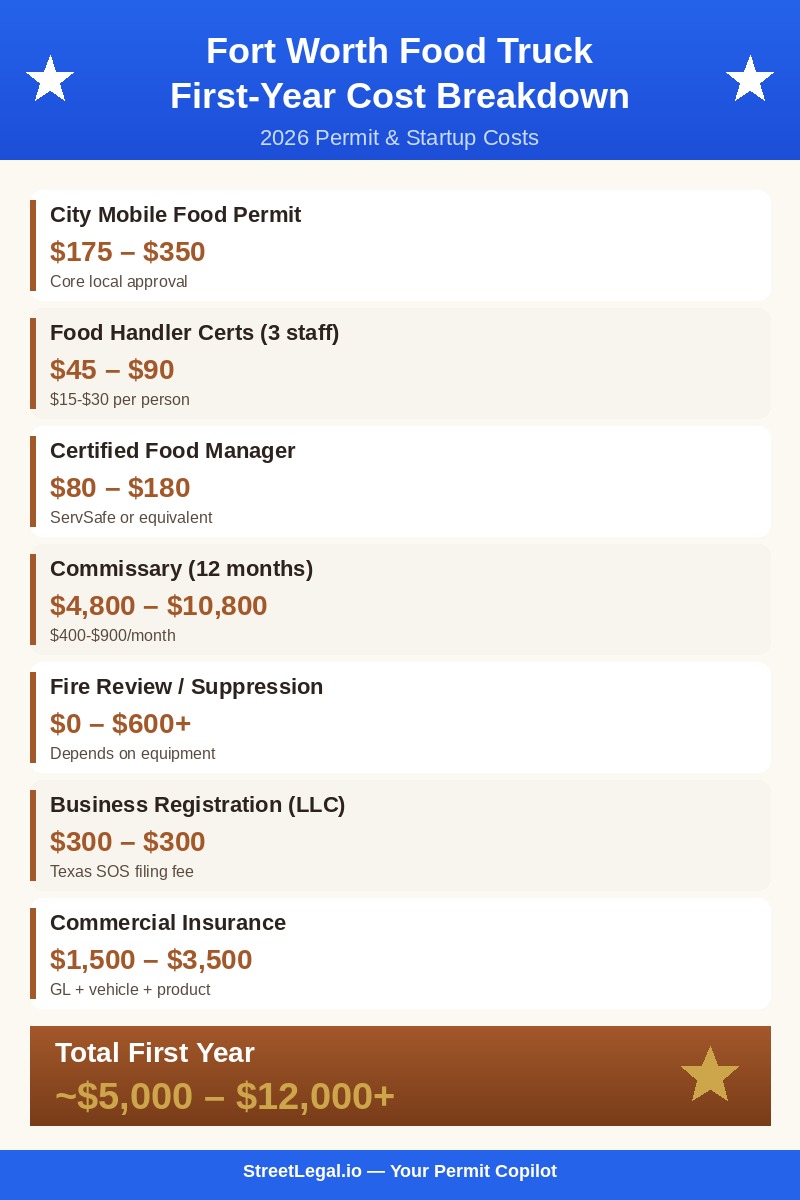
| Cost Item | Low | High | Notes |
|---|---|---|---|
| City mobile food permit | $175 | $350 | Core local approval cost |
| Food handler certs (3 staff) | $45 | $90 | $15–$30 per person |
| Certified Food Manager | $80 | $180 | ServSafe or equivalent |
| Commissary (12 months) | $4,800 | $10,800 | Based on roughly $400–$900/month |
| Fire review / suppression service | $0 | $600+ | Wide range depending on equipment and service status |
| Business registration (LLC) | $300 | $300 | Texas SOS filing fee |
| Commercial insurance | $1,500 | $3,500 | GL + vehicle + product liability range |
| Total First Year | ~$5,000 | ~$12,000+ | Driven mostly by commissary, insurance, and truck-readiness costs |
Realistic Timeline to Launch in Fort Worth
Week 1–2: Business Setup & Food Safety
Set up your entity or DBA, register for Texas sales tax, and complete your food manager / food handler coverage.
Week 2–3: Commissary Agreement
Lock in your commissary, gather a strong signed agreement, and confirm the facility really supports your service model.
Week 3–4: Equipment & Fire Prep
Finalize the equipment list, service any suppression system if needed, and get the truck truly inspection-ready.
Week 4–8: Permit Review & Inspection
Submit the permit package, handle corrections, and complete the local inspection cycle.
Week 6–10: Ready to Operate
Permit approved, venue relationships confirmed, insurance active, and truck ready for service.
5 Fort Worth-Specific Tips Most Guides Miss
1. Stockyards traffic is real — but so is the gatekeeping
Do not confuse a high-foot-traffic district with easy access. The Stockyards are valuable, but venue-side approval matters as much as your city paperwork.
2. Brewery partnerships are often the cleanest recurring play
In Fort Worth, stable private-property relationships often outperform chasing inconsistent public-foot-traffic assumptions.
3. Rodeo and event money is real — but only if you plan early
High-demand seasonal events reward operators who line up vendor approvals well ahead of time. Waiting for the season to start is too late.
4. The commissary decision shapes your whole economics
Two operators can have the same permit fee but radically different margins depending on commissary structure, storage, parking, and access terms.
5. Your first real blocker is usually readiness, not bureaucracy
Fort Worth is often faster than cities like LA or NYC — but only for operators whose truck, menu, documents, and venue plan are actually ready before filing.
Renewals: What to Track
Fort Worth approvals do not stay healthy on autopilot. Operators should proactively track renewal timing, current commissary agreements, staff certifications, and any equipment changes that would affect inspection status.
- City permit: renew before lapse and confirm whether any reinspection is triggered
- Fire-related approvals: keep suppression and extinguisher servicing current where applicable
- Commissary agreement: renew before contract expiration
- Food handler / manager coverage: track every expiration date, not just the lead operator
- Insurance and vehicle documents: keep current before renewal season arrives
Keep building inside the Texas cluster
Fort Worth makes more sense when founders compare it against the rest of Texas instead of treating it as an isolated permit problem.
Fort Worth Food Truck Permit FAQ
Can I operate a food truck in Fort Worth without a commissary kitchen?
How long does it take to get a Fort Worth food truck permit?
Do I need a separate permit for Stockyards events or private venues?
Is the Fort Worth permit the same as a Texas mobile food permit?
How much does a food truck permit cost in Fort Worth?
🏛️ Official Resources — Verify Current Requirements
- City of Fort Worth — start here for current local department routing and city information
- Texas Comptroller — Sales Tax Permit — required before you start selling
- Texas DSHS Food Safety Training — food handler / food manager compliance starting point
Fees and timelines above reflect 2026 working estimates and operating reality. Always confirm current requirements before filing.
More Texas & Nearby City Guides
Operating across multiple Texas cities? Each city has its own permit requirements. Here are guides for cities near Fort Worth:
People also ask about Fort Worth food truck permits
How much does a food truck permit cost in Fort Worth?
How long does it take to get a food truck permit in Fort Worth?
Do I need a commissary kitchen to operate a food truck in Fort Worth?
What documents do I need for a Fort Worth food truck permit?
Answers to the most common permit questions — costs, timelines, commissary rules, and more.
Find city-level permit guides for every state we cover — compare costs and requirements.
More from the blog
Jefferson County, MO Food Truck Permit Guide
Complete guide to food truck permits, fees, and requirements in Jefferson County, MO.
City GuidesSt. Charles County, MO Food Truck Permit Guide
Complete guide to food truck permits, fees, and requirements in St. Charles County, MO.
City GuidesSt. Louis County, MO Food Truck Permit Guide
Complete guide to food truck permits, fees, and requirements in St. Louis County, MO.
Buyer's GuideFood Truck POS Systems 2026: Square, Toast, Clover & Avocado
Compare 2026 food truck POS systems by pricing, hardware costs, offline mode, and contract terms for Square, Toast, Clover, and Avocado.