· Updated · 10 min read · StreetLegal Team

Texas Commissary Kitchen Rules for Food Trucks (2026)
Updated July 26, 2026 - reflects HB 2844 after its July 1, 2026 effective date and the local-rule checks operators still need to make.
Quick answer for Texas operators
Yes, you still need a commissary agreement in most Texas cities. HB 2844 (effective July 1, 2026) removed the state-level commissary mandate only for qualifying self-contained trucks -- but individual cities can still require one under local ordinance. Expect $200-$800/month, a signed agreement on file with your health department, and confirmation from your city before assuming the HB 2844 exemption applies to you.
Every Texas food truck operator has to answer one question before anything else: where is your commissary? Without a signed, approved commissary agreement, no Texas health department will issue or renew your food truck permit. This is not a city-specific rule — it is baked into Texas Food Establishment Rules (25 TAC Ch. 228) and applies across the entire state. Now that HB 2844 is in effect, the practical answer depends on whether your truck is self-contained and whether your local health department still requires a commissary under local code.
This guide explains exactly what Texas requires, how it works city by city (Houston, Austin, Dallas, San Antonio, Fort Worth, El Paso), what a commissary agreement must contain, what it costs, where to find one, and how HB 2844 changes the rules. We also cover the mistakes that get operators denied at inspection.
HB 2844 Update — Now Effective
Texas HB 2844 created a single statewide food truck permit and removed the state-level commissary mandate for qualifying self-contained trucks as of July 1, 2026. However, individual cities may still enforce local commissary ordinances. Until your city or county confirms it accepts the HB 2844 exemption for your unit, plan on needing a commissary. Always verify current requirements with your specific local health department.
The Texas Commissary Rule
Texas requires all mobile food vendors to operate from an approved commissary kitchen. This is not optional, not a city preference, and not something you can work around. Under Texas Food Establishment Rules (25 TAC Chapter 228), a mobile food unit must operate from a licensed food establishment that serves as the base of operations for food preparation, equipment cleaning, wastewater disposal, and storage.
The practical consequence: your city or county health department will not issue or renew your food truck permit unless you have a signed commissary agreement on file. Show up to a permit inspection without one, and the inspection ends immediately. Apply without one, and your application is rejected before it is reviewed.
This rule applies regardless of city. Austin, Houston, Dallas, San Antonio, Fort Worth, El Paso, Lubbock — all require it. What varies by city is which jurisdiction must approve your commissary and how strictly they enforce specific amenities.
HB 2844: What Changed on July 1, 2026
House Bill 2844 — sometimes called the "Food Truck Freedom Bill" — was signed into law and took full effect on July 1, 2026. It made two major changes that affect every food truck operator in Texas:
Single Statewide Permit
HB 2844 creates one statewide food truck license, replacing the patchwork of city-by-city permits. One permit lets you operate across Texas without re-applying in each municipality.
State-Level Commissary Exemption
The bill removes the state-level commissary mandate if your truck meets self-containment requirements: on-vehicle temperature control, approved potable water source, and approved waste disposal facilities. You must keep documentation of approved water sources and waste disposal locations on the truck at all times.
Do Not Assume the Exemption Applies to You
HB 2844 removes the state commissary requirement, but individual cities may still enforce local commissary ordinances. Houston, Austin, Dallas, and San Antonio each have their own health codes. Until your city's health department confirms it accepts the HB 2844 exemption for your truck, continue operating with a commissary agreement in place. Dropping your commissary prematurely is one of the riskiest moves a Texas food truck operator can make in 2026.
Post-July-1 operator checklist
- Ask your city or county health department whether it is accepting HB 2844 self-contained truck exemptions now, not just whether the state law passed.
- Keep proof of approved potable water, approved wastewater disposal, and on-board temperature control with your permit documents if you are claiming the exemption.
- Keep your commissary agreement active until the permitting authority that inspects your truck confirms the exemption applies to your specific unit and operating area.
- If you operate across multiple Texas cities, check each jurisdiction before dropping a commissary; local vending, health, and fire rules can still vary even under the statewide permit framework.
- HB 2844 sorts trucks into three license tiers based on food-prep method — the self-containment commissary exemption applies only to the tier that meets it, not automatically to every truck. Confirm your tier with DSHS before assuming you qualify.
What Your Commissary Must Provide
Under TFER (25 TAC Ch. 228), a valid Texas commissary must be a licensed food establishment and must provide the following. This table shows what is required, why it matters, and what inspectors specifically check:
| Requirement | Why It Matters | What Inspectors Check |
|---|---|---|
| Valid TFER food establishment license | Unlicensed facilities cannot legally serve as commissaries — period | License number on agreement matches DSHS database; license is current and not suspended |
| Approved wastewater disposal | Your truck generates greywater and cooking waste daily — it must go somewhere approved | Three-compartment sink or designated slop sink; proper grease trap connection; no dumping in parking lot drains |
| Potable water fill station | Food trucks must fill fresh water tanks from a tested, approved source before each service | Functioning hose bib or fill station; backflow prevention device; water supply meets testing requirements |
| Food preparation surfaces | Any prep done off the truck (marinating, batch cooking, cold prep) needs a licensed space | NSF-certified surfaces; proper handwash sinks; temperature logs for cold/hot holding |
| Cold and dry storage | Ingredients and prepared items need proper temperature-controlled storage between service periods | Walk-in or reach-in cooler/freezer at proper temps; dry storage off the floor, away from chemicals |
| Equipment storage | Truck supplies and equipment need covered, enclosed storage when not in use | Documented in agreement; Houston and Austin inspectors flag absence; must be vermin-proof |
| Truck parking / overnight storage | Many operators need a secure place to park the truck overnight — not all commissaries include this | Not universally required but strongly recommended; gated parking with electrical hookups adds $200–$500/mo to cost |
The commissary does not have to be exclusively for food trucks. Restaurants, catering companies, ghost kitchens, and institutional kitchens can all serve as commissaries — as long as they hold a valid TFER food establishment license issued by the same health authority covering your operating area.
City-by-City Commissary Rules in Texas
This is where operators get tripped up. The commissary approval process is jurisdiction-specific. Your commissary must be approved by the same health department that licenses your food truck. Here is how that breaks down across the six major Texas metros:
| City / Area | Health Authority | Commissary Specifics | Inspection Freq. |
|---|---|---|---|
| Houston (city limits) | City of Houston Health Dept (COHD) | COHD-approved facility required; signed agreement on MHFD application; commissary must hold active COHD permit | 2× / year + random |
| Harris County (outside Houston) | Harris County Public Health (HCPH) | HCPH-approved facility; cannot use COHD-only commissary in unincorporated areas without HCPH approval | 1–2× / year |
| Austin (city limits) | Austin Public Health (APH) | APH-licensed facility; strictest enforcement in TX — commissary agreement must list exact services; inspectors ask to see it on truck | 2× / year + random |
| Dallas (city limits) | Dallas County DCHHS | DCHHS-approved facility; Mobile Food Establishment permit requires commissary agreement before application review | 1–2× / year |
| Fort Worth (city limits) | Tarrant County Public Health (TCPH) | TCPH-approved facility; commissary agreement filed with MFU permit application; truck must return to commissary daily | 1–2× / year |
| San Antonio (city limits) | San Antonio Metro Health (SAMHD) | Metro Health approved facility; commissary list published at sa.gov; some commissaries offer $250/yr card access | 1–2× / year |
| El Paso (city limits) | City of El Paso Dept of Public Health | City DPH-approved facility; fewer options — operators often negotiate with restaurants; verify TFER license carefully | 1–2× / year |
The Cross-Jurisdiction Trap — Read This Before You Sign
Many operators find a commissary in a nearby city and assume it works. It does not automatically. If you operate in Houston city limits, your commissary must be COHD-approved — not just HCPH-approved, not just TFER-licensed. Signing a commissary contract with a facility in the wrong jurisdiction means starting your search over from scratch and potentially delaying your permit by weeks.
Commissary Kitchen Costs by City (2026)
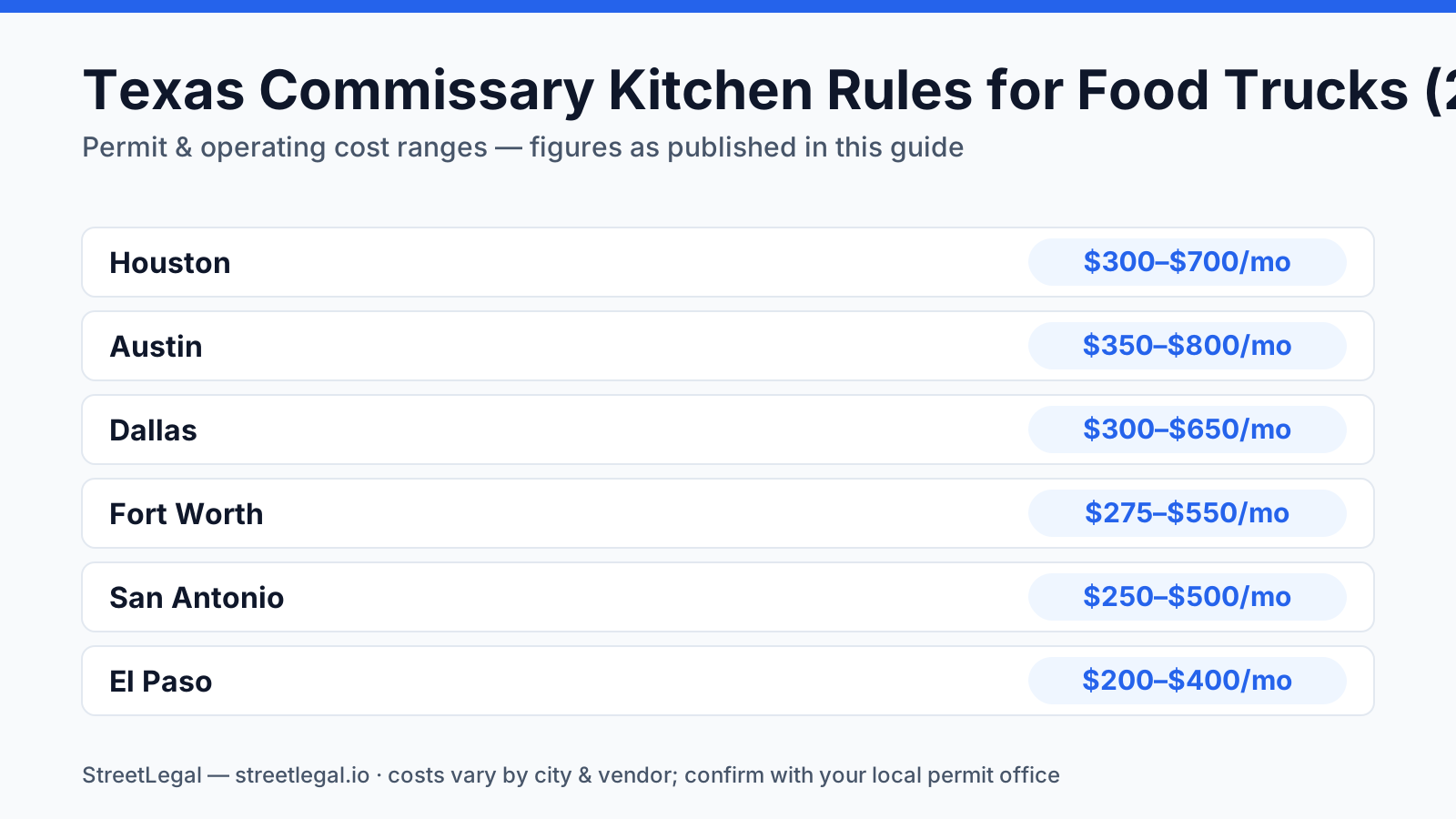
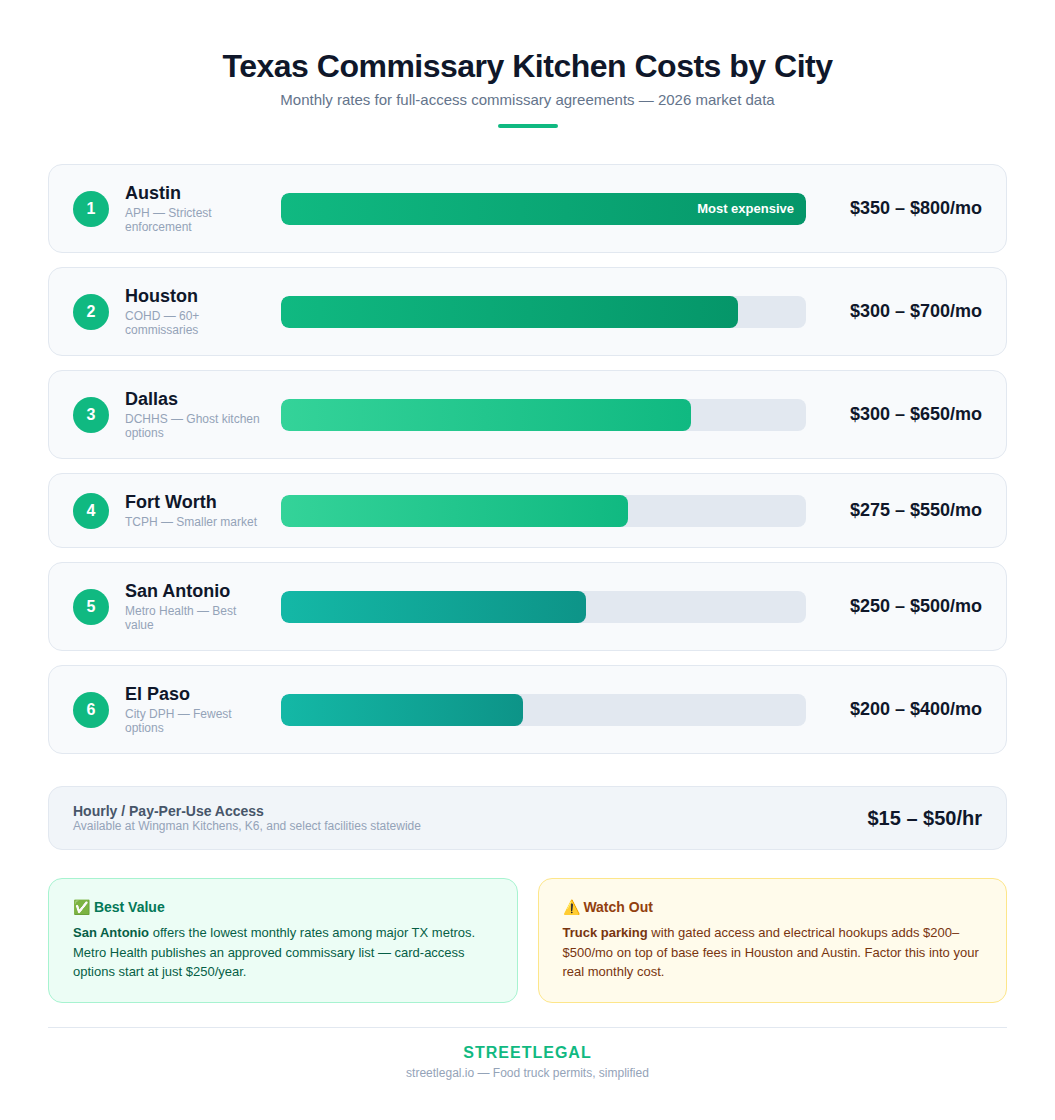
Commissary pricing varies significantly by metro. Austin is the most expensive — high demand, fewer licensed facilities relative to the number of food trucks. San Antonio and smaller Texas cities offer the best rates. Here is what to expect in 2026:
| City | Monthly Cost | What's Typically Included | Wait List? |
|---|---|---|---|
| Houston | $300–$700/mo | Water fill, wastewater, prep space, cold storage; truck parking extra ($200–$500/mo); 60+ licensed commissaries in metro | Rarely — competitive market |
| Austin | $350–$800/mo | Full access: prep, water, waste, storage; premium facilities include truck parking and 24/7 access | Yes — APH-licensed spots fill fast; book 2–4 weeks ahead |
| Dallas | $300–$650/mo | Prep space, water/waste, shared equipment; ghost kitchen crossover options available | Some premium spots — PREP Dallas opened 2025 |
| Fort Worth | $275–$550/mo | Water, waste, prep; fewer dedicated commissaries — many operators use restaurant agreements | Rarely — smaller market |
| San Antonio | $250–$500/mo | Best value in major TX metros; Metro Health publishes approved commissary list; card-access options from $250/yr | No — good availability |
| El Paso | $200–$400/mo | Fewer dedicated commissaries; operators often negotiate with restaurants; verify TFER licensing carefully | No — limited demand |
| Prep-time only (any city) | $150–$350/mo | Prep + water/wastewater only; no dedicated storage; typically hourly at $15–$50/hr | Varies |
When comparing commissary rates, factor in what is actually included. A $400/month commissary with wastewater dumping, water fill, cold storage, and prep time is a better value than a $250/month facility that only offers water fill and a signature. And keep in mind: secure overnight truck parking with gated access and electrical hookups typically adds $200–$500/month on top of base commissary fees in Houston and Austin.
Top Commissary Kitchens in Texas (2026)
These are real, operating commissary facilities across the major Texas metros. All are TFER-licensed and serve food truck operators. Verify current availability and pricing directly with each facility before signing:
| Facility | City | Monthly Cost | Key Amenities | Best For |
|---|---|---|---|---|
| PREP Houston | Houston | Call for rates* | Private + shared kitchens, cold/dry storage, 24/7 access; ask about truck parking & loading docks | High-volume trucks, catering crossover |
| Tastefully Yours | La Marque (Houston area) | Call for rates* | Truck parking with electrical hookups, gated storage, security monitoring, commercial equipment | Houston-area operators needing secure overnight parking |
| Wingman Kitchens | Houston, Austin, SA | $140–$500/mo | Hourly access ($8–$35/hr), health-dept approved, flexible plans, multiple locations | Part-time operators, new trucks on a budget |
| PREP ATX | Austin | $450–$800/mo | Austin's largest; private/shared/ghost/food truck kitchens, greywater drain, water fill station | Established Austin trucks, multi-concept operators |
| Capital Kitchens | Austin | $99/mo (food-truck commissary tier) | Shared-use kitchen, external greywater drain, water fill station, has served 100+ food trucks; separate full-kitchen membership runs $348–$396/mo | Food trucks needing central Austin location |
| K6 Shared Kitchen | Austin | $140–$1,900/mo | 1,800 sq ft, flexible access packages from hourly to full-time, commercial equipment | Scalable — works for startups through high-volume |
| PREP Dallas | Dallas | $400–$700/mo | 53 private kitchens, shared kitchen (10 stations), 10 MFU bases, 60,000+ sq ft; opened Q1 2025 | DFW operators, large-scale production |
| Truck Yard Commissary | Dallas (Lower Greenville) | $350–$550/mo | Kitchen + up to 6 weekend vending spots/mo at Truck Yard Dallas, The Colony, and Fort Worth locations | DFW trucks wanting built-in vending opportunities |
| SC Commissary & Catering | San Antonio | Call for rates* | Full commissary services, prep space, cold storage; confirm current Metro Health approval status directly | SA trucks, catering crossover |
| LocalSprout Food Hub | San Antonio | $400/mo (full access) or $250/yr (basic dump & fill) | Community food hub with commissary services, shared kitchen, food truck support | SA food entrepreneurs, community-oriented operators |
Prices shown are typical ranges based on 2026 market data. Many facilities offer hourly rates ($15–$50/hr) for operators who need less access. Always verify current pricing, availability, and TFER license status directly with the facility before signing any agreement. *"Call for rates" means the facility does not publish monthly pricing — contact them directly for a current quote.
Types of Commissary Arrangements in Texas
Not all commissary arrangements look the same. Texas health departments will accept several types of arrangements as long as the facility holds a valid TFER license:
Traditional Commissary Kitchen
Purpose-built facilities that lease space to food truck operators by the month. Provide prep space, water fill, wastewater, cold and dry storage, and often shared equipment (slicers, mixers, walk-ins). Most common option and the easiest to document for permit applications. Examples: PREP Kitchens (Houston, Austin, Dallas), Tastefully Yours (La Marque, Houston area).
Restaurant or Catering Company Agreement
A licensed restaurant or catering kitchen that agrees to serve as your commissary — typically cheaper than dedicated commissary facilities. Often negotiated as a flat monthly fee ($150–$300/month) or an agreement for off-hours kitchen access. Harder to find, but common in smaller markets and Fort Worth where dedicated commissaries are scarcer.
Ghost Kitchen / Shared Kitchen Hub
Full commissary plus dedicated prep space in a modern shared kitchen model. Higher end, but often turnkey — everything documented, licensed, and ready for your permit application. Examples: PREP ATX (Austin), Truck Yard Commissary (Dallas), CloudKitchens (DFW). Typically $400–$800/month.
Church or Institutional Kitchen
Some churches and community centers rent their kitchens to food truck operators. This can work — but only if the kitchen is licensed as a food establishment under TFER. Many church kitchens are not licensed, which disqualifies them entirely. Always ask to see the facility's current health department permit before agreeing to use one.
Hourly / Pay-Per-Use Access
Several Texas facilities — including Wingman Kitchens and K6 Shared Kitchen — offer hourly access starting at $8–$50/hour. This model works well for part-time operators, weekend-only trucks, or new operators testing the market before committing to a monthly agreement. Verify the facility provides all required commissary services, not just prep space.
Not Acceptable: Home Kitchens or Unlicensed Facilities
Home kitchens are not licensed food establishments under TFER. Neither are most personal storage units, garages, or informal shared spaces. Using an unlicensed facility as your commissary is a permit rejection — and if discovered post-permit, can result in permit revocation.
What a Texas Commissary Agreement Must Include
A valid Texas commissary agreement is a written document — not an informal handshake, not a text message, and not a simple lease. Most Texas health departments want it on commissary letterhead. At minimum, it must include:
- Commissary name, address, and license number: The full legal address and the commissary's current food establishment permit number from the relevant health authority (COHD, APH, DCHHS, TCPH, SAMHD, etc.).
- Owner and operator names: Both the commissary owner (or authorized representative) and the food truck operator must be identified by name.
- Services included: Explicitly list what the commissary provides — food prep space, water fill station, wastewater disposal, cold storage, equipment storage. Inspectors will check that your agreement covers what your operation actually requires.
- Access hours and schedule: When you can access the facility. A commissary agreement that provides 24/7 access is worth more than one that restricts you to daytime hours only.
- Agreement term and renewal date: Month-to-month or annual. Most health departments prefer a defined term. You must notify your health department when you change commissaries.
- Commissary owner signature: The commissary operator must sign. An unsigned agreement is rejected immediately.
Ask the commissary for a copy of their current health department license to attach to your permit application. Inspectors in Houston and Austin commonly ask for it, and having it ready speeds up application review by days.
How to Find a Commissary Kitchen in Texas
Finding a commissary is the single most time-consuming step in the Texas food truck permitting process. Here are the most effective strategies, ranked by reliability:
Pro Tip: Use DSHS to Verify Before You Sign
The Texas Department of State Health Services (DSHS) maintains a searchable database of licensed food establishments. Before signing any commissary agreement, look up the facility on the DSHS database to confirm their license is active, current, and covers the services they are offering. An expired or suspended license means you cannot use that facility. Search at dshs.texas.gov/food-establishments — filter by city and establishment type.
- DSHS licensed establishment database: Search TFER-licensed food establishments by city and zip code. Filter for commissary kitchens or shared kitchen facilities. This is the authoritative source — if a facility is not in this database with a current license, it cannot serve as your commissary.
- Call your local health department: COHD, APH, DCHHS, TCPH, Metro Health, and most county health departments will name approved commissary facilities over the phone. This is an underused shortcut — inspectors deal with new operators every week and often know exactly which commissaries have open slots. San Antonio Metro Health publishes a commissary list on sa.gov.
- The Kitchen Door (thekitchendoor.com): A national shared kitchen marketplace with strong Texas listings. Filter by city and "food truck friendly" — shows current availability for Houston, Austin, Dallas, Fort Worth, San Antonio, and El Paso.
- Texas Food Truck Association and city-specific Facebook groups: "Texas Food Truck Operators," "Houston Food Truck Network," "Austin Food Truck Community" — these groups have active commissary threads where operators share leads, warn about facilities with problems, and sometimes post available slots.
- Ask other food truck operators at parks: At any food truck park in Houston, Austin, or Dallas, at least half the operators will tell you their commissary if you ask. Operators in the same market are often willing to share information about facilities they trust.
- Local shared kitchen incubators: PREP Kitchens (Houston, Austin, Dallas), Wingman Kitchens (Houston, Austin, SA), Capital Kitchens (Austin), Kitchen Factories (Austin), and several Houston-based culinary incubators are all TFER-licensed and commissary-capable.
Common Commissary Mistakes Texas Operators Make
These are the mistakes that result in permit denials, delays, and operator headaches across Texas every year:
Using an unlicensed kitchen and getting denied at permit inspection
The most common mistake statewide. Someone finds a kitchen that "looks commercial" — maybe a church, a catering company's back room, or a closed restaurant — and assumes it qualifies. Inspectors check the license number on your commissary agreement against the TFER database. If it is not there, or if the license is expired, your application is rejected.
Using a commissary from a different jurisdiction than your operating area
An operator in Austin signs a commissary agreement with a Dallas facility. Or operates in Houston city limits but uses a commissary that is only HCPH-licensed. The commissary must be approved by the same health department that licenses your truck. Cross-jurisdiction commissary arrangements require explicit approval — never assume it is acceptable.
Dropping your commissary because of HB 2844 — before your city confirms the exemption
HB 2844 removes the state-level commissary requirement effective July 1, 2026, but it does not automatically override local health department ordinances. If your city still requires a commissary agreement, you need one — period. Do not cancel your commissary contract until your health department explicitly confirms you qualify for the exemption.
Operating month-to-month with no written agreement
Some commissary operators accept verbal or informal arrangements. Texas health departments do not. You must have a signed, written commissary agreement on file with your health department. A verbal deal or a text message from the commissary owner will not pass a permit inspection or renewal review.
Changing commissaries without notifying the health department
Operators switch commissaries — sometimes because a facility closes, sometimes because they find a better deal. Many do not notify their health department, which means their permit still shows the old commissary address. At a random inspection or renewal, this creates a compliance problem. Any commissary change must be reported to your health department with a new signed agreement.
Not keeping the commissary agreement on the truck
Houston (COHD) and Austin (APH) inspectors both commonly ask to see the commissary agreement during random truck inspections. The agreement should be kept on the truck with your other permit documentation — not at home, not in an email on your phone. Print it, laminate it, keep it in your permit binder on the truck.
Signing a long-term contract without touring the facility first
Online listings look great, but the reality on the ground matters. Some commissaries have 3 a.m. access restrictions that conflict with your prep schedule. Others have one water fill station shared by 20 trucks. Always tour the facility during your intended operating hours before signing anything longer than month-to-month.
Texas Commissary Kitchen FAQ
Do I need a commissary if I operate a food truck in Texas?
Can I use my restaurant as my own commissary?
What is the difference between a commissary and a shared kitchen?
What happens if my commissary loses its license?
Does HB 2844 eliminate the commissary requirement?
Do I need a commissary in every city I operate in?
How do I change my commissary on my food truck permit?
How much does a commissary cost in Texas?
Official Resources — Verify Current Requirements
State & City Health Department Links
- Texas DSHS — Licensed Food Establishments — Search the TFER database to verify your commissary's license status before signing
- HB 2844 Full Text — Read the bill that changes Texas food truck commissary rules effective July 1, 2026
- City of Houston Health Dept (COHD) — Commissary requirements for Houston-licensed food trucks
- Austin Public Health (APH) — Environmental health services, mobile food vendor licensing
- Dallas County DCHHS — Dallas County food establishment licensing and commissary approval
- Tarrant County Public Health (TCPH) — Fort Worth area food truck and commissary permitting
- San Antonio Metro Health — Mobile food vendor permitting, published commissary list
- El Paso Dept of Public Health — Food establishment licensing and commissary requirements
Requirements shown above reflect 2026 figures. Always confirm current rules with your specific local health department before filing.
Related Texas Food Truck Guides
Ready to move beyond commissary basics? These city-specific guides cover the full permit process, fees, and inspection requirements for each major Texas market:
Answers to the most common permit questions — costs, timelines, commissary rules, and more.
Find city-level permit guides for every state we cover — compare costs and requirements.
More from the blog
Food Truck POS Systems: Square vs. Toast vs. Clover vs. Avocado (2026)
Real 2026 pricing, hardware costs, offline mode, and contract terms for Square, Toast, Clover, and Avocado — compared specifically for food truck operators.
City GuidesEagan, MN Food Truck Permit Guide
Eagan MN food truck permit guide: MDH mobile food licensing, Dakota County food safety, city peddler rules, commissary records, costs, and launch timeline.
City GuidesBentonville, AR Food Truck Permit Guide
Complete guide to food truck permits, fees, and requirements in Bentonville, AR.
City GuidesBiloxi, MS Food Truck Permit Guide
Biloxi food truck permit guide 2026: licenses, health permit steps, commissary records, inspections, costs, renewal timing, and launch checklist.