· 9 min read · StreetLegal Team

Commissary Kitchens in Pittsburgh: Directory, Costs & Requirements (2026)
Updated June 28, 2026.
Every food truck in Pittsburgh needs a commissary kitchen before it can legally operate. The Allegheny County Health Department won't issue your health permit without a signed commissary agreement, and the City of Pittsburgh PLI requires the same for your vendor license. No commissary, no permits.
This guide covers what ACHD requires, what it actually costs, where to find a kitchen in Pittsburgh, and how to avoid the paperwork mistakes that delay permits.
ACHD Commissary Requirements
The Allegheny County Health Department (ACHD) enforces commissary requirements for all food trucks operating in Pittsburgh and Allegheny County. These aren't suggestions — they're hard requirements that block your permit if not met.
What ACHD Requires
- Licensed facility: Your commissary must hold its own current ACHD food facility permit. An unlicensed kitchen — even a commercial one — doesn't count.
- Written commissary agreement: The commissary operator must sign a formal agreement. ACHD may require their specific form (HR-FFS-17). Check with ACHD before submitting a generic template.
- Specified services: The agreement must list exactly which services the commissary provides: food preparation, food storage, equipment cleaning, utensil sanitization, wastewater disposal, and fresh water refilling.
- Access schedule: The agreement must state your access days and hours. ACHD wants to see that you have reliable, regular access — not occasional or "as available."
- Annual renewal: Commissary agreements must be updated each time you renew your health permit. An expired agreement blocks renewal.
- Inspection access: ACHD inspectors may visit your commissary to verify the relationship and that the facility matches what's documented.
Where to get the form: Contact the Allegheny County Health Department Food Safety Program directly. Phone: (412) 578-8044.
Pittsburgh Commissary Kitchen Directory
Finding a commissary in Pittsburgh is easier than most cities, but the options vary significantly in price, services, and availability. Here are the types of facilities Pittsburgh food truck operators use:
Shared Commercial Kitchens
Purpose-built shared kitchens that rent space to food businesses. These are the most common commissary option for food truck operators because they're designed for the workflow: prep stations, cold storage, cleaning facilities, and often wastewater handling.
- Typical pricing: $15–$35/hour or $400–$900/month for regular access
- Best for: Operators who need reliable daily access, high-volume trucks, operators prepping multiple menus
- Where to look: Strip District, Lawrenceville, and East Liberty have the highest concentration of shared kitchen facilities
Incubator Kitchens
Pittsburgh has a strong food incubator scene. These kitchens often offer below-market rates and business support in exchange for participating in their program.
- Pittsburgh Kitchen Incubator: Part of the broader Pittsburgh food business development ecosystem. Offers subsidized kitchen access for qualifying food entrepreneurs.
- Pricing: Varies by program — some are grant-funded, others charge $10–$20/hour
- Best for: New operators, operators who qualify for economic development programs, food entrepreneurs building a first menu
Restaurant Kitchen Partnerships
Many Pittsburgh food truck operators partner with restaurants to use their kitchen during off-peak hours (early morning, late night, or days the restaurant is closed).
- Typical pricing: $300–$700/month
- Requirements: The restaurant must hold a valid ACHD permit. You need a signed commissary agreement — a verbal arrangement won't pass inspection.
- Best for: Budget-conscious operators, trucks with simple prep needs, operators with existing restaurant relationships
- Watch out for: Access can be unreliable if the restaurant changes hours or ownership. Verify wastewater handling — not all restaurants have dump stations suitable for food truck waste tanks.
Church and Community Kitchens
Some churches and community organizations in Pittsburgh rent kitchen space. These can be affordable, but there's a critical catch: the facility must hold an ACHD food facility permit. Many church kitchens don't.
- Typical pricing: $100–$400/month
- Critical requirement: Verify ACHD licensing before signing. An unlicensed church kitchen will get your permit application rejected.
Finding Kitchens
- StreetLegal Kitchen Marketplace: Browse verified kitchens with licensing status, pricing, and contact info.
- PA Department of Agriculture — Retail Food: pa.gov retail food — statewide licensing and food safety requirements for retail food facilities and commissaries.
- ACHD licensed facility database: Search for licensed food facilities in Allegheny County. Contact ACHD at (412) 578-8044.
- Word of mouth: Other Pittsburgh food truck operators are the most reliable source. Most operators are willing to share commissary info — it's not a competitive secret.
What a Pittsburgh Commissary Actually Costs
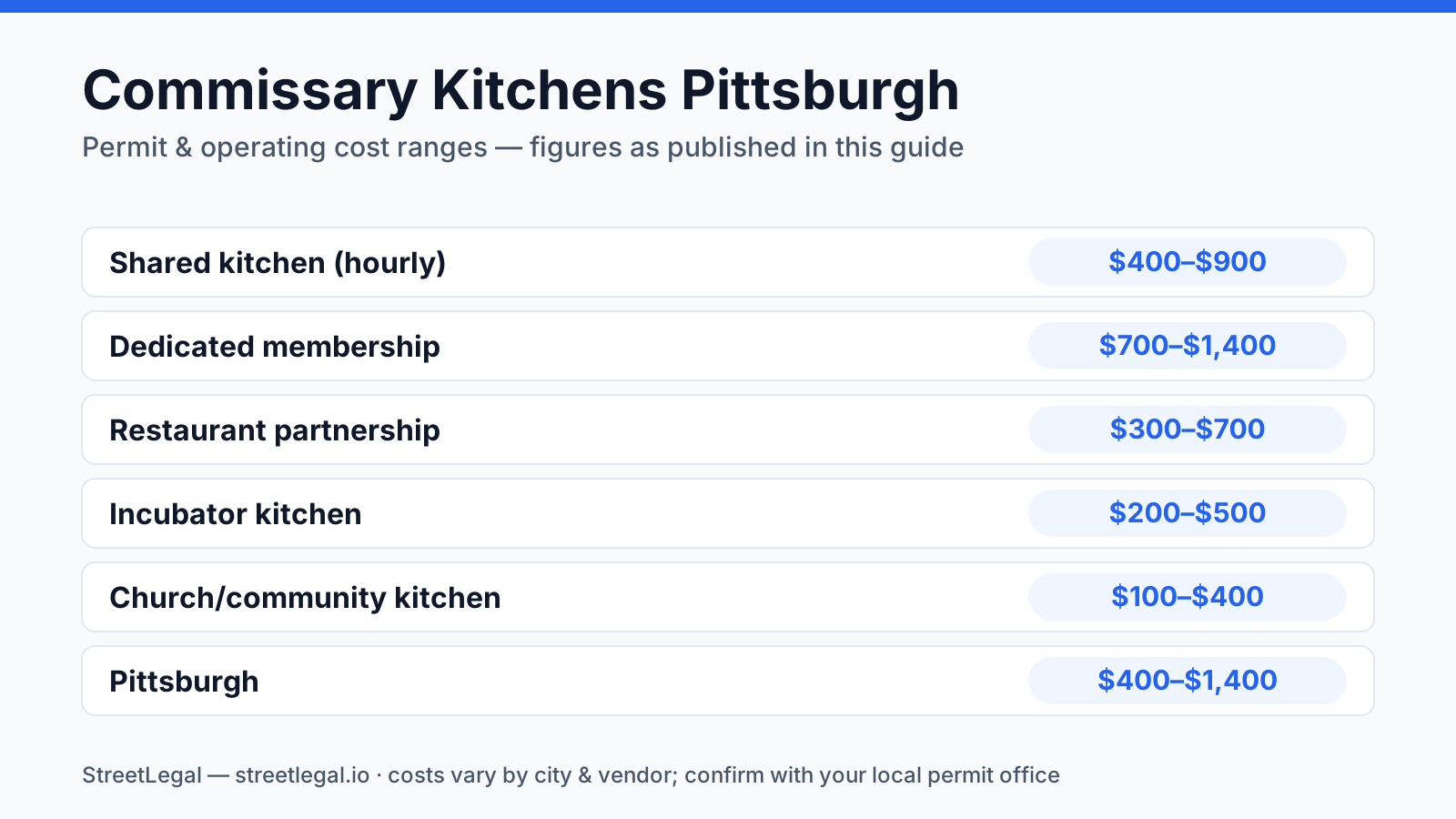
Commissary costs are one of the biggest recurring expenses for Pittsburgh food truck operators. Here's the real breakdown:
| Arrangement | Monthly Cost | Annual Cost | Best For |
|---|---|---|---|
| Shared kitchen (hourly) | $400–$900 | $4,800–$10,800 | Part-time operators, weekend trucks |
| Dedicated membership | $700–$1,400 | $8,400–$16,800 | Full-time, high-volume trucks |
| Restaurant partnership | $300–$700 | $3,600–$8,400 | Budget operators, simple prep |
| Incubator kitchen | $200–$500 | $2,400–$6,000 | New operators, qualifying businesses |
| Church/community kitchen | $100–$400 | $1,200–$4,800 | Low-volume, must verify ACHD license |
What's Included (and What's Extra)
Monthly membership rates at most Pittsburgh shared kitchens typically include:
- Prep station access during your scheduled hours
- Dry storage (limited — usually a shelf or cabinet)
- Shared refrigeration and freezer space
- Equipment cleaning area
- Basic utilities (water, electric, gas)
You'll often pay extra for:
- Dedicated cold storage or walk-in space
- Extended or overnight access
- Wastewater dump station use (some charge per dump)
- Equipment rental (mixers, specialized cookware)
- Overnight truck parking
How to Reduce Commissary Costs
- Negotiate a restaurant deal: Off-peak hours are dead time for restaurants. Many will rent kitchen access for $300–$500/month — cheaper than any shared kitchen.
- Share with another operator: Two food trucks splitting a commissary membership is common in Pittsburgh. Just make sure both operators have their own signed agreements.
- Check incubator programs: Pittsburgh's economic development ecosystem sometimes funds kitchen access for qualifying food entrepreneurs. Worth asking even if you're not sure you qualify.
- Start hourly, upgrade later: Pay-per-hour access ($15–$35/hr) often makes more sense for new trucks that aren't running daily yet.
Getting Your Commissary Agreement Right
The commissary agreement is the single most common reason Pittsburgh food truck permit applications get delayed. Here's exactly what needs to be in it:
Required Elements
| Element | What to Include |
|---|---|
| Commissary business name | Legal business name, not a DBA or abbreviation |
| Physical address | Full street address of the kitchen facility |
| ACHD permit number | The commissary's current food facility license number — verify this is active |
| Services provided | Check all that apply: food prep, food storage, equipment cleaning, utensil sanitization, wastewater disposal, fresh water, overnight parking |
| Access schedule | Specific days and hours you have access — not "as needed" or "by arrangement" |
| Agreement dates | Start and end dates, usually aligned with your permit cycle (12 months) |
| Commissary operator signature | Must be the licensed operator or authorized signer — not a manager or employee |
| Your operator info | Your business name, food truck name, and contact info |
Pro tip: Ask ACHD if they require their specific form (HR-FFS-17) or accept any format. Using their form eliminates the most common rejection reason — missing required fields.
How to Verify a Kitchen's ACHD License
Before you sign anything, verify the commissary's license. This step catches the most expensive mistake food truck operators make.
- Ask for the permit number. Any legitimate commissary will have their ACHD food facility permit posted in the kitchen. Ask for the number.
- Call ACHD directly. Phone: (412) 578-8044. Give them the facility name and address. Ask: "Is this facility currently licensed as a food facility under ACHD?" and "Is the license active and in good standing?"
- Visit the facility. Walk through before signing. Check that the kitchen actually has the equipment and space described in the agreement. If they claim wastewater disposal, see the dump station.
- Check for violations. Ask ACHD if the facility has any open violations or enforcement actions. A commissary under enforcement can create problems for your own permit.
Red flag: If a kitchen operator can't produce their permit number or gets evasive when you ask, walk away. An unlicensed commissary will get your entire application rejected and cost you weeks.
Common Mistakes That Delay Pittsburgh Permits
- Using an unlicensed kitchen. The most expensive mistake. A friend's restaurant, an unlicensed church kitchen, or a commercial space without ACHD certification — none of these count. Your application gets bounced and you start over.
- Submitting a vague agreement. "Access as needed" or "services as required" gets rejected. ACHD wants specific days, hours, and services. Be detailed.
- Missing the operator's signature. The agreement must be signed by the commissary's licensed operator — not a kitchen manager, not a building owner. Wrong signature = rejected.
- Expired commissary permit. You sign the agreement, but the commissary's own permit expires before your application is reviewed. Always check the permit expiration date and set a reminder.
- Not listing wastewater disposal. If your truck generates gray water (and it does), ACHD expects to see wastewater handling in your commissary agreement. Leaving it off raises questions during review.
- Commissary in a different county. Using a commissary outside Allegheny County can complicate your application. ACHD strongly prefers — and may require — a commissary within their jurisdiction.
Alternative Commissary Arrangements
Can I Build My Own Commissary?
Technically, yes — if you build or lease a commercial kitchen that meets ACHD standards and get it licensed as a food facility. In practice, this only makes sense for operators running multiple trucks or food businesses. The buildout cost ($50,000–$150,000+) and licensing timeline (months) make this impractical for single-truck operations.
Can I Use a Kitchen in Another County?
ACHD prefers commissaries within Allegheny County. If your commissary is in a neighboring county (Westmoreland, Butler, Washington, Beaver), you may need to get approval from ACHD and provide documentation showing why a local facility isn't feasible. Don't assume it'll be accepted — ask before signing a lease.
What About Shared Kitchen Co-ops?
Kitchen cooperatives — where multiple food businesses share ownership and costs of a licensed kitchen — exist in Pittsburgh. These can be cost-effective, but every operator in the co-op needs their own separate commissary agreement on file with ACHD. The co-op itself must hold the ACHD license.
Commissary Compliance Checklist
- ☐ Identified a commissary kitchen in Allegheny County
- ☐ Verified the facility holds a current, active ACHD food facility permit
- ☐ Visited the kitchen and confirmed it has the equipment/space you need
- ☐ Confirmed wastewater dump station availability
- ☐ Obtained ACHD's required commissary agreement form (HR-FFS-17 or current version)
- ☐ Filled in all required fields — no blanks, no vague language
- ☐ Got the commissary operator's signature (not a manager or employee)
- ☐ Noted the commissary's permit expiration date
- ☐ Set a renewal reminder 60 days before your health permit renewal
- ☐ Stored a copy of the signed agreement and commissary permit in your StreetLegal document vault
Pittsburgh Commissary Kitchen Costs vs. Other Cities
Pittsburgh's commissary costs are moderate compared to other major food truck markets:
| City | Typical Monthly Commissary Cost |
|---|---|
| Pittsburgh | $400–$1,400 |
| Los Angeles | $800–$2,500 |
| New York City | $1,000–$3,000 |
| Chicago | $500–$1,500 |
| Houston | $350–$1,200 |
| Austin | $400–$1,000 |
| Dallas | $350–$1,100 |
Pittsburgh sits in the middle — more expensive than Texas cities, less than NYC or LA. The quality of available kitchens is strong relative to the cost, especially in the Strip District corridor.
Next Steps
Your commissary agreement is one of the first things you need to lock down — it's required before either your ACHD health permit or your City of Pittsburgh vendor license application moves forward. Start with the commissary, then build your permit stack around it.
For the full Pittsburgh permit walkthrough — including health permits, vendor licenses, fire inspections, insurance, and timelines — see our complete Pittsburgh Food Truck Permit Guide.
For Pennsylvania-wide commissary rules, read Commissary Kitchen Requirements for PA Food Trucks.
People also ask about Pittsburgh food truck permits
How much does a food truck permit cost in Pittsburgh?
How long does it take to get a food truck permit in Pittsburgh?
Do I need a commissary kitchen to operate a food truck in Pittsburgh?
What documents do I need for a Pittsburgh food truck permit?
Answers to the most common permit questions — costs, timelines, commissary rules, and more.
Find city-level permit guides for every state we cover — compare costs and requirements.
More from the blog
Jefferson County, MO Food Truck Permit Guide
Complete guide to food truck permits, fees, and requirements in Jefferson County, MO.
City GuidesSt. Charles County, MO Food Truck Permit Guide
Complete guide to food truck permits, fees, and requirements in St. Charles County, MO.
City GuidesSt. Louis County, MO Food Truck Permit Guide
Complete guide to food truck permits, fees, and requirements in St. Louis County, MO.
Buyer's GuideFood Truck POS Systems 2026: Square, Toast, Clover & Avocado
Compare 2026 food truck POS systems by pricing, hardware costs, offline mode, and contract terms for Square, Toast, Clover, and Avocado.