· 6 min read · StreetLegal Team
How Much Does a PA Food Truck Permit Cost in 2026?
One of the first questions every aspiring food truck operator asks: "How much is this going to cost me?" The answer depends entirely on where in Pennsylvania you plan to operate. Each city has its own fee structure layered on top of state-level requirements.
We've broken down the costs for every major PA food truck market so you can budget accurately before investing a dollar. This guide covers Pittsburgh, Philadelphia, Allentown, Erie, Harrisburg, and Reading — with exact fees, hidden costs, and strategies to keep your startup expenses under control.
PA Food Truck Permits — At a Glance
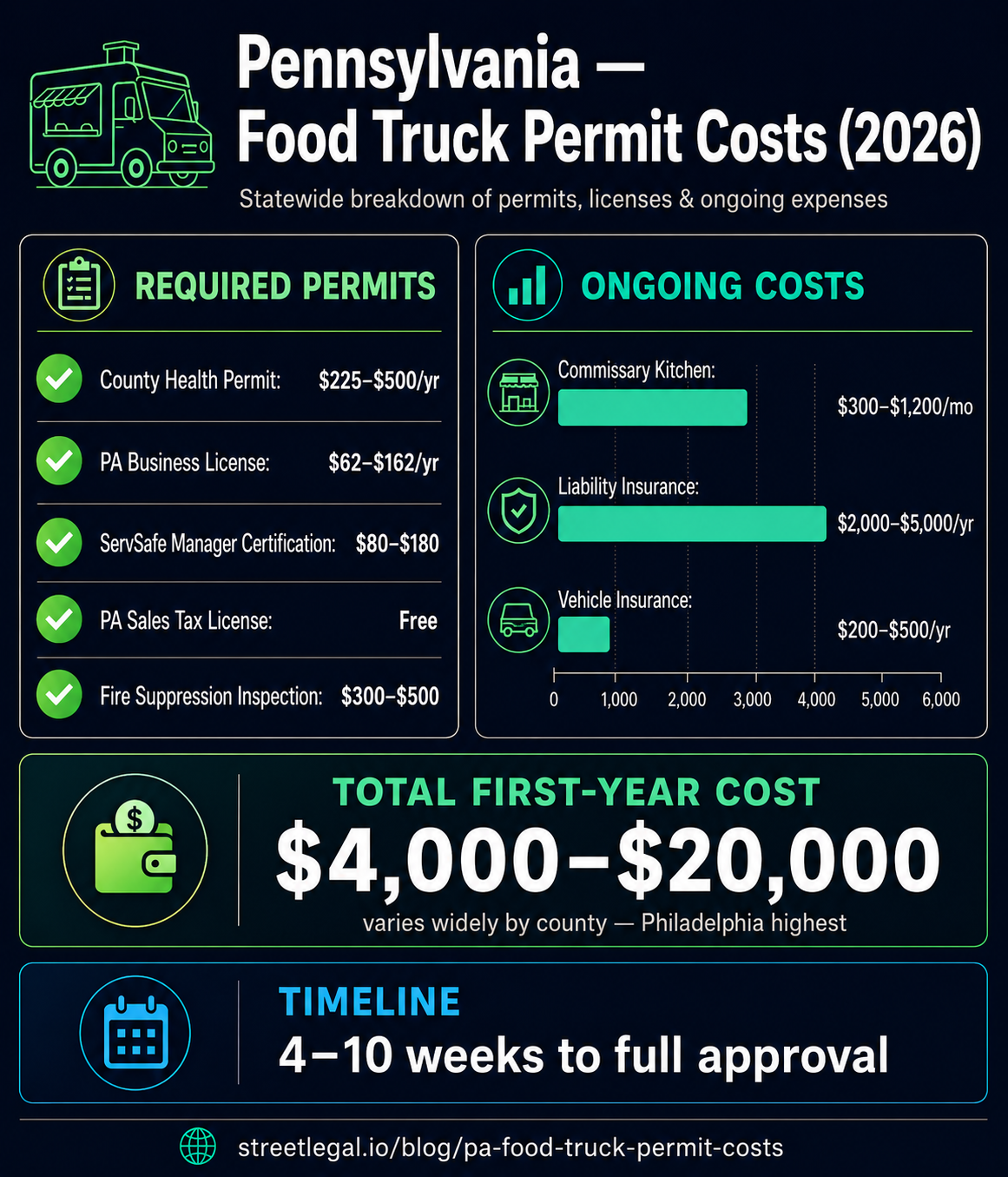
Total First-Year Cost
$4,000 – $20,400
Varies by city and commissary
Timeline to Launch
4 – 10 Weeks
Health inspection is the bottleneck
Key Requirements
State: Food Establishment License, Sales Tax License, Food Handler Cert
City: Vendor License, Health Permit, Commissary Agreement
Statewide Costs (Required Everywhere in PA)
No matter which city you operate in, every Pennsylvania food truck needs these:
| Permit / License | Cost | Frequency |
|---|---|---|
| PA Food Establishment License | $62–$162 | Annual |
| PA Sales Tax License | Free | One-time |
| Food Handler Certification | $15–$180 | 3–5 years |
| Commercial Auto Insurance | $2,000–$5,000 | Annual |
| General Liability Insurance | Included above | Annual |
| State-level subtotal | $2,077–$5,342 |
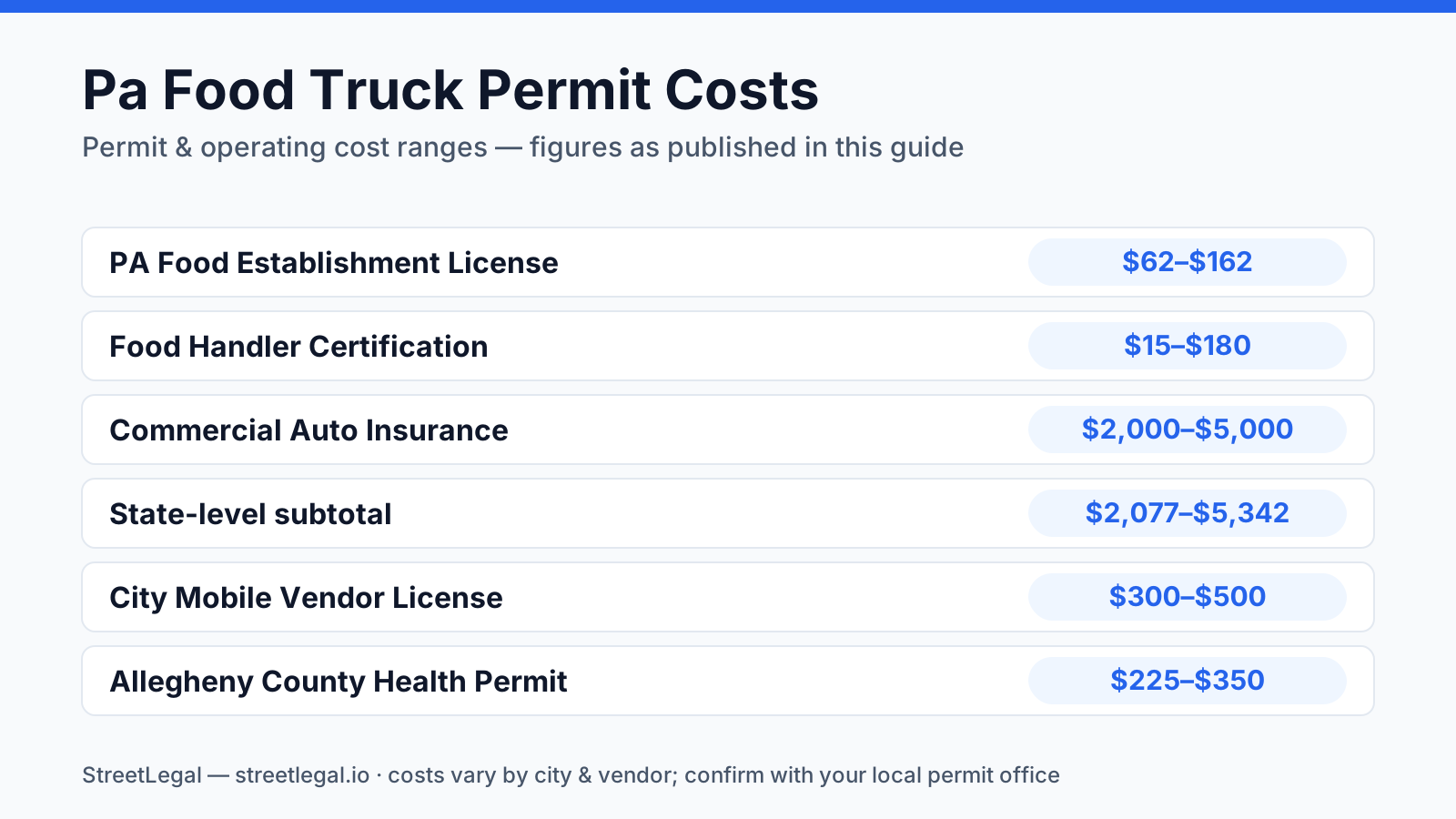
The PA Food Establishment License scales with gross food sales — operators under $50,000 pay $62; those above $500,000 pay $162. Most food trucks fall in the $62–$112 range.
Pittsburgh Costs
| Permit | Cost |
|---|---|
| City Mobile Vendor License | $300–$500 |
| Allegheny County Health Permit | $225–$350 |
| Commissary Kitchen (annual) | $3,600–$9,600 |
| Pittsburgh city-level subtotal | $4,125–$10,450 |
| Total with state costs | $6,200–$15,800 |
Pittsburgh's Allegheny County sales tax is 7% (6% state + 1% county). Commissary costs are generally lower than Philadelphia due to more available kitchen space relative to demand.
Required Permits in Pittsburgh
Pittsburgh food truck operators need permits from three levels of government:
- City of Pittsburgh Mobile Vendor License — issued by the Department of Permits, Licenses, and Inspections. Apply at the City-County Building on Grant Street or online through the city's ePermit portal.
- Allegheny County Health Department (ACHD) Food License — required for all food operations. ACHD conducts the health inspection and issues the Mobile Food Facility license. Expect a 3-4 week wait for inspection scheduling.
- State-level permits — PA Food Establishment License and Sales Tax License (see statewide costs above).
Commissary Options in Pittsburgh
Pittsburgh has a growing commissary market with options across the city:
- Iron City Kitchen (Strip District) — full-service commissary, $400-$700/month for food truck operators. Includes cold storage, prep space, and wastewater disposal.
- Church kitchens and community centers — several churches in Lawrenceville and East Liberty rent certified kitchen space at $200-$400/month. Check ACHD approval status before signing a lease.
- Shared restaurant kitchens — some restaurants rent off-hours kitchen access for $300-$600/month. Negotiate morning prep hours before the restaurant opens.
For a full list of approved options, see our PA commissary kitchen requirements guide.
Local Tips for Pittsburgh
- ACHD requires a plan review before scheduling your inspection. Submit your truck layout, equipment specs, and menu with your initial application to avoid a second round of paperwork.
- The city's designated vending zones are listed on the Pittsburgh Mobile Vendor map. Downtown and Oakland have the most foot traffic but also the most competition.
- Pittsburgh's food truck association negotiates group insurance rates — membership typically saves $200-$500/year on commercial auto policies.
- For a complete walkthrough of the Pittsburgh permitting process, see our Pittsburgh food truck permit guide.
Philadelphia Costs
| Permit | Cost |
|---|---|
| Mobile Food Vending License | $300 |
| Health Department Inspection & Cert | $200–$400 |
| BIRT Registration | Free (tax filed annually) |
| Commissary Kitchen (annual) | $4,800–$14,400 |
| Philadelphia city-level subtotal | $5,300–$15,100 |
| Total with state costs | $7,400–$20,400 |
Philadelphia's combined sales tax rate is 8% (6% state + 2% city). The BIRT tax adds an extra filing obligation, and commissary costs are among the highest in the state due to demand.
Required Permits in Philadelphia
Philadelphia has one of the most complex permit stacks in the state:
- Mobile Food Vending License — issued by the Department of Licenses and Inspections (L&I). Apply online or at the Municipal Services Building on JFK Boulevard.
- Philadelphia Department of Public Health Food License — requires health inspection and plan review. Schedule through the Environmental Health Services division.
- BIRT Registration — mandatory for any business operating in Philadelphia. Registration is free, but you must file the Business Income and Receipts Tax annually (1.415 mills on gross receipts + 5.99% on net income).
- Commercial Activity License (CAL) — required for businesses conducting commercial activity in Philadelphia. $300/year.
- State-level permits — PA Food Establishment License and Sales Tax License.
Commissary Options in Philadelphia
- The Kitchen (Kensington) — purpose-built commissary for food trucks, $500-$1,200/month depending on hours and storage needs.
- Venue Lab (South Philadelphia) — offers shared kitchen access with flexible scheduling, $400-$800/month.
- Restaurant off-hours rentals — common in Center City and University City. Negotiate 5am-10am prep windows for $350-$700/month.
Philadelphia commissary costs are the highest in the state. Budget aggressively here — it's usually your single largest ongoing expense. See our commissary kitchen requirements guide for what inspectors look for.
Local Tips for Philadelphia
- Don't forget BIRT. This is the number one mistake new Philly food truck operators make. Even if your net income is zero in year one, you must register and file. Penalties for non-filing are steep.
- Philadelphia enforces a proximity restriction — food trucks cannot operate within a certain distance of brick-and-mortar restaurants. This limits your legal parking spots significantly.
- The Philly Mobile Food Association is an excellent resource for navigating the permit process and finding vending opportunities.
- For the full Philadelphia permitting walkthrough, see our Philadelphia food truck license guide.
Other PA Cities: Quick Cost Comparison
| City | Vendor License | Health Permit | Sales Tax Rate | Estimated Total Year 1 |
|---|---|---|---|---|
| Pittsburgh | $300–$500 | $225–$350 | 7% | $6,200–$15,800 |
| Philadelphia | $300 | $200–$400 | 8% | $7,400–$20,400 |
| Allentown | $150–$250 | $100–$200 | 6% | $4,300–$11,000 |
| Erie | $100–$200 | $100–$175 | 6% | $4,000–$10,500 |
| Harrisburg | $150–$300 | $100–$200 | 6% | $4,300–$11,500 |
| Reading | $100–$200 | $100–$175 | 6% | $4,000–$10,500 |
Smaller cities generally have lower license fees and less expensive commissary options, but also smaller customer bases. The economics depend on your menu, pricing, and local competition.
Hidden Costs Most Operators Forget
Beyond permits and licenses, budget for these often-overlooked expenses:
- Vehicle inspection and repairs: $200–$800/year. Health inspectors and city officials may flag equipment issues during inspections.
- Generator fuel: $50–$150/week depending on your power needs and hours of operation.
- Propane: $15–$40/tank, typically 1–3 tanks per week for cooking.
- Event permit fees: $25–$200 per event for special event or festival permits.
- Parking tickets: Seriously — budgeting $50–$100/month for parking-related expenses is realistic in urban areas.
- Accounting/tax prep: $300–$800/year. Philadelphia's BIRT and city wage taxes add complexity.
- Permit consultant fees: $1,500–$5,000 if you hire someone to handle applications for you. (Or use StreetLegal starting at $79/month to handle it with AI.)
Realistic Timeline: Start to Serving
Here is a realistic week-by-week timeline for getting your Pennsylvania food truck permitted and operational. Most operators underestimate this — plan for 6-10 weeks, not 2-3.
| Week | Action | Notes |
|---|---|---|
| Week 1 | Secure commissary agreement | Tour 2-3 commissaries, verify health department approval, sign agreement. You cannot submit most applications without this. |
| Week 2 | Submit all applications simultaneously | File for PA Food Establishment License, city vendor license, county health permit, and sales tax license. Submit plan review materials with your health permit application. |
| Week 3 | Plan review period | County health department reviews your truck layout, equipment list, menu, and food safety plan. Address any questions promptly — delays here cascade. |
| Weeks 4-5 | Wait for inspection scheduling | This is the bottleneck. ACHD (Pittsburgh) and Philadelphia health inspectors are often booked 2-3 weeks out. Call to confirm your spot. |
| Week 6 | Health inspection | Inspector checks your truck, equipment, water systems, waste disposal, food storage temps, handwashing station. First-time pass rate is roughly 70% — most failures are minor fixes. |
| Weeks 7-8 | Receive permits, set up operations | If you passed inspection, permits typically issue within 5-10 business days. Use this time to finalize your vending locations and event calendar. |
| Week 8-10 | Begin serving | Start with familiar locations. Build your routine for commissary prep, truck stocking, and daily operations before scaling to events and new locations. |
Pro tip: Submit your applications on a Monday morning. Government offices process new applications at the start of the week, and you'll have the full week to respond to any questions or requests for additional documentation.
Top 5 Mistakes PA Food Truck Operators Make
We see these mistakes repeatedly from first-time operators in Pennsylvania. Every one of them costs money and delays your launch.
1. Operating Without a Commissary Agreement
This is the fastest way to get shut down. Both Allegheny County and Philadelphia health departments require a signed commissary agreement before they will issue your permit — and they verify it during inspections. Operating without one is a critical violation that results in immediate suspension. Don't assume you can "figure it out later."
2. Applying to the Wrong County Health Department
Pennsylvania's county-level health system confuses newcomers. If you operate in Pittsburgh, you need an Allegheny County Health Department (ACHD) permit — not a state health permit. Philadelphia has its own city health department. Smaller cities may fall under the PA Department of Agriculture for food safety inspections. Always verify which agency has jurisdiction over your operating area before applying.
3. Forgetting BIRT in Philadelphia
Philadelphia's Business Income and Receipts Tax (BIRT) catches every new operator off guard. Registration is free and takes 10 minutes, but failing to register before you start operating triggers penalties. Even if you have zero net income in your first year, you must register and file. The city actively audits food vendors, and BIRT non-compliance can result in license revocation.
4. Submitting Incomplete Applications
The single biggest cause of permit delays is incomplete paperwork. Health departments will not begin processing your application until every required document is included. Common missing items: commissary agreement, truck layout diagram, equipment specification sheets, menu with preparation methods, and proof of food handler certification. Use our PA health inspection guide as a checklist.
5. Assuming Permits Transfer Between Cities
A Pittsburgh vendor license does not work in Philadelphia, and vice versa. Each city requires its own set of permits and health inspections. Operators who plan to work festivals and events across the state need to budget for multiple city-level permit stacks. This is where costs escalate quickly — and where centralized permit tracking becomes essential.
Renewal Tracking: When Each Permit Expires
Missing a renewal deadline means you cannot legally operate. Here is every permit, its renewal cycle, and what to expect:
| Permit / License | Renewal Cycle | Lead Time Needed | Notes |
|---|---|---|---|
| PA Food Establishment License | Annual (July 1) | 30 days | Renewal notice mailed ~60 days before expiration. Don't wait for it — mark your calendar. |
| City Vendor License (Pittsburgh) | Annual (calendar year) | 2-4 weeks | Apply for renewal in November to avoid January gaps. |
| City Vendor License (Philadelphia) | Annual (calendar year) | 2-4 weeks | L&I sends renewal notices but processing can be slow. |
| County Health Permit (ACHD) | Annual | 4-6 weeks | Requires re-inspection. Schedule early — inspector availability is the bottleneck. |
| Philadelphia Health License | Annual | 4-6 weeks | Re-inspection required. Apply at least 6 weeks before expiration. |
| Food Handler Certification | 3-5 years | 1 week | Can be renewed online. Some certifications (ServSafe) are 5 years; others are 3. |
| Commercial Auto Insurance | Annual (varies) | 2-4 weeks | Shop rates 30 days before renewal. Lapse in coverage = immediate permit suspension. |
| Commissary Agreement | Annual (varies) | 30 days | Renegotiate terms and confirm pricing before auto-renewal. |
| BIRT Filing (Philadelphia) | Annual (April 15) | N/A — file by deadline | Tax filing, not a permit renewal. Extensions available but must be requested. |
The easiest way to miss a deadline is to track permits in a spreadsheet that you never check. StreetLegal sends automated renewal reminders 60, 30, and 7 days before each deadline — so you never get caught off guard.
Where to Operate: Best Locations and Events
Having permits is only half the equation — you need customers. Here are the highest-traffic locations and events for food trucks in Pennsylvania's two largest markets.
Best Locations in Pittsburgh
- Market Square (Downtown) — lunch crowd from surrounding office buildings. High foot traffic Monday-Friday, 11am-2pm. Requires city vending zone permit.
- Oakland / University of Pittsburgh area — student population creates steady demand. Best during the academic year (September-April). Evening hours work well here.
- Strip District — Saturday morning foot traffic is excellent. Complement the existing food scene rather than competing directly with it.
- Lawrenceville / Butler Street — growing residential area with a food-forward culture. Evening and weekend demand.
- PNC Park / Heinz Field area — game day revenue can be significant, but event permits and parking are competitive. Book early for Steelers and Pirates seasons.
Best Locations in Philadelphia
- University City (30th Street area) — lunch demand from Drexel, UPenn, and surrounding offices. One of the highest-volume food truck zones in the city.
- Center City (Market Street corridor) — competitive but high-volume. The proximity restriction to restaurants limits available spots, so scout locations early.
- Food truck parks (Germantown, South Philly) — lower per-customer volume but lower overhead (shared infrastructure, no parking hassles).
- Navy Yard — growing corporate campus with limited food options. Lunch weekdays only, but consistent demand.
Top Events for PA Food Trucks
- Pittsburgh Food Truck Roundup — multiple events throughout summer. Good exposure for new operators.
- Philly Food Truck Festival — annual event drawing large crowds. Apply early — vendor spots fill up months in advance.
- Three Rivers Arts Festival (Pittsburgh, June) — two weeks of high foot traffic in Point State Park. Vendor applications open in January.
- Made in America Festival (Philadelphia, September) — massive event on the Benjamin Franklin Parkway. Premium vendor fees but premium revenue potential.
- Local farmers markets — many markets across both cities welcome food trucks. Lower fees ($25-$75/day) and repeat customers who visit weekly.
- Corporate catering and private events — often the most profitable per-hour work. Build relationships with event planners and office managers.
Multi-City Operating Costs
If you plan to operate in both Pittsburgh and Philadelphia (or other cities), remember that most permits don't transfer between cities. You'll need separate city-level vendor licenses and health permits for each location.
This can roughly double your permit costs — a strong argument for tracking everything centrally. StreetLegal was built specifically for multi-city operators who need to manage different requirements, deadlines, and fees across jurisdictions.
How to Reduce Permit Costs
- Share a commissary kitchen. Split costs with another operator for off-peak hours. Many kitchens offer part-time rates that can cut your commissary expense by 30-50%.
- Bundle insurance policies. Ask your insurer about commercial package policies that combine general liability, auto, and workers' comp at a discount. Multi-policy discounts of 10-20% are standard.
- Apply early to avoid rush fees. Some agencies charge expedite fees if you need last-minute processing. Filing 8-10 weeks before your target launch date eliminates this risk.
- Use automation tools. StreetLegal's AI fills out permit forms for you, potentially saving $1,500–$5,000 in consultant fees. Plans start at $79/month.
- Join an operator association. Both Pittsburgh and Philadelphia have food truck associations that negotiate group rates on insurance and commissary access. Annual dues ($50-$200) pay for themselves quickly.
The Bottom Line
Plan for $4,000–$10,000 in a smaller PA city and $6,000–$20,000 in Pittsburgh or Philadelphia for your first year of permits, licenses, insurance, and commissary costs. The biggest variable is your commissary kitchen expense — shop around aggressively.
The second-year cost drops significantly since you won't have first-time application fees, plan review costs, or setup expenses. Budget roughly 60-70% of your first-year total for renewal years.
Frequently Asked Questions
What permits do I need to operate a food truck in Pennsylvania?
Most food truck operators in Pennsylvania need a mobile food vendor or mobile food unit permit from the local health department, a city or county business license, and a state sales tax permit. A commissary agreement and fire inspection may also be required. Philadelphia operators also need BIRT registration and a Commercial Activity License.
How long does it take to get a food truck permit in Pennsylvania?
Plan for 4-10 weeks from application to approval. Health inspections and plan reviews are often the slowest step. Submit a complete application and schedule your inspection early to reduce wait times. See the detailed timeline above for a week-by-week breakdown.
Do I need a commissary kitchen to operate in Pennsylvania?
Most Pennsylvania jurisdictions require food trucks to operate from an approved commissary for prep, cleaning, and wastewater disposal. Allegheny County and Philadelphia both enforce this requirement strictly. Confirm commissary requirements with the local health department before choosing a location.
How much does a food truck permit cost in Pennsylvania?
Annual costs typically range from $500 to $3,000+ depending on permit type, commissary fees, and state registrations. First-year operators should budget an extra $1,000-$2,000 for inspections and setup. Total first-year costs range from $4,000 in smaller cities like Erie and Reading to over $20,000 in Philadelphia.
Do I need separate permits for Pittsburgh and Philadelphia?
Yes. Pennsylvania food truck permits do not transfer between cities. You need separate city-level vendor licenses and health permits for each municipality you operate in. This roughly doubles your permit costs for multi-city operations. See the multi-city section for details.
What is the BIRT tax in Philadelphia and does it apply to food trucks?
BIRT stands for Business Income and Receipts Tax. Every business operating in Philadelphia must register for BIRT, including food trucks. Registration is free but you must file and pay the tax annually based on your gross receipts and net income. The current rate is 1.415 mills on gross receipts plus 5.99% on net income. Failing to register is one of the most common mistakes new operators make.
Where can I operate my food truck in Pennsylvania?
Food trucks must operate in approved zones. Pittsburgh has designated vending zones listed on the city's mobile vendor map. Philadelphia restricts food trucks from operating within certain distances of brick-and-mortar restaurants. See the where to operate section for the best locations and events in both cities.
Related Pennsylvania Guides
- Pittsburgh Food Truck Permit Guide — complete walkthrough of the Pittsburgh permitting process
- Philadelphia Food Truck License Guide — step-by-step guide to Philly permits and BIRT
- PA Commissary Kitchen Requirements — what inspectors look for and how to choose a commissary
- PA Food Truck Health Inspection Guide — inspection checklist and how to pass on the first try
Answers to the most common permit questions — costs, timelines, commissary rules, and more.
Find city-level permit guides for every state we cover — compare costs and requirements.
More from the blog
Jefferson County, MO Food Truck Permit Guide
Complete guide to food truck permits, fees, and requirements in Jefferson County, MO.
City GuidesSt. Charles County, MO Food Truck Permit Guide
Complete guide to food truck permits, fees, and requirements in St. Charles County, MO.
City GuidesSt. Louis County, MO Food Truck Permit Guide
Complete guide to food truck permits, fees, and requirements in St. Louis County, MO.
Buyer's GuideFood Truck POS Systems 2026: Square, Toast, Clover & Avocado
Compare 2026 food truck POS systems by pricing, hardware costs, offline mode, and contract terms for Square, Toast, Clover, and Avocado.