· Updated · 12 min read · Gibby, StreetLegal Editorial
How to Start a Food Truck in Seattle: Complete Permit Guide 2026
Seattle Quick Stats
- 🏛️ Primary permit: King County Public Health Mobile Food Unit (MFU) License
- 💰 License fee: $320–$615/year (based on risk level)
- 🏭 Commissary required: Yes — licensed commercial kitchen mandatory
- ⏱️ Timeline: 6–10 weeks from application to operating
- 📍 Unique challenge: Seattle's neighborhood councils + Pike Place Market zone restrictions
Seattle's Food Truck Regulatory Structure
Seattle operates under a split jurisdiction: King County Public Health (KCPH) handles food safety licensing for trucks operating in unincorporated King County and within Seattle city limits, while the City of Seattle issues business licenses and controls where you can park. Most food truck operators need permits from both.
Seattle has a strong food truck culture — the city's mobile food unit count has grown 40% since 2020 — but regulations are stricter than you might expect. Pike Place Market, downtown, and several neighborhood zones have specific rules that catch new operators off guard.
Step 1: King County Public Health Mobile Food Unit License
Every food truck operating in Seattle must hold a Mobile Food Unit (MFU) License issued by King County Public Health. This is the cornerstone permit. Without it, you cannot operate legally anywhere in the county.
Risk-Based Fee Schedule (2026)
- Risk Level 1 (Low): $320/year — pre-packaged foods only, no cooking
- Risk Level 2 (Medium): $440/year — limited food preparation (sandwiches, wraps, limited cooking)
- Risk Level 3 (High): $615/year — complex cooking, raw meats, full prep on-truck
Most full-service food trucks fall into Risk Level 3. KCPH assigns risk level during pre-application review based on your menu and cooking equipment. Budget for the $615 tier unless you're selling pre-packaged goods only.
Application Process
- Submit your Mobile Food Unit License application online at kingcounty.gov/health
- Include menu, equipment list, and commissary agreement
- Schedule and pass your pre-operational inspection ($125 inspection fee)
- Receive your license (allow 3–5 weeks processing)
- Display license visibly inside the truck at all times
⚠️ Annual Renewal: December 31
King County MFU licenses expire December 31 every year regardless of when you applied. If you start in October, your first renewal is in 2 months. Plan accordingly — renewal inspections book up fast in November.
Step 2: Seattle Business License
If you operate within Seattle city limits, you need a Seattle Business License Tax Certificate in addition to your King County health permit. This is separate from your state business registration.
- Fee: $110/year (standard) + gross receipts tax if annual revenue exceeds $100,000
- Apply at: seattle.gov/license-and-tax-administration
- Processing time: 1–2 weeks
- Required even if your primary operating location is outside city limits, as long as you sell within Seattle
Step 3: Washington State Business License
Register your business with the Washington Department of Revenue via the Master License Service (MLS). This covers your state business registration, UBI number, and state sales tax permit — all in one application.
- Fee: $90 initial + $19/year renewal per location
- Apply at: dor.wa.gov (Business Licensing Service)
- You'll need your UBI number before applying for other permits
- Also register for state sales tax — Washington's combined sales tax in Seattle is 10.25%
Step 4: Seattle Fire Department Permit
The Seattle Fire Department (SFD) requires a fire permit for any food truck using open flame cooking, deep fryers, or commercial cooking equipment. This is not automatic — you must apply and pass inspection.
- Fee: $200–$350 depending on equipment type
- Inspectors check: Ansul system, propane connections, fire extinguishers, hood/suppression system
- Required: K-class fire extinguisher (minimum 1.5-gallon wet chemical), hood suppression system certification
- SFD inspects independently of KCPH — some trucks fail SFD after passing KCPH
- Schedule at: seattle.gov/fire/business-and-development/permits
💡 Ansul System Tip
SFD requires Ansul system certification every 6 months. Many new operators don't know it's semi-annual (not annual) — mark your calendar. An expired Ansul cert can shut you down on the spot during a routine inspection.
Step 5: Commissary Kitchen Agreement
King County requires every mobile food unit to operate from a licensed commissary kitchen. You cannot prep, store food, or clean your truck at your home or an unlicensed space.
What King County Requires
- Written commissary agreement on file with KCPH before license issuance
- Commissary must be a licensed food establishment (they'll check)
- Agreement must specify hours of access, which services are included
- Commissary operator must co-sign — verbal agreements not accepted
Seattle Commissary Costs (2026)
- Shared commissary kitchen: $400–$900/month (daily access rates: $50–$80/day)
- Dedicated prep space: $1,200–$2,500/month
- Commercial kitchen rental: $20–$35/hour
Seattle's commissary market is tighter than most cities — there are fewer licensed commissaries than active food trucks. Secure your commissary agreement before completing your KCPH application. Some popular commissaries have 3–6 month waitlists.
Step 6: Where You Can (and Can't) Operate in Seattle
Seattle's parking rules for food trucks are complex. Here's the breakdown:
Legal Operating Zones
- Private property: Parking lots, business campuses, event venues — most permissive option, requires property owner permission
- Industrial/SoDo zones: Generally food-truck friendly, popular lunch spots
- Street vending (designated zones): Seattle has specific street vending zones — check the SDOT Street Use Permit map
- Events: Farmers markets, festivals — each requires a separate Temporary Food Establishment (TFE) permit from KCPH ($55–$125)
Restricted Zones (Know Before You Park)
- Pike Place Market: Strictly regulated — mobile food units cannot operate within the Market boundary without a Pike Place Market Authority permit. Waitlist exists.
- Downtown retail core: Brick-and-mortar restaurant proximity rules apply (no closer than 50 feet from a restaurant entrance without permission)
- School zones: Cannot operate within 1,000 feet of a school during school hours without a School Zone Food Vendor Permit
- City parks: Seattle Parks & Recreation permit required; not all parks allow food trucks
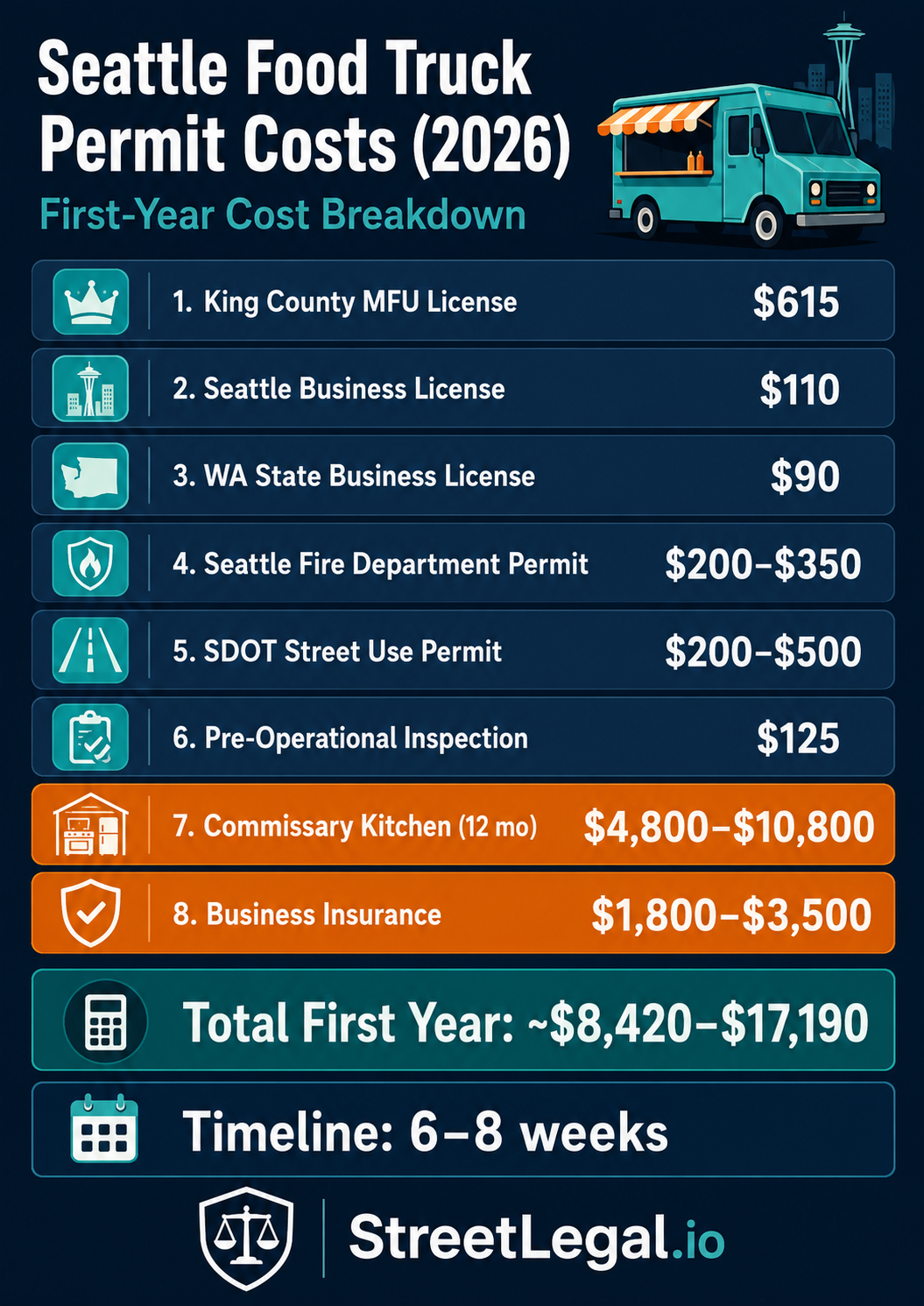
Full Cost Breakdown: Starting a Food Truck in Seattle
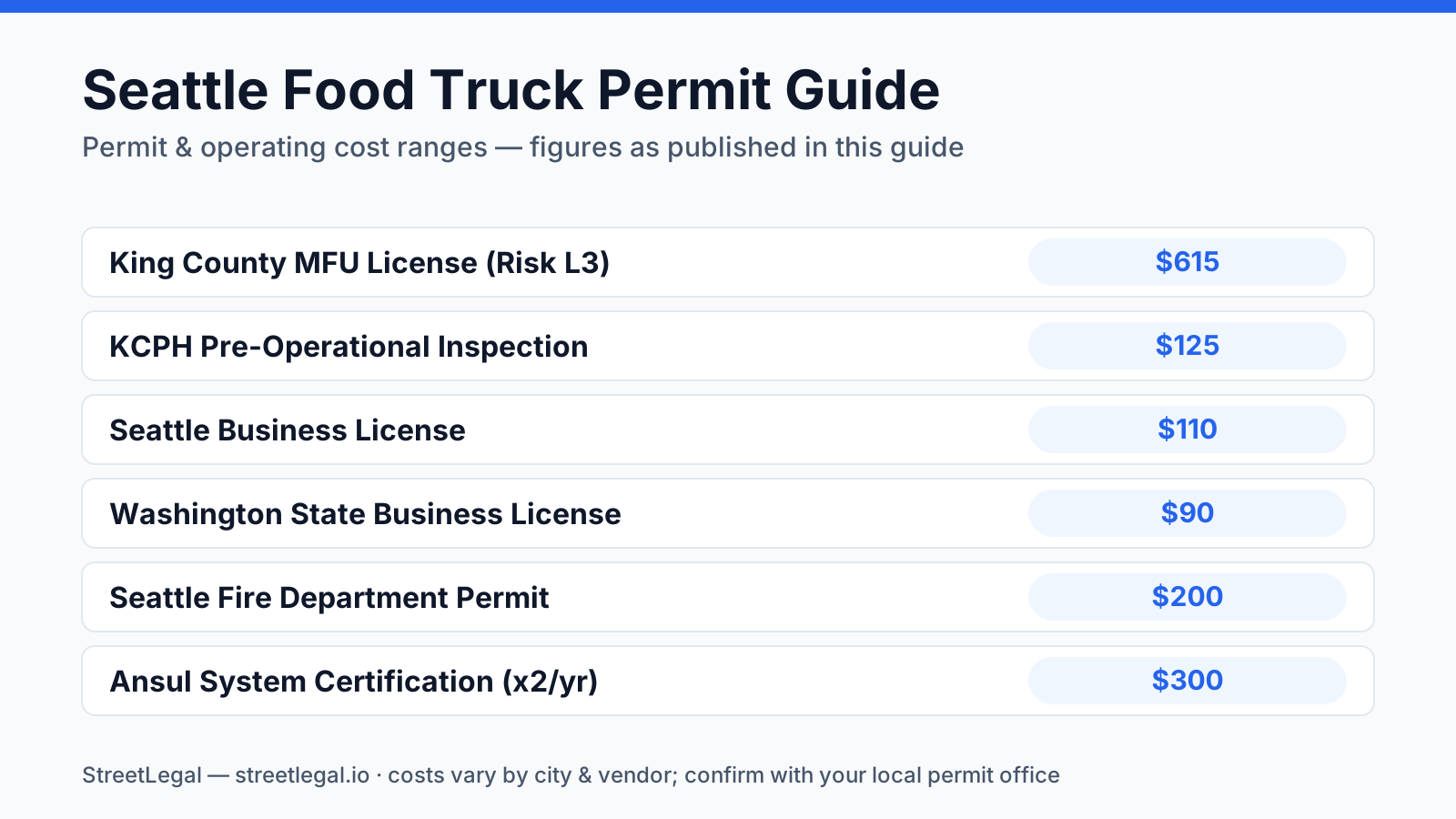
| Permit / Cost Item | Low | High |
|---|---|---|
| King County MFU License (Risk L3) | $615 | $615 |
| KCPH Pre-Operational Inspection | $125 | $125 |
| Seattle Business License | $110 | $110 |
| Washington State Business License | $90 | $90 |
| Seattle Fire Department Permit | $200 | $350 |
| Ansul System Certification (x2/yr) | $300 | $500 |
| SDOT Street Use Permit (if street vending) | $200 | $500 |
| Commissary Kitchen (annual) | $4,800 | $10,800 |
| Business Insurance (liability + auto) | $1,800 | $3,500 |
| Legal / LLC formation | $180 | $600 |
| Total First-Year Estimate | $8,420 | $17,190 |
Excludes truck purchase/lease, equipment, and initial inventory.
Seattle Food Truck Launch Timeline
- Week 1–2: Register WA state business license, form LLC, secure commissary agreement
- Week 2–3: Submit KCPH MFU application with menu and equipment list
- Week 3–4: Ansul system installed and certified; SFD permit submitted
- Week 4–5: SFD inspection; Seattle business license applied
- Week 5–7: KCPH pre-operational inspection scheduled and completed
- Week 7–9: KCPH license received; SDOT street use permit (if needed)
- Week 9–10: First day of operations
5 Seattle-Specific Tips
- Commissary first, everything else second. Seattle's commissary shortage is real. Lock in your agreement before you submit any permit applications — KCPH won't process your license without it, and the waitlists are long.
- Budget for Seattle's 10.25% sales tax. Washington has no income tax, but the combined state + city sales tax rate is one of the highest in the country. Build this into your pricing from day one.
- Know the Pike Place rules. Operating near Pike Place Market without authorization is one of the most cited violations in Seattle. The area is well-patrolled. If you want in, apply to the Pike Place Market Authority directly — it's a separate process entirely.
- Rain-proof your setup. Seattle averages 152 rainy days/year. A canopy or awning system, waterproofing for your exterior menu boards, and non-slip floor mats are not optional — they're survival.
- Neighborhood councils matter. Some Seattle neighborhoods (Capitol Hill, Fremont, Ballard) have active business improvement districts or neighborhood councils that informally coordinate food truck placement. Connecting with these groups can unlock primo spots that aren't on any official map.
Seattle vs. Other Pacific Northwest Cities
| City | License Cost | Timeline | Key Challenge |
|---|---|---|---|
| Seattle, WA | $615 | 6–10 wks | Commissary shortage, zone rules |
| Portland, OR | $550 | 4–8 wks | Cart pod culture, competition |
| Tacoma, WA | $280 | 3–5 wks | Smaller market, less foot traffic |
| Bellevue, WA | $440 | 4–7 wks | Corporate campus focus, strict zoning |
Related City Guides
People also ask about Seattle food truck permits
How much does a food truck permit cost in Seattle?
How long does it take to get a food truck permit in Seattle?
Do I need a commissary kitchen to operate a food truck in Seattle?
What documents do I need for a Seattle food truck permit?
Answers to the most common permit questions — costs, timelines, commissary rules, and more.
Find city-level permit guides for every state we cover — compare costs and requirements.
More from the blog
Food Truck POS Systems: Square vs. Toast vs. Clover vs. Avocado (2026)
Real 2026 pricing, hardware costs, offline mode, and contract terms for Square, Toast, Clover, and Avocado — compared specifically for food truck operators.
City GuidesEagan, MN Food Truck Permit Guide
Eagan MN food truck permit guide: MDH mobile food licensing, Dakota County food safety, city peddler rules, commissary records, costs, and launch timeline.
City GuidesBentonville, AR Food Truck Permit Guide
Complete guide to food truck permits, fees, and requirements in Bentonville, AR.
City GuidesBiloxi, MS Food Truck Permit Guide
Biloxi food truck permit guide 2026: licenses, health permit steps, commissary records, inspections, costs, renewal timing, and launch checklist.