· Updated · 13 min read · Gibby, StreetLegal Editorial

How to Start a Food Truck in Chicago: Licenses, Permits & Costs 2026
Updated June 6, 2026
Chicago has a well-defined food truck licensing system — possibly the most structured of any major US city. That's actually a good thing. When the rules are clear, you know exactly what you're working with. The city processes thousands of mobile food vendor applications a year, and the path is well-worn.
That said, the total timeline from application to first service typically runs 3–6 months, and the cost structure has nuances that catch new operators off guard. This guide covers everything: which license you need, what it costs, how long it takes, and how to avoid the common mistakes that slow people down.
Chicago vs. Other Major Midwest Markets
If you're deciding where to launch in the Midwest or considering Chicago vs. nearby markets, here's how the major cities compare:
| Market | Launch Friction | Best First Revenue Lane | Best First Truck Fit | Why This Market |
|---|---|---|---|---|
| Chicago | High (200-foot rule, mandatory commissary, strict inspections, 3-5 month timeline) | Private corporate lots, catering, festivals | Taco/Mexican, BBQ trailer, specialty coffee cart | Largest Midwest market, strong event scene, high revenue potential, but 200-foot rule makes street vending hard; events/catering lanes are golden |
| Milwaukee, WI | Low-medium (fewer proximity rules, simpler permitting, 6-10 week timeline) | Brady Street, Water Street, Summerfest/festivals | Bratwurst/German, craft beer pairing trucks, BBQ | Strong beer culture, easier permitting than Chicago, Summerfest is 11 days of high-volume vending; smaller market but lower barriers |
| Minneapolis, MN | Medium (health dept is thorough, commissary required, but no 200-foot rule) | Downtown Mpls lunch rush, Uptown, food truck courts | Scandinavian/Nordic, upscale fusion, hot dish/comfort food | Food truck-friendly city with active scene; harsh winters reduce year-round viability but strong summer demand; good event culture |
| Detroit, MI | Low-medium (permitting is improving, lower costs, faster timeline) | Downtown Detroit, Eastern Market, Corktown | Coney dog trucks, soul food, Middle Eastern | Revitalized downtown, lower startup costs, strong local food culture; smaller established food truck scene means less competition |
| St. Louis, MO | Low (business-friendly permitting, no proximity rules, 4-8 week timeline) | Soulard, Delmar Loop, corporate parks | BBQ (St. Louis-style ribs), gooey butter cake dessert trucks | BBQ capital culture, easy permitting, lower commissary costs than Chicago; smaller market but strong food tourism angle |
| Indianapolis, IN | Low (straightforward permitting, reasonable costs, 6-8 week timeline) | Mass Ave, Fountain Square, Indy 500 events | Pork tenderloin trucks, BBQ, comfort food | Growing food scene, easy permitting, strong corporate lunch market downtown; Indy 500 month brings huge temporary demand |
Chicago offers the highest revenue ceiling in the Midwest, but the 200-foot restaurant proximity rule means you'll need to lean into private lots, corporate catering, and festival circuits. If your business model is street vending, Milwaukee or St. Louis may be easier entry points. If you're event-focused or catering-oriented, Chicago's scale justifies the permitting friction.
Two License Types: Which One Do You Need?
Chicago draws a clear line between two kinds of food trucks. Your menu determines which license you need:
Mobile Food Preparer (MFP) License
Required if your truck involves any cooking on board — grilling, frying, boiling, or any open-flame food preparation. This is the most common license for full-service food trucks.
- Fee: $1,000 for a 2-year license
- Issued by: Chicago Department of Business Affairs & Consumer Protection (BACP)
- Additional requirements: 3-compartment sink, grease trap, exhaust hood with fire suppression, certified food protection manager on-site at all times
Mobile Food Dispenser (MFD) License
Required if you sell pre-prepared, packaged, or pre-wrapped food only — no cooking on the truck. Think specialty coffee, pre-packaged sandwiches, or bottled beverages.
- Fee: $700 for a 2-year license
- Issued by: Chicago BACP
- Simpler equipment requirements — less inspecting to do, which means faster approval
If your menu involves anything you cook to order, you need the MFP. When in doubt, go MFP — it covers more and you can't upgrade mid-year without reapplying.
The Complete Chicago Food Truck Permit Checklist
1. Mobile Food Vendor License (MFP or MFD)
Your primary operating license from BACP. Apply through Chicago Business Direct. You'll submit your menu, floor plan/equipment list, vehicle specifications, and commissary letter at the time of application.
2. Chicago Department of Public Health (CDPH) Inspection
Your truck must pass a CDPH inspection at the Lexington facility before BACP will issue your license. Schedule this through the Small Business Center's health consultation process — free pre-inspection consultations are available to help you pass on the first try.
- Timeline: Schedule 3–6 weeks in advance
- Common failure points: Temperature control equipment, handwashing station, food storage, grease trap installation
3. Chicago Fire Department (CFD) Fire Safety Permit
Required for any truck that cooks on board (MFP license holders).
- Application fee: $100
- Process: Submit $100 to CFD, attend a required Thursday safety class (free), then schedule inspection
- Timeline: 2–4 weeks from application to permit issuance
4. Shared Kitchen / Commissary User License
All Chicago food trucks must have a licensed commissary kitchen agreement — no home prep allowed, ever. The commissary agreement letter must be dated within 30 days of your BACP application submission.
- Commissary access cost: Typically $350+/month depending on facility and services
- Key requirement: Your commissary must be licensed by CDPH. Out-of-city commissaries are allowed but require CDPH-approved inspection reports.
5. Food Handler Certificates
All employees who handle food must hold a current food handler certificate from an ANSI-accredited program within 30 days of hire.
- Cost: $15–$40/person depending on provider
6. Certified Food Protection Manager (CFPM)
At least one person on the truck must hold a CFPM certification (ServSafe Manager or equivalent). For MFP license holders, this person must be physically present on the truck during all operations.
- Cost: $125–$200 for the exam and certification
- Validity: 5 years
7. GPS Device / Affidavit
Chicago requires all licensed food trucks to have a GPS tracking device installed and submit an affidavit confirming this as part of the BACP application. This is a 2025 enforcement update — don't miss it.
- Cost: $50–$200 for the device, one-time
8. Vehicle Registration & Commercial Insurance
- Insurance requirement: Minimum $1,000,000 general liability
- Vehicle registration: Commercial plates required; CDL needed only if vehicle exceeds 26,000 lbs
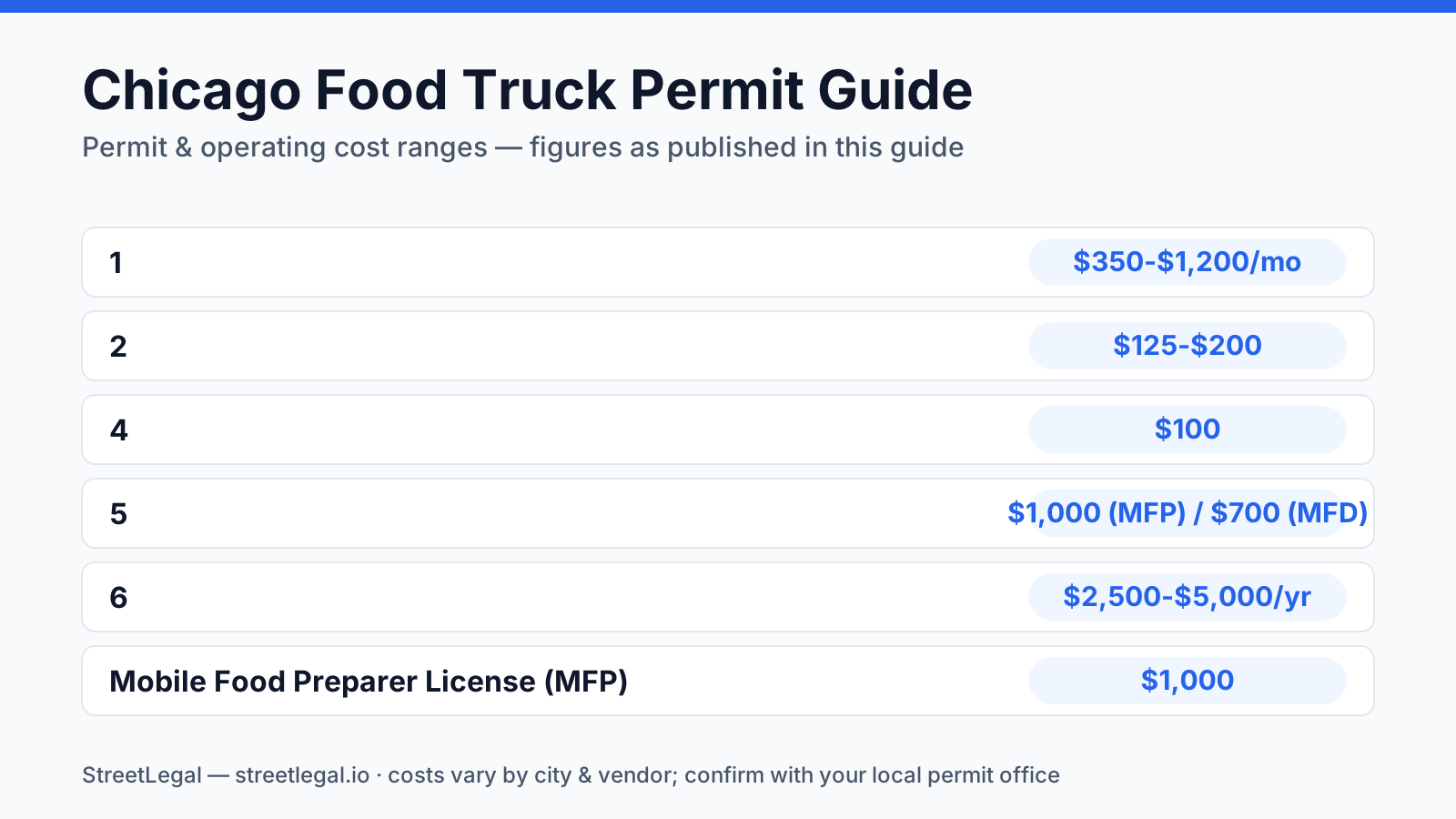
Chicago Food Truck Permit Snapshot
Here's the full permit stack at a glance:
| Step | Agency | Permit / License | Fee | Timeline | Sequence |
|---|---|---|---|---|---|
| 1 | Commissary | CDPH-licensed commissary agreement | $350-$1,200/mo | Weeks 2-3 | Required before BACP application |
| 2 | Certification | Certified Food Protection Manager (CFPM) | $125-$200 | Weeks 2-4 | Must be submitted with BACP application |
| 3 | CDPH | Health inspection (at Lexington facility) | Free | Weeks 5-8 | Required before BACP license issuance |
| 4 | CFD | Fire Safety Permit (MFP only) | $100 | Weeks 4-8 | Required before BACP license issuance |
| 5 | BACP | Mobile Food Preparer (MFP) or Dispenser (MFD) License | $1,000 (MFP) / $700 (MFD) | Weeks 8-14 | Final license after all inspections pass |
| 6 | Insurance | Commercial general liability insurance | $2,500-$5,000/yr | Ongoing | Required for BACP application |
Chicago Food Truck Cost Breakdown
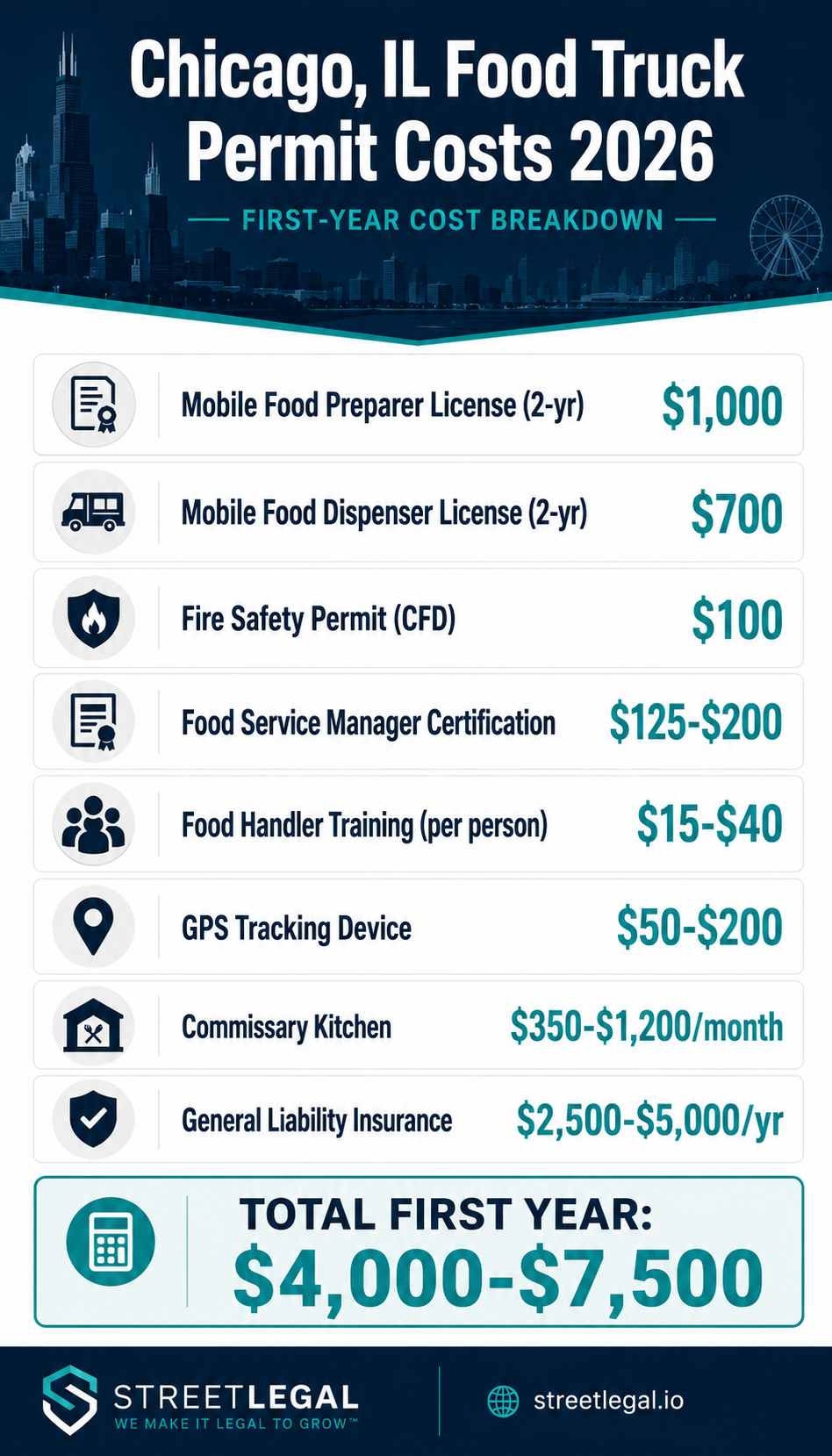
| Permit / License | Cost | Frequency |
|---|---|---|
| Mobile Food Preparer License (MFP) | $1,000 | Every 2 years |
| Mobile Food Dispenser License (MFD) | $700 | Every 2 years |
| CFD Fire Safety Permit | $100 | Per CFD schedule |
| CFPM Certification | $125–$200 | Every 5 years |
| Food Handler Certs (per employee) | $15–$40 | Varies by program |
| GPS Device (one-time) | $50–$200 | One-time |
| Commissary Kitchen Access | $350–$1,200/mo | Monthly |
| Commercial Insurance | $2,500–$5,000 | Annual |
| Total Year 1 (excl. commissary) | $4,000–$7,500 |
Step-by-Step Chicago Food Truck Launch Timeline
- Weeks 1–2: Register business entity (LLC), obtain EIN, register for Illinois state taxes
- Week 1: Paint or letter your business name on the truck in 2-inch letters (required by Chicago ordinance — yes, before you apply)
- Weeks 2–3: Secure commissary kitchen agreement (must be dated <30 days before submission)
- Weeks 2–4: Complete CFPM certification; ensure all staff get food handler certs
- Week 3: Book CDPH health consultation (free pre-inspection) through the Small Business Center
- Weeks 4–6: Submit MFP/MFD application through Chicago Business Direct; submit CFD application + attend Thursday safety class
- Weeks 5–8: Pass CDPH and CFD inspections at Lexington facility
- Weeks 8–14: Receive license from BACP; begin operations
Realistic total timeline: 3–5 months. Most delays happen at the inspection scheduling stage — CDPH and CFD don't operate on your timeline. Book both inspections as early as possible, even before you think you need to.
Best Food Truck Types for Chicago
Chicago's 200-foot restaurant proximity rule and strong ethnic food culture create a unique market fit landscape. Here's what works best:
| Truck Type | Why It Fits Chicago | Commissary Pressure | Event Flexibility | Rationale |
|---|---|---|---|---|
| Taco/Mexican truck | Huge Pilsen/Little Village demand, year-round appetite, lower ingredient cost | Medium | High (festivals, Taste of Chicago, street fairs) | Chicago has the second-largest Mexican population in the US — proven market fit with strong repeat business and event bookings |
| BBQ/Smoked meats trailer | Midwest comfort food culture, strong suburban catering demand, high margins | Medium-high | High (Ribfest, corporate, weddings) | BBQ travels well and commands premium pricing; trailer format handles smoker equipment; strong catering lane bypasses 200-foot rule |
| Specialty coffee/espresso cart | Loop office demand, lower startup cost, operates as MFD (cheaper license) | Low | Medium (farmer's markets, festivals) | No cooking = MFD license ($700 vs $1,000); lighter commissary needs; strong morning office rush revenue in Loop/River North |
| Polish/Eastern European truck | Strong Polish corridor (Avondale, Jefferson Park), underserved niche, loyal customer base | Medium | Medium (cultural festivals, parish events) | Chicago has 200k+ Polish residents; authentic pierogi/kielbasa trucks have built-in demand and less competition than tacos/burgers |
| Dessert/ice cream truck | Family-friendly, operates year-round indoors at events, lower fire safety requirements | Medium | High (weddings, corporate, festivals) | Dessert trucks thrive in private-event lane where 200-foot rule doesn't apply; strong margins and repeat corporate bookings |
| Italian beef truck | Chicago signature dish, tourist appeal, proven concept, strong citywide demand | Medium | High (sports events, festivals, tourism) | Italian beef is Chicago food culture; tourists seek it out; strong event booking potential near Navy Pier, Wrigley, Guaranteed Rate Field |
Where You Can Actually Operate in Chicago
Chicago's 200-foot restaurant proximity rule changes the operating-lane calculus. Here's where permit approval alone is enough vs. where real access requires more work:
| Operating Lane | Permit Approval Alone Enough? | Access Reality | Best Truck Fit |
|---|---|---|---|
| Food truck parks / designated zones | Yes (if park accepts new vendors) | Limited slots, some parks have waitlists or exclusive agreements; apply early | Any truck type; parks often rotate vendors weekly |
| Festivals & special events (Taste of Chicago, Ribfest, etc.) | No — event-specific vendor applications required | Competitive application process; many events have preferred vendor lists; apply 3-6 months in advance | BBQ, tacos, Italian beef, dessert trucks with proven event track record |
| Private property / corporate campuses | No — property owner permission required | Best revenue lane; bypasses 200-foot rule entirely; suburban Cook County corporate parks are goldmine | Lunch trucks (coffee, gourmet, healthy options) for predictable weekday revenue |
| Street vending (Loop, River North, high-traffic areas) | Yes, but 200-foot restaurant rule severely limits viable spots | Enforcement is strict; most high-traffic corners are blocked; scout spots in advance with 200-foot measuring tool | Quick-service trucks (coffee carts, hot dogs, ice cream) that can pivot locations quickly |
| Neighborhood vending (Pilsen, Logan Square, Wicker Park) | Yes, but same 200-foot rule applies | Residential neighborhoods have fewer restaurants, so more viable spots; build local following through consistency | Ethnic food trucks (Mexican, Polish, soul food) that match neighborhood demographics |
| Catering & private events | MFP/MFD covers it; some venues require additional event permits | Most profitable lane for experienced operators; requires strong referrals/portfolio; venue permitting can be complex | BBQ trailers, upscale fusion trucks, dessert trucks with strong presentation and service track record |
| Suburban Cook County (outside Chicago city limits) | No — different jurisdictions, different rules | Many suburbs have NO 200-foot rule; Evanston, Oak Park, Skokie have separate food truck programs with easier access | Any truck; suburban corporate parks and office corridors offer best consistent lunch revenue |
Where Can You Vend in Chicago?
Chicago has specific zoning rules about where food trucks can operate. Key restrictions:
- 200-foot rule: You cannot park within 200 feet of a licensed restaurant during that restaurant's operating hours. This is strictly enforced in downtown and high-density areas.
- No parking near schools: Prohibited during school hours within a defined perimeter
- No crosswalks or hydrants: Standard parking rules apply plus additional food truck restrictions
- Private property: With written permission from the property owner, you can vend on private lots — this avoids the 200-foot rule entirely and is how many trucks build a steady customer base
- Food truck courts and designated zones: The city has sanctioned several food truck zones, particularly in the Loop area; check Chicago Business Direct for current approved locations
7 Tips for a Smooth Chicago Permit Process
- Book the CDPH pre-inspection consultation first. It's free, it's informative, and it's the fastest way to learn what your truck will fail before your actual inspection.
- Get your commissary agreement 30+ days before you need it. It's a rolling deadline — needs to be recent — so lock in your commissary early, then get the agreement re-dated closer to your application.
- Don't skip the GPS device. BACP will flag your application without proof of a GPS device and an affidavit. This catches people by surprise every year.
- Plan for the 200-foot rule before you pick vending spots. Scout your intended locations and map the nearby restaurants. Some of the best foot-traffic corners in Chicago are blocked for food trucks.
- Budget 5 months, not 3. The 3–6 month timeline is real. Plan your launch date around it.
- Join the Chicago Food Truck Association (ChiFTA). They publish annual permit updates, run advocacy, and have useful resources at chifta.org.
- Track every deadline. Your MFP license (2-year) and commissary agreement need renewal at different times. A missed renewal can shut you down mid-season. Tools like StreetLegal handle this tracking automatically.
Common Questions About Chicago Food Truck Permits
Can I prep food at home and just sell from the truck?
No. Chicago explicitly prohibits home prep for commercial food operations. You must use a licensed commissary kitchen — no exceptions.
Do I need a different license if I also do catering?
If you're catering private events in addition to street vending, you may need additional event-specific permits depending on the venue. Verify with BACP on a case-by-case basis.
What happens if I vend within 200 feet of a restaurant?
BACP takes this seriously. Violations can result in fines and, for repeat offenders, license suspension. Don't test it.
Is the MFP or MFD license renewable?
Yes — both are 2-year licenses with renewal. Renewal requires a re-inspection and updated commissary agreement.
The Bottom Line
Chicago's food truck permitting system is thorough, but it's also predictable. You know what it costs, you know what's required, and the inspection process is well-established. The operators who struggle aren't dealing with a broken system — they're just not giving themselves enough runway. Build in 5 months, lock in your commissary early, and get your CFPM certification done before anything else.
If you want a system that tracks every Chicago permit deadline and reminds you before anything expires, StreetLegal is built for exactly that.
🏛️ Official Resources — Verify Current Requirements
- Chicago Business Direct (BACP) — MFP/MFD license applications and renewals
- Chicago Dept of Public Health — Certified Food Protection Manager (CFPM) and commissary approval
- Chicago Fire Dept — CFD permit and Thursday safety class schedule
- Illinois Dept of Revenue (MyTax Illinois) — Retailer's Occupation Tax registration
Fees and timelines shown above reflect 2026 figures. Always confirm current requirements before filing.
Related City Guides
People also ask about Chicago food truck permits
How much does a food truck permit cost in Chicago?
How long does it take to get a food truck permit in Chicago?
Do I need a commissary kitchen to operate a food truck in Chicago?
What documents do I need for a Chicago food truck permit?
Answers to the most common permit questions — costs, timelines, commissary rules, and more.
Find city-level permit guides for every state we cover — compare costs and requirements.
More from the blog
Food Truck POS Systems: Square vs. Toast vs. Clover vs. Avocado (2026)
Real 2026 pricing, hardware costs, offline mode, and contract terms for Square, Toast, Clover, and Avocado — compared specifically for food truck operators.
City GuidesEagan, MN Food Truck Permit Guide
Eagan MN food truck permit guide: MDH mobile food licensing, Dakota County food safety, city peddler rules, commissary records, costs, and launch timeline.
City GuidesBentonville, AR Food Truck Permit Guide
Complete guide to food truck permits, fees, and requirements in Bentonville, AR.
City GuidesBiloxi, MS Food Truck Permit Guide
Biloxi food truck permit guide 2026: licenses, health permit steps, commissary records, inspections, costs, renewal timing, and launch checklist.