Use this as a starting point, then confirm before filing
This guide cites official public sources; no direct municipal response is displayed for this guide.
Informational only — not legal advice. Confirm requirements with the city before you apply. See our Disclaimer.
How to Start a Food Truck in New Orleans: Complete Permit Guide 2026
Updated June 29, 2026

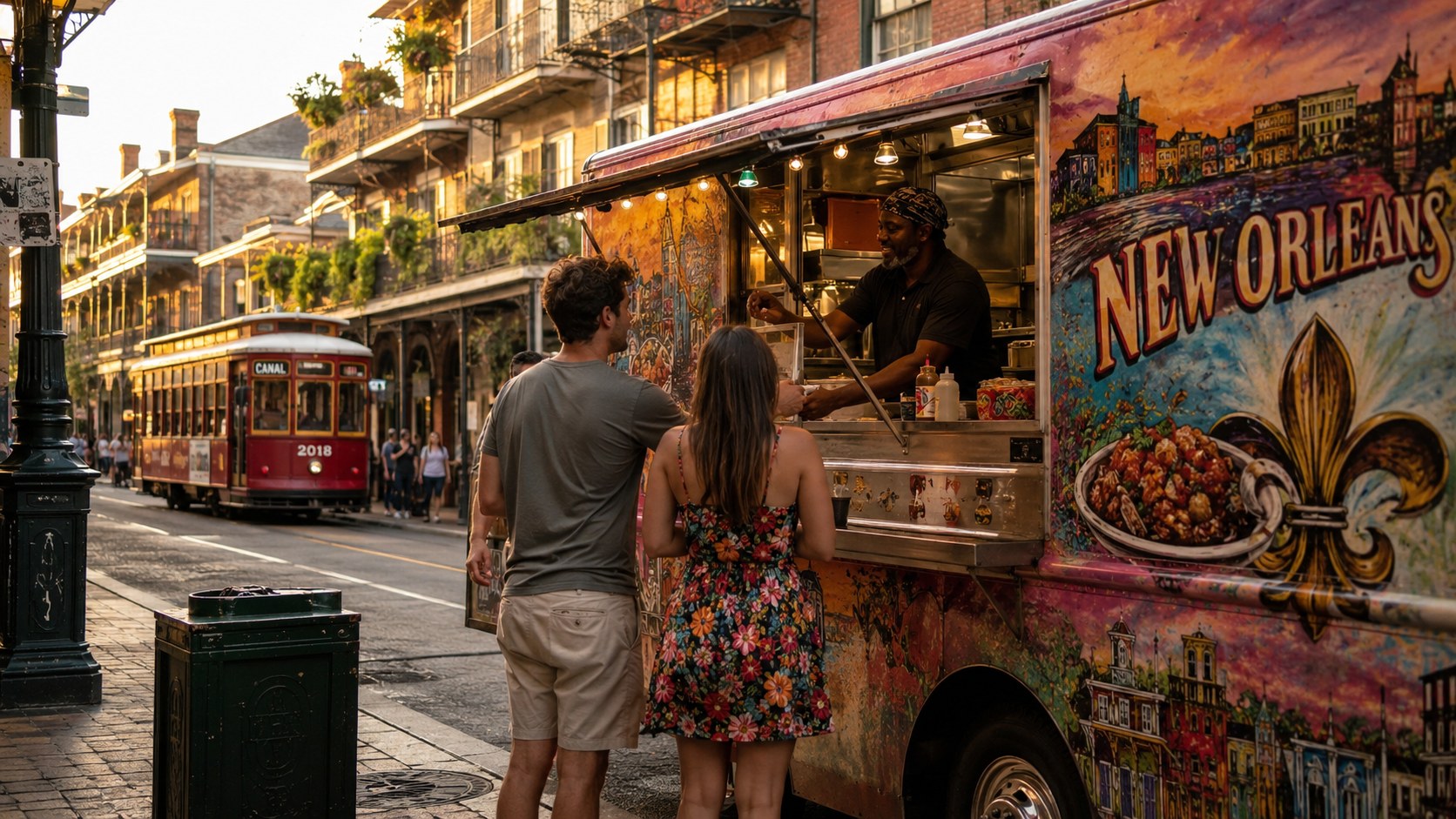
New Orleans is one of America's great food cities — and food trucks are a legitimate part of that culture. But the permitting process is layered across city, state, and parish systems that can trip up operators who don't know the landscape. This guide covers every permit you need, the real fees, commissary requirements, and where food trucks can legally set up in NOLA.
Louisiana Disclaimer
Food truck rules in New Orleans are split between the City of New Orleans (via the Department of Business and Information Affairs) and the Louisiana Department of Health. Requirements and fees change periodically. Always verify current rules directly with each agency before applying.
In This Guide
Use the section headings below to jump through the guide quickly.
The New Orleans Food Truck Licensing Landscape
New Orleans operates under a city-parish consolidated government (Orleans Parish = City of New Orleans), which simplifies some things but adds local character to the rules. Food trucks operate under two overlapping systems:
- City of New Orleans / DBIA — Mobile food vending permits, sidewalk vending, and location approvals
- Louisiana Department of Health (LDH) — State-level food establishment permit and health inspections
- NOPD Special Events — Permits for festivals, events, and Mardi Gras activations
- New Orleans Fire Department (NOFD) — Fire safety inspections for cooking equipment with open flame or propane
The French Quarter has additional restrictions — the Vieux Carré Commission controls signage and some vendor placement, so if you plan to operate near or in the Quarter, you need to verify those rules separately.
What Licenses Do You Actually Need?
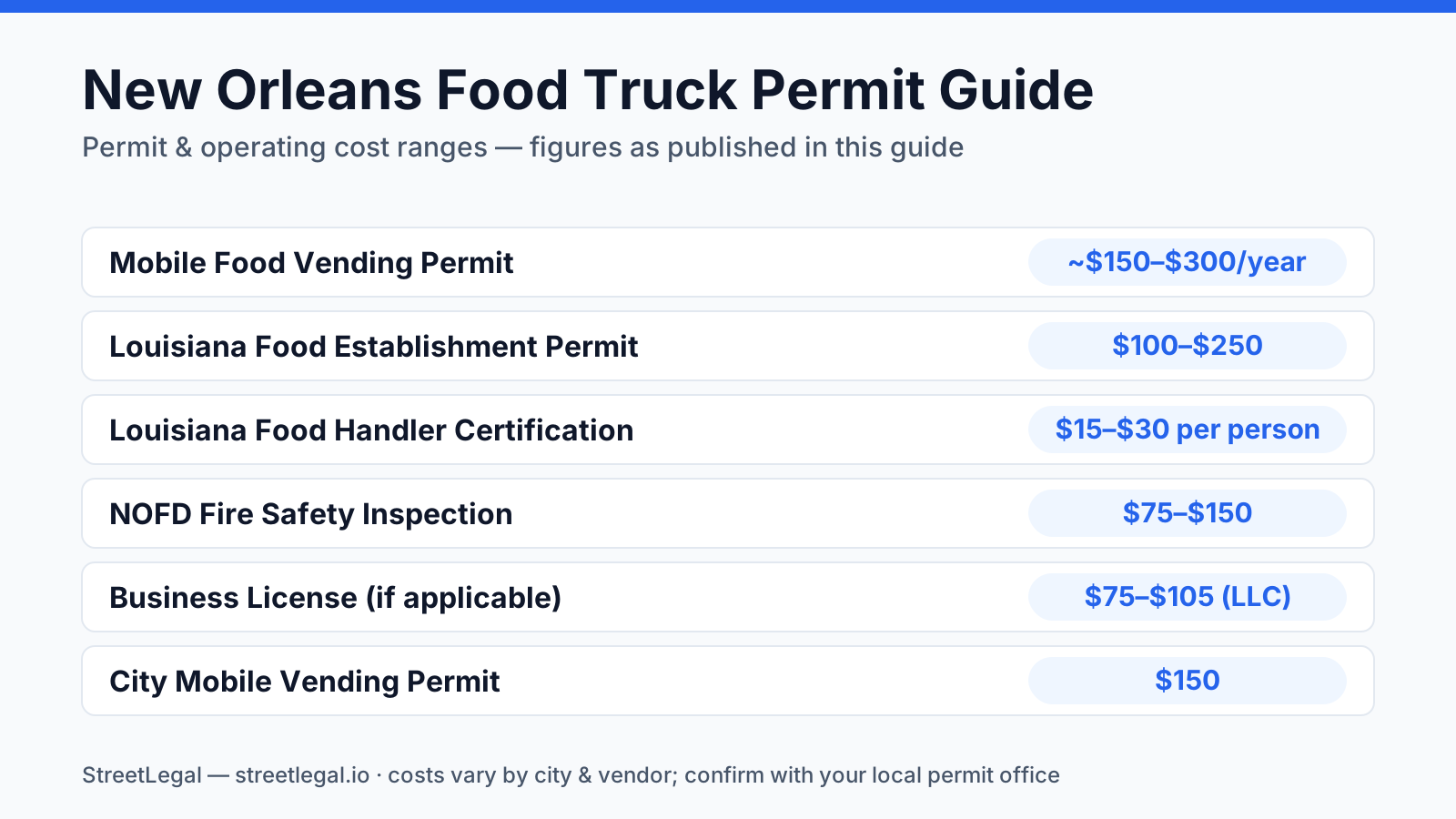
| License / Permit | Issuing Authority | Fee | Renewal |
|---|---|---|---|
| Mobile Food Vending Permit | City of New Orleans / DBIA | ~$150–$300/year | Annually |
| Louisiana Food Establishment Permit | Louisiana Dept. of Health (LDH) | $100–$250 | Annually (Jan. 1) |
| Louisiana Food Handler Certification | LDH-approved provider | $15–$30 per person | Every 3 years |
| NOFD Fire Safety Inspection | New Orleans Fire Department | $75–$150 | Annually or when required |
| Louisiana Sales Tax Registration | Louisiana Dept. of Revenue | Free | Permanent (file returns) |
| Business License (if applicable) | Louisiana Secretary of State | $75–$105 (LLC) | Annual report |
Step 1: The City of New Orleans Mobile Food Vending Permit
The city-level mobile food vending permit is issued through the Department of Business and Information Affairs (DBIA). This permit authorizes you to operate within city limits and is separate from the state health permit.
What You Need to Apply
- Completed mobile food vending application (available via the city's One Stop Shop portal)
- Valid Louisiana Food Establishment Permit (LDH) — the city requires this first
- Proof of commissary kitchen agreement (signed contract, not just a name)
- Vehicle registration and proof of ownership or lease for the food truck
- General liability insurance certificate ($500,000 minimum, city listed as additional insured)
- Certificate of Zoning Compliance for any fixed location or regular spot
Timeline
Plan for 4–6 weeks for city processing after you've secured the state health permit. DBIA processes applications in order, and peak times (post-Mardi Gras and pre-summer) can slow things further. Start early.
Step 2: Louisiana Food Establishment Permit (LDH)
The Louisiana Department of Health issues a Food Establishment Permit to mobile food units. This is required before you can get the city permit — LDH has to approve you first.
LDH Application Requirements
- Completed LDH application form (available on the LDH website)
- Floor plan / equipment layout of the food truck interior
- Menu with all food items listed
- Proof of commissary kitchen (contract with licensed commissary facility)
- Certified Food Manager certificate (ServSafe or equivalent)
- Food handler certifications for all employees who handle food
- Vehicle inspection documentation
After submitting, an LDH inspector will schedule a physical inspection of your truck. They check equipment, handwashing stations, temperature control systems, water supply, and waste disposal. Plan 2–4 weeks for scheduling and inspection.
Commissary Kitchen Requirement
Every food truck in Louisiana must be based out of a licensed commissary kitchen. This is non-negotiable — you cannot get a state health permit without a commissary agreement in place.
What counts as a valid commissary?
- A licensed commercial kitchen that holds a current LDH Food Establishment Permit
- Must have storage space for your truck's supplies (dry goods, refrigeration)
- Must have adequate facilities for cleaning equipment and waste disposal
- Agreement must be in writing — verbal agreements are not accepted
New Orleans has a growing number of shared commissary kitchens, including purpose-built spaces that cater specifically to food truck operators. Expect to pay $300–$600/month for a full commissary membership with storage, or $15–$35/hour for occasional use.
Fire Safety Inspection (NOFD)
If your truck uses propane, open flame, or commercial cooking equipment, the New Orleans Fire Department will inspect your truck. This covers:
- Ansul suppression system (installed and current inspection tag)
- LP gas system inspection — connections, shutoff valves, and ventilation
- Fire extinguisher (K-class for cooking areas, ABC for general)
- Hood and ductwork clearance and grease trap
Schedule the fire inspection after your equipment is fully installed. A failed inspection typically means 2–3 weeks to reschedule, so make sure the truck is ready before calling NOFD.
Where Can Food Trucks Actually Set Up in New Orleans?
Legal Operating Locations
- Private lots with owner permission: The most common and reliable setup — written permission from the property owner is required
- Food truck parks and pods: Several dedicated spots including the Mid-City area and along Magazine Street corridor — operators often handle collective permits
- Festival and event permits: Mardi Gras, Jazz Fest, French Quarter Festival, and hundreds of smaller events — high revenue but require separate event vendor permits
- Farmers markets: Crescent City Farmers Market and others welcome food trucks; market management handles vendor permits
- Street vending (selected corridors): Allowed in designated zones with a sidewalk/street vending permit from the city — locations are limited and competition is high
Restrictions to Know
- French Quarter street vending is heavily restricted — the Vieux Carré Commission controls this area
- Operating within 600 feet of a licensed restaurant without the restaurant owner's permission may trigger complaints (this is a gray area in NOLA, but be aware)
- Bourbon Street and Canal Street have specific restrictions on commercial vending during certain hours
- Neutral grounds (medians) are generally off-limits for food trucks

First-Year Cost Breakdown
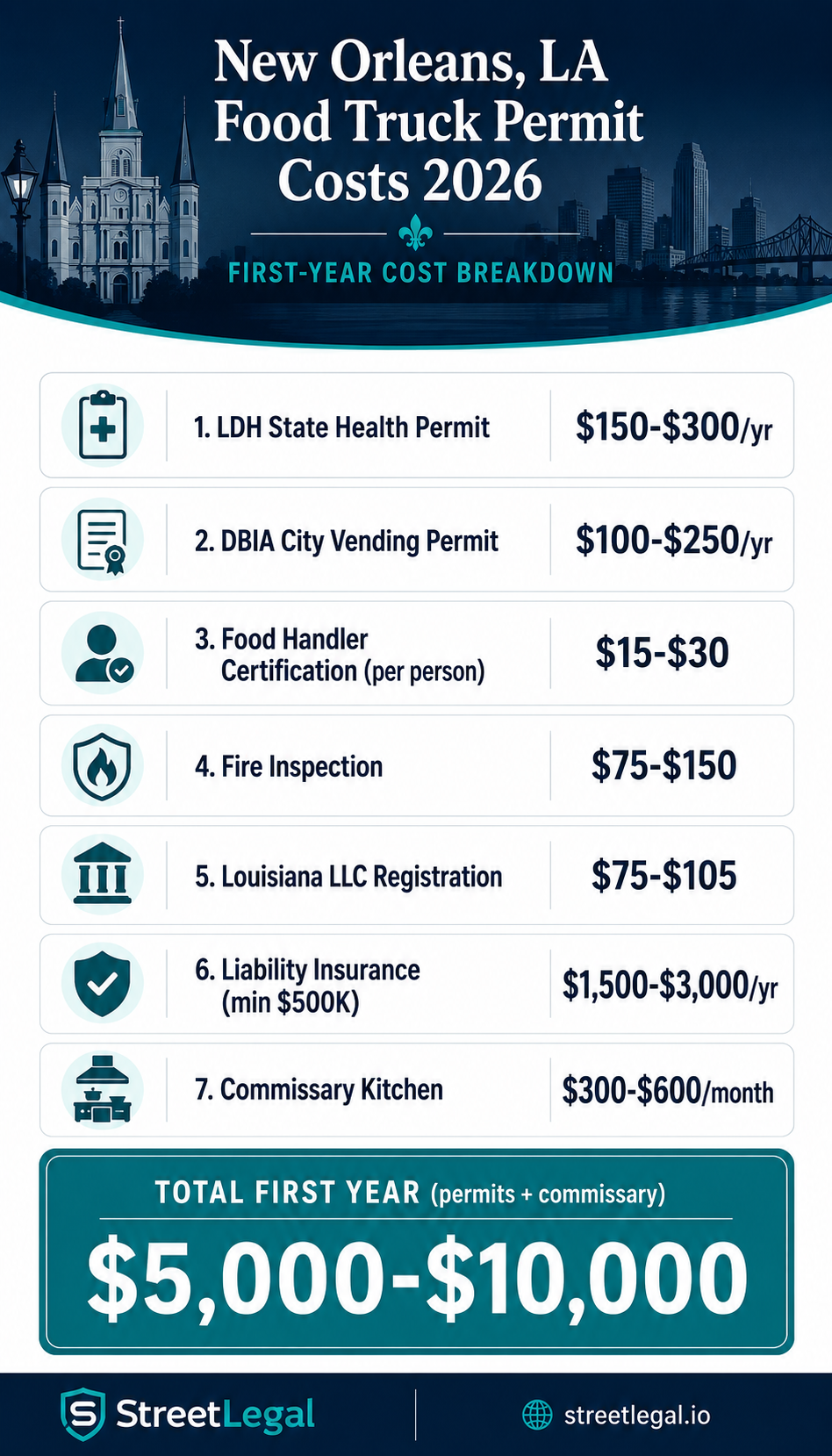
| Cost Item | Low | High | Notes |
|---|---|---|---|
| City Mobile Vending Permit | $150 | $300 | Varies by vehicle class |
| LDH Food Establishment Permit | $100 | $250 | Based on risk category |
| NOFD Fire Inspection | $75 | $150 | Plus Ansul service if needed |
| Ansul System Service | $150 | $400 | Required before fire inspection |
| Commissary Kitchen (monthly) | $300/mo | $600/mo | Full membership with storage |
| Food Handler Certs (3 staff) | $45 | $90 | LDH-approved provider |
| ServSafe Food Manager Cert | $35 | $120 | Required, 5-year validity |
| General Liability Insurance | $800/yr | $2,000/yr | $500k minimum required by city |
| Louisiana LLC Formation | $75 | $105 | Optional but strongly recommended |
Total first-year estimate (excluding commissary and vehicle): roughly $1,400–$3,400 in permits, fees, and required certifications. If you're using an existing vehicle, first-year all-in operating costs (with commissary) typically run $5,000–$10,000 before food costs and labor.
Realistic Timeline to Get Operational
Weeks 1–2: Entity formation + insurance + commissary agreement
Form your LLC, get your insurance binder, and sign a commissary kitchen agreement. You can't apply for the LDH permit without these.
Weeks 3–5: LDH Food Establishment Permit
Submit your LDH application, wait for an inspector to schedule your physical inspection. This is often the longest wait. Don't skip ahead.
Weeks 5–6: NOFD Fire Inspection
Schedule and pass the fire inspection. Service your Ansul system beforehand to avoid a second inspection.
Weeks 6–10: City Mobile Vending Permit (DBIA)
Submit your city application with LDH permit in hand. DBIA processing typically takes 3–5 weeks. Do not operate until this is approved.
Week 10–12: Operational
With permits in hand, you can legally operate. Keep your city and state permits posted visibly in the truck at all times.
Key Tips for New Orleans Food Truck Operators
- Festival season is your biggest revenue window — Jazz Fest, French Quarter Festival, and Mardi Gras can make or break annual revenue, but vendor applications open months in advance. Apply early.
- LDH renews on January 1 — Don't let it lapse. A lapsed state permit means you have to re-apply, not just renew, which can take weeks.
- Keep originals accessible — Both LDH and city inspectors may check your truck at any time. Permits should be physically posted or immediately available.
- Commissary access matters year-round — During summer heat, refrigerated storage at your commissary becomes critical. Verify the commissary's refrigeration capacity before signing a long-term contract.
- Humidity management is real — New Orleans summers are brutal. Proper venting, a reliable water system, and an Ansul system in good condition matter more here than in most cities.
New Orleans Food Truck Permit FAQ
What permits do I need?
LDH Mobile Food Unit permit (state) + DBIA Mobile Vending Permit (city). Get LDH first — DBIA requires it. You also need a commissary agreement and NOFD fire inspection.
How much does it cost?
LDH: approx $150-$300/year. DBIA: $100-$250/year. Commissary: $300-$600/month. Total first-year typically $2,000-$3,500.
Do I need a commissary kitchen?
Yes, required by LDH before your permit is issued. No exceptions.
When does the permit renew?
LDH renews January 1. If it lapses, you re-apply from scratch — not just renew. Set November reminders.
Related City Guides
People also ask about New Orleans food truck permits
How much does a food truck permit cost in New Orleans?
How long does it take to get a food truck permit in New Orleans?
Do I need a commissary kitchen to operate a food truck in New Orleans?
What documents do I need for a New Orleans food truck permit?
Answers to the most common permit questions — costs, timelines, commissary rules, and more.
Find city-level permit guides for every state we cover — compare costs and requirements.
More from the blog
Jefferson County, MO Food Truck Permit Guide
Complete guide to food truck permits, fees, and requirements in Jefferson County, MO.
City GuidesSt. Charles County, MO Food Truck Permit Guide
Complete guide to food truck permits, fees, and requirements in St. Charles County, MO.
City GuidesSt. Louis County, MO Food Truck Permit Guide
Complete guide to food truck permits, fees, and requirements in St. Louis County, MO.
Buyer's GuideFood Truck POS Systems 2026: Square, Toast, Clover & Avocado
Compare 2026 food truck POS systems by pricing, hardware costs, offline mode, and contract terms for Square, Toast, Clover, and Avocado.