· Updated · 12 min read · Ben, Co-founder of StreetLegal
What This Guide Covers
- ✅ Whether a commissary kitchen is actually a good business in your market
- ✅ The four business models — and which one fits your space and capital
- ✅ Real buildout and equipment costs, including the grease/grey-water layer trucks need
- ✅ The licensing and inspection stack that makes you an approved commissary
- ✅ How to price memberships and hourly time so the math works
- ✅ A first-year cost breakdown and realistic revenue model
How to Start a Commissary Kitchen Business in 2026: The Complete Guide
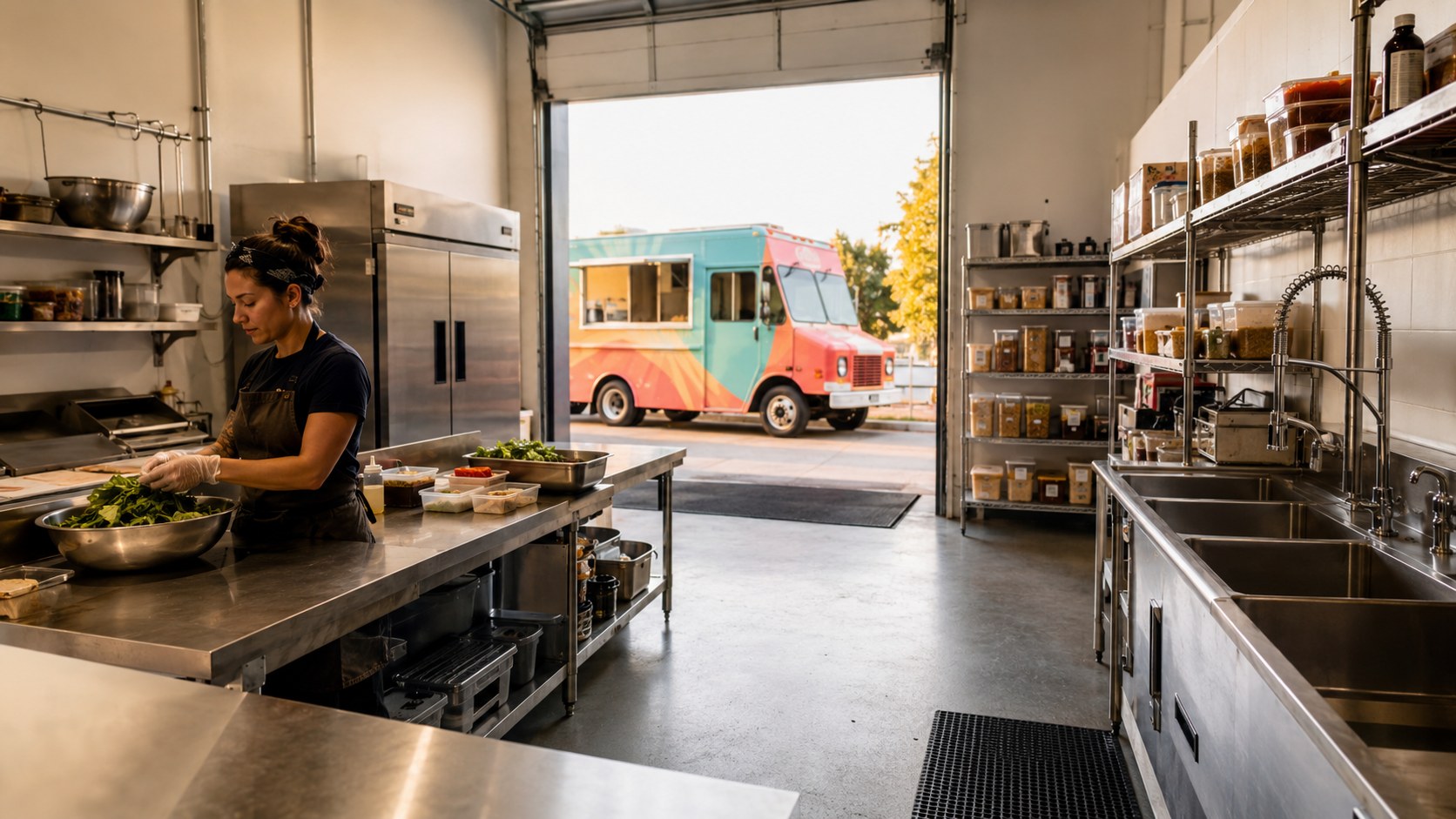
A commissary kitchen is one of the few food businesses where you make money by renting the same licensed kitchen to many people instead of cooking yourself. Food trucks, caterers, bakers, and meal-prep brands all need a permitted commercial kitchen — but almost none of them can afford to build one. You build it once, get it licensed, and rent it by the hour, the shift, or the month.
The demand is real and structural: in nearly every U.S. city, a food truck cannot get a health permit without a signed commissary agreement. That requirement creates a built-in customer base that has to come to you. But a commissary is also a real-estate-and-buildout business, and the operators who lose money are the ones who underestimate the plumbing, the grease and grey-water infrastructure, and how long it takes to fill memberships.
This guide walks the whole thing — demand validation, the four models, leasing, buildout, licensing, pricing, and the first-year math — so you can decide whether to open one and how to do it without overspending on the wrong space.
To start a commissary kitchen: confirm local food trucks need a commissary and there's unmet demand, pick a model (membership/hourly, private suites, truck-park commissary, or hybrid), lease a space that already has commercial kitchen infrastructure, build out hoods/fire suppression/grease/grey-water, pass health, plumbing, fire, and zoning inspections to become an approved commissary, then price memberships and hourly time to fill it. Budget $80K–$650K+ depending on whether you convert an existing kitchen or build from a shell.
Step 1: Is a Commissary a Good Business? Validate Demand First
Before you sign a lease, prove there are paying customers who can't get what you'd sell. A commissary's anchor tenants are food trucks that are legally required to have one, so start there.
Run this validation checklist for your metro:
- Confirm the legal requirement. Call or read your county/city health department's mobile food rules. In most jurisdictions, a food truck must list an approved commissary on its permit application. That's your demand engine. (See our commissary kitchen guide for how the requirement works from the truck's side.)
- Count the trucks. Look at active mobile vendor permits, local food-truck associations, and event rosters. A market with 80–200+ active trucks can support multiple commissaries; a market with 20 may already be served.
- Map the existing supply. Search commissary kitchen and shared kitchen listings for your city and county. If there are only one or two and they are full or far from where trucks operate, that is a gap. If there are six with vacancy, be cautious.
- Find the under-served segment. Many cities have prep kitchens but no facility with truck parking, a grey-water dump, and a fresh-water fill. That truck-infrastructure gap is the single most common opening, confirmed across markets from Chicago to Phoenix.
- Pre-sell. Talk to 10–15 operators before you commit. If five say "I'd switch tomorrow if you had overnight parking and a dump station," you have a business. If they're all happy where they are, keep looking.
💡 The truck-infrastructure gap is the real opportunity
Plain prep kitchens are common. What's scarce in most cities is a kitchen that also offers truck parking, a grey-water/waste dump, fresh-water fill, propane, and 24/7 access. Trucks pay a premium for that bundle, and it's the feature most existing shared kitchens skip. If you can offer it, you can charge for it.
Step 2: The Four Commissary Business Models
Commissaries aren't one thing. The model you pick determines your buildout cost, your pricing, and who rents from you.
| Model | How It Works | Typical Pricing | Best For |
|---|---|---|---|
| Membership + hourly | Shared stations booked by the hour; members pay a base fee plus usage | $75–$250/mo + $18–$25/hr | Mixed makers, caterers, bakers, smaller trucks |
| Private suites | Dedicated, lockable kitchens leased to one brand each | $1,500–$4,500/mo | Ghost kitchens, high-volume caterers, packaged food |
| Truck-park commissary | Parking + dump/fill + storage, with optional prep space | $250–$600/mo per truck | Food trucks needing a compliant home base |
| Hybrid (most resilient) | Anchor trucks + shared prep + a few private suites | Blended | Most new commissaries — diversifies revenue |
The hybrid model is what most successful new facilities land on. Trucks are your anchor demand, shared hourly stations fill daytime gaps with caterers and meal-prep makers, and one or two private suites lock in predictable monthly income. Real facilities show the range: BLT Kitchens in Phoenix tiers its plans from a $250/mo basic membership to a $1,100/mo premium; truck-focused spots like Electric Avenue Kitchen run roughly $250/mo with 24/7 access; and large truck-park commissaries on the coasts serve 60–200 trucks from a single gated lot.
Step 3: Finding & Leasing the Right Space
Your real-estate decision drives almost everything else. The cheapest path to opening is taking over a space that was already a licensed commercial kitchen — a closed restaurant, a former caterer, or an existing commissary. The infrastructure that's most expensive to add is the infrastructure you most want to inherit.
What to prioritize, in order:
- Existing hood & fire suppression. A commercial exhaust hood with Ansul suppression is one of the costliest single line items to add from scratch. Inheriting one can save $20,000–$60,000+.
- Grease interceptor & commercial plumbing. Three-compartment sinks, mop sinks, floor drains, and an in-ground grease trap are expensive to retrofit into a raw shell.
- Zoning that allows it. Confirm the parcel is zoned for commercial food production and, if you want trucks, for vehicle parking and overnight access. Zoning surprises kill more commissary deals than anything else.
- Truck access. If trucks are your anchor, you need a yard or lot for parking, a roll-up door, room to maneuver, and somewhere to legally install a grey-water dump and fresh-water fill.
- Power & water capacity. Multiple operators running fryers, fridges, and equipment at once need real electrical service (often 200A+) and adequate water/sewer.
⚠️ Verify zoning and the grease/grey-water path BEFORE you sign
Get written confirmation from the city on zoning, grease-interceptor requirements, and (for trucks) where wastewater can legally be dumped. A lease that looks cheap can become unworkable if the building can't pass plan review or the city won't allow a truck dump station on site. Make your lease contingent on plan-review approval.
Step 4: Buildout & Equipment
Buildout is where budgets blow up. Converting an existing licensed kitchen might cost $40,000–$120,000 in updates. Building a multi-station commissary out of a bare warehouse shell can run $250,000–$650,000 or more, because you're installing the commercial systems from zero.
The big-ticket systems trucks and inspectors care about:
- Exhaust hoods + Ansul fire suppression over every cook line — installed and fire-marshal inspected.
- Grease interceptor sized for your output, plus three-compartment and mop sinks and floor drains.
- Grey-water dump & fresh-water fill station if you serve trucks — the feature most kitchens skip and trucks most want. Some jurisdictions (e.g., Maricopa County, AZ) even spec truck tank ratios like a grey-water tank 15% larger than the fresh-water tank, so design the dump station to match local rules.
- Commercial refrigeration & freezer — shared walk-ins plus lockable member storage.
- Dry & cold storage assigned per member so nobody fights over shelf space.
- Access control — keypad or fob entry with logging, since 24/7 access is a major selling point and you can't staff the door around the clock.
Buy reliable used equipment where you safely can (refrigeration and ranges have strong used markets), but don't cheap out on hoods, suppression, or anything an inspector signs off on. A failed inspection costs you weeks of rent with no revenue.
Step 5: Licensing, Inspections & Becoming an "Approved" Commissary
A commissary is a permitted commercial food establishment, and it only has value to food trucks if your health department recognizes it as an approved commissary — the status that lets trucks list you on their mobile food unit application.
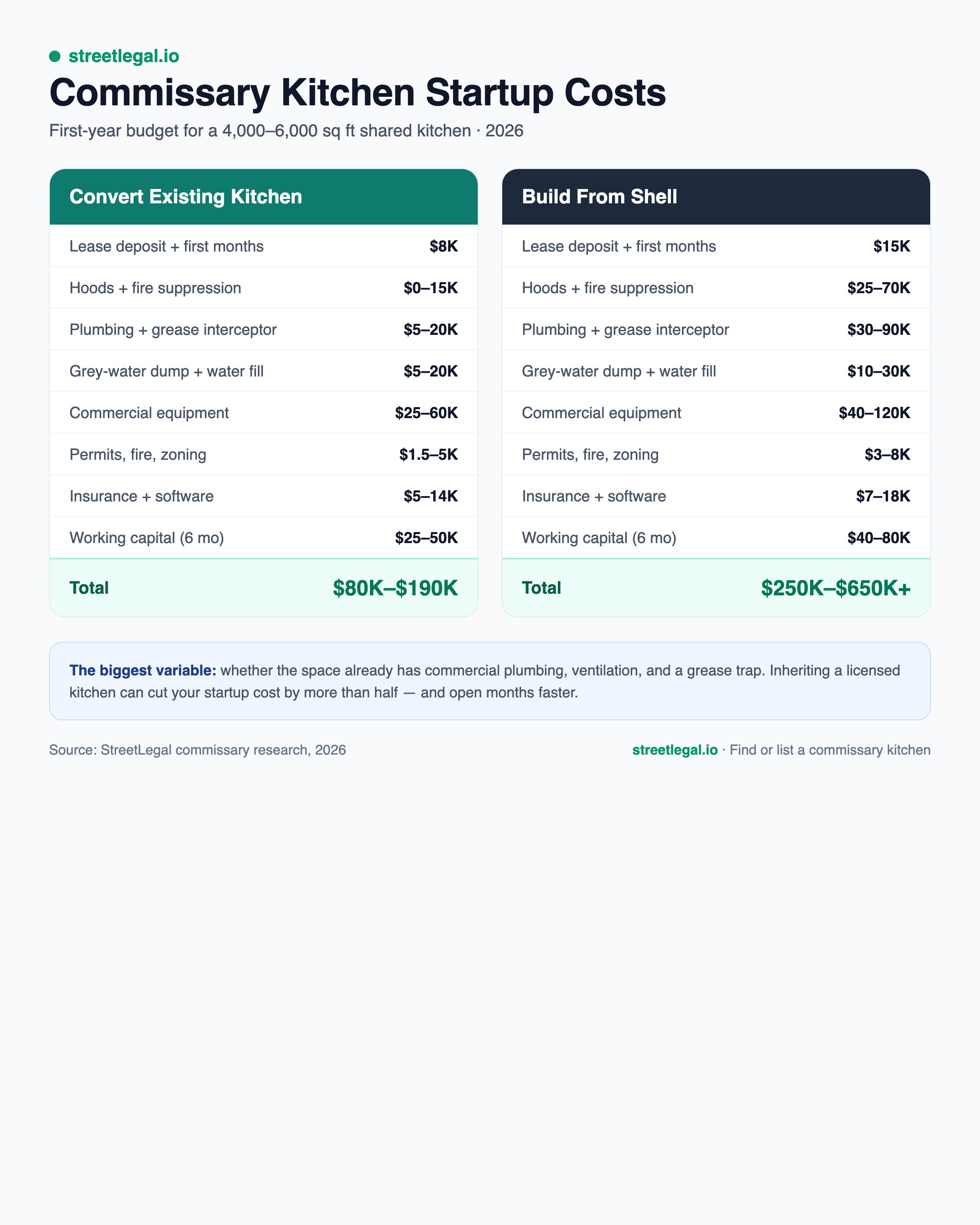
The approval stack, roughly in order:
| Step | Authority | What It Covers | Typical Cost |
|---|---|---|---|
| Plan review | Health department | Approves your layout, finishes, plumbing, equipment before buildout | $300–$1,500 |
| Food establishment permit | Health department | Your operating license as a commercial kitchen / commissary | $300–$1,200/yr |
| Plumbing / grease permit | City building / utility | Grease interceptor sizing, backflow, sinks, drains | $200–$1,000 |
| Fire inspection | Fire marshal | Hood suppression, extinguishers, exits, propane handling | $100–$400 |
| Zoning / use permit | City planning | Confirms food production + truck parking are allowed | $0–$2,000 |
| Business license + EIN | State / city / IRS | Legal entity, business registration, sales/use tax | $50–$500 |
Once you're licensed, ask the health department how to be included on or recognized for their commissary list, and set up a clean commissary agreement template your members sign — health departments require that document on every truck's application. A tight agreement that spells out access, storage, dump-station use, insurance, and liability protects you and speeds up your members' permits.
Step 6: Pricing & Revenue Model
Price for two things at once: cover your fixed costs from memberships, and capture peak demand with hourly and add-on fees. The blended model below is what most filling commissaries use.
- Base membership: $75–$250/mo for shared-station access; truck home-base plans $250–$600/mo with parking.
- Hourly station time: $18–$25/hr on top of membership, often with a monthly minimum.
- Private suite lease: $1,500–$4,500/mo for a dedicated, lockable kitchen.
- Onboarding / application fee: $150–$250 one-time, which also screens out non-serious inquiries.
- Add-ons: dedicated cold/dry storage, grey-water dump & water fill, propane, extra parking, and after-hours access — each a separate line that lifts revenue per member.
💡 Charge for the infrastructure, not just the square footage
The members who pay the most aren't renting a counter — they're renting compliance and convenience: a legal dump station, 24/7 access, propane on site, and a signed agreement that gets their permit approved. Bundle and price those explicitly. They're your highest-margin revenue.
Step 7: First-Year Cost Breakdown
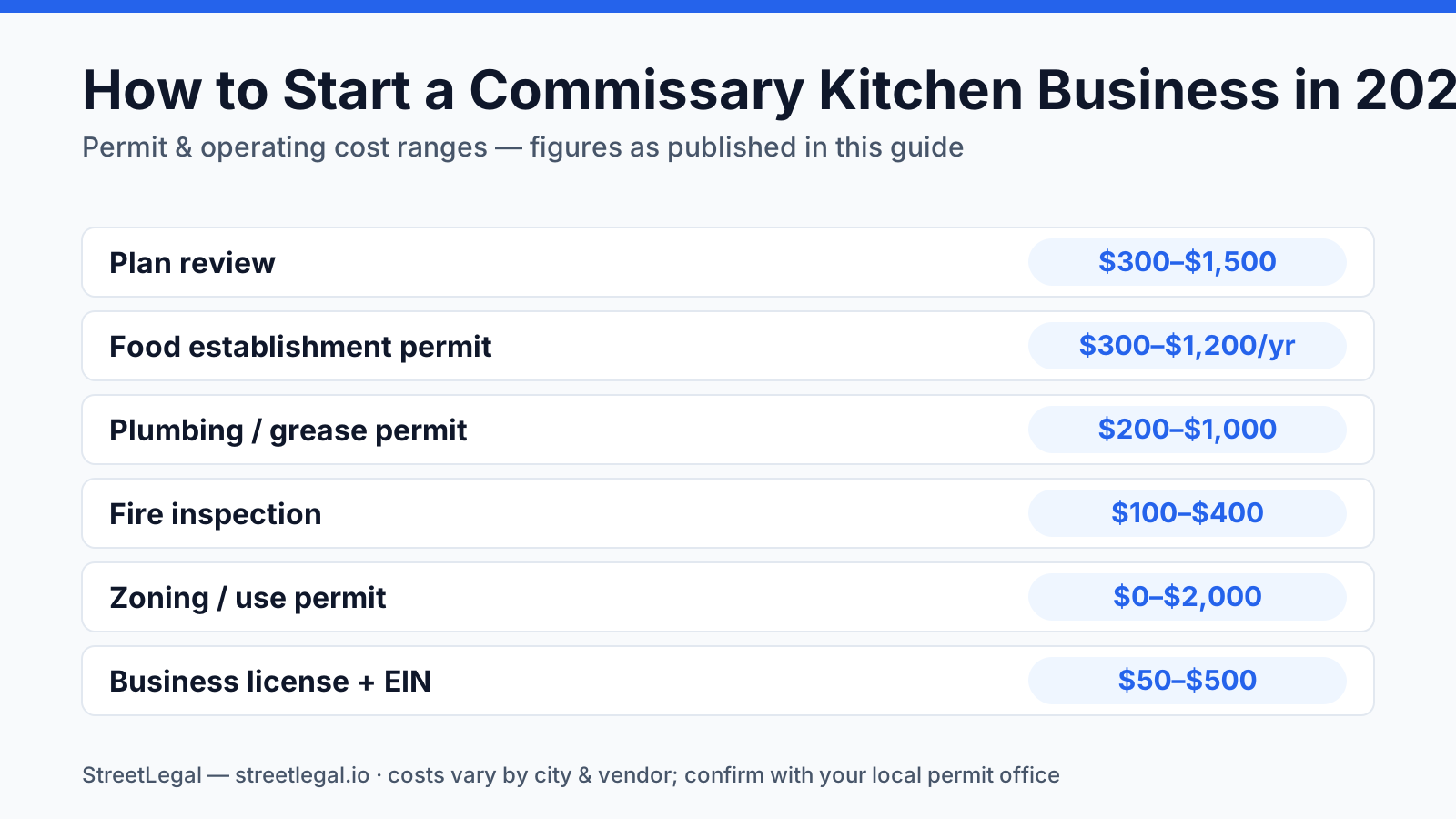
This is an illustrative first-year budget for a mid-size shared commissary (roughly 4,000–6,000 sq ft) under two scenarios: converting an existing licensed kitchen versus building from a warehouse shell. Your numbers will move with local rents, labor, and how much infrastructure already exists.
| Category | Convert Existing Kitchen | Build From Shell | Notes |
|---|---|---|---|
| Lease deposit + first months | $8,000 | $15,000 | Bigger raw space = higher rent base |
| Hoods + fire suppression | $0–$15,000 | $25,000–$70,000 | Inherit if you can |
| Plumbing + grease interceptor | $5,000–$20,000 | $30,000–$90,000 | In-ground trap is costly |
| Grey-water dump + water fill (trucks) | $5,000–$20,000 | $10,000–$30,000 | Skip only if no trucks |
| Commercial equipment | $25,000–$60,000 | $40,000–$120,000 | Used refrigeration saves a lot |
| Permits, plan review, fire, zoning | $1,500–$5,000 | $3,000–$8,000 | See licensing table |
| Access control + software | $2,000–$6,000 | $3,000–$8,000 | Booking, billing, door logging |
| Insurance (year 1) | $3,000–$8,000 | $4,000–$10,000 | Property + GL; higher with trucks |
| Working capital (6 mo) | $25,000–$50,000 | $40,000–$80,000 | Covers rent + debt while filling |
| First-Year Total | ~$80K–$190K | ~$250K–$650K+ | Space condition is everything |
The revenue side: a hybrid commissary with 10 members — say six trucks at $350/mo, three hourly makers averaging $300/mo all-in, and one private suite at $2,500/mo — grosses roughly $9,400/month, or about $113,000/year, before add-ons like storage, dump-station, and propane. Push to 15 members and add suites and you're well past $200,000/year gross. Fixed costs (rent, utilities, insurance, debt service, light staffing) typically run 55–75% of revenue early, so net margins climb as occupancy climbs. The whole game is getting to 70%+ occupancy fast.
Step 8: Finding & Onboarding Members
An empty commissary loses money every day. Start filling it before you open.
- Pre-sell during buildout. Sign letters of intent from the operators you interviewed in Step 1. Offer a founding-member rate to the first 3–5.
- Get on the health department's radar. Ask to be listed or recognized as an approved commissary so trucks applying for permits find you.
- List where trucks look. Google Business Profile, shared-kitchen directories, and local food-truck Facebook groups and associations.
- Court caterers and meal-prep brands. They fill your off-peak daytime hours that trucks don't use, smoothing revenue.
- Make onboarding effortless. A clean commissary agreement, a fast tour, and same-week access turn inquiries into signed members. The faster a truck gets a signed agreement, the faster their permit clears — and that's what they're buying.
Common Mistakes That Sink New Commissaries
- Building from a shell when a licensed kitchen was available. The conversion path is often half the cost and months faster.
- Skipping the truck infrastructure. No dump station or parking means you compete with every plain prep kitchen instead of owning the scarce, high-margin niche.
- Signing a lease before plan review. Zoning or grease-trap problems can make a "cheap" space unbuildable.
- Underfunding working capital. Memberships fill over 6–12 months; you still owe rent and debt every month in between.
- Pricing flat instead of bundled. Leaving storage, dump-station, and after-hours access unpriced gives away your best margin.
- Weak agreements. A vague commissary agreement creates liability and slows your members' permit approvals.
Frequently Asked Questions
How much does it cost to start a commissary kitchen?
Converting an existing licensed kitchen can open a small commissary for roughly $80,000–$200,000. Building a multi-station shared kitchen from a raw shell typically runs $250,000–$650,000+, driven by hoods and fire suppression, grease interceptors, grey-water/dump infrastructure, and equipment. Whether the space already has commercial plumbing, ventilation, and a grease trap is the biggest single variable.
Is a commissary kitchen profitable?
It can be, once you're 70%+ occupied. A facility with 8–15 members paying $250–$1,100/month plus hourly and add-on fees can gross $8,000–$30,000/month. Net margins of 15–35% are realistic at stable occupancy, but the first 6–12 months are usually thin while you fill memberships against fixed rent and debt.
Do you need a license to operate a commissary kitchen?
Yes. It's a permitted commercial food establishment licensed by your county or city health department, and the building must pass plan review plus plumbing, fire, and zoning approvals. To serve food trucks, your health department must recognize you as an approved commissary so trucks can list you on their mobile food unit applications.
Who actually rents commissary kitchens?
Food trucks (often legally required to have one), caterers, bakers, meal-prep and ghost-kitchen brands, packaged-food makers, and pop-up chefs. Trucks are the anchor demand; caterers and meal-prep brands rent off-peak hours and stabilize revenue.
How big does a commissary kitchen need to be?
Small shared kitchens start around 1,500–3,000 sq ft with two to four stations. Mid-size facilities run 5,000–8,000 sq ft, and large truck-focused commissaries with parking and dump stations can exceed 14,000 sq ft. Plan for roughly 300–600 sq ft of usable kitchen per simultaneous member, plus storage, an office, and truck parking and a dump/fill station.
Opening a commissary is part real estate, part compliance, and part community-building. The operators who win do the demand validation before signing, inherit as much infrastructure as they can, build the truck dump-and-fill that everyone else skips, and start filling memberships during buildout instead of after. Get those four right and the occupancy math takes care of the rest.
Last updated: June 19, 2026. Permit names, fees, and zoning rules vary by jurisdiction and change often — confirm specifics with your local health department, building department, and fire marshal before signing a lease.
Answers to the most common permit questions — costs, timelines, commissary rules, and more.
Find city-level permit guides for every state we cover — compare costs and requirements.
More from the blog
Jefferson County, MO Food Truck Permit Guide
Complete guide to food truck permits, fees, and requirements in Jefferson County, MO.
City GuidesSt. Charles County, MO Food Truck Permit Guide
Complete guide to food truck permits, fees, and requirements in St. Charles County, MO.
City GuidesSt. Louis County, MO Food Truck Permit Guide
Complete guide to food truck permits, fees, and requirements in St. Louis County, MO.
Buyer's GuideFood Truck POS Systems 2026: Square, Toast, Clover & Avocado
Compare 2026 food truck POS systems by pricing, hardware costs, offline mode, and contract terms for Square, Toast, Clover, and Avocado.