· 8 min read ·
How to Get a Food Truck Permit in San Jose, CA (2026 Guide)
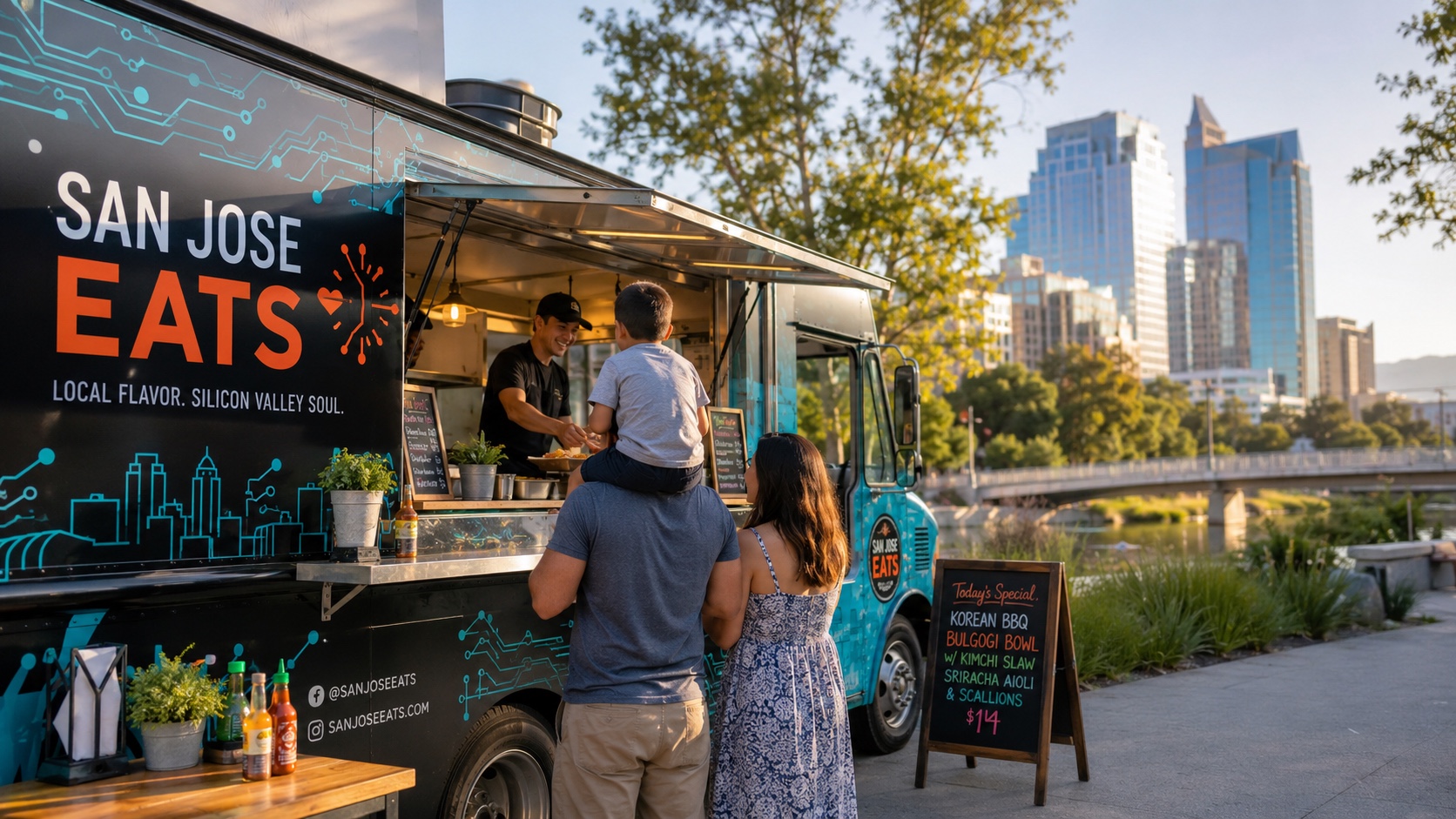
San Jose is one of the highest-income food truck markets in the United States — Silicon Valley tech workers, a massive and diverse immigrant population, and a dense event calendar create real demand. But California's permitting process is among the slowest in the country: plan review alone takes 4–6 weeks, total launch time runs 8–12 weeks, and commissary costs in Santa Clara County run $700–$1,500/month, well above national norms.
This guide covers the complete San Jose permit stack: your Mobile Food Facility (MFF) permit from Santa Clara County Environmental Health Department, business tax certificate, fire suppression requirements, commissary rules under the California Retail Food Code, where you can actually park and operate, which truck concepts work best in this market, and how to sequence everything to avoid the delays that kill first-year operators.
Updated June 5, 2026 — permit fees, timelines, commissary rules, operating-lane guidance, California market comparison, and best-truck-type recommendations reviewed for San Jose and Santa Clara County.
California Disclaimer
San Jose food truck requirements span Santa Clara County Environmental Health, City of San Jose, California CDTFA, and site-specific operating rules. Requirements change. Always verify current fees, timelines, and rules with the relevant agencies before filing any application.
The San Jose Food Truck Licensing Landscape
San Jose sits inside Santa Clara County, which means your primary health authority is the Santa Clara County Environmental Health Department (EHD) — not a city health agency. The county issues the Mobile Food Facility (MFF) permit that allows you to operate legally across unincorporated county areas and the City of San Jose itself.
Three agencies govern most of what you need:
- Santa Clara County Environmental Health Department (EHD) — MFF permit, plan review, pre-opening inspection, ongoing inspections
- City of San Jose Finance Department — Business Tax Certificate (required for all businesses operating in San Jose)
- California Department of Tax and Fee Administration (CDTFA) — Seller's Permit (free, required to collect and remit California sales tax)
- Santa Clara County Fire — Fire suppression system inspection for trucks with open-flame cooking equipment
- City of San Jose — Sidewalk Vending Permit for public right-of-way vending (SB 946 framework)
California makes this harder than most states: the CRFC (California Retail Food Code) imposes strict commissary requirements, the EHD plan review process is slower than almost any comparable market, and the city's sidewalk vending rules add a layer that most operators underestimate.
The San Jose Food Truck Permit Stack
1. Mobile Food Facility (MFF) Permit — Santa Clara County EHD
This is your primary operating permit. The MFF permit from Santa Clara County EHD is required for any food truck, cart, or trailer selling food in San Jose or Santa Clara County. No MFF permit means you cannot legally operate.
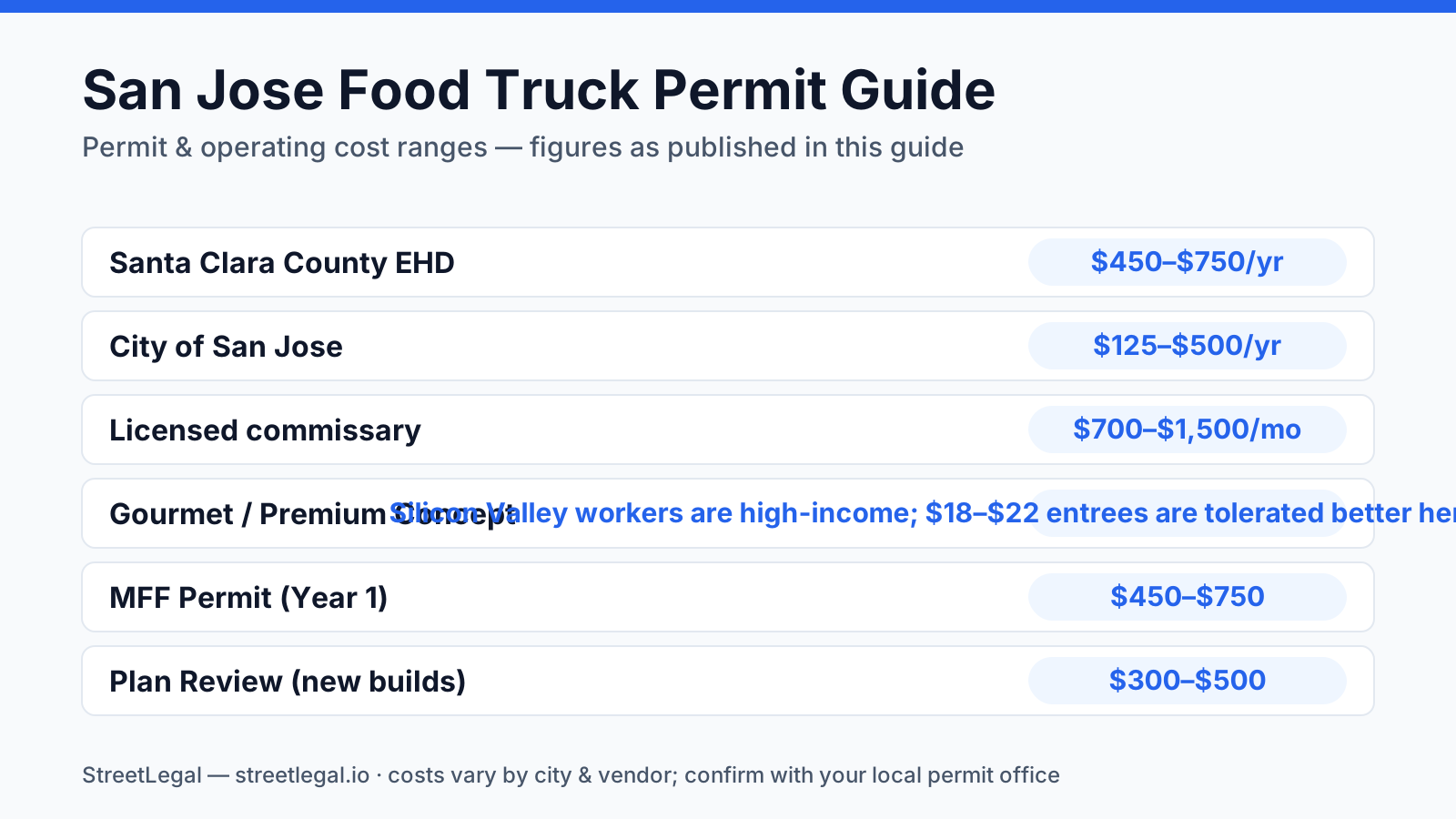
- Annual fee: $450–$750 depending on permit type. Type A trucks (with cooking equipment) are at the higher end; Type B (limited food prep) are lower.
- Plan review (one-time for new builds): $300–$500. Required for any new truck build or significant equipment change.
- Pre-opening inspection: Required before the permit is issued. You cannot open until you pass.
- Required documents: Completed application, commissary agreement, menu, equipment list, floor plan/drawings, CFPM certificate.
- Timeline: 4–6 weeks for plan review, then schedule inspection. Total: 6–10 weeks from application to permit.
2. San Jose Business Tax Certificate
Any business operating within San Jose city limits must have a Business Tax Certificate from the City of San Jose Finance Department. This is separate from the county health permit and is required regardless of whether you own a brick-and-mortar location.
- Fee: $125–$500/year, based on number of employees and business type
- Renewal: Annual — renew before your expiration date
- Filing: Apply online at sanjoseca.gov or in person at City Hall
3. California Seller's Permit (CDTFA)
Before collecting sales tax on food sales, you must register with the California Department of Tax and Fee Administration (CDTFA). This permit is free and can be registered online at cdtfa.ca.gov. Required before your first day of sales.
- Fee: Free
- Timeline: Immediate online registration
- Note: Many prepared foods sold by food trucks are subject to California sales tax. Verify taxability of your specific menu items with CDTFA.
4. Sidewalk Vending Permit (City of San Jose)
If you plan to operate on public right-of-way — sidewalks, parkways, or public plazas — you need a Sidewalk Vending Permit from the City of San Jose. California SB 946 (effective 2019) limits cities from outright banning sidewalk vending but allows time, place, and manner restrictions. San Jose enforces specific rules about where and when vendors can set up.
5. Fire Suppression Inspection (Santa Clara County Fire)
Required for any truck with open-flame cooking equipment. See the Fire / Hood / Safety section for full details.
6. Certified Food Protection Manager (CFPM)
California law requires at least one CFPM per truck — someone who has passed an ANSI-accredited food safety exam (ServSafe, Prometric, or equivalent). This certificate must be presented at your pre-opening inspection and kept current. All other food handlers should complete California Food Handler training (AB 1252).
San Jose Food Truck Permit Snapshot
| Agency | Permit / License | Cost | Timeline | Sequence |
|---|---|---|---|---|
| Santa Clara County EHD | Mobile Food Facility (MFF) Permit | $450–$750/yr | 6–10 weeks | Step 4 (after plan review) |
| Santa Clara County EHD | Plan Review (new builds) | $300–$500 one-time | 4–6 weeks | Step 2 (critical path) |
| City of San Jose | Business Tax Certificate | $125–$500/yr | 1–2 weeks | Step 3 (concurrent) |
| California CDTFA | Seller's Permit | Free | Immediate online | Step 1 (can do early) |
| Santa Clara County Fire | Fire Suppression Inspection | Varies (install + inspect) | 2–4 weeks | Step 3 (before EHD inspection) |
| City of San Jose | Sidewalk Vending Permit | Varies | 2–4 weeks | Step 5 (if operating on ROW) |
| Licensed commissary | Commissary Agreement | $700–$1,500/mo | Before EHD application | Step 1 (required first) |
Commissary Requirements in San Jose (California Retail Food Code)
California's commissary requirement under the California Retail Food Code (CRFC Section 114294–114295) is one of the most strictly enforced in the country. Every Mobile Food Facility must return to a licensed commissary at least daily. This is not optional and is not a suggestion — it is a hard requirement enforced at every inspection.
What Makes a Valid Commissary in Santa Clara County
- Must hold its own current Santa Clara County EHD food facility permit
- Must be capable of supporting your specific truck (matching cooking equipment, cold storage, wastewater disposal capacity)
- Must have a three-compartment sink, mop sink, potable water supply, and proper ventilation
- Written commissary agreement naming your truck must be presented to EHD at application and kept current
- EHD may inspect the commissary as part of your MFF permit review
What You Must Do at the Commissary Daily
- Receive, store, and prep food (no food prep is permitted at unapproved locations)
- Fill all fresh water tanks from the commissary's potable water supply
- Dispose of all wastewater (greywater) into the commissary's approved drain system — never on the street or in storm drains
- Clean all equipment, utensils, and the truck itself
- Maintain all food supplies in proper temperature-controlled storage
Silicon Valley Commissary Costs
Commissary fees in the San Jose / Santa Clara County area run $700–$1,500/month — significantly higher than most U.S. markets. This reflects real estate costs in Silicon Valley. Budget for this from day one; many operators underestimate commissary cost relative to other startup expenses.
Common Commissary Mistake
Do not sign an MFF permit application listing a commissary you have not formally secured in writing. EHD verifies commissary agreements. If your listed commissary cannot confirm your agreement, your application stalls. Secure the commissary agreement before you submit anything to EHD.
Finding a Commissary in Santa Clara County
- Shared commissary kitchens in San Jose (search for licensed commercial kitchen rentals in the 95110–95136 zip codes)
- Restaurant kitchens that rent overnight or early morning hours (common in Silicon Valley)
- Purpose-built food truck commissary facilities — some offer covered parking, water hookup, and power alongside kitchen access
- Note: the commissary cannot be your home kitchen, even if permitted as a cottage food operation — CRFC requirements exceed cottage food scope
Fire Suppression, Hood Requirements, and Safety Inspections
California takes fire safety in mobile food facilities seriously, and Santa Clara County Fire enforces it. If your truck has any open-flame cooking equipment — gas burners, griddles, fryers, broilers — you need a UL 300-rated fire suppression system installed in your ventilation hood.
Fire Suppression System Requirements
- UL 300 standard: Your hood suppression system must meet UL 300 rating. This is the current NFPA 96 standard for kitchen fire suppression.
- Inspection: Santa Clara County Fire Department inspects the system before your MFF permit is issued. Inspection is conducted at your truck — the suppression company typically schedules this.
- Semi-annual service: UL 300 systems must be professionally serviced every 6 months by a certified technician. Keep service records on the truck at all times.
- Class K extinguisher: A portable Class K dry-chemical fire extinguisher must be mounted in an accessible location in the cooking area. Standard ABC extinguishers do not satisfy this requirement for cooking equipment with vegetable oils or animal fats.
- Class K inspection: The extinguisher must be professionally inspected annually and tagged. Carry the tag.
Hood Ventilation
- Hood must be appropriately sized for your cooking equipment — EHD reviews hood specifications during plan review
- Exhaust must vent to the outside — interior circulation-only setups are not permitted for open-flame equipment
- Grease filters must be maintained and replaced on a regular schedule (document this)
Event-Specific Fire Rules
Events at SAP Center, San Jose Convention Center, and large flea market gatherings will often require an additional fire inspection from the event's venue fire marshal or a county fire inspector. Bring current suppression system service records and extinguisher tags to every major event. Running expired certifications at an event is a fast path to a forced shutdown and potential permit action.
Where You Can Operate in San Jose
The most important thing to understand about operating in San Jose: getting your MFF permit does not give you automatic access to any specific location. Every location category has its own access reality — sometimes requiring additional permits, sometimes requiring private negotiation, sometimes requiring an application to a competitive vendor program.
Tech Campuses
Silicon Valley tech campuses (Cisco HQ in San Jose, Adobe HQ, Broadcom, Zoom, PayPal) are among the most lucrative food truck opportunities in the U.S. — but they are privately managed vendor programs. Having an MFF permit is required to even apply, but acceptance is competitive and often involves waitlists of 6–18+ months. Build relationships directly with campus food services or facilities management.
Downtown San Jose and Diridon Station
Downtown San Jose includes SAP Center (Sharks games, concerts), the San Jose Convention Center, and the Diridon Caltrain hub. Operating near these venues on public right-of-way requires your Sidewalk Vending Permit. Private lots near the arena require negotiation with property owners. Event-night crowds are high-volume but short-window opportunities.
San Jose Flea Market
The San Jose Flea Market (Berryessa Road) is one of the largest flea markets in the United States, drawing massive weekend crowds with strong Hispanic community attendance. Flea market vending requires a separate vendor spot application directly to the flea market management — your MFF permit is necessary but not sufficient. Apply for a vendor spot early; popular food categories can have waitlists.
Private Property: Santana Row, Valley Fair, Commercial Lots
Santana Row and Westfield Valley Fair are privately managed retail destinations. Vending access requires direct negotiation with property management — there is no standard application process. Some private commercial lots in San Jose have informal food truck clusters (Willow Glen neighborhood, East San Jose corridors) where operators negotiate informal or formal agreements with property owners.
City Parks
Vending in City of San Jose parks requires a separate park vendor permit from San Jose Parks, Recreation and Neighborhood Services. This is distinct from your MFF permit and the Sidewalk Vending Permit. Parks permits are location-specific and often tied to event permits.
Little Saigon and East San Jose Neighborhoods
San Jose has one of the largest Vietnamese communities in the United States (centered around Story Road and King Road in East SJ), as well as strong Korean, Filipino, and Indian communities. This creates strong demand for authentic ethnic food concepts. Operators who understand these communities can build loyal repeat customer bases faster than generic concepts. Private-lot and event relationships in these neighborhoods are often built through community organizations and cultural events.
San Jose Operating Lane Reality
| Operating Lane | MFF Permit Enough? | Access Reality | Best Truck Fit |
|---|---|---|---|
| Tech Campus Programs | No — need vendor program acceptance | Highly competitive; waitlists common | Compact versatile truck, diverse/healthy menu |
| Public Sidewalks / Caltrain | No — Sidewalk Vending Permit required | SB 946 protections apply; time/place rules enforced | Any truck; coffee/quick-serve for commute traffic |
| San Jose Flea Market | No — separate vendor application required | Strong demand; apply directly to management | Taco/Mexican, Filipino, Vietnamese concepts |
| SAP Center / Convention Center Events | No — event vendor approval needed | High-volume, short windows; competitive applications | Event trailer, high-throughput concept |
| Private Lots / Willow Glen | Yes (if owner permits) | Negotiate directly with property owner; no standard process | Gourmet/premium, neighborhood-friendly concept |
| City Parks | No — separate parks vendor permit required | Location-specific; tied to event permits | Family-friendly, ice cream, lighter fare |
Best Truck Types for the San Jose Market
San Jose is not a one-size-fits-all market. The tech campus lane, the ethnic community corridors, and the event circuit all reward different concepts. Here is what actually works:
| Truck Type | Market Fit | Commissary Pressure | Event Flex | Why It Works |
|---|---|---|---|---|
| Compact / Versatile Truck | Excellent for tech campus rotation | Moderate | High | Fits restricted parking spaces; diverse menu satisfies vegetarian/vegan demand; easy to reposition between campuses |
| Asian Fusion / Authentic Ethnic | Excellent — large Vietnamese, Korean, Filipino, Indian populations | Moderate–High | Moderate | San Jose has one of the largest Vietnamese communities in the U.S. (Little Saigon, East SJ); authentic concepts build fierce loyalty and repeat traffic |
| Gourmet / Premium Concept | Excellent for tech workers and Santana Row area | High | Moderate | Silicon Valley workers are high-income; $18–$22 entrees are tolerated better here than almost anywhere else in the U.S. |
| Taco / Mexican Truck | Strong — large Hispanic community, especially East San Jose | Moderate | High | East San Jose corridors, flea market, and community events reward authentic taquero-style operations with a loyal base |
| Event Trailer | Good for SAP Center, Convention Center, flea market | High | Very High | High-volume short windows at events; throughput capacity matters more than niche concept appeal |

California market comparison: San Jose vs other major markets (2026)
| Market | Launch Friction | Best First Revenue Lane | Best First Truck Fit | Why This Market Matters |
|---|---|---|---|---|
| San Jose | Medium (Santa Clara County health + city layers) | Tech campus partnerships + downtown lunch | 18ft step van — service speed + ethnic menu flex | Silicon Valley tech demand, diverse ethnic food culture, less saturated than SF |
| Los Angeles | Medium (multi-agency stack, commissary tight) | Private events + brewery residencies first | 24ft step van — scale + brand presence | 5,000+ trucks, highest event volume, best revenue ceiling in CA, strong cultural credibility |
| San Francisco | High (SFDPH slow, commissary expensive) | Tech campus catering + FiDi lunch | 16-18ft compact truck — tight streets, fast service | Tech worker lunch demand, premium price tolerance, smaller footprint required |
| San Diego | Low-medium (faster county approval) | Beach/boardwalk spots + brewery circuits | 20-22ft trailer — tourist + local mix, flex parking | Beach tourism + military/family demo, easier permitting than SF/LA |
| Sacramento | Low (faster permitting, lower commissary cost) | State worker lunch + festival circuits | 16-20ft trailer — lower build cost, easier parking | State capital steady lunch demand, lower operating costs, family-friendly events |
San Jose sits between SF's permitting friction and Sacramento's lower costs. The tech campus lane is a huge opportunity if you can navigate vendor program applications, and the ethnic community corridors reward authentic concepts better than almost any other California market.
Week-by-Week Launch Timeline for San Jose
California's plan review process is the constraint that controls everything else. Build your timeline around it.
-
Weeks 1–2: Entity Formation and Early Applications
Form your LLC or business entity. Get your EIN. Register for your California Seller's Permit at cdtfa.ca.gov (free, immediate). Begin searching for a licensed commissary — this takes longer than most operators expect in Silicon Valley.
-
Weeks 2–3: Secure Commissary and Finalize Truck Equipment
Sign your commissary agreement. Finalize menu and complete equipment list. You cannot submit to EHD without a signed commissary agreement. Begin scheduling your fire suppression system installation if the truck does not already have one.
-
Weeks 3–4: Submit MFF Plan Review to Santa Clara County EHD
Submit your complete MFF application with plan drawings, equipment list, menu, commissary agreement, and CFPM certificate. Pay the plan review fee ($300–$500). This starts the 4–6 week California plan review clock — your critical path item. Also apply for your San Jose Business Tax Certificate at this time.
-
Weeks 4–7: Plan Review Period
EHD is reviewing your plans. Use this time productively: complete fire suppression installation and get your Class K extinguisher mounted, obtain ServSafe or equivalent CFPM certification if not already current, secure your Sidewalk Vending Permit application if you plan to operate on public right-of-way, and begin approaching tech campus vendor programs — the acceptance process often runs parallel to permitting.
-
Weeks 7–8: Fire Inspection and EHD Plan Review Corrections
Schedule Santa Clara County Fire inspection of your suppression system. Address any EHD plan review corrections — respond to correction requests within 5 business days to avoid resetting the clock. EHD issues plan approval when corrections are resolved.
-
Weeks 8–10: Pre-Opening Inspection and Permit Issuance
Schedule your EHD pre-opening inspection. Bring your truck to the commissary or to the inspection site with all equipment operational. Once you pass, your MFF permit is issued. Annual fee ($450–$750) is paid at this stage.
-
Weeks 10–12: Final Location Access and Soft Launch
Finalize any remaining location agreements (private lots, event applications, flea market vendor spot). Begin soft launch operations with permits in hand. Track all renewal dates before leaving week one of operations.
Total Costs: Startup vs. Annual
First-Year Startup Costs (Permits and Compliance Only)
| Expense | Estimated Cost | Notes |
|---|---|---|
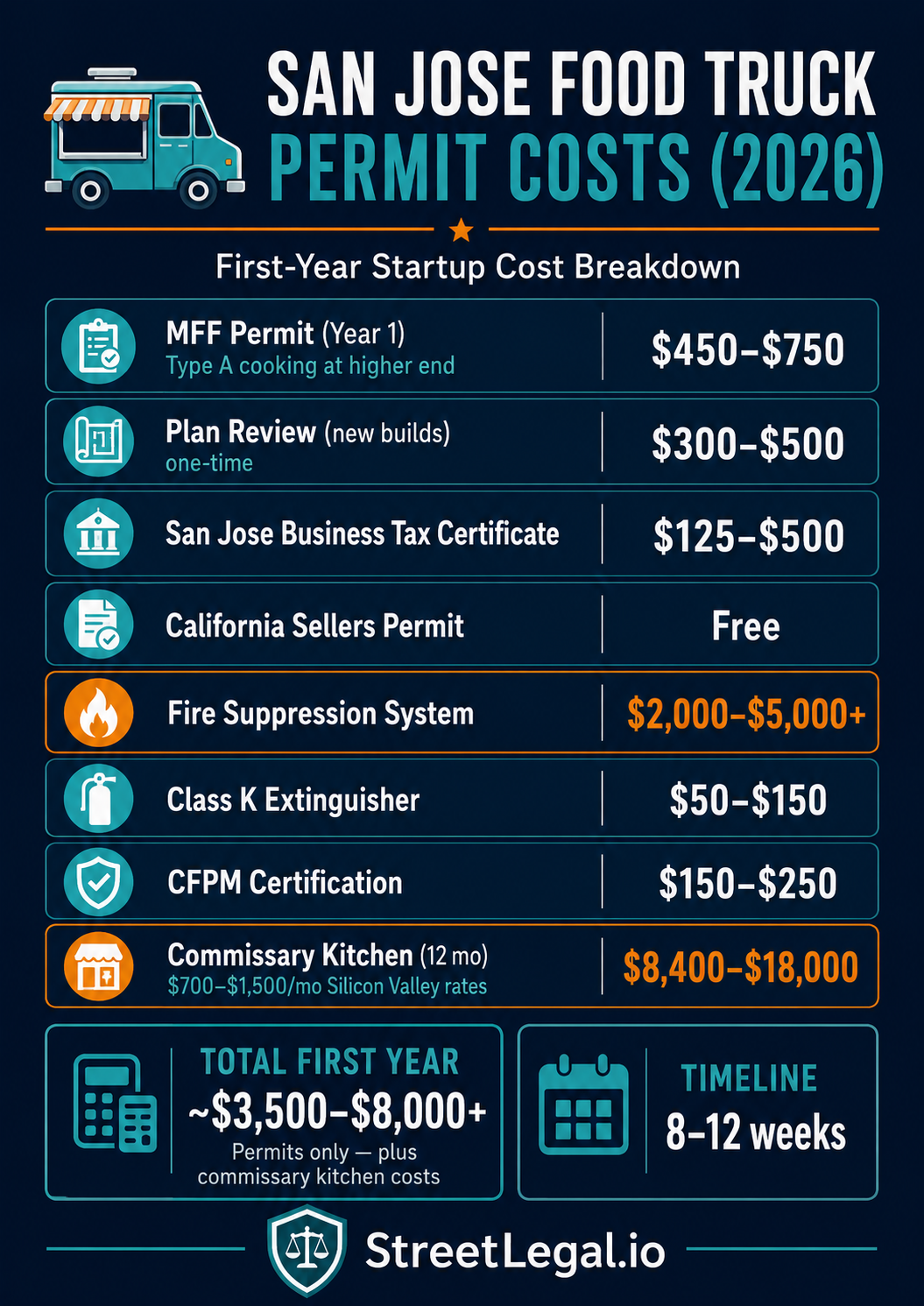
| MFF Permit (Year 1) | $450–$750 | Type A (cooking) at higher end |
| Plan Review (new builds) | $300–$500 | One-time fee for new truck builds |
| San Jose Business Tax Certificate | $125–$500 | Based on employees / business size |
| California Seller's Permit | Free | Register at cdtfa.ca.gov |
| Fire Suppression System (new install) | $2,000–$5,000+ | UL 300 system + professional install |
| Class K Extinguisher | $50–$150 | Plus annual inspection tag |
| CFPM Certification (ServSafe or equivalent) | $150–$250 | Per certified person |
| Total First-Year Permits and Setup | $3,500–$8,000+ | Excluding commissary and truck purchase/build |
Annual Ongoing Costs (Year 2+)
| Expense | Annual Cost |
|---|---|
| MFF Permit Renewal | $450–$750 |
| San Jose Business Tax Certificate | $125–$500 |
| Fire Suppression System Service (semi-annual) | $300–$600 |
| Class K Extinguisher Inspection | $50–$100 |
| CFPM Recertification (every 5 years, prorated) | $30–$50/yr avg |
| Total Annual Permits and Compliance | ~$1,000–$2,000/yr |
StreetLegal Tracks Your Deadlines
Managing MFF renewals, fire inspection schedules, CFPM recertification, and business tax deadlines across multiple agencies is easy to drop. StreetLegal's platform tracks every deadline and sends alerts before renewals are due — so you never lose your permit to a missed date.
See How StreetLegal WorksRenewal and Ongoing Compliance
- MFF Permit: Renew annually with Santa Clara County EHD. EHD conducts routine unannounced inspections throughout the year. Keep your truck inspection-ready at all times — not just at renewal.
- San Jose Business Tax Certificate: Annual renewal with the City of San Jose Finance Department. Fee may change based on business changes (headcount, revenue classification).
- Fire Suppression System: Professionally serviced every 6 months. Keep your service records in the truck — inspectors and event managers will ask for them.
- Class K Extinguisher: Annual professional inspection and tag. Replace the tag immediately if it expires.
- CFPM Certification: 5-year recertification cycle. Track your CFPM's expiration date — operating without a current CFPM is a health code violation and can result in forced closure during inspection.
- Commissary Agreement: Must remain active and current. If you change commissaries, update your EHD records before the change takes effect, not after.
- California Seller's Permit: No annual renewal needed, but file sales tax returns on CDTFA's schedule (typically quarterly for food trucks). Late filings result in penalties.
Common Mistakes Made by San Jose Food Truck Operators
- Underestimating plan review time: 4–6 weeks for California EHD plan review is slow compared to most U.S. markets. Operators who assume 2–3 weeks end up pushing their launch back by months. Build the full 8–12 weeks into your planning from day one.
- Not securing the commissary before applying: EHD will not process your MFF application without a current, signed commissary agreement from a Santa Clara County EHD-permitted facility. Going to EHD without this ready delays your entire timeline.
- Treating the MFF permit as location access: The MFF permit is your health authorization. It is not a location permit. Tech campuses, flea markets, parks, events, and sidewalks all have separate access requirements. Many operators are permitted and still cannot legally park anywhere productive.
- Missing the fire suppression semi-annual service: Operating with an expired suppression system service tag is a code violation that can result in permit suspension — especially at events where fire marshals check documentation before letting you set up.
- Underbudgeting for commissary: Silicon Valley commissary costs ($700–$1,500/month) are 30–50% higher than national norms. Operators who budget for a $400/month commissary and discover the real market rate are consistently shocked. Model this into your business plan before you buy the truck.
- Assuming tech campus waitlists are short: Campus vendor programs at major Silicon Valley companies often have waitlists measured in years, not months. Do not build your financial model around tech campus revenue you have not yet secured.
- Letting CFPM certification lapse: California requires at least one currently certified CFPM per truck. An expired certificate is a violation at any routine inspection. Track the expiration date and recertify well in advance.
- Ignoring SB 946 nuances: SB 946 protects sidewalk vendors but does not eliminate all restrictions. San Jose has time, place, and manner rules. Operating on public right-of-way without understanding the local SB 946 implementation can result in citations even with a Sidewalk Vending Permit.
San Jose Food Truck Permit FAQ
What is the Santa Clara County EHD MFF permit fee?
How long does the San Jose food truck permitting process take?
Is a commissary required in San Jose?
Do I need a fire inspection for my San Jose food truck?
Can I operate on tech campuses in San Jose with just my MFF permit?
What food truck concepts do best in San Jose?
Do I need a separate permit to vend on San Jose sidewalks or near Caltrain?
What certifications does a San Jose food truck operator need?
The Bottom Line on San Jose Food Truck Permits
San Jose is a high-reward market, but California makes you earn it. The MFF permit process is slower than almost any comparable city, commissary costs are among the highest in the country, and getting a health permit does not get you into a tech campus, a flea market vendor spot, or an event at SAP Center — those are all separate lanes that require separate effort.
The operators who succeed in San Jose treat the 8–12 week permitting window as productive time: locking in commissary agreements, applying to campus programs, building location relationships, and having their fire suppression and food safety certifications ready before the EHD inspection date. Start now, sequence correctly, and budget honestly for Silicon Valley costs.
Launch Your San Jose Food Truck With StreetLegal
StreetLegal is the permit tracking platform built for food truck operators. Track your MFF permit status, Santa Clara County EHD deadlines, fire inspection schedules, commissary compliance, and renewal dates — all in one place. Never miss a deadline that costs you your permit.
Get Started with StreetLegal →More California Food Truck Permit Guides
San Jose is one of many California cities where StreetLegal covers the complete food truck permit process. If you are operating in or expanding to other California markets:
- San Francisco Food Truck Permit Guide — Bay Area neighbor with a more complex city-level health permit process and stricter location rules
- Los Angeles Food Truck Permit Guide — LA County EHD, LADOT vending rules, and the largest food truck market in California
- San Diego Food Truck Permit Guide — San Diego County DEH permit process and coastal operating rules
- Sacramento Food Truck Permit Guide — Sacramento County EHD, capital city events, and government-area operating rules
- Fresno Food Truck Permit Guide — Central Valley market and Fresno County EHD requirements
- Long Beach Food Truck Permit Guide — Long Beach Health Department, port-area, and event circuit guide
People also ask about San Jose food truck permits
How much does a food truck permit cost in San Jose?
How long does it take to get a food truck permit in San Jose?
Do I need a commissary kitchen to operate a food truck in San Jose?
What documents do I need for a San Jose food truck permit?
Answers to the most common permit questions — costs, timelines, commissary rules, and more.
Find city-level permit guides for every state we cover — compare costs and requirements.
More from the blog
Food Truck POS Systems: Square vs. Toast vs. Clover vs. Avocado (2026)
Real 2026 pricing, hardware costs, offline mode, and contract terms for Square, Toast, Clover, and Avocado — compared specifically for food truck operators.
City GuidesEagan, MN Food Truck Permit Guide
Eagan MN food truck permit guide: MDH mobile food licensing, Dakota County food safety, city peddler rules, commissary records, costs, and launch timeline.
City GuidesBentonville, AR Food Truck Permit Guide
Complete guide to food truck permits, fees, and requirements in Bentonville, AR.
City GuidesBiloxi, MS Food Truck Permit Guide
Biloxi food truck permit guide 2026: licenses, health permit steps, commissary records, inspections, costs, renewal timing, and launch checklist.