· 11 min read · StreetLegal Team
How to Start a Food Truck in San Diego: Complete Permit Guide 2026
Updated June 27, 2026
San Diego Food Truck Permitting Overview
San Diego operates a two-tier permit system for food trucks. The County of San Diego Department of Environmental Health and Quality (DEHQ) issues your public health permit under the California Retail Food Code — this covers food safety and applies everywhere in the county. The City of San Diego Development Services Department issues a separate Mobile Food Truck Permit for operations on private property within city limits.
You also need to understand the difference between the two mobile food facility types California recognizes:
- Mobile Food Facility (MFF) — A motorized vehicle where food is prepared and sold; the standard "food truck"
- Occupied Mobile Food Facility (OMMF) — A facility in which an employee works inside during service (most full-service food trucks qualify)
Both types require county health permits, but the construction and equipment standards differ slightly. Know which category applies to your operation before you design or purchase your truck.
Permit Snapshot: San Diego at a Glance
| Step | Agency | Permit | Fee | Timeline | Sequence |
|---|---|---|---|---|---|
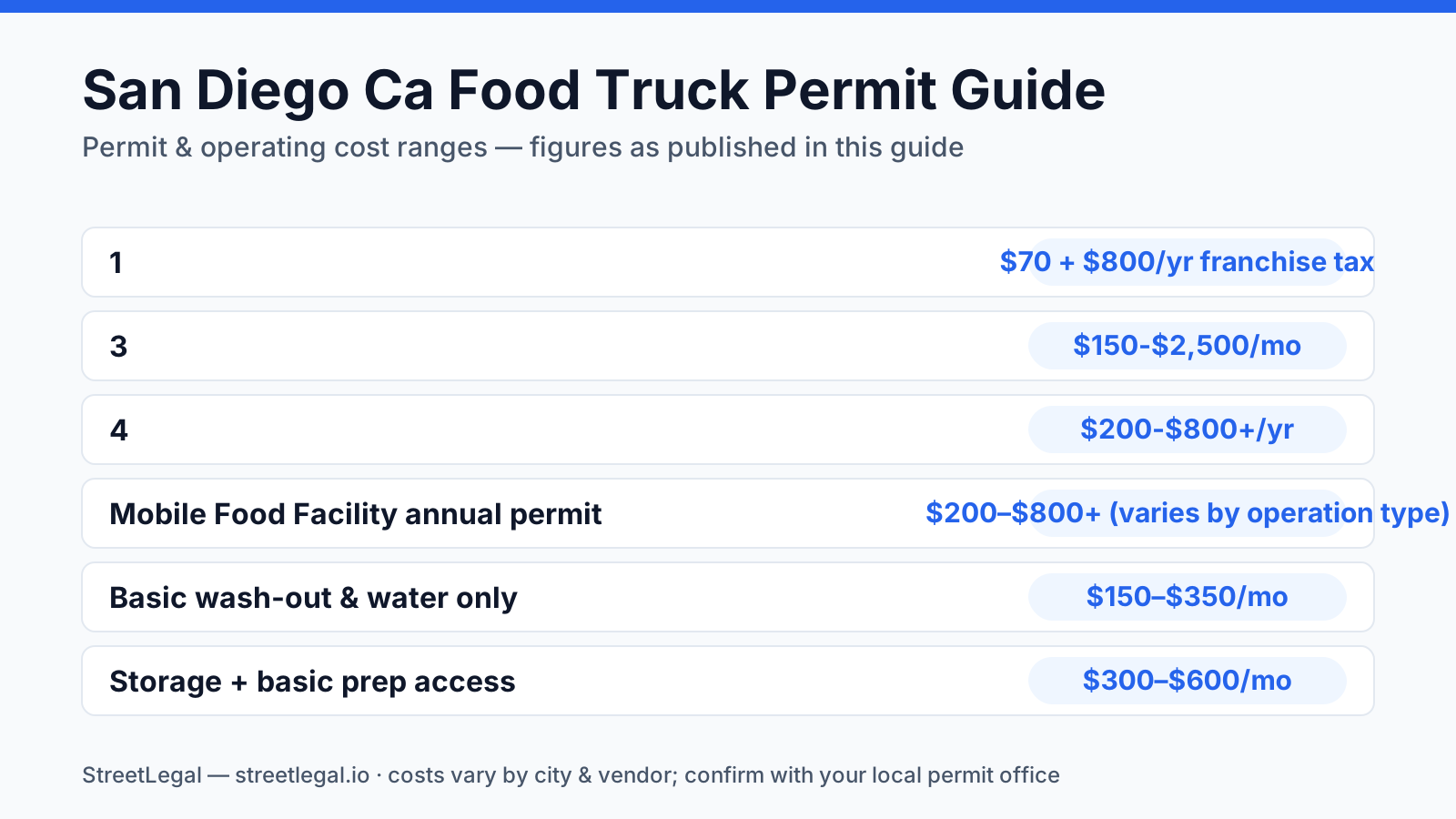
| 1 | CA Secretary of State | LLC Registration | $70 + $800/yr franchise tax | 1-2 days | Before health permit |
| 2 | SD County DEHQ | Plan Check Approval | Varies | 2-4 weeks | Before truck build |
| 3 | Licensed Commissary | Commissary Agreement | $150-$2,500/mo | 1-7 days | Before health permit |
| 4 | SD County DEHQ | Mobile Food Facility Permit | $200-$800+/yr | 3-6 weeks | After plan check + commissary |
| 5 | City of SD DSD | Mobile Food Truck Permit | Varies | 2-4 weeks | After county health permit |
| 6 | CA CDTFA | Seller's Permit | Free | Same day (online) | Before first sale |
How San Diego Compares to Other California Markets
| Market | Launch Friction | Best First Revenue Lane | Best First Truck Fit | Why This Market Matters |
|---|---|---|---|---|
| San Diego | Medium — dual permit stack (county + city), strict plan check | Brewery pop-ups, military base catering, coastal events | Taco truck or BBQ trailer — strong taco culture, military demand | Year-round weather, huge military population, strong tourism, deep taco culture |
| Los Angeles | High — LA County + city layers, strict commissary enforcement | Office lunch runs, private lot deals, entertainment shoots | Specialty/fusion truck — LA expects high variety, Instagram-ready food | Largest CA market, entertainment industry, diverse neighborhoods, but intense competition |
| San Francisco | Very High — MTA permit + SFDPH + restricted vending zones | Tech campus catering, Off The Grid events, Financial District lunch | Specialty/upscale truck — SF market expects quality, variety, sustainability | Highest revenue potential, tech spending power, but toughest permit stack in CA |
| San Jose | Medium — county health + city business license, moderate competition | Tech campus catering, San Jose State lunch, industrial parks | Taco truck or international/fusion — large Latino and Asian populations | Silicon Valley demand without SF-level friction, strong ethnic food culture |
| Sacramento | Low-Medium — county health + city business license, easier access | Government office lunch, Midtown/Downtown street vending, breweries | BBQ trailer or taco truck — strong government lunch demand, Central Valley BBQ culture | State capital, steady government/office demand, lower competition than coastal markets |
County of San Diego Health Permit (DEHQ)
Your primary operating permit comes from the San Diego County Food and Housing Division (FHD). This is required for every mobile food facility operating anywhere in San Diego County, regardless of city.
What You Need to Apply
- Completed FHD application — Available from DEHQ; submit via their online portal or in person
- Plan check approval — Any new construction or remodel of your truck must be reviewed and approved by FHD's Plan Check unit before the truck is built or modified; plans must be submitted prior to construction
- Commissary agreement — Required. A signed agreement with an approved commissary must be submitted; commissary must be a licensed retail food facility in San Diego County
- Toilet use agreement — Agreement designating where staff have access to restroom facilities during service
- Proposed operation location — Address or zone where you intend to operate
- Food manager certification — At least one California-certified Food Protection Manager (ServSafe or equivalent) required
- California Food Handler cards — All food handlers must obtain a California Food Handler card within 30 days of hire; must be accredited by ANSI
County DEHQ Permit Fees (Revised July 1, 2025)
| Permit Item | Fee |
|---|---|
| Mobile Food Facility annual permit | $200–$800+ (varies by operation type) |
| Plan check fee (new construction/remodel) | Varies |
| Re-inspection fee (if failed) | Per county fee schedule |
The County publishes a full fee schedule (revised July 1, 2025) at sandiegocounty.gov/deh. Always verify current fees directly with DEHQ at (858) 505-6900.
What Inspectors Check
DEHQ inspectors conduct routine and unannounced inspections of all mobile food facilities. Inspection violations are posted publicly in the SD Food Info database. Inspectors verify:
- Proper temperature control (hot ≥135°F, cold ≤41°F)
- Handwashing station with warm water, soap, and paper towels
- 3-compartment sink (wash, rinse, sanitize)
- California Food Handler cards current for all staff
- Valid commissary agreement on file and visits recorded
- No home-based food prep; all prep at commissary or on truck
- Proper wastewater containment and disposal
- Equipment NSF-certified and in good working order
City of San Diego Mobile Food Truck Permit
If you're operating on private property within San Diego city limits, you need a Mobile Food Truck Permit from the City's Development Services Department (DSD). This is separate from the county health permit.
- One DSD permit can cover multiple trucks operating on the same property
- Operations on property in certain exempted zones (per SDMC §141.0612(f)) may not require the city permit — verify with DSD
- You must maintain a valid Business Tax Certificate issued by the City Treasurer
- Allowed operational zones are typically commercial, industrial, or specific mixed-use areas — the Land Development Code §141.0612 governs which zones permit food trucks
Special event permits: If you're operating at a special event, the event organizer typically obtains the event permit, and your county health permit covers you as a vendor. Confirm with the organizer before each event.
Commissary Kitchen Requirements in San Diego
All San Diego food trucks must operate in conjunction with an approved commissary — a licensed, permitted retail food facility that services and supplies your truck. The commissary requirement is strictly enforced.
Key rules:
- Return to commissary daily — Every mobile food unit must return to its commissary at the end of each operating day for cleaning, restocking, and waste disposal
- Keep records of commissary visits — Inspectors can and do ask for these records; failure to produce them can result in permit suspension
- Commissary must be licensed — Your commissary must hold a valid San Diego County health permit; it cannot be a private residence
- No private residence storage — You cannot park or store your truck at a private residence; it must be stored at an approved location
Finding an approved commissary: Call the San Diego Food and Housing Division at (858) 505-6900 to request a list of approved commissaries in the county. There are dozens of permitted commissaries ranging from basic storage and wash-out facilities to full-service prep kitchens.
San Diego Commissary Cost Ranges
| Type | Monthly Cost |
|---|---|
| Basic wash-out & water only | $150–$350/mo |
| Storage + basic prep access | $300–$600/mo |
| Full shared prep kitchen (hourly) | $20–$35/hr |
| Full shared prep kitchen (monthly) | $600–$1,200/mo |
| Dedicated commissary agreement | $1,000–$2,500/mo |
Best Food Truck Types for San Diego
| Truck Type | San Diego Market Fit | Commissary Pressure | Event Flexibility | Rationale |
|---|---|---|---|---|
| Taco Truck / Lonchera | Very High | Medium — daily protein prep required | High — fast service, universal appeal | Deep SD taco culture, military/Latino population, year-round demand, proven model |
| BBQ Trailer | High | Low-Medium — smoker on truck, minimal daily prep | Very High — brewery pop-ups, private events, catering | Craft beer scene is massive, military loves BBQ, strong catering demand |
| Seafood / Fish Taco Truck | Very High | High — daily fresh seafood prep, cold chain critical | High — coastal events, beach crowds, festivals | Coastal city, huge tourism, fish taco is iconic SD food, summer season is year-round |
| Dessert / Ice Cream Truck | High | Low-Medium — pre-made desserts, simpler prep | Very High — family events, beach service, festivals | Year-round warm weather, beach culture, family tourism, Comic-Con season |
| Specialty / Fusion Truck | Medium-High | High — complex prep, varied ingredients | Medium — appeals to foodies, less universal than tacos/BBQ | Strong foodie culture, craft beer pairing opportunities, but taco trucks dominate volume |
| Coffee / Espresso Truck | Medium | Low — minimal commissary dependence | Very High — morning events, corporate campus catering | Military base morning demand, tech campus catering, event flexibility |
Where You Can Actually Operate in San Diego
| Operating Lane | Permit Approval Alone Enough? | Real Access Reality | Best Truck Fit |
|---|---|---|---|
| Craft Brewery Pop-Ups | No — need brewery agreement | Must negotiate with each brewery; Miramar Road corridor is competitive but friendly | BBQ, tacos, upscale/fusion — pair with beer styles |
| Military Base Catering (Miramar, Naval Base) | No — need base access approval + contract | Requires DoD vetting, but huge captive audience once approved; long-term revenue stability | Tacos, BBQ, burgers — high volume, proven favorites |
| Coastal Events / Beach Festivals | No — event organizer controls vendor slots | Highly competitive; Coronado, La Jolla, Pacific Beach have summer event calendars | Fish tacos, seafood, ice cream — beach crowds expect coastal food |
| Gaslamp Quarter / Downtown Street Vending | Partially — permit allows parking, but 2-hour limits + 100ft restaurant rule apply | High foot traffic, late-night demand, but heavy competition and strict parking enforcement | Tacos, late-night comfort food — fast service critical |
| North Park / South Park Neighborhood Vending | Partially — permit allows parking, subject to time limits | Highest food truck density in SD; strong dinner/weekend demand, but crowded market | Specialty/fusion, BBQ, tacos — foodie neighborhood expects variety |
| Mission Valley / Kearny Mesa Office Lunch | No — need property owner permission for private lots | Corporate parks are receptive; lunch demand is strong M-F, dead on weekends | Tacos, sandwiches, fast-casual — speed and consistency win |
| Little Italy Saturday Market | No — vendor slots controlled by market organizer | Huge crowds, but vendor slots are competitive and require advance application | Specialty/upscale, dessert — foodie crowd expects quality and variety |
Fire Safety Requirements
Food trucks in San Diego using propane, fryers, or open flame must comply with fire safety requirements enforced by the local fire authority (San Diego Fire-Rescue Department or your jurisdiction's fire marshal):
- Type I hood — Required over all heat-producing commercial cooking equipment
- Fire suppression system — Ansul R-102 or equivalent required if you operate a fryer or open-flame grill under a Type I hood
- Semi-annual service — Fire suppression systems must be serviced every 6 months by a certified technician
- K-class fire extinguisher — Required and must be within inspection date
- Propane compliance — All LPG systems must meet California state standards for secure mounting, pressure relief, and shutoff access
Business Registration & Other Requirements
- California LLC or corporation — Register with the CA Secretary of State; LLC filing fee $70 + $800/year minimum franchise tax
- City of San Diego Business Tax Certificate — Required for all businesses operating in San Diego; obtained from the City Treasurer
- California Seller's Permit — Free from the CA Department of Tax and Fee Administration (CDTFA); required to collect California sales tax on prepared food
- EIN — Free from the IRS
- California vehicle registration — Register as a commercial vehicle with the CA DMV
California minimum franchise tax: All California LLCs pay a minimum $800/year state franchise tax regardless of revenue. Factor this into your operating cost projections — it's a significant difference from most other states.
Required Permits Summary
| Permit / License | Issuing Agency | Fee | Renewal |
|---|---|---|---|
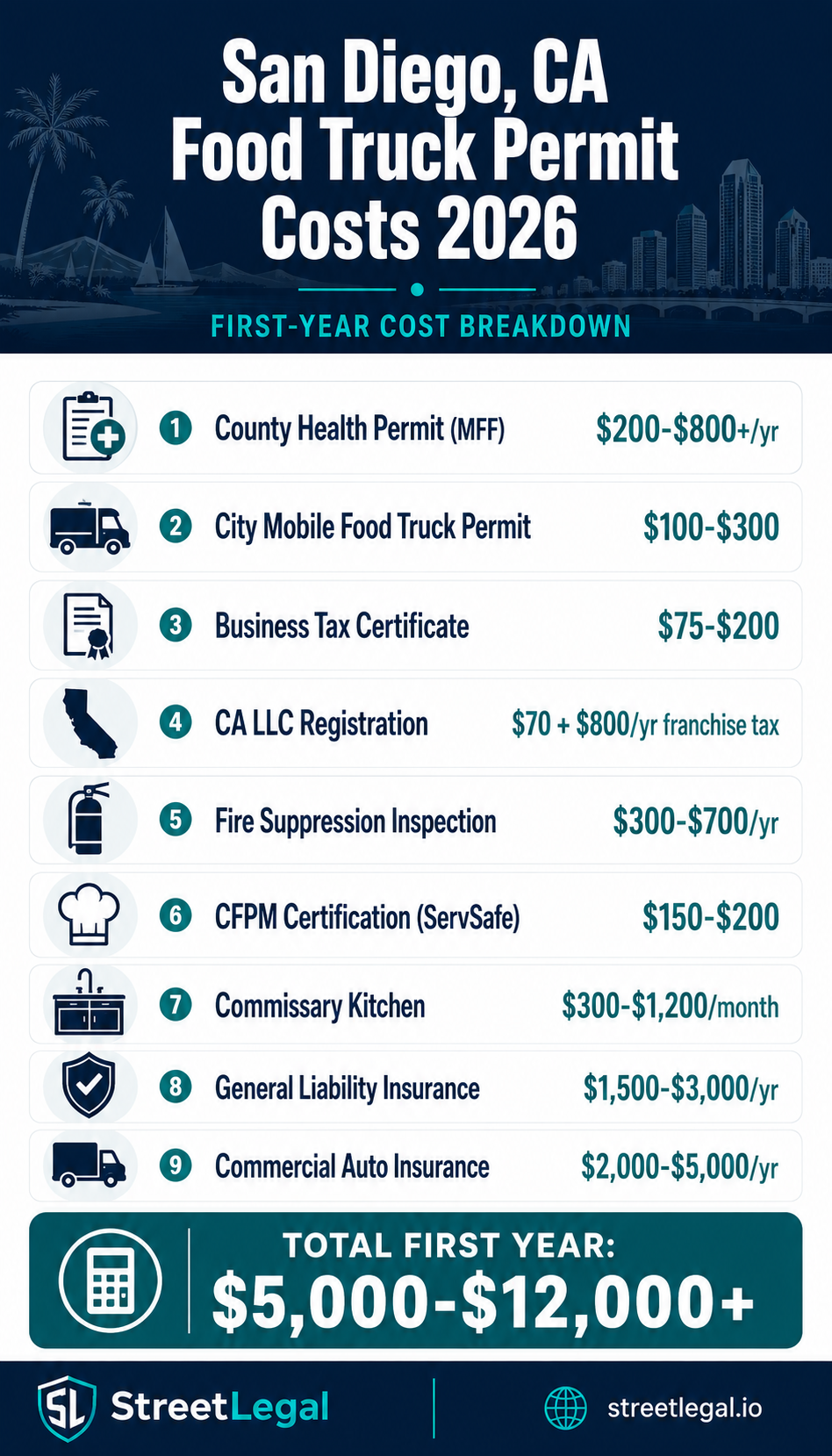
| County Health Permit (MFF) | San Diego County DEHQ | $200–$800+ | Annual |
| City Mobile Food Truck Permit | City of San Diego DSD | Varies | Annual |
| Business Tax Certificate | City of San Diego Treasurer | Varies by revenue | Annual |
| CA Seller's Permit | CA CDTFA | Free | Ongoing |
| CA LLC Registration | CA Secretary of State | $70 + $800/yr franchise tax | Annual |
| Fire Suppression Inspection | SDFD / fire marshal | $300–$700/yr (service) | Semi-annual |
| CFPM Certification (ServSafe) | Accredited provider | $150–$200 | Every 5 years |
| CA Food Handler Cards (per employee) | ANSI-accredited provider | $8–$15 each | Every 3 years |
Full San Diego Food Truck Cost Breakdown (First Year)
| Item | Low | High |
|---|---|---|
| County DEHQ health permit | $200 | $800 |
| City mobile food truck permit | $100 | $300 |
| Business tax certificate | $75 | $200 |
| CA LLC registration | $70 | $70 |
| CA minimum franchise tax | $800 | $800 |
| Fire suppression inspection & service | $300 | $700 |
| ServSafe (CFPM) certification | $150 | $200 |
| CA Food Handler cards (3 staff) | $24 | $45 |
| Commissary kitchen (annual) | $1,800 | $14,400 |
| General liability insurance (annual) | $1,500 | $3,000 |
| Commercial vehicle registration | $200 | $500 |
| TOTAL (first year) | $5,219 | $21,015 |
California's $800 minimum franchise tax applies regardless of revenue. Commissary cost varies significantly by arrangement type.
San Diego Permitting Timeline
- Week 1–2: Form CA LLC, file for EIN, register for CA Seller's Permit, obtain Business Tax Certificate
- Week 2–3: Submit truck plans to DEHQ Plan Check unit for review and approval (required before truck build or major modification)
- Week 3–5: Build or modify truck to approved plans; secure commissary agreement
- Week 5–6: Complete CFPM certification; obtain CA Food Handler cards for all staff
- Week 6–7: Submit completed county health permit application with commissary agreement, toilet use agreement, and proposed location
- Week 7–9: DEHQ review and health inspection of truck
- Week 8–9: Apply for City DSD Mobile Food Truck Permit (if operating on private property in city)
- Week 9–12: Fire suppression inspection; all permits issued
Total: 10–12 weeks from start to first service, primarily driven by the plan check timeline. Starting with a pre-existing commissary-ready truck can compress this to 6–8 weeks.
Where to Operate in San Diego
San Diego has a diverse geography of food truck opportunity:
- North Park / South Park — The highest-density food truck corridor; strong dinner and weekend demand
- Gaslamp Quarter / downtown — Heavy tourism and late-night demand; tighter parking competition
- Little Italy — Saturday farmers market draws huge crowds; vendor spots are competitive
- Mission Valley / Kearny Mesa — Large office and retail corridor; strong lunch demand from corporate parks
- Military bases (MCAS Miramar, Naval Base San Diego) — Require additional base access agreements; large captive population
- Craft beer corridor (Miramar Road) — San Diego's world-class brewery scene regularly partners with food trucks for pop-ups and tap room food service
5 San Diego-Specific Tips
- Submit plans to DEHQ Plan Check before you build or buy. San Diego's county plan check process is serious — operating a truck that wasn't built to approved plans can mean costly retrofits or permit denial. If you're commissioning a new build or buying a used truck and modifying it, submit plans first.
- The daily commissary return rule is enforced. San Diego inspectors track commissary records during inspections. Keep a log of every commissary visit — date, time in, time out, activities performed. An operator who can't produce these records faces permit suspension.
- California's $800 franchise tax is unavoidable. Most operators don't factor this in when they model first-year costs. You owe it from the day you form your LLC — even if you haven't served a single customer yet. It's a meaningful fixed cost in year one.
- Taco trucks operate in a different league here. San Diego's taco truck and lonchera culture has created intense competition in certain neighborhoods. Do your location research before committing to a spot — some streets have 3–4 established trucks already. The craft brewery and tech campus corridors are less saturated.
- Year-round weather is your biggest operational advantage — protect it. San Diego's climate means no forced winter slowdowns. But ocean-adjacent fog can affect morning service along the coast. Position your commissary and primary vending spots to maximize the warm, inland zones for consistent year-round revenue.
Official San Diego Resources
- San Diego County DEHQ — Mobile Food Program
- City of San Diego DSD — Mobile Food Truck Permit
- San Diego County DEHQ — Fee Schedule (Rev. July 2025)
- CA CDTFA — Seller's Permit Registration
Questions about San Diego food truck permits? Contact our support team — we help California operators navigate county and city permitting requirements.
Related California Guides
People also ask about San Diego food truck permits
How much does a food truck permit cost in San Diego?
How long does it take to get a food truck permit in San Diego?
Do I need a commissary kitchen to operate a food truck in San Diego?
What documents do I need for a San Diego food truck permit?
Answers to the most common permit questions — costs, timelines, commissary rules, and more.
Find city-level permit guides for every state we cover — compare costs and requirements.
More from the blog
Food Truck POS Systems: Square vs. Toast vs. Clover vs. Avocado (2026)
Real 2026 pricing, hardware costs, offline mode, and contract terms for Square, Toast, Clover, and Avocado — compared specifically for food truck operators.
City GuidesEagan, MN Food Truck Permit Guide
Eagan MN food truck permit guide: MDH mobile food licensing, Dakota County food safety, city peddler rules, commissary records, costs, and launch timeline.
City GuidesBentonville, AR Food Truck Permit Guide
Complete guide to food truck permits, fees, and requirements in Bentonville, AR.
City GuidesBiloxi, MS Food Truck Permit Guide
Biloxi food truck permit guide 2026: licenses, health permit steps, commissary records, inspections, costs, renewal timing, and launch checklist.