· 11 min read · Gibby, StreetLegal Editorial
How to Start a Food Truck in Sacramento: Complete Permit Guide 2026
Updated June 23, 2026
Sacramento Quick Stats
- 🏛️ Primary permit: Sacramento County Environmental Health Division Mobile Food Facility (MFF) Permit
- 💰 Permit cost: $400–$600/yr via Sacramento County EHD
- 📋 Mandatory requirement: Commissary agreement (county-approved facility)
- 🏭 Commissary required: Yes — California law mandates licensed commissary
- ⏱️ Timeline: 4–8 weeks (moderate processing)
- 📍 Unique advantage: Farm-to-fork culture; strong event catering market; local sourcing valued
Permit Snapshot: What You're Getting Into
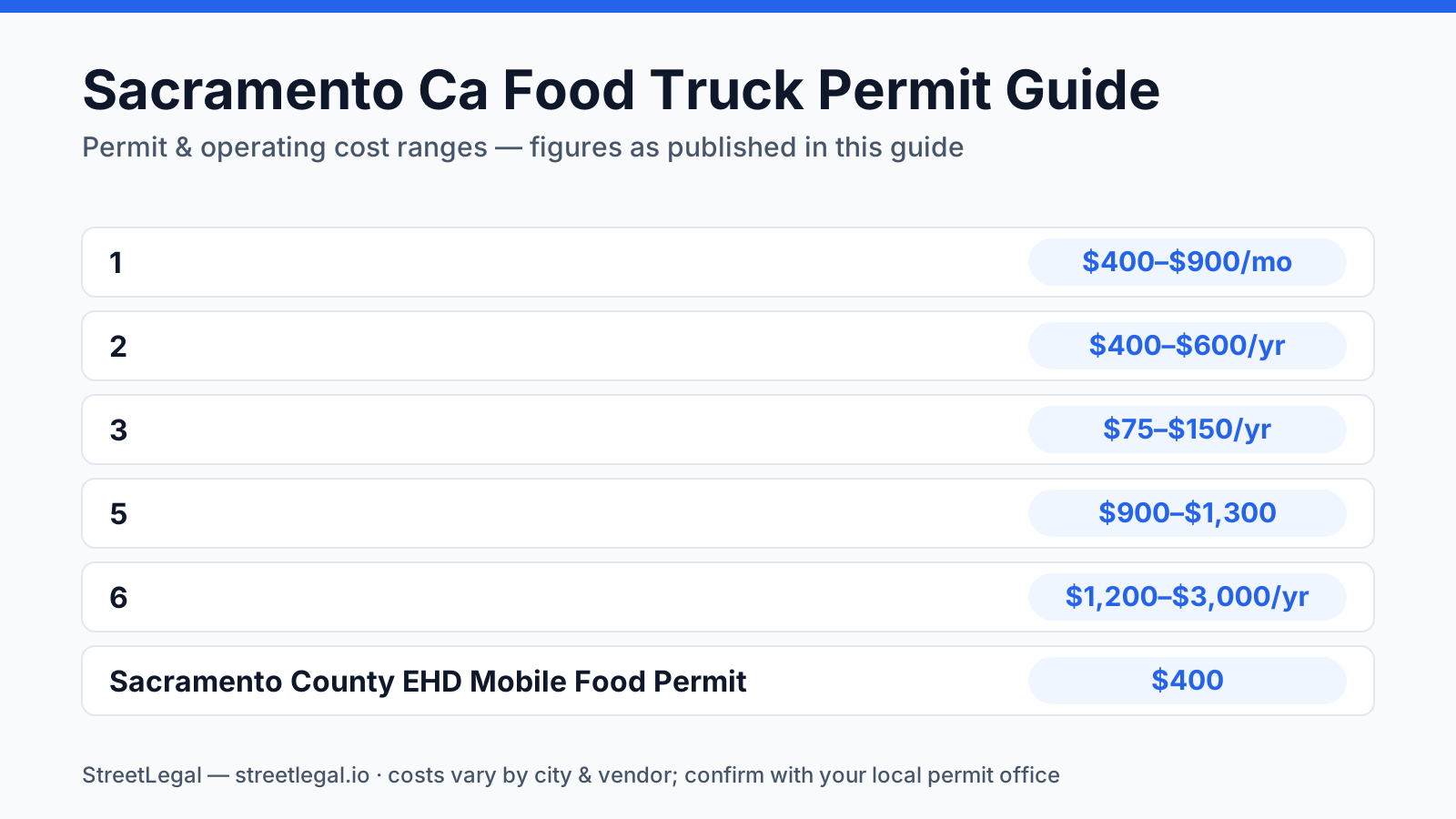
| Step | Agency | Permit / Requirement | Fee | Timeline | Sequence |
|---|---|---|---|---|---|
| 1 | Private commissary | Commissary agreement | $400–$900/mo | 1–2 weeks | Required before EHD application |
| 2 | Sacramento County EHD | Mobile Food Facility (MFF) Permit | $400–$600/yr | 4–8 weeks | Main permit; requires commissary agreement first |
| 3 | City of Sacramento Finance | Business Operations Tax Certificate | $75–$150/yr | 3–5 days | Can run parallel |
| 4 | CA CDTFA | Seller's Permit (sales tax) | Free | 1–2 days | Can run parallel |
| 5 | Sacramento Fire Dept | Fire suppression system inspection | $900–$1,300 | 1–2 weeks | Required if cooking equipment present |
| 6 | Insurance carrier | General liability insurance | $1,200–$3,000/yr | 1–3 days | Required before launch |
Why Sacramento Stands Out: Farm-to-Fork Culture
Sacramento isn't just another California city for food trucks. It's the farm-to-fork capital of California — a city built on local agriculture, sustainable sourcing, and farm-direct relationships. Consumers here actively seek out local, organic, and ethically-sourced food options. This cultural preference translates into premium pricing and customer loyalty for operators who embrace local sourcing.
If your truck concept includes local ingredients, seasonal menus, or sustainable practices, Sacramento is one of the best markets in the country for your brand to thrive.
Sacramento vs. Other California Markets
| Market | Launch Friction | Best First Revenue Lane | Best First Truck Fit | Why This Market Matters |
|---|---|---|---|---|
| Sacramento | Moderate (commissary + County EHD permit) | Farmers markets + event catering | Farm-to-fork concept with local sourcing | Farm-to-fork culture; event catering market; Capitol district lunch demand |
| Los Angeles | High (complex zoning + strict parking enforcement) | Private lots + tech campuses | Specialty/upscale or ethnic cuisine | Largest market; most competition; highest revenue ceiling if positioned well |
| San Francisco | High (MTA permit + limited street vending zones) | Off The Grid + tech campus lunch | Upscale or specialty (SF expects quality) | Premium pricing power; tech lunch demand; strong event/festival culture |
| San Diego | Moderate (County health + city permit) | Craft breweries + coastal events | Taco/lonchera, BBQ, seafood | Year-round weather; military/brewery culture; tourism revenue stable |
| San Jose | Moderate (County EHD + city permit) | Tech campus catering + private lots | Ethnic/international or upscale lunch | Silicon Valley tech money; strong lunch demand; less street competition than SF |
Best Truck Types for Sacramento Market
| Truck Type | Sacramento Market Fit | Commissary Pressure | Event Flexibility | Rationale |
|---|---|---|---|---|
| Farm-to-fork / local sourcing truck | Excellent | High (fresh/local supply chain) | High (weddings, farmers markets, upscale events) | Sacramento's cultural identity; premium pricing; loyal customer base; media coverage for local sourcing |
| International / ethnic cuisine | Very Good | Moderate (specialty ingredients but stable sourcing) | High (diverse city; event catering demand) | Sacramento is diverse; strong demand for Thai, Vietnamese, Mexican, Ethiopian, Indian; less saturated than SF/LA |
| BBQ / smoked meats trailer | Very Good | Low (BBQ can prep at commissary or onsite) | Very High (events, festivals, catering) | Strong BBQ culture in Sacramento; farmers market fit; catering demand; lower commissary friction |
| Specialty coffee / espresso cart | Good | Very Low (minimal prep) | Moderate (Capitol district, office parks, events) | Capitol workers need quality coffee; low commissary friction; fast setup; stable morning revenue |
| Dessert / ice cream truck | Good | Low (desserts often pre-made) | Very High (weddings, kids events, festivals) | Strong event demand; farmers market fit; family-friendly Sacramento culture; low operational complexity |
| Upscale / fusion truck | Very Good | High (requires complex prep space) | Very High (corporate events, weddings, tech catering) | Sacramento values quality; premium pricing accepted; strong tech/government catering market; less competition than SF |
Step 1: Secure Commissary Agreement
Non-negotiable in California. State law requires all food trucks to operate from a licensed commissary kitchen. Sacramento County Environmental Health Division will not issue your permit without proof of a commissary agreement with a county-approved facility.
Commissary Requirements
- Must be approved: The commissary must be a licensed food establishment, approved by Sacramento County EHD
- Written agreement: Signed contract with the commissary operator
- County verification: Sacramento County verifies the commissary license is current
- Cold storage requirement: Commissary must have adequate cold storage for your truck's daily supply
Sacramento Commissary Costs (2026)
- Shared commercial kitchen: $400–$900/month (higher due to California pricing)
- Daily access: $50–$80/day if available
- Hourly rental: $25–$35/hour
Sacramento has quality commissary options in Midtown and the business district. Many cater specifically to food truck operators and support local sourcing initiatives.
Step 2: Sacramento County Environmental Health Division Permit
Once you have your commissary agreement, apply for the Sacramento County Environmental Health Division Mobile Food Facility (MFF) Permit. This is your primary food safety license.
Application Process
- Gather commissary agreement (signed and verified)
- Complete Sacramento County EHD Mobile Food Facility application
- Provide detailed menu and equipment list
- Describe water/wastewater system (food trucks require special provisions)
- Submit application with permit fee ($400–$600)
- County schedules health inspector visit
- Pass initial inspection
- Receive Mobile Food Facility Permit
Permit Fees (2026)
- Mobile Food Facility (MFF) Permit: $400–$600/yr (risk-based pricing)
- Annual renewal: Same cost structure
Processing Timeline
- Application review: 1–2 weeks
- Inspection scheduling: 1–2 weeks
- Health inspection: 1 week
- Total: 4–8 weeks from submission
⚠️ California Water/Wastewater Requirements Are Strict
Sacramento County requires specific water and wastewater infrastructure in your truck. You'll need grey water tanks, potable water tanks, and proper drain systems. Ensure your truck meets these specs before applying — retrofitting is expensive.
Step 3: City of Sacramento Business Operations Tax Certificate
County permits food; city licenses business. Apply for the City of Sacramento Business Operations Tax Certificate to operate your business within city limits.
Business Tax Certificate Details
- Fee: $75–$150 (food service classification)
- Processing time: 3–5 business days
- Apply at: City of Sacramento Finance Department
- Renewal: Annual
Step 4: California State Fire Inspection
Any food truck with cooking equipment must pass fire safety inspection. California has strict requirements.
Fire Safety Requirements
- Fire suppression system: Commercial-grade K-class system (Ansul or equivalent) required for any cooking
- Installation: ~$900–$1,300 professionally installed and certified
- Annual maintenance: $100–$200/yr
- Inspection: Request from Sacramento Fire Department
Step 5: California Sales Tax Registration
- Registration: Free via California Department of Tax and Fee Administration
- Sales Tax ID: Issued within 1–2 business days
- Filing: Monthly or quarterly depending on sales volume
Where You Can Actually Operate in Sacramento
Sacramento is food truck-friendly in most areas, but verify location legality before committing. Below is a realistic breakdown of where permits actually translate to revenue access.
| Operating Lane | Permit Approval Alone Enough? | Access Reality | Best Truck Fit |
|---|---|---|---|
| Farmers markets | No — market acceptance required | Apply separately to each farmers market; permit is baseline; markets curate vendors | Farm-to-fork, local sourcing, BBQ, desserts |
| Midtown Sacramento street vending | Partly — zoning + property consent required | Check city zoning; many Midtown spots require property owner approval | Upscale, specialty, ethnic cuisine |
| Capitol district (government workers lunch) | Partly — some spots are open, some restricted | Public sidewalks near Capitol allowed in many zones; verify with city | Fast lunch, coffee, upscale lunch |
| Old Sacramento (tourist district) | No — special event permits often required | Old Sacramento is event-driven; apply for event vendor permits | Tourist-friendly (BBQ, desserts, ethnic) |
| Event catering (weddings, corporate, conferences) | Yes — permit is sufficient for private events | Private events on private property; your permit covers food safety; no extra city approval needed | Upscale, farm-to-fork, BBQ, desserts |
| Land Park / neighborhood vending | Partly — zoning varies by neighborhood | Check zoning; some residential zones restrict; parks may require park permit | Family-friendly (desserts, BBQ) |
| Tech campus / office park catering | No — campus approval required | Each campus has vendor approval process; permit is baseline; need property consent | Upscale lunch, specialty coffee, ethnic |
Full Cost Breakdown: Starting a Food Truck in Sacramento
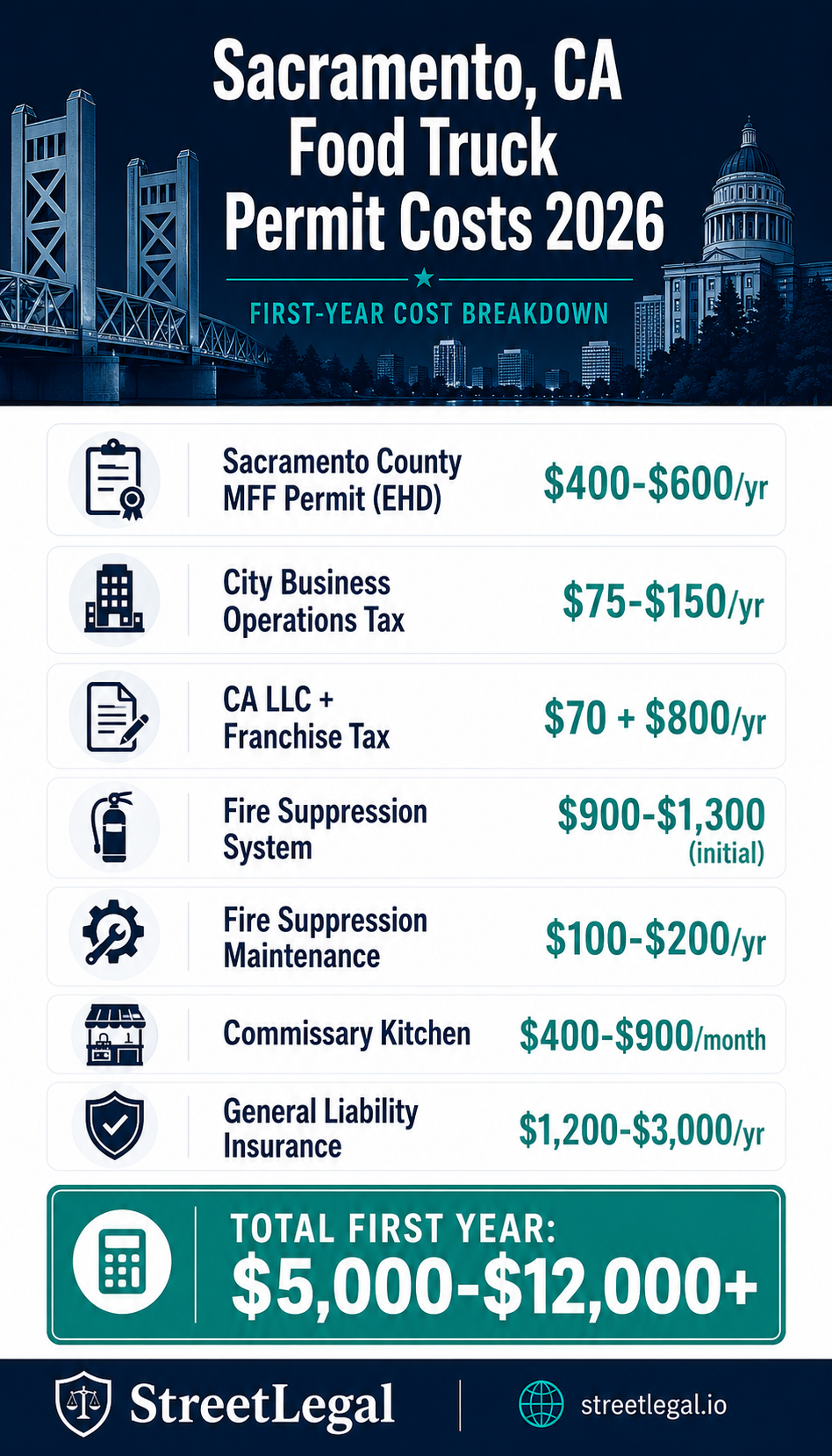
| Permit / Cost Item | Low | High |
|---|---|---|
| Sacramento County EHD Mobile Food Permit | $400 | $600 |
| City of Sacramento Business Tax Certificate | $75 | $150 |
| California Sales Tax Registration | $0 | $0 |
| Fire Suppression System Installation | $900 | $1,300 |
| Fire Suppression Maintenance (annual) | $100 | $200 |
| Commissary Kitchen (annual) | $4,800 | $10,800 |
| Business Liability Insurance | $1,200 | $3,000 |
| Total First-Year Estimate | $7,475 | $16,050 |
Excludes truck purchase/lease, equipment, and initial inventory. California permits and commissaries carry higher costs than most states.
Timeline: Sacramento Food Truck Launch
- Week 1–2: Secure commissary agreement with county-approved facility
- Week 2–3: Register for California sales tax; apply for City business tax certificate
- Week 3–4: Verify truck water/wastewater systems meet Sacramento County specs
- Week 4: Install fire suppression system; arrange installation certification
- Week 4–5: Submit Sacramento County EHD permit application
- Week 5–6: County schedules health inspector
- Week 6–7: Pass health inspection; receive permit
- Week 7–8: Pass fire inspection; finalize insurance
- Week 8: Ready to operate — connect with farmers markets and event planners
5 Sacramento-Specific Tips
- Farm-to-fork positioning is profitable here. If you can source locally and highlight it, Sacramento customers will pay premium prices. Local farms, organic suppliers, and artisanal ingredients are not just acceptable — they're expected.
- Farmers markets are gold. Sacramento has thriving farmers markets year-round. Get on a vendors list immediately. Farmers market revenue is stable and loyal customer base builds fast.
- Check your truck's water system NOW. Before you apply, verify your truck meets Sacramento County's water and wastewater infrastructure requirements. Retrofitting is expensive — get it right before launch.
- Event catering is substantial. Sacramento has a strong wedding and corporate event market. Food truck catering commands premium rates here. Build event vendor relationships alongside street operations.
- Midtown is competitive but worth it. Midtown Sacramento is hip, young, and food-focused. Competition is higher, but volume and customer loyalty are excellent. Only compete here if you have a strong concept.
Answers to the most common permit questions — costs, timelines, commissary rules, and more.
Find city-level permit guides for every state we cover — compare costs and requirements.
More from the blog
Food Truck POS Systems: Square vs. Toast vs. Clover vs. Avocado (2026)
Real 2026 pricing, hardware costs, offline mode, and contract terms for Square, Toast, Clover, and Avocado — compared specifically for food truck operators.
City GuidesEagan, MN Food Truck Permit Guide
Eagan MN food truck permit guide: MDH mobile food licensing, Dakota County food safety, city peddler rules, commissary records, costs, and launch timeline.
City GuidesBentonville, AR Food Truck Permit Guide
Complete guide to food truck permits, fees, and requirements in Bentonville, AR.
City GuidesBiloxi, MS Food Truck Permit Guide
Biloxi food truck permit guide 2026: licenses, health permit steps, commissary records, inspections, costs, renewal timing, and launch checklist.