· Updated · 10 min read · Gibby, StreetLegal Editorial
How to Start a Food Truck in Birmingham, AL: Complete Permit Guide 2026
Birmingham Quick Stats
- 🏛️ Primary permit: Jefferson County Department of Health Mobile Food Permit
- 💰 Permit cost: $150–$250/yr (one of the lowest in Southeast)
- 📋 Mandatory requirement: Commissary agreement (signed and verified)
- 🏭 Commissary required: Yes — Alabama law mandates licensed commissary
- ⏱️ Timeline: 3–6 weeks (fast processing)
- 📍 Unique advantage: Growing market with lower competition than Atlanta/Nashville
Why Birmingham Is an Excellent Market for New Food Truck Operators
Birmingham is one of the best kept secrets in the Southeast for food truck entrepreneurs. Unlike Atlanta or Nashville, Birmingham has lower competition, lower permit costs, and a growing food truck culture. The city is actively encouraging small food businesses, and the demographic is hungry for diverse, independent food options. Jefferson County processes permits quickly, and the commissary market is less crowded than larger cities.
If you're looking to break into the food truck business without fighting for every spot, Birmingham deserves serious consideration.
Step 1: Secure Commissary Agreement
Your first task. Alabama law requires all food trucks to operate from a licensed commissary kitchen. Jefferson County Department of Health will not issue your permit without proof of a commissary agreement. This is your gateway to everything else.
Commissary Requirements
- Must be licensed: The commissary must hold a current Jefferson County food service establishment license
- Written agreement: You need a signed contract with the commissary operator
- County contact: The commissary must agree to cooperate with health department inspections
Birmingham Commissary Costs (2026)
- Shared commercial kitchen: $175–$400/month (one of the lowest in the region)
- Daily access: $30–$50/day if available
- Hourly rental: $15–$25/hour
Birmingham's commissary market is much less saturated than Atlanta or Memphis. You have more options and better pricing.
Step 2: Jefferson County Mobile Food Permit
Once you have your commissary agreement, apply for the Jefferson County Department of Health Mobile Food Service Establishment Permit. This is your primary food safety license.
Application Process
- Gather commissary agreement (signed)
- Complete Jefferson County Mobile Food Permit application
- Provide menu and equipment list
- Submit application with permit fee ($150–$250)
- County schedules health inspector visit
- Pass inspection
- Receive Mobile Food Permit
Permit Fees (2026)
- Mobile Food Service Permit: $150–$250/yr (based on menu complexity)
- Annual renewal: Same cost
Processing Speed
Jefferson County typically processes mobile food permits within 2–4 weeks of submission. This is faster than most comparable cities.
💡 Competitive Advantage: Fast Permitting
Birmingham's faster permit processing is a real advantage. While operators in larger cities wait 8–12 weeks, you could be operational in 3–6 weeks in Birmingham.
Step 3: City of Birmingham Business License
County permits food; city licenses business. Apply for the City of Birmingham Business License to operate your business legally in the city.
Business License Details
- Fee: $50–$200 (based on projected annual revenue — gross receipts-based fee; new operators estimated at lower end)
- Processing time: 3–5 business days
- Apply at: City of Birmingham Business Licensing Department
- Renewal: Annual
Step 4: Alabama State Fire Inspection
Any food truck with cooking equipment must pass a fire safety inspection. Alabama does not charge a separate state fire permit fee, but you must have a commercial-grade fire suppression system.
Fire Safety Requirements
- Fire suppression system: K-class commercial system (Ansul or equivalent) required for any cooking
- Installation cost: ~$1,500–$3,500
- Annual maintenance: $75–$150/yr
- Inspection: Request from Birmingham Fire and Rescue Department
Step 5: Alabama Sales Tax Registration
- Registration: Free via Alabama Department of Revenue
- Sales tax number: Issued within 1–2 business days
- Filing: Monthly or quarterly depending on sales volume
Step 6: Operating Zones & Location Selection
Birmingham is food truck-friendly across multiple neighborhoods. Check zoning before committing to a location.
Popular Operating Areas
- Downtown Birmingham: Growing food scene, lunchtime crowds, event venues
- Avondale: Trendy neighborhood with young professionals and weekend crowds
- Five Points South: Bar/restaurant district with event opportunities
- Homewood: Affluent suburb with good foot traffic
- Private property: Parking lots, business campuses (requires owner permission)
Estimate Your Startup Costs
Answer three questions to get a rough first-year estimate for Birmingham.
Your estimated first-year costs:
Rough estimate only. Contact Jefferson County Health Dept and City of Birmingham for exact permit fees.
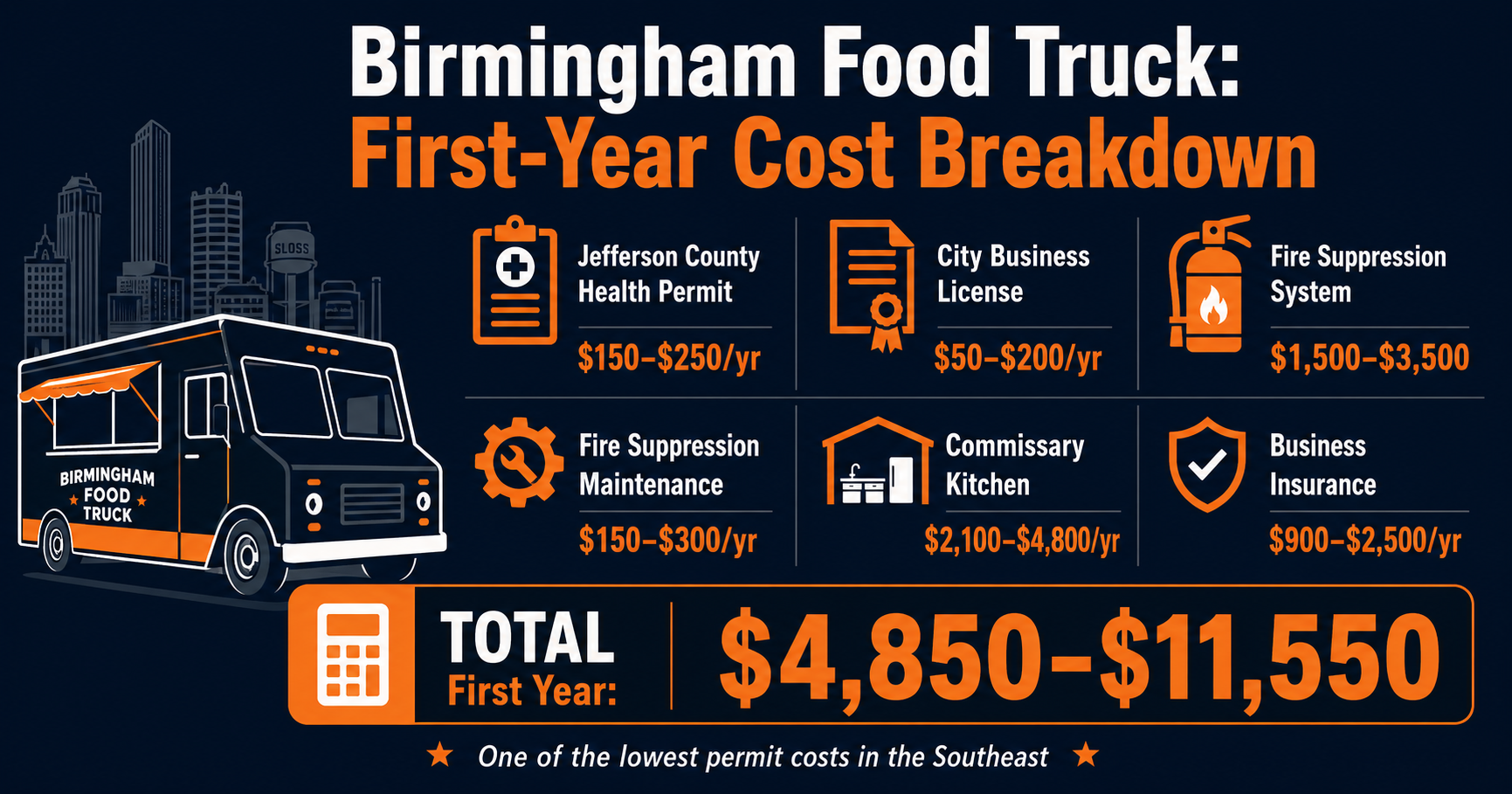
Full Cost Breakdown: Starting a Food Truck in Birmingham
| Permit / Cost Item | Low | High |
|---|---|---|
| Jefferson County Mobile Food Permit | $150 | $250 |
| City of Birmingham Business License | $50 | $100 |
| Alabama Sales Tax Registration | $0 | $0 |
| Fire Suppression System Installation | $1,500 | $3,500 |
| Fire Suppression Maintenance (annual) | $150 | $300 |
| Commissary Kitchen (annual) | $2,100 | $4,800 |
| Business Liability Insurance | $900 | $2,500 |
| Total First-Year Estimate | $4,850 | $11,550 |
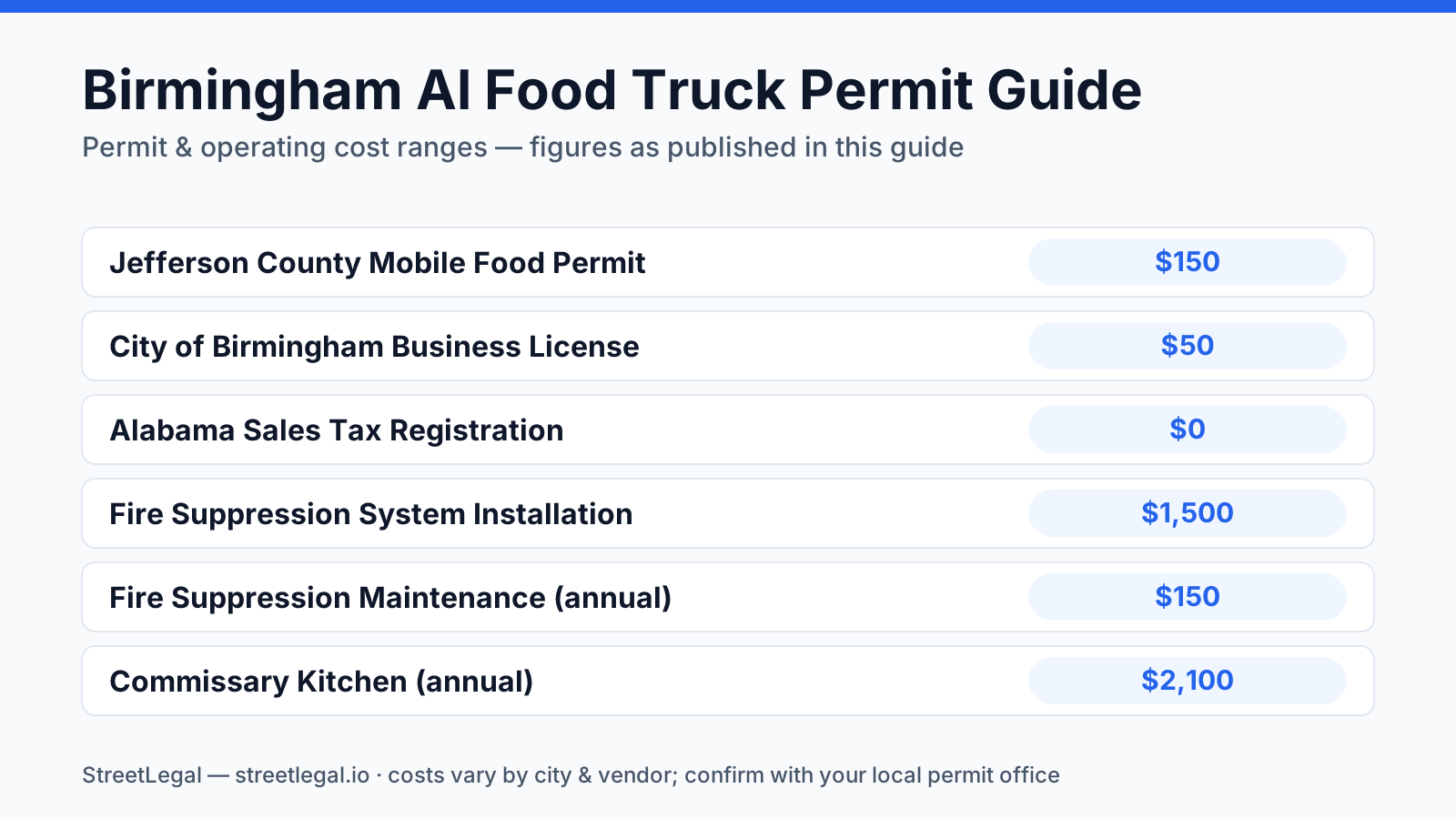
Excludes truck purchase/lease, equipment, and initial inventory. Birmingham's lower costs make it one of the most affordable markets in the Southeast.
Timeline: Birmingham Food Truck Launch
- Week 1–2: Secure commissary agreement
- Week 2–3: Register for Alabama sales tax; apply for City business license
- Week 3–4: Install fire suppression system
- Week 4: Submit Jefferson County permit application
- Week 4–5: County schedules health inspector visit
- Week 5–6: Pass inspection; receive permit
- Week 6: Final fire inspection
- Week 6–7: Ready to operate
5 Birmingham-Specific Tips
- You have a first-mover advantage. Birmingham's food truck scene is not yet saturated like Atlanta or Nashville. If you move fast, you can claim prime locations before competitors arrive.
- Avondale is the hottest neighborhood right now. Young professionals are flooding into Avondale, and the food scene is exploding. Secure a spot there early if possible.
- Lower costs = faster path to profitability. Your commissary and permit costs are significantly lower than larger cities. This means you can break even faster and build profit quicker.
- Connect with local event organizers. Birmingham has a strong event calendar (farmers markets, street festivals, sports events). Get your name on local event vendor lists early — it's a huge revenue stream.
- Five Points South can be lucrative for night crowds. If you're willing to operate evening/night shifts, the bar district and entertainment zone offer excellent revenue potential.
Commissary Kitchens in Birmingham, AL
Jefferson County requires a signed commissary agreement before your permit application. Here are the verified commissary kitchens serving Birmingham food truck operators:
Chef's Workshop of Alabama
Verified ✓3439 Lorna Lane, Hoover, AL 35216 • (205) 637-1055
5,000 sq ft facility with 4 fully equipped certified kitchens. Gas ranges, convection ovens, prep tables, sinks, coolers, grease disposal. Founded 2013 — the most established commissary in the Birmingham metro. Eugene's Hot Chicken used this kitchen to build their food truck brand.
Pricing: $25/hr • from $175/month (discounts for 30+ hrs/month)
Lone Star Kitchen
Partially VerifiedHomewood, AL (contact for address) • lonestarkitchen.com
Purpose-built food truck commissary with full infrastructure: propane, gray water disposal, used oil disposal, fresh water fill-up, secure truck parking, and commissary letter support. Membership/longer-term arrangement — tours by appointment Mon–Fri.
Pricing: Membership-based, contact for rates • Best for truck infrastructure
Bham Kitchen Hub
Partially VerifiedEastside Birmingham • bhamkitchenhub.com
Commissary and prep space on Birmingham's Eastside targeting food truck operators, caterers, and bakers. Also offers shared office, business setup services, brand development, and tax prep. Renovation completed Feb 2025.
Pricing: Contact for rates
📋 Commissary Tip
Get your commissary agreement signed before you submit your Jefferson County permit application. The county requires it at time of submission — not after approval. Waiting until later is the most common reason permit applications get delayed in Birmingham.
Birmingham Food Truck FAQ
Does Birmingham require a commissary kitchen for food trucks?
Yes. Alabama law requires all food trucks to operate from a licensed commissary kitchen. Jefferson County Department of Health requires a signed commissary agreement before issuing your mobile food permit. This is non-negotiable — your application will not be accepted without it.
How much does the Jefferson County mobile food permit cost?
The Jefferson County Department of Health permit costs $150–$250 per year depending on your equipment and menu complexity. This is one of the lower permit costs in the Southeast. By comparison, Atlanta's Fulton County health permit runs $450–$750/year and Nashville's metro permit is approximately $300/year.
Is Birmingham a competitive food truck market?
No — compared to Atlanta, Nashville, and Austin, Birmingham has noticeably lower competition and growing demand. The food truck scene is expanding into neighborhoods like Avondale and Five Points South, and the city has a strong event calendar year-round. This makes Birmingham an excellent market for new operators to establish themselves before competition heats up.
Where can I legally operate a food truck in Birmingham?
Downtown Birmingham, Avondale, Five Points South, Homewood, and residential neighborhoods all allow food truck operation with proper permits. You'll need your Jefferson County health permit and City of Birmingham business license to operate anywhere in the metro. Always check zoning with the City of Birmingham before committing to a specific location — some areas have distance restrictions from existing restaurants.
How long does it take to get a food truck permit in Birmingham?
From application to permit issuance, expect 3–6 weeks — assuming your commissary agreement is already in place when you apply. Jefferson County processes permits faster than most comparable cities. The main delay comes from scheduling the health inspector visit, which typically takes 2–4 weeks after submission. Having all paperwork complete (commissary agreement, menu, equipment list) when you apply prevents costly resubmission delays.
Related Guides
Birmingham, AL City Permit Guide →
Quick-reference: fees, deadlines, key contacts
Food Truck Permit Costs 2026 →
How Birmingham compares to other major cities
Atlanta Food Truck Permits →
Nearby major market — compare licensing complexity
Nashville Food Truck Permits →
Southeast neighbor — understand regional differences
People also ask about Birmingham food truck permits
How much does a food truck permit cost in Birmingham?
How long does it take to get a food truck permit in Birmingham?
Do I need a commissary kitchen to operate a food truck in Birmingham?
What documents do I need for a Birmingham food truck permit?
Answers to the most common permit questions — costs, timelines, commissary rules, and more.
Find city-level permit guides for every state we cover — compare costs and requirements.
More from the blog
Jefferson County, MO Food Truck Permit Guide
Complete guide to food truck permits, fees, and requirements in Jefferson County, MO.
City GuidesSt. Charles County, MO Food Truck Permit Guide
Complete guide to food truck permits, fees, and requirements in St. Charles County, MO.
City GuidesSt. Louis County, MO Food Truck Permit Guide
Complete guide to food truck permits, fees, and requirements in St. Louis County, MO.
Buyer's GuideFood Truck POS Systems 2026: Square, Toast, Clover & Avocado
Compare 2026 food truck POS systems by pricing, hardware costs, offline mode, and contract terms for Square, Toast, Clover, and Avocado.