· Updated · 12 min read · Gibby, StreetLegal Editorial

How to Start a Food Truck in Nashville: Complete Permit Guide 2026
Nashville Quick Stats
- 🏛️ Primary permit: Metro Public Health Dept Mobile Food Vending Permit
- 💰 Permit cost: $200–$400 via ePermits system
- 📋 Mandatory requirement: Food Protection Manager Certification (ServSafe) BEFORE applying
- 🏭 Commissary required: Yes — notarized commercial kitchen agreement mandatory
- ⏱️ Timeline: 4–10 weeks (after Food Manager cert)
- 📍 Unique advantage: Booming food scene; Broadway/Gulch/East Nashville high revenue
Nashville's Food Truck Regulatory Structure
Nashville operates under a unified jurisdiction through Metro Public Health Department, which handles all food safety licensing for the Nashville-Davidson metropolitan area. The City of Nashville Metropolitan Planning Dept (NDOT) issues street vending permits for public right-of-way locations, particularly in the high-revenue Downtown Core.
Nashville's food truck scene is booming — 12th Ave South, East Nashville, Germantown, and the Gulch are hot zones for independent vendors — but Tennessee has a mandatory requirement that catches many operators unprepared: you must obtain your Food Protection Manager Certification before you submit any permit applications. This is not optional, and it can add 1–2 weeks to your startup timeline.
Step 1: Food Protection Manager Certification (Mandatory)
This step must be completed before anything else. Tennessee law requires the operator or at least one full-time employee to hold a Food Protection Manager Certification from an accredited program. ServSafe is the most recognized option, but other approved programs qualify.
Certification Options
- ServSafe Food Protection Manager: 3-hour course + exam ($155–$200). Available online and in-person throughout Nashville. Valid for 5 years.
- Prometric Food Manager Certification: Similar cost and timeline to ServSafe
- Local health department courses: Some may be available through Metro Public Health at lower cost
Timeline: 1–2 weeks (take the course, pass the exam, receive certification). Without this, Metro Public Health will reject your application immediately.
How to Obtain
- Register for ServSafe Food Protection Manager course (online or in-person)
- Complete the 3-hour course
- Pass the exam (70% score minimum)
- Receive your certificate (valid for 5 years)
- Proceed to Metro Public Health application with certificate in hand
Step 2: Metro Public Health Mobile Food Vending Permit
Once you have your Food Protection Manager Certification, apply for the Metro Public Health Mobile Food Vending Permit via the Metro ePermits system. This is your primary operational license.
Metro Permit Fees (2026)
- Mobile Food Vending Permit: $200–$400 depending on menu and equipment complexity
- Risk Level: Metro assigns based on your menu at application
- Annual Renewal: Same fee structure, renewals due every 12 months
Application Process
- Have your Food Protection Manager Certification ready — you'll need the certificate number
- Log into ePermits.metrohealth.org and select "Mobile Food Vending Permit"
- Submit detailed menu, equipment list, and commissary agreement (notarized)
- Pay the permit fee ($200–$400) online
- Metro reviews and assigns risk level (typically 3–5 business days)
- Schedule your initial inspection with Metro Health Inspector
- Pass inspection, receive your permit (allow 2–3 weeks total from application)
- Display permit visibly in your truck
⚠️ ePermits System Is Online-Only
Metro no longer accepts paper applications for mobile food vending. All applications must go through ePermits. If you're not comfortable with online systems, budget time to get help or call Metro's help desk at the phone number on their website.
Step 3: Tennessee State Fire Permit
Tennessee requires a state-level fire safety permit for any food truck using cooking equipment, propane, or open flames. This is issued by the Tennessee State Fire Marshal's Office, not a local fire department.
- Fee: $300 (state-level, not local)
- Apply at: tnfire.org (State Fire Marshal)
- Required documentation: Equipment list, propane tank specifications, fire suppression system details
- Processing time: 2–3 weeks
- Required: Commercial-grade fire suppression system (Ansul or equivalent), K-class fire extinguisher
Step 4: Tennessee Business License & Sales Tax Permit
Register with both Tennessee Department of Revenue (state) and your local county/city for business licensing.
Tennessee State Registration
- Fee: None for initial registration
- Apply at: sos.tn.gov (Secretary of State) or revenue.tn.gov (TN Dept of Revenue)
- You'll receive a TN Business Identification Number (BIN)
- Sales and Use Tax Permit: Free, issued at same time via TNTAP (Tennessee Tax Administration Portal)
Davidson County / Metro Business License
- Fee: $15–$100 depending on business classification (food service is typically $50–$75)
- Apply at: Metro Planning Department (if operating in Nashville city/metro area)
- Processing time: 3–5 business days
Step 5: Commissary Kitchen Agreement (Notarized)
Metro Public Health requires a notarized commissary agreement before you submit your permit application. This is stricter than many other cities — a simple signed agreement is not acceptable.
Metro Commissary Requirements
- Written, notarized agreement signed by both operator and commissary manager
- Commissary must be a licensed food establishment (Metro verifies)
- Agreement must specify hours of access and services (prep, storage, cleaning)
- Commissary must agree to cooperate with Metro inspections
- Metro inspects commissary as part of your food truck approval process
Nashville Commissary Costs (2026)
- Shared commercial kitchen: $350–$800/month (daily access: $40–$70/day)
- Dedicated prep space: $900–$1,800/month
- Hourly kitchen rental: $18–$28/hour
Nashville's commissary market is well-developed. Most shared kitchens are clustered in East Nashville and the industrial areas. Get your notarized agreement 2–3 weeks before you plan to submit your Metro application — notarization can take time if commissary owner is unavailable.
Step 6: NDOT Mobile Food Vendor Permit (If Downtown/Public Right-of-Way)
If you plan to operate on public right-of-way in Nashville, particularly the Downtown Core (Broadway area, The Gulch), you need a separate permit from the Nashville Department of Transportation (NDOT).
- Fee: $55 for 2 months (renewable)
- Apply at: ndot.nashville.gov or in-person at NDOT offices
- Designated zones only: Check the downtown vending map for available spots
- School hour restriction: Cannot vend within 1+ block of schools during 6am–3pm school days
Step 7: Metro Parks Permit (If Operating in Parks)
If you want to operate in Metro Parks (Nashville's public parks system), you need a separate Metro Parks permit.
- Insurance requirement: $1 million liability insurance (mandatory)
- Permit fee: Varies by park and usage
- Apply at: nashville.gov/parks or directly to specific park management
- Not all parks allow food trucks — check availability before applying
Step 8: Food Handler Cards for Employees
All employees handling food must obtain a Tennessee Food Handler Card (not to be confused with the manager certification).
- Food Handler Card Cost: ~$15 per person
- Valid for 3 years
- Required before employee starts working
- You (operator) must also hold one — no exceptions
Step 9: Where You Can (and Can't) Operate in Nashville
Nashville has dynamic food truck zones and restrictions. The city is encouraging mobile food vendors in specific areas while protecting brick-and-mortar restaurants.
Hot Revenue Zones (Legal Operating Locations)
- Downtown Core (Broadway/Gulch): NDOT-designated vending zones; premium foot traffic and tourist revenue
- 12th Ave South: Hip dining district; allow property owner permission for parking
- East Nashville: Trendy, growing food scene; mostly private property vending
- Germantown: Artsy neighborhood with food truck-friendly culture
- Private property: Parking lots, business campuses, events (requires owner permission)
- Metro Parks: If you have Metro Parks permit + $1M liability insurance
Restricted Zones (Must Avoid)
- School zones: Cannot vend within 1+ block of schools during school hours (typically 6am–3pm weekdays)
- Restaurant proximity: Cannot vend too close to established brick-and-mortar restaurants without explicit permission
- Residential neighborhoods: Limited vending outside designated zones
- Operating hours: Most zones limit hours to 6am–12am (midnight)
Full Cost Breakdown: Starting a Food Truck in Nashville
| Permit / Cost Item | Low | High |
|---|---|---|
| Food Protection Manager Certification (ServSafe) | $155 | $200 |
| Metro Public Health Mobile Food Permit | $200 | $400 |
| Tennessee State Fire Permit | $300 | $300 |
| Tennessee Business License / State Registration | $0 | $0 |
| Metro / County Business License | $50 | $100 |
| Sales & Use Tax Permit (TNTAP) | $0 | $0 |
| NDOT Mobile Food Vendor Permit (2 months) | $0 | $55 |
| Metro Parks Permit (if applicable) | $0 | $500 |
| Fire Suppression System (annual maintenance) | $300 | $500 |
| Food Handler Cards (2–3 employees @ $15) | $45 | $75 |
| Commissary Kitchen (annual) | $4,200 | $9,600 |
| Business Insurance (liability + auto + Metro Parks) | $1,800 | $4,000 |
| Legal / LLC formation | $150 | $500 |
| Total First-Year Estimate | $7,250 | $16,225 |
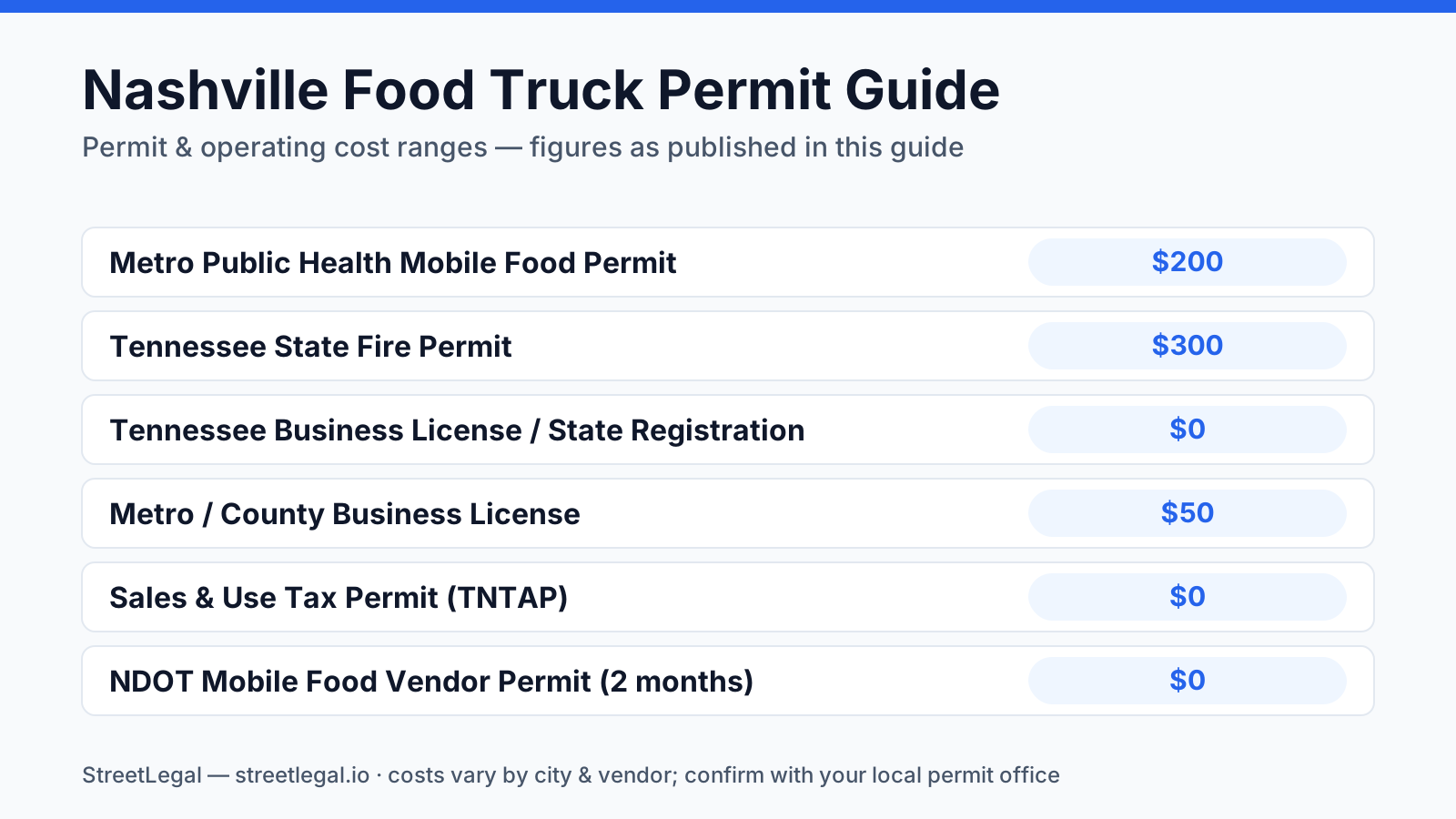
Excludes truck purchase/lease, equipment, and initial inventory. Costs vary by operating location (downtown vs. residential areas).
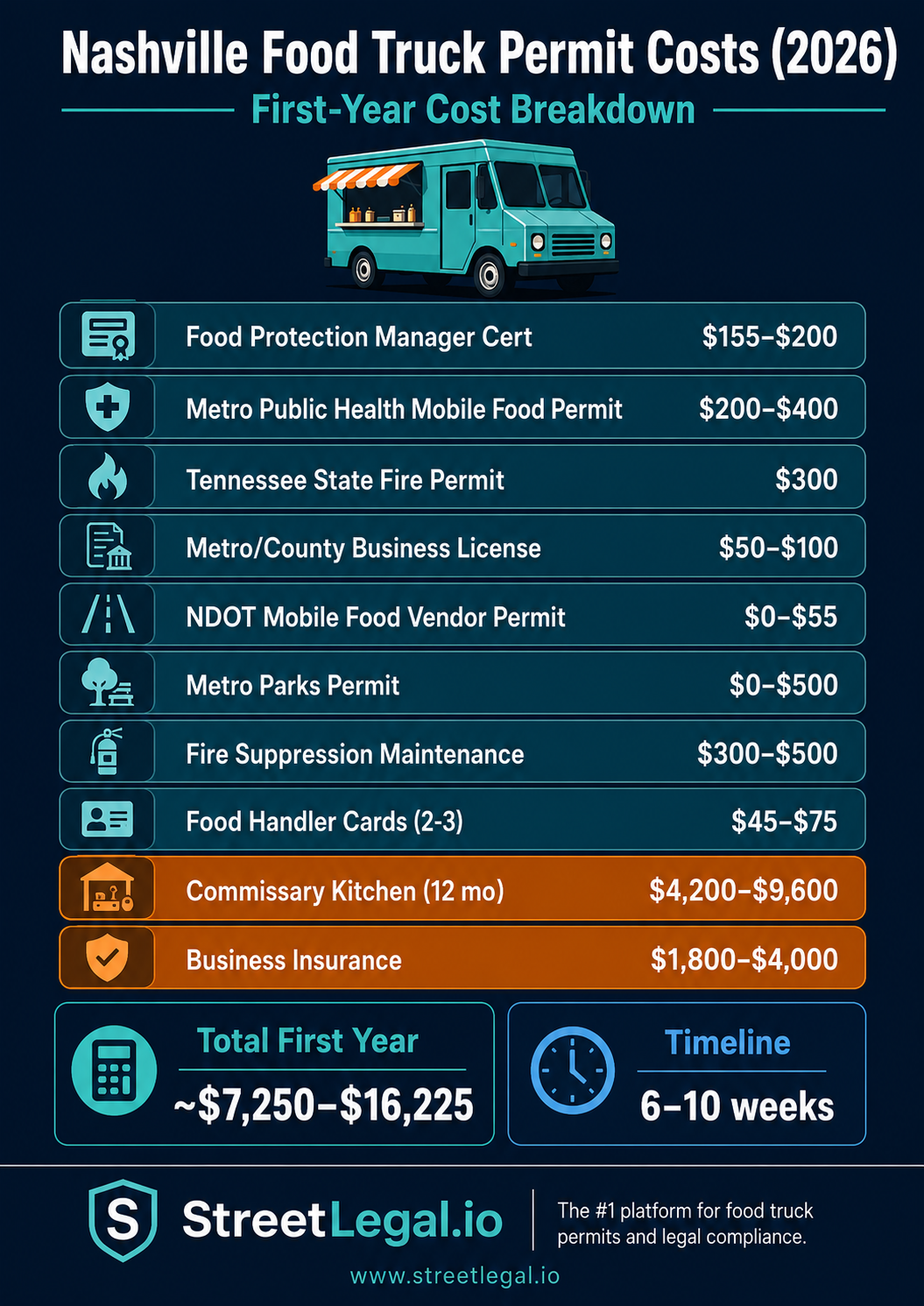
Timeline: Nashville Food Truck Launch
- Week 1–2: Complete Food Protection Manager Certification (ServSafe course + exam)
- Week 2–3: Secure notarized commissary agreement; register Tennessee state business license
- Week 3–4: Submit Metro Public Health Mobile Food Vending Permit via ePermits
- Week 4–5: Apply for Tennessee State Fire Permit; install fire suppression system
- Week 5–6: Apply for Metro/County business license
- Week 6–7: Schedule Metro Health Inspector visit for initial inspection
- Week 7–8: Pass Metro inspection; receive Mobile Food Permit
- Week 8–9: Fire Permit approved; Food Handler Cards for employees
- Week 9–10: NDOT permit (if applicable); confirm parking location; first day of operations
5 Nashville-Specific Tips
- Don't skip the Food Protection Manager Certification. This is a showstopper — Metro will reject your application if you don't have it. Enroll in ServSafe immediately; it's a 3-hour online course. Plan this first, everything else second.
- Get your commissary agreement notarized early. Metro requires notarization, which can take 1–2 weeks depending on commissary owner availability. Don't let this become your bottleneck — line it up before you submit any permits.
- East Nashville and 12th Ave South are golden locations, but competitive. These neighborhoods are hot for food trucks, but you're competing with established favorites. Scout locations early, lock down property owner agreements, and consider a unique menu or brand to stand out.
- The NDOT downtown zones are high-revenue but limited. If you want a Broadway/Gulch location, apply early for the NDOT permit ($55/2 months). Spots are competitive and sometimes fill up quickly during peak season.
- Network with local food truck operators. Nashville's food truck community is tight-knit. Talk to existing vendors, attend local food truck meetups, and connect with the community — many will share tips on best locations, commissaries, and how to navigate the regulatory landscape.
Nashville vs. Other Southeast Cities
| City | License Cost | Timeline | Key Challenge |
|---|---|---|---|
| Nashville, TN | $705 | 4–10 wks | Food Manager cert required first, notarized commissary |
| Memphis, TN | $550 | 3–7 wks | Similar food manager requirement, less downtown vending |
| Atlanta, GA | $600 | 4–8 wks | High competition, strict zoning; good food truck culture |
| Austin, TX | $500 | 3–6 wks | Food truck capital; high foot traffic, moderate regulations |
Nearby Cities & Tennessee Food Truck Guides
People also ask about Nashville food truck permits
How much does a food truck permit cost in Nashville?
How long does it take to get a food truck permit in Nashville?
Do I need a commissary kitchen to operate a food truck in Nashville?
What documents do I need for a Nashville food truck permit?
Answers to the most common permit questions — costs, timelines, commissary rules, and more.
Find city-level permit guides for every state we cover — compare costs and requirements.
More from the blog
Jefferson County, MO Food Truck Permit Guide
Complete guide to food truck permits, fees, and requirements in Jefferson County, MO.
City GuidesSt. Charles County, MO Food Truck Permit Guide
Complete guide to food truck permits, fees, and requirements in St. Charles County, MO.
City GuidesSt. Louis County, MO Food Truck Permit Guide
Complete guide to food truck permits, fees, and requirements in St. Louis County, MO.
Buyer's GuideFood Truck POS Systems 2026: Square, Toast, Clover & Avocado
Compare 2026 food truck POS systems by pricing, hardware costs, offline mode, and contract terms for Square, Toast, Clover, and Avocado.