· 8 min read · StreetLegal Team
Updated June 29, 2026 — permit fees, timelines, operating-lane guidance, and Florida market comparison verified current for St. Petersburg / Pinellas County operators.
How to Get a Food Truck Permit in St. Petersburg, FL (2026 Guide)
St. Petersburg, FL has one of Florida's most active food truck scenes — built on craft breweries, outdoor markets, beach tourism, and a walkable arts district. Operating here requires three core approvals: a Florida DBPR Mobile Food Dispensing Vehicle (MFDV) license, a Pinellas County Environmental Health food permit, and a City of St. Petersburg Business Tax Receipt. You also need Florida Sales Tax registration and a commissary agreement before either permit can be issued.
This guide covers the full permit stack, costs, timeline, commissary requirements, fire inspection rules, where you can actually operate (not just where permits allow), and how St. Pete compares to other Florida markets for truck build and revenue lane decisions.
Permit snapshot — what you need and in what order
St. Petersburg's permit stack follows the Florida statewide pattern: DBPR MFDV first, county health second, city BTR third. Commissary must be signed before both DBPR and Pinellas County will process your application.
| Step | Agency | Permit / License | Fee | Timeline | Sequence note |
|---|---|---|---|---|---|
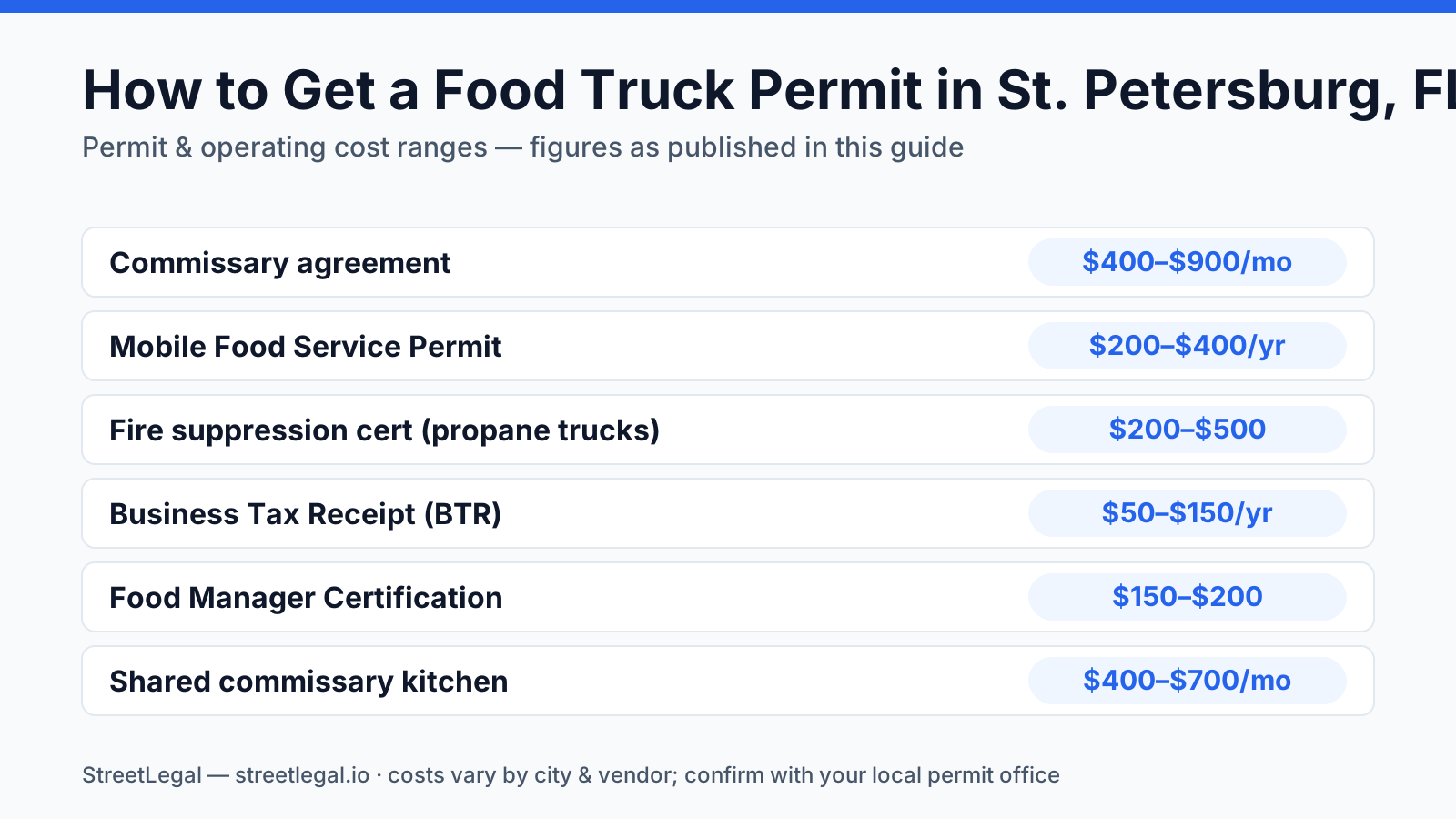
| 0 | Licensed commissary | Commissary agreement | $400–$900/mo | Secure before applying | Required by DBPR + Pinellas County; start here first |
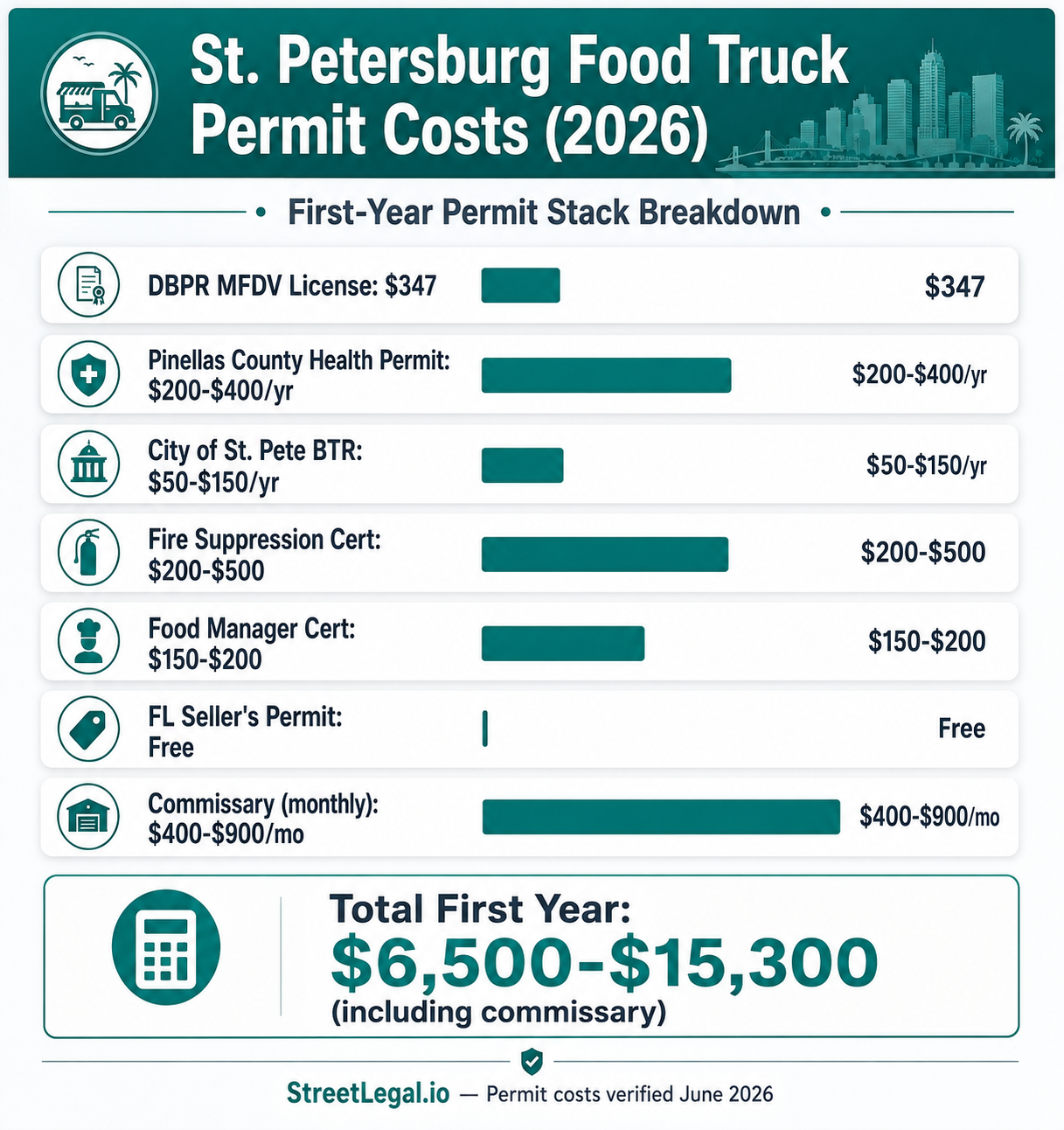
| 1 | Florida DBPR | MFDV License (statewide) | $347 new / $228 renewal | ~3–4 weeks (21-day inspection wait) | Apply online at MyFloridaLicense.com; physical truck inspection required |
| 2 | Florida Dept. of Revenue | FL Seller's Permit / Sales Tax | Free | 1–2 weeks online | Can apply in parallel with DBPR; register at floridarevenue.com |
| 3 | Pinellas County Environmental Health | Mobile Food Service Permit | $200–$400/yr | 2–4 weeks | Submit commissary agreement + DBPR approval letter; separate from Hillsborough County (Tampa) |
| 4 | St. Pete Fire Rescue | Fire suppression cert (propane trucks) | $200–$500 | 2–4 weeks (install + inspection) | Required for fryers, griddles, open flame; schedule early — inspectors book out |
| 5 | City of St. Petersburg | Business Tax Receipt (BTR) | $50–$150/yr | 1–2 weeks | Final step; submit DBPR + Pinellas County permit copies; apply at stpete.org or City Hall |
| 6 | ServSafe / CFPM | Food Manager Certification | $150–$200 | 1 day (exam) + shipping | Required for all FL food establishments; one certified manager per truck |
A Hillsborough County health permit (Tampa) does not cover Pinellas County (St. Petersburg). If you plan to operate across Tampa Bay in both markets, you need separate county health permits and separate city Business Tax Receipts for each jurisdiction. This is the single most common and costly permitting mistake among new Tampa Bay operators.
Commissary requirements
Florida requires all MFDV operators to use a licensed commissary for food prep, water fill, wastewater disposal, and truck storage. Your commissary agreement must be on file with DBPR before your license is issued, and Pinellas County will ask for it separately during health permit processing.
A valid Florida commissary must be a licensed food service establishment — not a residential kitchen or unlicensed prep space. Many shared commissary kitchens in Pinellas and Hillsborough counties serve food truck operators. Some breweries with licensed kitchens allow commissary arrangements, though this is less common than in Miami or Fort Lauderdale.
| Commissary type | Typical monthly cost | Notes |
|---|---|---|
| Shared commissary kitchen | $400–$700/mo | Most common; hourly or monthly rental; typically includes water/wastewater service |
| Restaurant commissary agreement | $400–$800/mo | Partner with licensed restaurant kitchen; must match DBPR records exactly |
| Private commissary (if you own/rent) | $800–$1,500/mo | Full control; higher cost; must be licensed as food service establishment before use |
Start your commissary search first, before any other permit step. Commissary spots in the Tampa Bay area fill up quickly, especially during October–May peak season when demand from seasonal operators spikes. Budget 4–6 weeks to find, negotiate, and sign before your DBPR application is submitted.
Fire safety & inspection
If your St. Petersburg food truck uses propane cooking equipment — fryers, griddles, charbroilers, or open flame burners — St. Petersburg Fire Rescue will inspect your truck before you can operate. Fire inspection requirements include:
- UL 300 fire suppression system over all cooking equipment (fryers, griddles) — commercial hood and Ansul or equivalent wet-chemical system required
- Class K fire extinguisher mounted within reach of cooking area
- ABC dry-chemical extinguisher as secondary device
- Propane system inspection — shutoff valves, hose integrity, tank mounting, ventilation
- CFPM cert (Certified Food Protection Manager) — ServSafe or equivalent; one certified person per truck
- Temperature logs and food safety documentation
Budget $200–$500 for fire suppression installation or re-certification if your truck was not previously certified in Florida. Fire inspectors in Pinellas County book out 2–4 weeks, so schedule your inspection as soon as your truck is equipped and your Pinellas County health permit is in process.
Trucks with electric-only cooking equipment (induction, electric griddles) have lighter fire requirements — no hood suppression system needed — which simplifies the inspection process and saves $300–$800 in equipment costs.
Week-by-week launch timeline
| Week | Action | Notes |
|---|---|---|
| 1–2 | Find and sign commissary agreement | Non-negotiable first step; DBPR and Pinellas County both require it |
| 1–2 | Register Florida LLC and EIN | sunbiz.org / IRS.gov; needed for all subsequent permits |
| 2–3 | Submit DBPR MFDV application | MyFloridaLicense.com; $347 fee; truck must be ready for inspection |
| 2–3 | Register for FL Sales Tax (DOR) | Free; floridarevenue.com; run in parallel with DBPR |
| 3–5 | DBPR inspection completed | 21-day minimum lead time after application; inspector visits your truck at commissary |
| 4–6 | Apply for Pinellas County Environmental Health permit | Submit commissary agreement + DBPR approval; $200–$400/yr; 2–4 week processing |
| 4–6 | Schedule fire inspection | St. Pete Fire Rescue; book 2–4 weeks out; have all equipment installed and Ansul tagged |
| 7–8 | Receive Pinellas County permit; pass fire inspection | Both should arrive within same week if paperwork is clean |
| 8–9 | Apply for City of St. Pete Business Tax Receipt | stpete.org or City Hall; $50–$150/yr; submit DBPR + county permit copies |
| 9–10 | Receive City BTR; begin operating | Now legal to operate in St. Petersburg; brewery/market relationships ideally already secured during this window |
Fast-path tip: Buy an already-licensed food truck with an existing Florida DBPR MFDV license. Transferring an existing license can skip the 21-day inspection window and save 2–3 weeks on your timeline. Verify with DBPR that the license is in good standing and that any inspection notes are cleared before purchase.
Startup costs & fees
| Cost item | Estimated amount | Notes |
|---|---|---|
| DBPR MFDV License (new) | $347 | Statewide; annual renewal $228 |
| Florida Sales Tax Registration | Free | DOR; floridarevenue.com |
| Pinellas County Environmental Health permit | $200–$400/yr | Separate from Hillsborough County (Tampa) |
| City of St. Petersburg BTR | $50–$150/yr | Required for all St. Pete commercial activity |
| Fire suppression cert / inspection | $200–$500 | Propane trucks only; includes Ansul tag and extinguisher cert |
| ServSafe / CFPM certification | $150–$200 | Required; one certified manager per truck |
| General liability insurance | $800–$2,000/yr | Required for most markets, events, and private lots |
| Commissary (annual, 12 months) | $4,800–$10,800 | $400–$900/mo; mandatory ongoing operating cost |
| Total first-year (permits only) | $1,747–$4,550 | Excluding commissary, insurance, and equipment |
| Total first-year (with commissary) | $7,347–$17,350 | With commissary + insurance; excludes truck purchase and build |
Where you can actually operate in St. Petersburg
Having all your permits in order does not automatically grant you access to the best revenue locations. Most of St. Pete's high-traffic food truck lanes require private agreements, event applications, or brewery partnerships on top of your permits.
| Operating lane | Permit alone enough? | Access reality | Best truck fit |
|---|---|---|---|
| Saturday Morning Market (Al Lang Stadium) | No | Competitive vendor application required; Oct–May only; spots fill fast in Aug–Sep | Any truck type; high volume, tourist + local mix |
| Private brewery lots (3 Daughters, Cycle, Green Bench, St. Pete Brewing) | No | Direct brewery agreement required; most rotate 2–5 trucks; build relationships early | BBQ, Cuban, upscale fusion, taco; pairs well with craft beer |
| Grand Central District / Central Ave events | No | Event organizer approval required; First Friday / food truck rallies; apply per event | Taco, dessert, Cuban, specialty food |
| EDGE District & Warehouse Arts District (WADS) | No | Second Saturday ArtWalk; event/organizer application; growing artsy-food scene | Upscale/fusion, dessert, international, specialty coffee |
| Waterfront parks (Beach Drive, Vinoy, Straub Park) | Partially | City mobile vending permit + location approval; strong tourist traffic but limited slots | Seafood, coffee, dessert, ice cream |
| Downtown / Tropicana Field area corporate parks | No | Property owner permission required; weekday lunch revenue; growing office cluster near downtown | Gourmet lunch, specialty coffee, upscale quick-service |
| Private events (weddings, corporate, sports) | No | Event catering contract required; strong during Oct–Apr peak season; insurance required | Any truck type; upscale premium pricing possible |
The Saturday Morning Market has a competitive application process and limited spots. New operators have the best success building relationships with local breweries (3 Daughters, Cycle, Green Bench, St. Pete Brewing) and securing private property agreements before attempting high-competition public market spots. Brewery lots provide consistent weekend revenue without waiting for market applications to open.
Best truck types for St. Petersburg
| Truck type | St. Pete market fit | Commissary pressure | Event flexibility | Why it works |
|---|---|---|---|---|
| Cuban / Latin fusion | Very strong | Medium | High | Cuban sandwich culture runs deep in Tampa Bay; tourist demand year-round; pairs well with Saturday Market and brewery lots |
| Seafood / fish taco | Very strong | Medium-high | High | Gulf Coast location; beach and waterfront tourist lanes; fresh fish sourcing possible from local suppliers |
| BBQ / smoked meats trailer | Strong | Low-medium | Very high | Brewery lot staple; pairs perfectly with craft beer; Gasparilla-style events; smoked meats appeal crosses demographics |
| Specialty coffee cart | Strong | Low | Very high | Saturday Morning Market traffic; office park morning rush; lowest entry cost of any truck type; electric-friendly (no fire suppression) |
| Upscale / fusion | Strong | High | High | Arts district demand; EDGE/WADS crowd; private event catering; GenZ/Millennial resident base in Grand Central and Central Ave corridor |
| Dessert / ice cream | Strong | Low-medium | Very high | Year-round warm climate; beach/waterfront tourist pull; works as event add-on; complement to brewery lots and market events |
Florida market comparison — how St. Pete stacks up
| Market | Launch friction | Best first revenue lane | Best first truck fit | Why this market |
|---|---|---|---|---|
| St. Petersburg | Medium — 6–10 weeks, dual county if doing Tampa too | Brewery lots + Saturday Morning Market | Cuban/Latin, seafood, BBQ, specialty coffee | Strong local brewery scene, arts district, year-round outdoor culture, lower competition than Tampa/Miami |
| Miami | High — 8–12 weeks, complex multi-agency stack | Wynwood BID, private lots, events | Cuban/Latin, upscale fusion, seafood | Highest revenue ceiling in FL; year-round tourist demand; most complex permitting |
| Tampa | Medium-high — 8–14 weeks, Hillsborough County stack | Ybor City, private breweries, Gasparilla | Cuban/Latin, BBQ, taco | Larger market than St. Pete but higher competition; separate Hillsborough permit needed |
| Orlando | Medium — 8–10 weeks, strong convention demand | OCCC events, Downtown, private lots | Taco, specialty coffee, Latin fusion | Tourism and convention demand; inland market; different truck-type mix than coastal markets |
| Jacksonville | Low-medium — 6–10 weeks, lighter zoning | Brewery lots, private events, Riverside | BBQ, seafood, taco | Easiest FL market to enter; military community demand; lower foot-traffic density vs Tampa Bay |
Common mistakes in St. Petersburg
- Treating Tampa and St. Pete as one market. Hillsborough County (Tampa) and Pinellas County (St. Pete) are separate jurisdictions. Operating in both requires two separate county health permits and two city BTRs. Budget the time and fees accordingly before launching a Tampa Bay dual-market strategy.
- Starting commissary search too late. Commissary spots in Tampa Bay fill quickly, especially before the Oct–May peak season. Starting your search in September for an October launch is often too late. Start 6–8 weeks before your target launch date.
- Missing the Saturday Morning Market application window. Market spots open for applications months before the October season start. Many established operators renew annually. First-time applicants who miss the August–September window often wait until the following season.
- Skipping fire suppression for propane trucks. Operators who build a truck with fryers or open-flame grills and assume fire inspection will happen quickly are regularly delayed 3–4 weeks. Schedule the inspection during Week 4–5, not after permits arrive.
- Street-only operating strategy. Unlike Austin's vibrant street vending scene, St. Pete's highest-revenue lanes are brewery lots, market events, and private property — not street corners. New operators who plan a street-first model often find fewer legal spots than expected.
- Not building brewery relationships during the permit window. The 6–10 weeks you spend getting permits is the right time to introduce yourself to 3 Daughters, Cycle Brewing, Green Bench, and St. Pete Brewing. By the time permits arrive, you should already have informal agreements in place.
- Underestimating commissary cost in cash flow planning. Commissary is $400–$900/month ongoing. First-time operators who plan only for permit fees and miss commissary in their Year 1 budget often run into cash flow problems within 90 days of launch.
FAQ
Permit costs run $1,747–$4,550 in the first year (excluding commissary and insurance). Key costs: DBPR MFDV $347, Pinellas County health $200–$400/yr, City BTR $50–$150/yr, fire suppression cert $200–$500, CFPM cert $150–$200. Add $400–$900/month for commissary for a total first-year operating cost of $7,347–$17,350.
Yes. Florida law requires all MFDV operators to use a licensed commissary for food prep, water service, and wastewater disposal. Your DBPR application and Pinellas County health permit both require a signed commissary agreement. Shared commissary kitchens in the Tampa Bay area run $400–$900/month.
No. Hillsborough County (Tampa) permits do not cover Pinellas County (St. Pete). Each county requires its own health permit and each city requires its own BTR. Operating in both Tampa Bay markets requires two separate permit stacks — a common and costly oversight for new operators.
Expect 6–10 weeks from commissary agreement to final City BTR. The DBPR inspection has a mandatory 21-day lead time. Pinellas County Environmental Health processes in 2–4 weeks. Buying an already-licensed truck can save 2–3 weeks by skipping the DBPR inspection wait.
The highest-revenue lanes are: Saturday Morning Market (Oct–May, application required), private brewery lots (3 Daughters, Cycle, Green Bench, St. Pete Brewing), Grand Central District events, EDGE District / WADS Second Saturday ArtWalk, waterfront parks (with City permit), and private property with owner permission. Build brewery relationships while your permits are being processed for the fastest launch.
Yes, for propane cooking trucks. St. Petersburg Fire Rescue inspects hood suppression systems (UL 300), Class K extinguishers, propane shutoffs, and hose integrity. Budget $200–$500 for system certification and schedule the inspection in Week 4–5 of your launch timeline since inspectors book 2–4 weeks out.
Applications typically open in late summer (August–September) for the October season start. Apply as early as possible with all permits already in order. Many operators renew year-to-year; first-timers compete for remaining spots. Missing the application window means waiting until the following season.
Annual renewal costs run approximately $628–$1,178: DBPR renewal $228/yr, Pinellas County health permit $200–$400/yr, City BTR $50–$150/yr, insurance ~$800–$2,000/yr (separate). Plus ongoing commissary at $400–$900/month. Mark the DBPR renewal date on your calendar — Florida suspends the license without notice if renewal is missed.
- → Florida food truck permit hub — all FL markets, state-level rules, and permit stacks
- → Miami food truck permit guide — South Florida's highest-revenue market
- → Tampa food truck permit guide — Hillsborough County stack for the Tampa Bay market
- → Orlando food truck permit guide — convention and tourist-driven Central Florida market
Auto-fill your St. Petersburg permit application
StreetLegal can pre-fill your DBPR, Pinellas County, and City BTR permit forms using your truck profile and uploaded documents.
Get Started FreePeople also ask about St. Petersburg food truck permits
How much does a food truck permit cost in St. Petersburg?
How long does it take to get a food truck permit in St. Petersburg?
Do I need a commissary kitchen to operate a food truck in St. Petersburg?
What documents do I need for a St. Petersburg food truck permit?
Answers to the most common permit questions — costs, timelines, commissary rules, and more.
Find city-level permit guides for every state we cover — compare costs and requirements.
More from the blog
Food Truck POS Systems: Square vs. Toast vs. Clover vs. Avocado (2026)
Real 2026 pricing, hardware costs, offline mode, and contract terms for Square, Toast, Clover, and Avocado — compared specifically for food truck operators.
City GuidesEagan, MN Food Truck Permit Guide
Eagan MN food truck permit guide: MDH mobile food licensing, Dakota County food safety, city peddler rules, commissary records, costs, and launch timeline.
City GuidesBentonville, AR Food Truck Permit Guide
Complete guide to food truck permits, fees, and requirements in Bentonville, AR.
City GuidesBiloxi, MS Food Truck Permit Guide
Biloxi food truck permit guide 2026: licenses, health permit steps, commissary records, inspections, costs, renewal timing, and launch checklist.