· 14 min read · StreetLegal Team
How to Start a Food Truck in Tampa: Complete Permit Guide 2026
Updated June 29, 2026 - DBPR MFDV license, Hillsborough County BTR, commissary rules, fire inspection, operating lanes, and best truck types reviewed for Tampa Bay 2026.
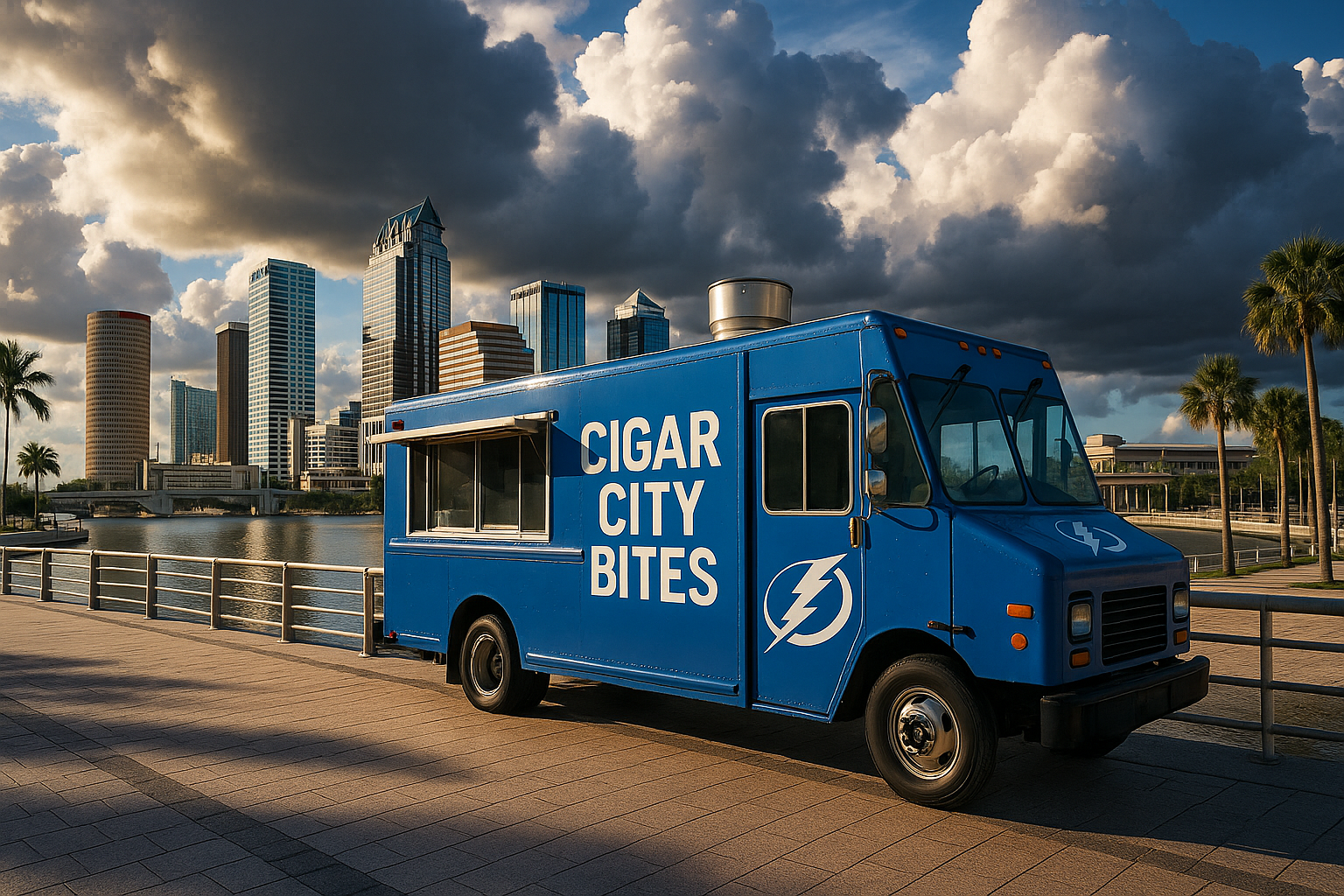
Tampa is one of Florida's fastest-growing food truck markets — a booming downtown, a massive events scene (Gasparilla, Guavaween, Ybor City Saturday market), year-round warm weather, and a strong brewery culture make it prime territory for food truck operators. Getting licensed here means working through Florida's state-level DBPR health permitting, Hillsborough County, and the City of Tampa's business and vending rules. This guide covers every permit you need, the real costs, launch timeline, and where you can actually make money in Tampa Bay.
What's in this guide
- Permit snapshot — every agency, fee, and sequence
- Florida MFDV License — your core state health permit
- Commissary requirements in Tampa
- Fire inspection and hood suppression
- Total first-year cost estimate
- Where you can actually operate in Tampa
- Best food truck types for Tampa Bay
- Tampa vs other Florida markets
- Common mistakes and operator tips
- FAQ
Florida Disclaimer
Food truck regulations in Tampa are administered by the Florida Department of Business and Professional Regulation (DBPR), Hillsborough County, and the City of Tampa. Requirements and fees change periodically. Always verify current rules directly with each agency before applying.
Permit Snapshot — Every Agency, Fee, and Sequence
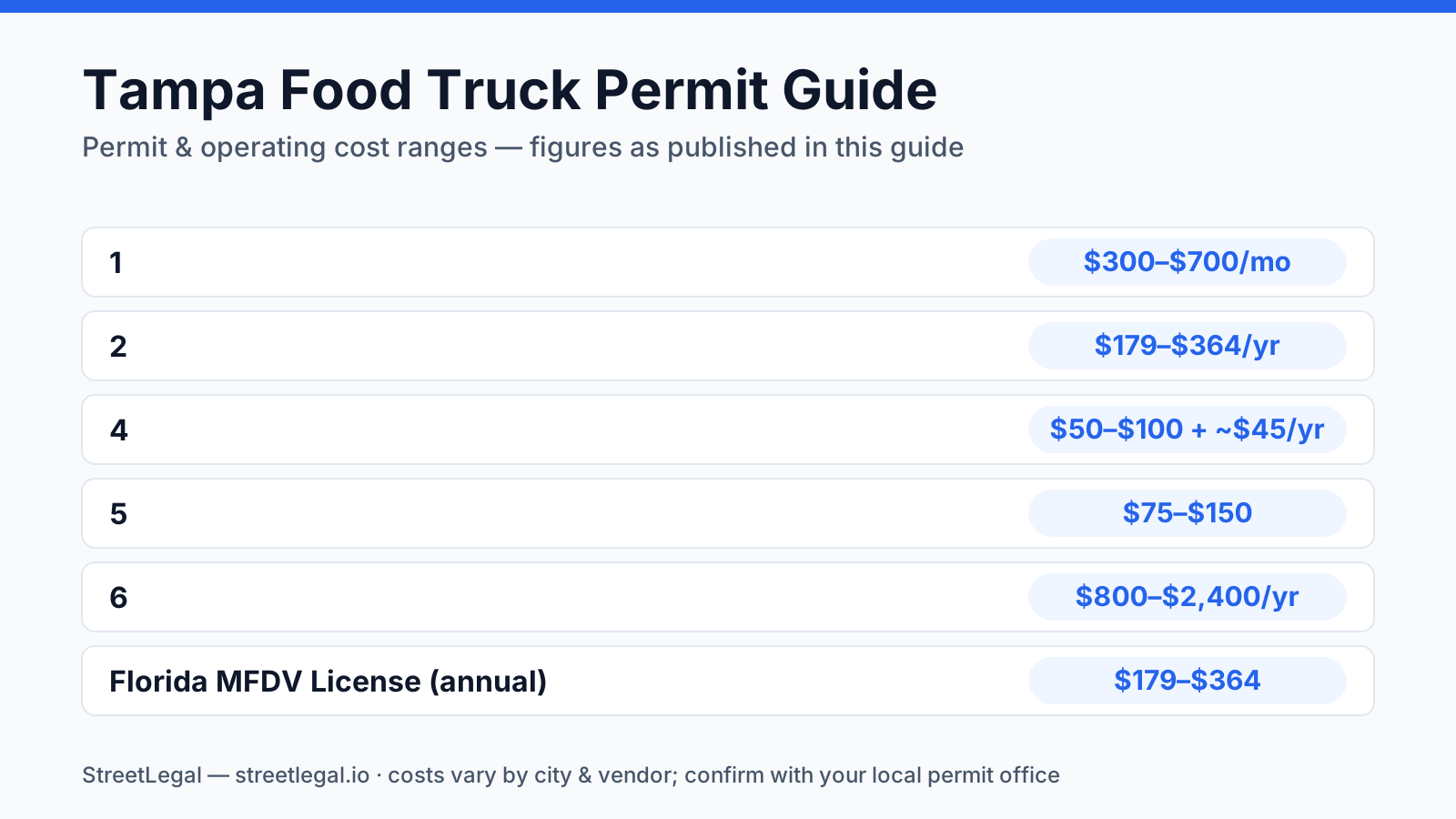
Tampa's permit stack follows Florida's state-driven model: the core food safety permit comes from the state (DBPR), with city and county business registrations layered on top. Most Tampa operators need all six steps below before their first legal service day.
| Step | Agency / Permit | Fee | Timeline | Sequence Note |
|---|---|---|---|---|
| 1 | Commissary Agreement (DBPR-licensed kitchen) | $300–$700/mo | 1–2 weeks to find + sign | Required before MFDV application; sign before applying |
| 2 | Florida DBPR — MFDV License (Mobile Food Dispensing Vehicle) | $179–$364/yr | 3–6 weeks (app + inspection) | Core state health permit; portable across all FL counties |
| 3 | Florida Dept. of Revenue — Sales Tax Registration | Free | 1–3 days online | Can be done in parallel; 7.5% Hillsborough County rate |
| 4 | City of Tampa BTR + Hillsborough County BTR | $50–$100 + ~$45/yr | 2–3 weeks each | Both required if operating within Tampa city limits |
| 5 | Tampa Fire Rescue — Fire Safety Inspection | $75–$150 | 2–4 weeks scheduling | Required for propane/open-flame; schedule as early as possible |
| 6 | General Liability Insurance | $800–$2,400/yr | 1–5 days (online broker) | Not state-required but required by most events + private lots |
The Florida MFDV License — Your Core Permit
Florida is unique: food truck health permitting is handled at the state level through the Florida DBPR's Division of Hotels and Restaurants — not the county or city. This means your MFDV license is portable across all Florida counties, which is a major advantage for Tampa Bay operators who work across Hillsborough, Pinellas, Pasco, and surrounding counties.
Apply online at myfloridalicense.com under "Hotels and Restaurants." You'll need: completed MFDV application, signed commissary agreement, menu with all items listed, food manager certification ($35–$75), and fire inspection clearance for propane/open-flame operations. DBPR will schedule a physical truck inspection — plan for 2–4 weeks after submission.
Truck Equipment Requirements (DBPR-Enforced)
- Mechanical refrigeration capable of maintaining foods at 41°F or below
- Hot holding equipment maintaining 135°F or above
- Handwashing sink with soap, single-use towels, hot/cold water
- Three-compartment sink for utensil washing
- Potable water tank sized to your menu and service volume
- Wastewater tank 15% larger than potable water capacity
- Food-grade surfaces, pest-proof construction
Commissary Requirements in Tampa
Tampa has a solid commissary market. Monthly commissary costs typically run $300–$700/month. Florida commissary rules are stricter than many states — your commissary must hold an active DBPR license, not just a general kitchen rental.
Florida-specific commissary rules:
- Commissary must hold active DBPR license — verify the license number before signing any agreement
- If your commissary loses its DBPR license, your MFDV license can be suspended immediately
- DBPR can inspect your commissary relationship at any time
- Some operators use licensed restaurant kitchen rentals as commissary — allowed if the restaurant holds an active DBPR license
- Commissary must provide: prep access, potable water, wastewater disposal, cold storage, and equipment cleaning facilities
Fire Inspection and Hood Suppression
Tampa Fire Rescue must inspect your truck if it uses any cooking equipment with open flame, propane, or deep-frying. Schedule your inspection as early as possible — wait times are often 2–4 weeks. Key requirements:
- UL-300 Type K fixed fire suppression system — required for any deep fryer or high-heat cooking (Ansul or equivalent; cost $1,800–$4,000 if not already installed)
- Portable fire extinguisher (2A10BC minimum, Class K for cooking oil)
- Propane tank mounting and shutoff compliance
- Exhaust hood and ventilation clearances meeting NFPA 96 standards
- Annual Ansul system inspection and certification required after installation
Coffee cart / cold-serve advantage
If your concept is a specialty coffee cart, cold desserts, or a no-open-flame setup, you avoid the Ansul suppression requirement entirely — saving $1,800–$4,000 in startup cost and 2–4 weeks in inspection scheduling. This is a meaningful Tampa market entry advantage for those concepts.
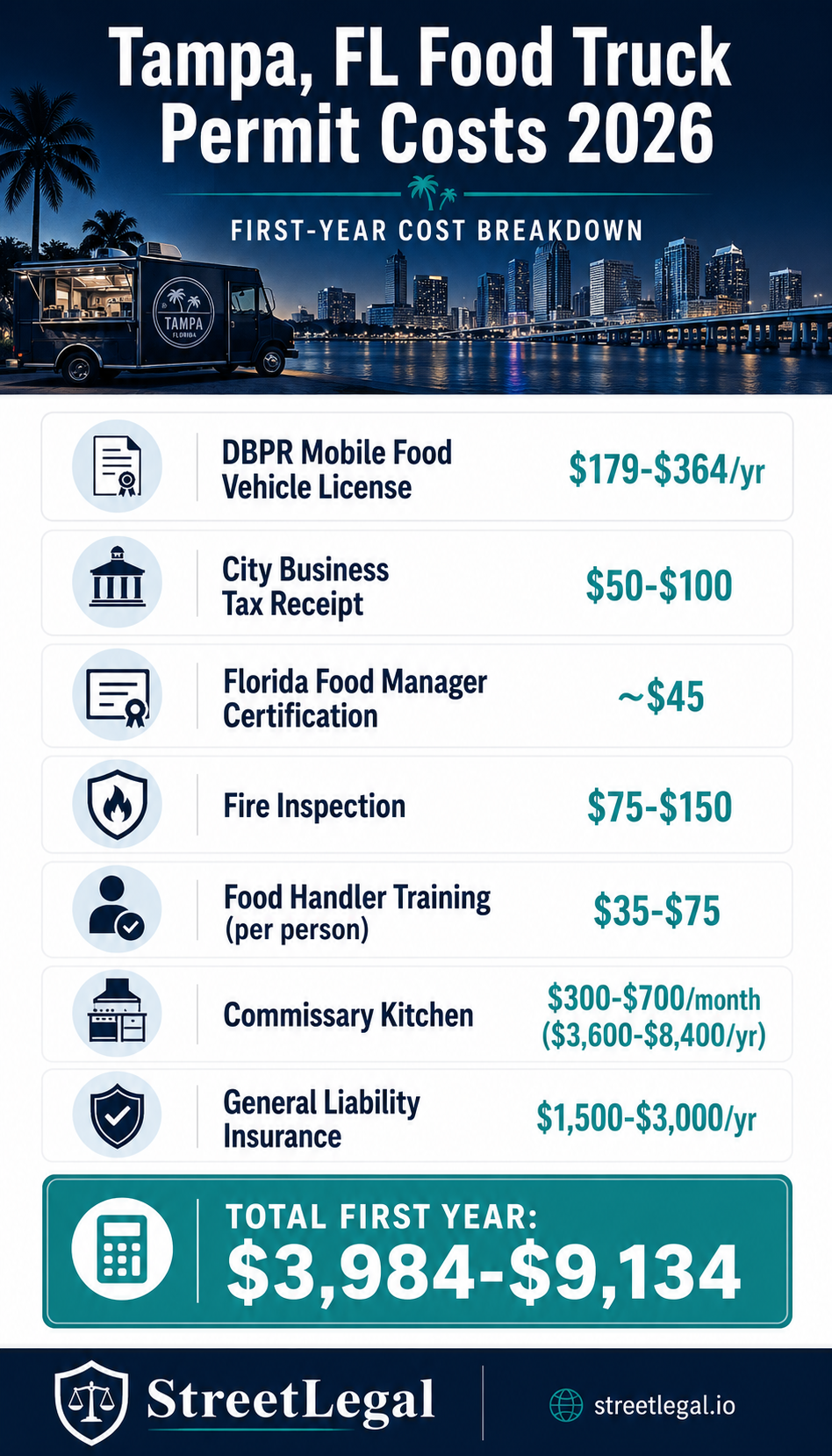
Total First-Year Cost Estimate
| Cost Item | Estimated Range | Notes |
|---|---|---|
| Florida MFDV License (annual) | $179–$364 | Renews Oct. 1 each year |
| City of Tampa Business Tax Receipt | $50–$100 | Renews Sept. 30 |
| Hillsborough County BTR | ~$45 | Needed if operating county-wide |
| Florida Sales Tax Registration | Free | 7.5% Hillsborough County rate |
| Tampa Fire Rescue Inspection | $75–$150 | For propane/open-flame setups |
| Food Manager Certification (ServSafe) | $35–$75 | Required by DBPR; valid 5 years |
| General Liability Insurance | $800–$2,400/yr | Required by most events and private venues |
| Commissary (monthly × 12) | $3,600–$8,400 | $300–$700/month Tampa Bay market rate |
| Total First-Year Compliance Cost | ~$4,784–$11,534 | Excludes truck, equipment, Ansul install |
Where You Can Actually Operate in Tampa
Having your MFDV license and BTR does not automatically mean you can operate anywhere in Tampa. Permit approval and real operating-lane access are two separate things. Here's the honest breakdown by lane:
| Operating Lane | Permit Alone Enough? | Real Access Reality | Best Truck Fit |
|---|---|---|---|
| Ybor City Historic District | No — Ybor City Development Corp rules apply | Designated vending areas and events only; Saturday Market is prime; coordinate with YCDC directly | Cuban/Latin fusion, BBQ, dessert trucks with evening crowd appeal |
| Tampa Riverwalk | No — Parks and Recreation permit required | Designated events and vendor zones through City of Tampa Parks; competitive spots; apply months ahead | All truck types perform well; upscale/fusion and dessert trucks strong here |
| Private brewery taprooms (Tampa Bay area) | Yes — property owner permission + MFDV sufficient | Strong lane — Tampa has a large and growing craft brewery scene; direct brewery relationships are the fastest first revenue | BBQ trailer, taco truck, upscale fusion — pairs well with craft beer |
| Office parks / corporate catering (South Tampa, Westshore) | Yes — MFDV + BTR sufficient; property owner permission needed | Consistent weekday lunch revenue; Westshore business district and South Tampa offices are primary targets; book via property manager | Specialty coffee, gourmet lunch trucks, upscale fusion |
| Gasparilla / Tampa Bay festivals | No — event-specific vendor application required | Gasparilla (Jan), Guavaween (Oct), Gasparilla Music Fest, Riverwalk events — applications open months ahead; competition is high but revenue potential is massive | BBQ, taco, Cuban/Latin, dessert — high-volume event setups |
| Food truck parks (Seminole Heights, Pinellas County) | Yes — MFDV + BTR sufficient once accepted by park operator | Tampa area food truck parks and weekly gatherings offer consistent weekend revenue; Pinellas County (St. Pete, Clearwater) has active food truck park scene reachable with FL MFDV alone | All truck types; variety is preferred by park operators |
| Public streets / downtown right-of-way | No — City of Tampa Transportation coordination required | Must maintain ADA sidewalk clearance; no blocking driveways or loading zones; limited prime spots available; lower foot traffic than event lanes for most truck types | Coffee carts and grab-and-go concepts suited to low-friction street setups |
Best Food Truck Types for Tampa Bay
Tampa's market is shaped by its Cuban heritage, strong events culture, year-round warm weather, and fast-growing brewery scene. The best-performing truck types reflect these local demand realities:
| Truck Type | Tampa Market Fit | Commissary Pressure | Event Flexibility | Why It Fits |
|---|---|---|---|---|
| Cuban / Latin fusion truck | Very strong | Medium (daily prep required) | Excellent — Ybor City, Gasparilla, festivals | Tampa has deep Cuban heritage (Ybor City is historically Cuban); demand is both local and tourist-driven; no competing city in Florida has the same brand story advantage |
| BBQ / Southern comfort trailer | Strong | High (smoker setup, daily commissary) | Very strong — outdoor events, festivals, brewery circuit | Florida's outdoor event culture and brewery scene drives consistent BBQ demand; large trailer fits the Gasparilla and Guavaween event scale well; commissary pressure is high but event revenue compensates |
| Taco truck / Mexican street food | Strong | Medium (daily prep) | Strong — works year-round across all Tampa Bay lanes | Year-round warm weather means consistent demand; casual format fits brewery, corporate, and event catering equally well; familiar and easy to price for any crowd |
| Specialty coffee / espresso cart | Strong | Low (no cooking, simple daily clean) | Strong — morning corporate, farmers markets, events | No fire suppression system required; lower startup cost; morning corporate demand in Westshore and South Tampa is underserved; consistent daily revenue potential without event dependency |
| Dessert / ice cream truck | Strong | Low–Medium | Excellent — beach events, festivals, year-round outdoor demand | Year-round warm weather is a structural advantage; beach and waterfront events are consistent; pairs well with Gasparilla and family-oriented festivals; tourist traffic at Riverwalk and Hyde Park is a bonus lane |
| Upscale fusion / Latin-Caribbean truck | Strong in South Tampa / SoHo | High (fresh daily prep) | Strong for private and corporate catering | South Tampa and SoHo/Hyde Park demographics support premium pricing; private event catering is the primary revenue lane; corporate lunch in Westshore office district is a secondary market with high average ticket |
Tampa vs Other Florida Markets
Florida's statewide MFDV license makes it relatively easy to operate across multiple markets. Here's how Tampa compares to the other major Florida food truck cities on launch friction, revenue potential, and best entry strategy:
| Market | Launch Friction | Best First Revenue Lane | Best First Truck Fit | Why This Market |
|---|---|---|---|---|
| Tampa | Medium — DBPR + City + County BTR; 8–14 weeks to launch | Brewery taproom circuit + private events | Cuban/Latin fusion, BBQ trailer, taco truck | Strong cultural identity (Cuban heritage), large events calendar, growing brewery scene, year-round outdoor operating weather |
| Miami | High — Miami-Dade BTR + City BTR + DBPR; complex private-lot approval; higher commissary costs | Private lots (Wynwood BID) + event circuit | Cuban/Latin fusion, upscale seafood, coffee cart | Highest revenue ceiling in FL; strongest international food demand; tourism volume; but permit friction and commissary cost are significantly higher |
| Jacksonville | Medium-Low — DBPR + Duval BTR; relatively fast approval path | Private brewery lots + military community catering | BBQ/smoked meats, seafood, taco truck | Largest FL city by area; NAS Jax and Mayport military community is an underserved catering lane; lower cost to launch vs Miami |
| Orlando | Medium — DBPR + Orange County BTR; convention demand is strong but irregular | Convention center catering + hotel event circuit | Taco/Mexican, specialty coffee, upscale fusion | Convention and theme park perimeter demand; Mills 50 neighborhood vending is a solid weekday lane; International Drive tourist corridor has high volume but competition is intense |
| Fort Lauderdale | Medium — DBPR + Broward County + City BTR; marina/yacht event access requires relationships | Marina district events + beach corporate catering | Upscale seafood, Latin fusion, coffee/dessert | Strong yacht and marina culture; beach events year-round; less competition than Miami with similar demographic premium pricing potential |
Common Mistakes and Operator Tips
Mistake 1: Assuming Tampa permit covers all of Hillsborough County
The City of Tampa BTR covers operations within Tampa city limits only. If you operate in unincorporated Hillsborough County (including areas near Brandon, Riverview, Westchase), you need the Hillsborough County BTR separately. St. Pete and Clearwater require their own separate city BTRs — though your FL MFDV remains valid.
Mistake 2: Not verifying commissary DBPR license before signing
A commissary that loses its DBPR license puts your MFDV at risk of suspension. Always look up the facility's DBPR license number on myfloridalicense.com before signing. Active status = green light. Expired or suspended = walk away.
Mistake 3: Missing the October 1 MFDV renewal deadline
Florida DBPR licenses expire September 30. Operating with an expired license is a serious violation and can result in fines and forced closure. Renew online in August — don't wait for the renewal notice to arrive. City of Tampa and Hillsborough County BTRs also renew by September 30.
Mistake 4: Underestimating Gasparilla application lead time
Gasparilla Pirate Festival vendor applications typically open in September–October for the January event. Guavaween (October) applications open in summer. First-year operators who wait until November or December find all prime vending spots are taken. Research the event vendor application timelines before you even have your truck built.
Mistake 5: Operating in Ybor City without YCDC coordination
Ybor City Historic District is governed by the Ybor City Development Corporation in addition to standard City of Tampa rules. Showing up without YCDC coordination is a fast way to get asked to leave — even with a valid MFDV and BTR. Contact YCDC directly to understand current vending zones and permitted events.
Tip: Florida MFDV is your Tampa Bay superpower
Your Florida MFDV license covers you in St. Pete, Clearwater, Sarasota, Bradenton, Naples, and every other Florida city. You only need local BTRs (~$50–$100) for each additional city — no second state health permit. This makes the Tampa Bay metro + Gulf Coast corridor one of the most operationally efficient multi-city markets in the country.
Tip: Brewery taproom circuit is the fastest first revenue lane
Tampa's craft brewery scene (Cigar City, Angry Chair, 81Bay, and 50+ others across the metro) offers consistent weekend revenue without event application friction. Contact breweries directly with your truck concept and a one-page pitch. Most prefer variety — if three similar trucks are already rotating, you'll get passed over. Differentiate your concept when pitching.
Exploring all of Florida?
See our complete Florida food truck permit hub — permit stacks for Miami, Jacksonville, Orlando, Fort Lauderdale, and the full Florida MFDV license walkthrough in one place.
Florida Food Truck Permit Guide →Frequently Asked Questions
What permits do I need to operate a food truck in Tampa?
How long does it take to get a food truck permit in Tampa?
How much does a food truck permit cost in Tampa?
Does my Tampa permit work in St. Pete and Clearwater?
When does my Tampa food truck permit renew?
Related Florida and National Guides
People also ask about Tampa food truck permits
How much does a food truck permit cost in Tampa?
How long does it take to get a food truck permit in Tampa?
Do I need a commissary kitchen to operate a food truck in Tampa?
What documents do I need for a Tampa food truck permit?
Answers to the most common permit questions — costs, timelines, commissary rules, and more.
Find city-level permit guides for every state we cover — compare costs and requirements.
More from the blog
Food Truck POS Systems: Square vs. Toast vs. Clover vs. Avocado (2026)
Real 2026 pricing, hardware costs, offline mode, and contract terms for Square, Toast, Clover, and Avocado — compared specifically for food truck operators.
City GuidesEagan, MN Food Truck Permit Guide
Eagan MN food truck permit guide: MDH mobile food licensing, Dakota County food safety, city peddler rules, commissary records, costs, and launch timeline.
City GuidesBentonville, AR Food Truck Permit Guide
Complete guide to food truck permits, fees, and requirements in Bentonville, AR.
City GuidesBiloxi, MS Food Truck Permit Guide
Biloxi food truck permit guide 2026: licenses, health permit steps, commissary records, inspections, costs, renewal timing, and launch checklist.