· 11 min read · StreetLegal Team

Shared Kitchen vs. Commissary: Which Setup Is Right for Your Food Truck? (2026)
Updated June 28, 2026 - commissary agreement, shared-kitchen, and health-department requirement guidance reviewed for 2026.
Here is the question I see food truck operators get wrong more often than any other: "Can I use this shared kitchen instead of a commissary?" The answer is almost always: it depends on whether that shared kitchen is also licensed as a commissary — and most of them are not. This guide explains exactly what these terms mean, why the distinction matters to your permit application, and how to do the math on which arrangement actually makes sense for your operation.
The short version before we go deep: commissary is a licensing status granted by a health department. Shared kitchen is a business model. Some shared kitchens hold commissary status. Most do not. If your city requires a commissary letter and you sign up for a shared kitchen that is not a licensed commissary, you will have paid for something that cannot satisfy your permit requirement.
Check Your Permit Application Language First
Before you decide between a shared kitchen and a commissary, pull up your city's mobile food vendor permit application. If it uses the words "commissary agreement," "commissary letter," or "base of operations," you need a facility that holds a commissary endorsement. If it says "proof of licensed kitchen access," your options may be broader. Always verify requirements with your local health department before signing any contract.
Defining the Terms Clearly
These terms get used interchangeably online, in Facebook groups, and sometimes by the kitchens themselves — which is how operators end up signing the wrong contract. Here is how health departments actually use these terms:
Commissary (or Commissary Kitchen)
A commissary is a food establishment that has received a specific endorsement from a health authority permitting it to serve as the base of operations for mobile food units — meaning food trucks, carts, and trailers. This endorsement has real meaning: the health department has inspected the facility and confirmed it meets the infrastructure requirements to support mobile operators. Those requirements typically include:
- Adequate handwashing, food prep, and 3-compartment sink facilities
- Potable water supply sufficient for filling mobile unit tanks
- Wastewater/greywater disposal capacity
- Refuse and grease disposal facilities
- Adequate cold storage and dry storage for operator use
- Equipment cleaning and sanitizing capacity
When a health department issues your food truck permit, they typically record the name and license number of your commissary. The commissary relationship is a documented, regulated arrangement — not just a business transaction.
Shared Kitchen (Incubator Kitchen / Rental Kitchen)
A shared kitchen is a commercial kitchen that rents time or space to multiple users — typically by the hour, by the day, or on a monthly membership basis. The business model is about access: you pay for a licensed facility without having to own one. Shared kitchens serve caterers, personal chefs, cottage bakers scaling up, pop-up restaurant operators, and yes, food truck operators.
Here is the critical point: a shared kitchen's health department license covers the kitchen itself. It permits that facility to operate as a food establishment. It does not automatically authorize that kitchen to serve as a commissary for mobile food units unless the kitchen has separately obtained a commissary or MFU endorsement.
Most shared kitchens have not obtained that endorsement — either because they serve a different customer base, because of the additional inspection requirements, or simply because they never thought to apply for it. Always ask before assuming.
The Overlap: Shared Kitchens That Are Also Commissaries
Some shared kitchens have obtained commissary endorsements specifically because they want to serve food truck operators. These facilities are the best of both worlds: they offer the flexible rental model of a shared kitchen and they can satisfy your commissary requirement. They are not common, but they exist in most major markets.
Pro Tip: One Question Cuts Through the Confusion
When evaluating any kitchen, ask: "Are you licensed as a commissary for mobile food units by [your city/county health department], and can you provide a signed commissary agreement letter with your health department license number for my permit application?" If they hesitate, ask for clarification, or say they're "basically a commissary," assume the answer is no and verify directly with the health department.
What a Commissary Relationship Gives You (That a Plain Shared Kitchen Rental Doesn't)
Beyond the regulatory distinction, there are practical differences in what a commissary relationship typically includes versus a standard shared kitchen rental. Here is a side-by-side breakdown:
| Feature | Commissary | Shared Kitchen (Non-Commissary) |
|---|---|---|
| Health dept commissary letter | Yes — included | No — cannot provide |
| Satisfies permit commissary requirement | Yes | No (in most jurisdictions) |
| Potable water tank fill station | Usually included | Varies — often not available |
| Greywater / wastewater dump | Usually included | Rarely included |
| Overnight truck parking | Often available (extra cost) | Rarely available |
| Dedicated food prep time | Yes — included in monthly rate | Yes — hourly basis |
| Cold / dry storage | Usually included | Sometimes available, extra cost |
| Billing structure | Monthly flat rate | Hourly or monthly membership |
| Minimum commitment | Typically month-to-month or 3–6 mo | Pay-as-you-go or monthly min |
| Health dept inspection focus | Inspected for MFU compliance | Inspected as food establishment only |
The things that are the same: both provide a licensed commercial kitchen with proper equipment, both are inspected by health authorities, and both allow you to legally prepare food for sale in a commercial setting. The difference is in the specific endorsements and what those endorsements authorize you to do for your food truck permit.
Cost Comparison: Commissary vs. Shared Kitchen
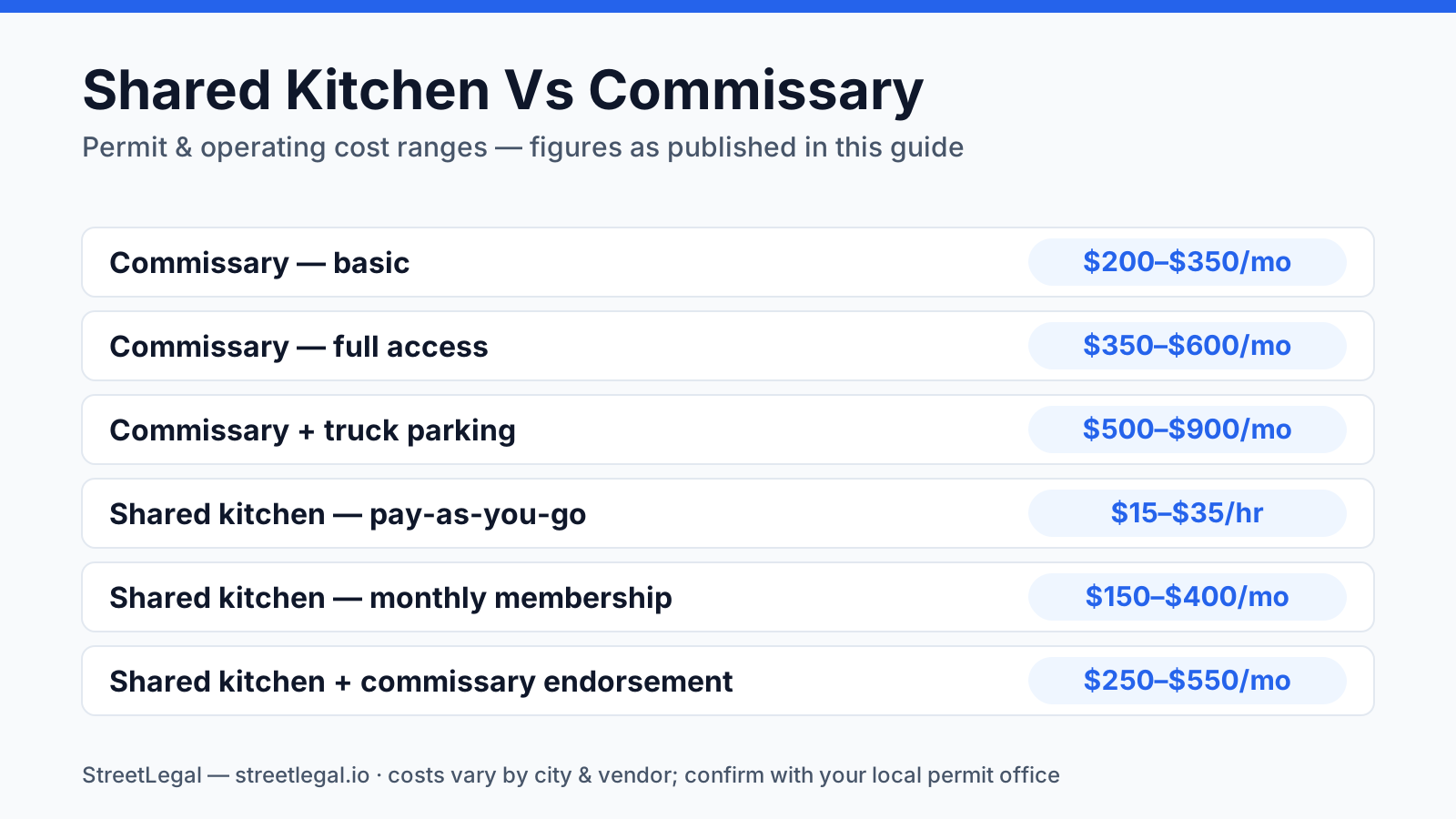
Costs vary significantly by market. Here are realistic ranges for 2026 across major metro areas:
| Arrangement | Typical Structure | Cost Range | Notes |
|---|---|---|---|
| Commissary — basic | Monthly retainer, limited hours | $200–$350/mo | Typically 8–12 prep hours included |
| Commissary — full access | Monthly retainer, more hours + storage | $350–$600/mo | Includes water/waste services, storage |
| Commissary + truck parking | Monthly retainer + parking | $500–$900/mo | Overnight secured truck storage |
| Shared kitchen — pay-as-you-go | Hourly rate, no minimum | $15–$35/hr | Major cities skew toward $25–$35/hr |
| Shared kitchen — monthly membership | Monthly fee, included hours | $150–$400/mo | Usually 15–30 hr/mo included |
| Shared kitchen + commissary endorsement | Monthly membership + commissary letter | $250–$550/mo | Best of both worlds; less common |
Pro Tip: Negotiate Before You Sign
Most commissary and shared kitchen operators have more flexibility than their posted rates suggest — especially for new operators willing to sign a 6-month or annual agreement. Off-peak hour access (early morning before 7am or evening after 8pm) is often available at a 15–25% discount. A rate cap provision in a multi-year agreement can save $1,500–$3,000 over two years if the kitchen raises rates.
The Math: Which Setup Is Actually Cheaper for Your Operation?
The answer depends entirely on how many hours per week you need prep time — and whether your city requires a commissary specifically. Let's run the numbers for a few common operating patterns:
Scenario A: Light Prep, 3x Week (about 6 hours/week)
You operate three days a week and do most of your cooking on the truck. You need the kitchen primarily for mise en place, saucing, and cleaning. You do not store much at the commissary.
| Option | Monthly Cost | Annual Cost | Satisfies Commissary Req? |
|---|---|---|---|
| Shared kitchen at $25/hr x 24 hrs/mo | $600 | $7,200 | No |
| Commissary basic retainer | $300 | $3,600 | Yes |
| Shared kitchen with commissary endorsement | $350 | $4,200 | Yes |
Verdict for Scenario A: The commissary basic retainer wins on cost and meets the requirement. The shared kitchen without commissary status is both more expensive and useless for your permit.
Scenario B: Heavy Prep, 5x Week (about 15 hours/week)
You run a scratch kitchen operation. You're butchering, batch cooking, and doing serious prep five days a week. You need 60+ hours per month of kitchen access.
| Option | Monthly Cost | Annual Cost | Satisfies Commissary Req? |
|---|---|---|---|
| Shared kitchen at $25/hr x 60 hrs/mo | $1,500 | $18,000 | No |
| Commissary full access (storage + water) | $500 | $6,000 | Yes |
| Shared kitchen membership (30 hr included) + commissary retainer | $700 | $8,400 | Yes |
Verdict for Scenario B: For heavy prep operations, the commissary flat rate is dramatically cheaper than hourly shared kitchen access. If you're in the kitchen 15+ hours a week, a commissary with unlimited or high-hour access almost always wins on cost.
The Special Case: Your City Doesn't Require a Commissary Letter
If your health department only requires proof of access to a licensed commercial kitchen — not a formal commissary agreement — then a shared kitchen rental can satisfy your permit requirement. In this case, you are making a pure cost decision: commissary monthly flat rate vs. hourly kitchen access based on your actual prep hours. Run the math for your specific volume. Below about 12 hours per month of prep time, shared kitchen hourly access is usually cheaper.
Don't Forget the Hidden Cost: Minimum Hours
Most shared kitchens have monthly minimum commitments — commonly 10–20 hours per month. If you are only using 6–8 hours of actual prep time, you are paying for unused hours. Factor the minimum, not just your actual usage, into your cost comparison. Some commissary arrangements at $250–$300/mo beat shared kitchen minimums even for light-prep operators.
What Your Health Department Actually Requires
The single most important research step before choosing between a commissary and a shared kitchen: pull up your city or county's mobile food vendor permit application and read the exact language about kitchen requirements. Here is how to decode what you find:
| Language in Your Application | What It Means | What You Need |
|---|---|---|
| "Commissary agreement" | Specific licensed relationship required | Licensed commissary only |
| "Commissary letter" | Formal letter on facility letterhead with license number | Licensed commissary only |
| "Base of operations" | Facility that serves as your home base | Usually requires commissary status |
| "Licensed food establishment agreement" | May be broader — verify with your dept | Commissary or licensed shared kitchen (confirm) |
| "Proof of licensed kitchen access" | Broader — any licensed commercial kitchen may work | Licensed commercial kitchen (commissary or shared) |
| No kitchen requirement listed | Rare — verify this is actually the case | Call the health dept to confirm |
When in doubt, call your local health department and ask directly: "For a mobile food vendor permit, do I need a commissary agreement from a facility specifically licensed as a commissary for mobile food units, or will proof of access to any licensed commercial kitchen work?" Write down who you spoke with and the date.
Red Flags in Shared Kitchen Contracts That Don't Meet Commissary Requirements
Before signing a shared kitchen contract, read it carefully for these warning signs that the arrangement will not satisfy your permit requirement:
-
Contract describes service as "kitchen rental" or "hourly kitchen access" only
No mention of commissary relationship, base of operations, or mobile food unit endorsement. This kitchen is not presenting itself as a commissary and likely cannot provide the letter your health dept requires.
-
No health department license number or permit number referenced in the agreement
A legitimate commissary agreement must include the facility's health department license number. If the contract has no reference to licensing, it is a business contract, not a commissary agreement.
-
Operator cannot or will not provide a signed commissary agreement letter on their letterhead
Commissary operators know what this letter is and provide it routinely. Hesitation or unfamiliarity with what you are asking for is a strong signal this is not a licensed commissary for food trucks.
-
Facility is licensed as a commissary for a single anchor tenant but not approved for third-party trucks
Some restaurants hold a commissary license that only covers their own catering vehicles. This license does not extend to unaffiliated food trucks. Verify that the kitchen's commissary endorsement explicitly covers third-party mobile food unit operators.
-
Contract caps your access at hours that will not cover your actual prep needs
Some low-cost commissary arrangements offer very few included prep hours — sometimes as few as 4–6 hours per month. Read the fine print: overage rates can make the effective monthly cost far higher than the listed retainer.
-
No mention of water fill or wastewater disposal if your truck requires these services
If your permit inspection requires you to demonstrate a commissary with water and waste services, a kitchen that cannot provide them fails that requirement — regardless of whether it holds commissary status on paper.
Questions to Ask Before Signing Either Arrangement
Go into any kitchen conversation — commissary or shared — with these specific questions ready. Write down the answers.
For Any Kitchen
- What health department licenses this facility and what is the license number?
- When was the last health inspection and what was the result?
- What equipment is available and included in the rate?
- What are the overage rates if I exceed my included hours?
- What is the minimum monthly commitment?
- Is there a rate cap or escalation clause in multi-month agreements?
- What are the scheduling policies — guaranteed time slots, or first-come basis?
- Who else uses this kitchen and is there equipment conflict risk?
Specifically for Commissary Status
- Are you licensed as a commissary for mobile food units by [city/county health dept]?
- Can you provide a signed commissary agreement letter for my permit application?
- Will the letter include your health department license number, your facility address, and my truck's permit information?
- How many food trucks are currently using this commissary?
- What happens if your commissary license lapses or you close — how much notice do I get?
- Do you provide water tank fill and greywater dump services? If so, at what times?
- Is overnight truck parking available? What does it cost?
Pro Tip: Verify Independently
After a kitchen operator tells you they are a licensed commissary, verify it independently before signing. Call your city or county health department and ask them to confirm that the facility at that address holds an active commissary endorsement for mobile food units. This takes 10 minutes and prevents a very expensive mistake.
City-Specific Notes
Commissary and kitchen requirements vary significantly by city. Here are the specifics for five major markets where the rules have important nuances:
Chicago (Chicago Dept of Public Health — CDPH)
Chicago has one of the stricter commissary requirements in the country. CDPH requires food trucks to operate from a licensed commissary, and that commissary must be located within the city limits of Chicago. Suburban commissaries — even those just across the city line — do not satisfy the Chicago permit requirement. You must have a CDPH-licensed commissary at a Chicago address.
Chicago commissary operators who work with food trucks know this requirement well. The commissary agreement must include the facility's CDPH license number and must cover your specific truck's permit number. Costs in Chicago for a commissary arrangement typically run $350–$600/month for established operators serving multiple trucks.
Houston (City of Houston Dept of Health — COHD)
Houston requires all mobile food vendors to operate from a licensed commissary. The City of Houston Health Department (COHD) maintains a list of licensed commissaries. The commissary must hold a valid COHD food establishment permit and must specifically be authorized as a commissary base of operations for mobile food units.
Houston has a relatively active market for commissary arrangements with costs typically ranging $250–$500/month. Key detail: if you operate in both Houston city limits and unincorporated Harris County, your commissary must be approved by both the City of Houston and Harris County Public Health depending on where you primarily operate. Operators who work across both jurisdictions often maintain commissary agreements with both.
Austin (Austin Public Health — APH)
Austin requires mobile food vendors to have a commissary agreement with a licensed food establishment. The facility must hold an APH food establishment permit with a commissary or MFU endorsement. Austin has a robust commissary market — the city's active food truck scene has created strong demand, and commissary availability is generally better than in smaller Texas cities.
Note that Austin food truck regulation has evolved in recent years, with some operators using food truck parks with on-site support facilities. If you operate at a permanent food truck park location in Austin, confirm with APH whether the park's facilities satisfy your commissary requirement directly.
Los Angeles (LA County Dept of Public Health — LACDPH)
LA County requires mobile food facilities to operate from an approved commissary. The commissary must hold an LA County Environmental Health permit as a food facility and must be approved as a commissary base of operations. LA is notable for having an extremely large commissary market — there are dozens of commissary operators serving LA's large food truck community, with a wide range of facilities and pricing.
LA costs tend to run on the higher end: $400–$700/month for a full-service commissary in or near the city. Budget-conscious operators can find lower-cost arrangements in suburban LA County, but verify that the facility's LACDPH commissary endorsement covers the districts where you operate.
New York City (NYC Dept of Health and Mental Hygiene — DOHMH)
NYC's mobile food vendor permit system is famously complex. The DOHMH requires food trucks to operate from a licensed commissary. NYC commissary arrangements are among the most expensive in the country — $500–$900/month is not unusual in the five boroughs, reflecting the extremely high cost of commercial kitchen real estate in New York.
NYC has strict requirements around what qualifies as a commissary: the facility must hold a DOHMH food service establishment permit with a commissary endorsement and must meet specific infrastructure standards for food truck support. The city's limited commissary slots relative to demand means competition for quality arrangements is real — finding one before you finalize your business plan is strongly recommended.
Frequently Asked Questions
What is the difference between a shared kitchen and a commissary?
Can I use a shared kitchen instead of a commissary for my food truck permit?
How much does a food truck commissary cost per month?
Does my city require a commissary letter or just proof of a licensed kitchen?
What are red flags that a shared kitchen does not qualify as a commissary?
Related Guides
Commissary Kitchen Requirements by State
State-by-state breakdown of what qualifies as a commissary and what documentation you need for your permit.
Commissary Kitchen Requirements in Texas
Texas-specific rules — Houston, Austin, Dallas, San Antonio. What TFER requires and where to find an approved commissary.
Commissary Kitchen Requirements in Illinois
Illinois and Chicago-specific rules — CDPH requirements, city-limits restriction, and finding a commissary in the metro area.
The Real Cost of Running a Food Truck (2026)
Full annual cost breakdown including commissary, insurance, permits, vehicle, and COGS. The numbers most operators don't budget for.
Answers to the most common permit questions — costs, timelines, commissary rules, and more.
Find city-level permit guides for every state we cover — compare costs and requirements.
More from the blog
Jefferson County, MO Food Truck Permit Guide
Complete guide to food truck permits, fees, and requirements in Jefferson County, MO.
City GuidesSt. Charles County, MO Food Truck Permit Guide
Complete guide to food truck permits, fees, and requirements in St. Charles County, MO.
City GuidesSt. Louis County, MO Food Truck Permit Guide
Complete guide to food truck permits, fees, and requirements in St. Louis County, MO.
Buyer's GuideFood Truck POS Systems 2026: Square, Toast, Clover & Avocado
Compare 2026 food truck POS systems by pricing, hardware costs, offline mode, and contract terms for Square, Toast, Clover, and Avocado.