· Updated · 9 min read · StreetLegal Team
How to Start a Food Truck in Salt Lake City, UT: Complete Permit Guide 2026
Updated: August 3, 2026. Reviewed for Salt Lake County health permit fees, Salt Lake City business licensing, and current zoning/operating rules.
Salt Lake City is Utah's flagship food truck market: a dense Wasatch Front corridor with downtown office lunches, breweries, universities, ski-season visitors, conventions, and recurring Food Truck League events. Permitting runs through two separate agencies - Salt Lake County for your health permit, and Salt Lake City for your business license and operating rules.
This guide covers the full stack: Salt Lake County's 2026 fee schedule, the city's mobile food business license, the zoning ordinance that limits public right-of-way vending to specific commercial and mixed-use zones, commissary rules, insurance, and realistic costs.
Salt Lake City Disclaimer
Salt Lake City food truck compliance runs through separate county (health) and city (business license, zoning) lanes, plus fire inspection. Always verify current requirements with Salt Lake County Health Department and Salt Lake City Business Licensing before filing.
The Salt Lake City Food Truck Licensing Landscape
Salt Lake City doesn't run its own food safety inspection program - that's Salt Lake County's job. The Salt Lake County Health Department Food Protection Bureau licenses and inspects all mobile food businesses operating within the county. The City of Salt Lake City layers its own business license, background check, insurance requirement, and zoning rules on top.
- Salt Lake County Health Department, Food Protection Bureau - your mobile food business permit, plan review, and inspections
- Salt Lake City Business Licensing - your mobile food business license, background check, and insurance verification
- Salt Lake City Fire Department - food truck operation fire inspection/permit
- Salt Lake City Transportation Division - permits allowing longer than two hours in one public right-of-way location
What Permits Do You Need for a Salt Lake City Food Truck?
1. Salt Lake County Mobile Food Business Permit
Utah's current county fee schedule prices mobile food trucks and carts by tier and risk level.
- Food Truck Permit Tier 1: $350/year
- Food Truck Permit Tier 2: $500/year
- Plan review, mobile food cart/truck/trailer (new unit): $755
- Food handler card (or replacement): $15
- How to apply: Register for the county's Mobile Food Service Class (385-468-3845), complete a commissary and restroom agreement, submit plan review, pay the fee, register your Certified Food Safety Manager, and pass a preopening inspection
- Issued by: Salt Lake County Health Department, Food Protection Bureau
2. Salt Lake City Mobile Food Business License
- Commercial base license fee: $193/year (rising to $198 effective September 2026, per Ordinance 2026-29)
- Per-vehicle mobile food fee: a separate fee applies for each vehicle operating under one business license - confirm the current per-vehicle amount on the city's Consolidated Fee Schedule (page 15), since the mobile-business fee line in the schedule refers back to the base license fee structure
- Requires: certificate of insurance naming Salt Lake City as additional insured, owner/driver background check, Utah state tax ID, health permit, fire approval, and vehicle information
- Issued by: Salt Lake City Business Licensing
- Governing ordinance: Salt Lake City Code Sections 5.69 and 21A.36.160
3. Salt Lake City Fire Department Inspection
- Fee: not published in the current public fee schedule - confirm the exact food truck operation permit/inspection fee directly with SLC Fire before budgeting
- Covers: extinguisher tags, hood/suppression documentation for grease-laden cooking vapors, propane and generator safety, LPG detection where applicable, and fuel shutoffs
- Note: a current, accepted reciprocal Utah fire safety inspection from another jurisdiction may satisfy this requirement - confirm with SLC Fire
4. Utah State Tax Commission Sales Tax License
- Fee: no Salt Lake City-specific fee published; account setup depends on business facts
- How to apply: Utah Taxpayer Access Point / business registration
5. Insurance (Certificate of Liability)
Salt Lake City requires a certificate of insurance naming the city as additional insured as part of the mobile food business license application. The exact citywide dollar minimum was not published on the reviewed city pages - confirm with Business Licensing.
- Commercial auto and workers comp: commonly required by insurers, event organizers, private-property hosts, and commissaries even where not separately mandated by the city
Salt Lake City Commissary Kitchen Requirements
Salt Lake County requires a permitted local commissary and restroom agreement before it will complete plan review - residential kitchens are not allowed.
| Commissary option | Monthly cost (estimate) | Notes |
|---|---|---|
| Utah Commissary Club | Flexible rentals - call to confirm | Advertises truck parking, potable water, greywater dump, shore power, and propane support |
| Square Kitchen, 751 W 800 S | Affordable hourly/monthly - call to confirm | Commercial kitchen incubator with cold/frozen/dry storage; confirm mobile-unit commissary letter support |
| Commissary Kitchen (132 South 800 West) | From $500/month | Advertises space for up to 5 Level 1/Level 2 trucks with fresh water, greywater, and power; confirm current county approval before signing |
Key mistake to avoid: Do not build the truck before plan review - Salt Lake County requires plan review approval before the rest of the permit path can finish, and the commissary/restroom agreement is a prerequisite for submitting.
Fire, Propane, and Safety Review in Salt Lake City
Salt Lake City Fire Department (or an accepted reciprocal Utah authority) reviews food truck operations for propane/gas systems, hood suppression where grease-laden vapors are produced, extinguisher service tags, LPG detection, and fuel shutoffs.
- Processing time: typically 1-3 weeks once the unit is inspection-ready
- Reciprocity: Utah allows some cross-jurisdiction recognition of fire inspections, but confirm SLC's current acceptance policy directly
Salt Lake City Food Truck Permit Snapshot (2026)
| Permit / License | Issuing agency | Cost | Timeline | Sequence step |
|---|---|---|---|---|
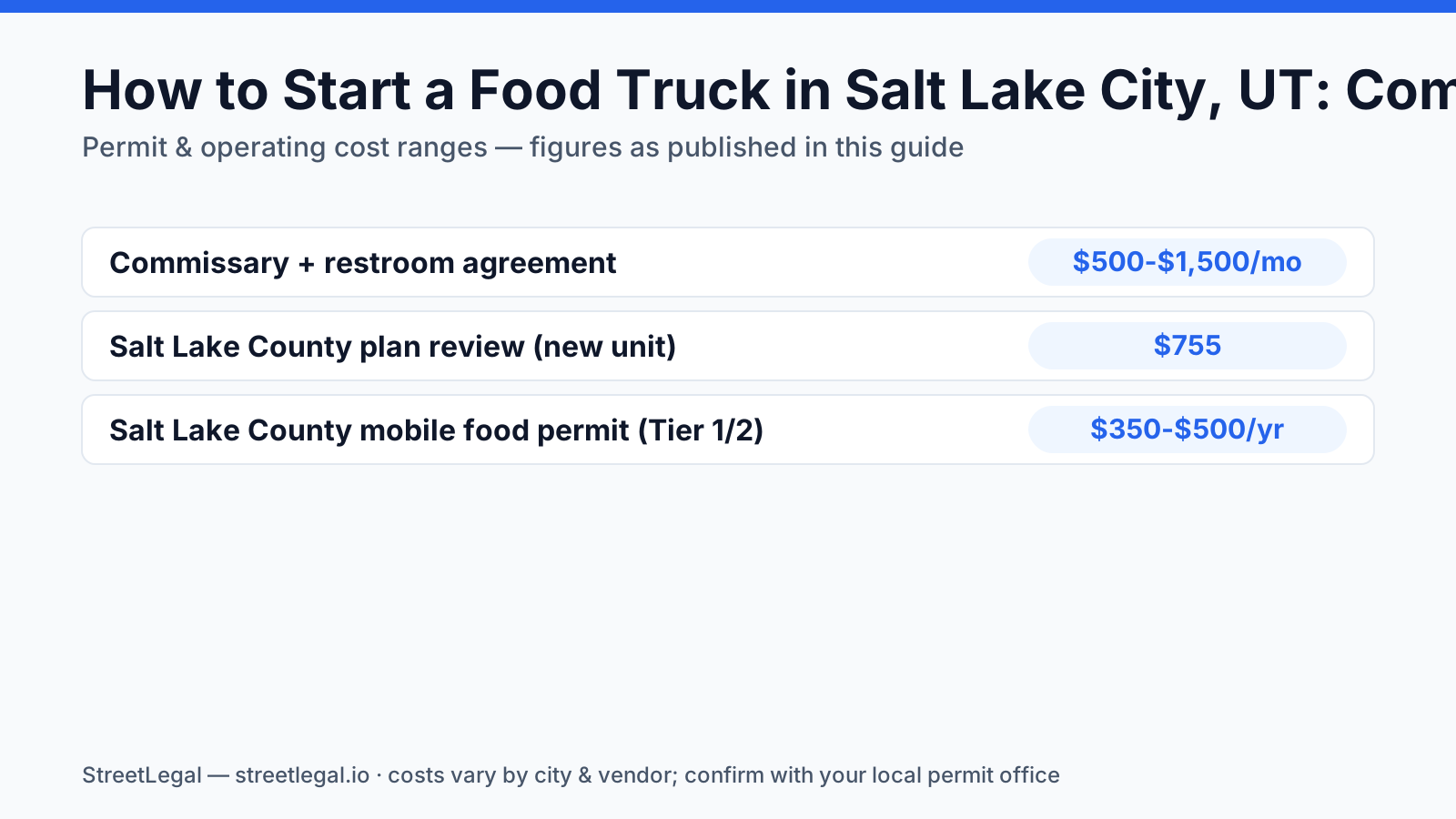
| Commissary + restroom agreement | Private kitchen | $500-$1,500/mo | Before all else | Step 1 - required before county will review plans |
| Salt Lake County plan review (new unit) | SL County Health Dept. | $755 | Varies by class timing/corrections | Step 2 |
| Certified Food Safety Manager + food handler cards | SL County / approved providers | $15/card + provider course cost | Same day to several days | Step 3 |
| Salt Lake County mobile food permit (Tier 1/2) | SL County Health Dept. | $350-$500/yr | After preopening inspection | Step 4 |
| Fire inspection / food truck operation permit | SLC Fire (or reciprocal AHJ) | Not published - confirm with SLC Fire | 1-3 weeks | Step 5 |
| Salt Lake City mobile food business license | SLC Business Licensing | $193+/vehicle/yr | 2-6 weeks | Step 6 |
Critical note: Start with your commissary agreement and county plan review - Utah rule requires renewal within 30 days before permit expiration, and the county side drives the real timeline.
Full First-Year Cost Breakdown
| Permit / License | Cost | Frequency |
|---|---|---|
| Salt Lake County plan review (new unit) | $755 | One-time |
| Salt Lake County mobile food permit (Tier 1/Tier 2) | $350-$500 | Annual |
| Food handler cards (per employee) | $15 each | As needed |
| Salt Lake City business license (commercial base) | $193 (→$198 Sept 2026) | Annual, per vehicle |
| Fire inspection | Not published - confirm with SLC Fire | Annual |
| Liability + auto insurance | Varies - confirm minimums with Business Licensing | Annual |
| Total Year 1 (confirmed fees only, excl. commissary & insurance) | $1,300-$1,450+ |
This total reflects only the fees independently confirmed against the current Salt Lake County fee schedule and Salt Lake City consolidated fee schedule. Add insurance, commissary ($500-$1,500/month), and the SLC Fire inspection fee once confirmed - the Cities research file estimates $2,500-$8,500 for a full first-year budget including those variable costs.
Realistic Timeline to Launch in Salt Lake City
- Weeks 1-3: Secure a commissary and restroom agreement, register your Utah business and sales tax account
- Weeks 2-5: Register for the county Mobile Food Service Class, build/retrofit the unit to plan-review requirements, and submit plan review
- Weeks 5-8: Register your Certified Food Safety Manager, complete food handler cards, and pass the county preopening inspection
- Weeks 6-9: Complete fire inspection and submit your Salt Lake City mobile food business license application with insurance and background check
- Week 10+: Confirm zoning/operating locations and launch!
Realistic total timeline: 30-75 days. Plan-review corrections and preopening inspection scheduling are usually the slowest steps - submit early.
Best Food Truck Types for Salt Lake City
Salt Lake City's Wasatch Front market combines downtown office lunches, a strong brewery/taproom scene, university and hospital traffic, and a busy events calendar (Food Truck League, conventions, ski-season visitors).
Strong Salt Lake City fits: tacos and Mexican/Latin trucks for fast service and event demand, coffee/breakfast trucks for downtown and university traffic, and bowls/healthy lunch trucks for the office and outdoor-recreation crowd.
| Truck Type | Market Fit | Commissary Pressure | Event Flexibility | Why |
|---|---|---|---|---|
| Tacos / Mexican / Latin | High | Medium | High | Fast service, broad demand, strong event fit |
| Coffee / breakfast / pastries | High | Medium | Medium | Downtown, office, and university morning demand |
| BBQ / smoker | Medium | High | High | Excellent event draw; heavier fire and commissary requirements |
| Bowls / healthy lunch | High | High | Medium | Strong office and outdoor/fitness market fit |
Where Can You Actually Operate in Salt Lake City?
| Operating lane | Permit alone enough? | Access reality | Best truck fit |
|---|---|---|---|
| Public right-of-way vending | No | Allowed only in M-1, M-2, D-1, D-2, D-3, D-4, and G-MU zones; max 2 hours per location (12 hrs/24 hrs) without a Transportation Division permit; one truck per block face; no vending within 100 ft of a restaurant/food vendor without a waiver | Fast lunch, coffee, tacos, bowls |
| Private property (with owner permission) | No | Allowed only in listed commercial, mixed-use, downtown, manufacturing, business park, and residential mixed-use zones; max 12 hrs/24 hrs | Any, with recurring host relationship |
| Events / Food Truck League | No | Recurring Gallivan Center and Glendale League Night events, plus civic events and festivals | Any, especially high-throughput |
| Brewery / taproom | Host permission | Strong Wasatch Front lane; private-property zoning and insurance apply | BBQ, tacos, burgers |
| Residential areas | N/A | Effectively excluded - private-property vending limited to nonresidential/mixed-use zones | N/A |
Important: No overnight parking for mobile food business activity is allowed, and only one vehicle may operate on a given block face at one time - build your route plan around these rules before you submit your city application.
Events & Opportunities in Salt Lake City
- Food Truck League / Gallivan Center - recurring downtown lunch events at 50 East 200 South
- Glendale League Night - recurring Food Truck League activity at 1235 West 1700 South
- Convention and downtown office demand - Salt Lake City's downtown, convention, hotel, and state-government traffic supports lunch and event vending
- University / medical / ski-adjacent catering - University of Utah, hospitals, and ski-season visitors add private catering demand, subject to property-specific approvals
- Brewery and taproom lane - strong fit for trucks that can rotate through breweries and private lots with clear host permission
Most Common Salt Lake City Permit Mistakes
- Building the truck before plan review - Salt Lake County requires plan review approval first; retrofitting after the fact is expensive
- Skipping the commissary/restroom agreement - required before the county will proceed, and residential kitchens are not allowed
- Assuming Utah reciprocity erases city rules - a mobile food permit from another Utah health department doesn't exempt you from Salt Lake City's zoning, parking, event, or property rules
- Parking outside an approved zone - public right-of-way vending is allowed only in specific commercial/mixed-use zones, not citywide
- Exceeding the 2-hour/12-hour time limits - without a Transportation Division permit, this is a common violation
Renewals: What to Track
- Salt Lake County mobile food permit: annual; Utah rule calls for renewal within 30 days before expiration
- Salt Lake City mobile food business license: annual, per vehicle
- Fire inspection: annual or as required by the issuing authority
- Insurance: keep current with Salt Lake City named as additional insured
- Commissary/restroom agreement: keep current signed proof on hand for county inspections
Salt Lake City Food Truck Permit FAQ
What permits do I need to operate a food truck in Salt Lake City, UT?
Who licenses food trucks in Salt Lake City - the city or the county?
How much does a Salt Lake City food truck permit cost?
Are there location restrictions for food trucks in Salt Lake City?
The Bottom Line
Salt Lake City is a strong, event-dense Wasatch Front market once you line up the county health permit and city business license in parallel. Budget at least $1,300-$1,450 in confirmed fees before adding insurance and commissary costs, give yourself 30-75 days, and start your commissary agreement and county plan review first.
Utah food truck operators
Salt Lake City is StreetLegal's Utah anchor market. See the state hub for the full Utah picture as more city guides are added.
Open Utah state hub →More permit planning reading
🏛️ Official Resources — Verify Current Requirements
- Salt Lake County Health Dept. — Mobile Food Permits — plan review, permit tiers, and fees
- City of Salt Lake City — Mobile Food Business — business license, zoning zones, and operating rules
- Salt Lake City Fire Department — Permits — food truck operation fire inspection
Fees and timelines shown above reflect 2026 published figures. Always confirm current requirements before filing.
People also ask about Salt Lake City food truck permits
How much does a food truck permit cost in Salt Lake City?
How long does it take to get a food truck permit in Salt Lake City?
Do I need a commissary kitchen to operate a food truck in Salt Lake City?
What documents do I need for a Salt Lake City food truck permit?
Answers to the most common permit questions — costs, timelines, commissary rules, and more.
Find city-level permit guides for every state we cover — compare costs and requirements.
More from the blog
Jefferson County, MO Food Truck Permit Guide
Complete guide to food truck permits, fees, and requirements in Jefferson County, MO.
City GuidesSt. Charles County, MO Food Truck Permit Guide
Complete guide to food truck permits, fees, and requirements in St. Charles County, MO.
City GuidesSt. Louis County, MO Food Truck Permit Guide
Complete guide to food truck permits, fees, and requirements in St. Louis County, MO.
Buyer's GuideFood Truck POS Systems 2026: Square, Toast, Clover & Avocado
Compare 2026 food truck POS systems by pricing, hardware costs, offline mode, and contract terms for Square, Toast, Clover, and Avocado.