· Updated · 12 min read · Gibby, StreetLegal Editorial
How to Start a Food Truck in Oakland, California: Complete Permit Guide 2026
Updated July 2, 2026
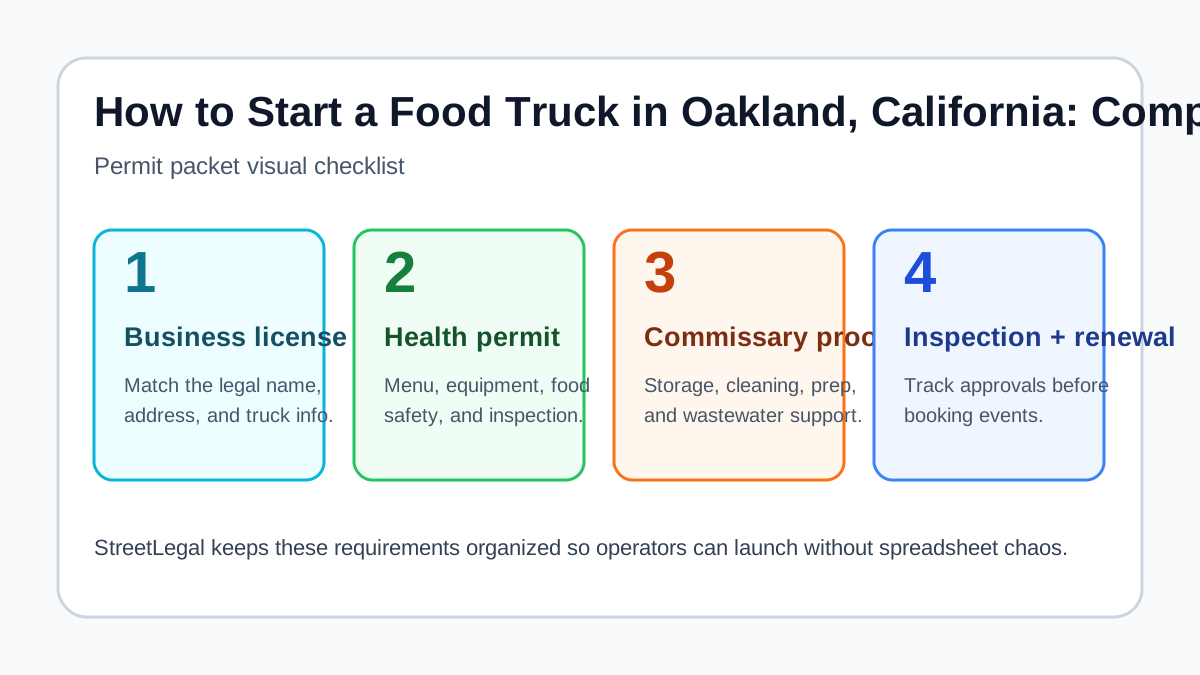
Oakland Quick Stats
- 🏛️ Primary permit: Alameda County Mobile Food Facility (MFF) / CMFO Permit
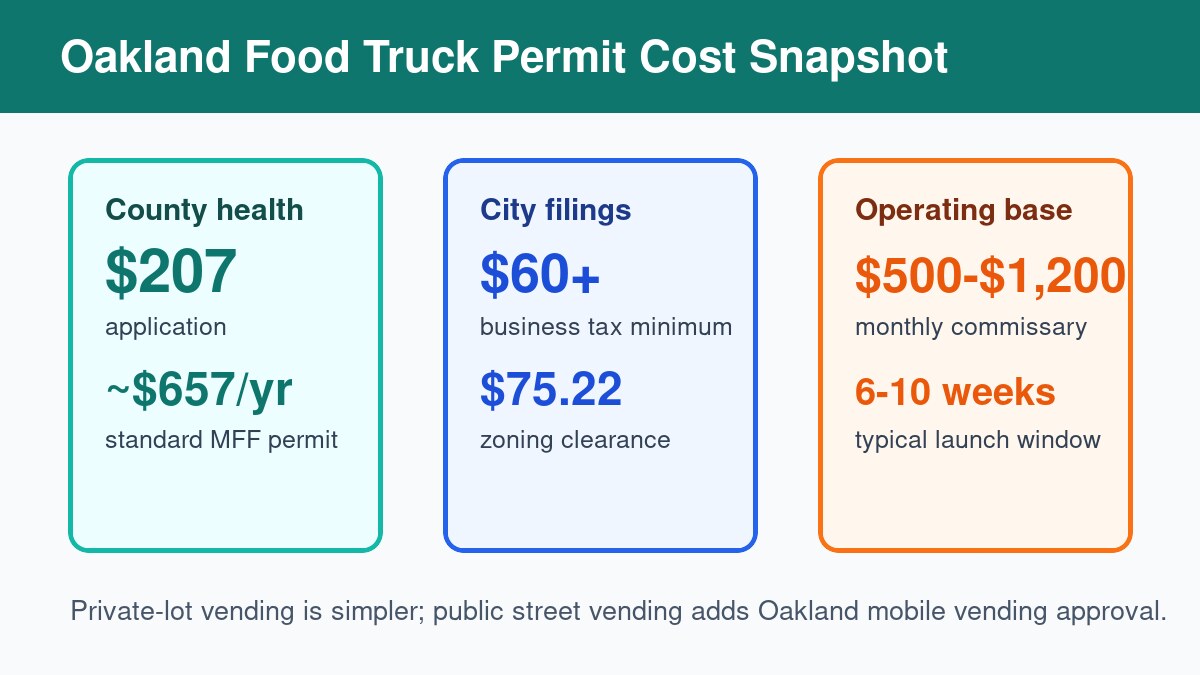
- 💰 Permit cost: ~$207 application + ~$657/yr for a standard enclosed truck
- 📋 Mandatory requirement: Commissary agreement (Alameda County-permitted facility)
- 🏭 Commissary required: Yes — California CALCODE mandates a licensed commissary
- ⏱️ Timeline: 6-10 weeks (county inspection scheduling is the long pole)
- 📍 Unique advantage: East Bay brewery scene, dense ethnic-food demand, First Fridays Art Murmur, Jack London Square waterfront
Oakland has one of the most diverse food scenes in the Bay Area — a deep brewery culture, dense immigrant communities from Fruitvale to the Laurel District, and a lower cost of entry than San Francisco just across the bridge. Getting licensed here means working through Alameda County Environmental Health for your food permit and the City of Oakland for your business tax and vending permits. This guide covers every permit, the real fees, commissary requirements, and where you can actually set up.
California Disclaimer
Food truck regulations in Oakland are administered by Alameda County Environmental Health, the City of Oakland, and the California Department of Tax and Fee Administration. Requirements and fees change periodically. Always verify current rules directly with each agency before applying.
Permit Snapshot: What You're Getting Into
| Step | Agency | Permit / Requirement | Fee | Timeline | Sequence |
|---|---|---|---|---|---|
| 1 | Private commissary | Commissary agreement | $500-$1,200/mo | 1-2 weeks | Required before MFF application |
| 2 | Alameda County Environmental Health | Mobile Food Facility (MFF) Permit | $207 app + ~$657/yr | 6-10 weeks | Core permit; requires commissary agreement first |
| 3 | Oakland Fire Department | Fire safety inspection | $50-$200 | 1-2 weeks | Required if cooking with propane/open flame |
| 4 | City of Oakland Finance Dept. | Business Tax Certificate + Zoning Clearance | $60 min + $75.22 | 1-2 weeks | Required for the commissary/base address; renews annually by March 1 |
| 5 | City of Oakland | Special Activity Mobile Vending Permit | Varies by type | 2-4 weeks | Only if vending on public streets/sidewalks; private-lot only doesn't need this |
| 6 | CA Dept. of Tax and Fee Admin. (CDTFA) | Seller's Permit (sales tax) | Free | 1-2 days | Can run parallel |
| 7 | Insurance carrier | General liability + auto insurance | $1,200-$3,000/yr | 1-3 days | Required before launch |
Oakland vs. Other California Markets
| Market | Launch Friction | Best First Revenue Lane | Best First Truck Fit | Why This Market Matters |
|---|---|---|---|---|
| Oakland | Moderate (county health + city business tax + separate vending permit for public ROW) | West Oakland/Jack London brewery lots + First Fridays | Ethnic/fusion, BBQ, vegan/plant-based, specialty coffee | Lower cost of entry than SF; dense immigrant food culture; strong brewery partnership scene |
| San Francisco | High (SFDPH + Public Works siting process) | Off The Grid + tech campus lots | Specialty/upscale, international/fusion | Highest revenue ceiling in the Bay Area but the toughest, slowest siting process |
| San Jose | Moderate (Santa Clara County health + city permit) | Tech campus lunch + Japantown/downtown events | Asian street food, taco, coffee cart | Large corporate lunch market; steadier weekday revenue than event-driven cities |
| Sacramento | Moderate (Sacramento County EHD + city tax) | Midtown street vending + Capitol district lunch | Farm-to-fork, international, BBQ | Lower overhead than the Bay Area; strong farm-to-fork identity |
| Long Beach | Moderate (LA County DPH + city license) | Retro Row/East Village breweries + Port workforce | Taco/lonchera, BBQ, seafood | Port workforce and brewery scene create steady weekday and weekend demand |
Best Truck Types for the Oakland Market
| Truck Type | Oakland Market Fit | Commissary Pressure | Event Flexibility | Rationale |
|---|---|---|---|---|
| Ethnic / international cuisine | Excellent | Moderate (specialty ingredients) | High (Fruitvale, Laurel District, farmers markets) | Oakland has deep Latino, Southeast Asian, and East African communities; ethnic food trucks consistently outperform generic concepts here |
| BBQ / smoked meats | Very Good | Low-Moderate (prep at commissary) | Very High (breweries, festivals, private events) | Strong pairing with Oakland's West Oakland/Jack London brewery circuit; reliable weekend draw |
| Vegan / plant-based | Very Good | Moderate | High (farmers markets, First Fridays, Temescal) | Oakland has one of the strongest plant-based dining scenes on the West Coast; Temescal and Uptown crowds actively seek it out |
| Taco / Mexican street food | Excellent | Moderate (fresh prep daily) | Very High (Fruitvale, International Blvd corridor, events) | Fruitvale is one of the strongest Mexican food corridors in the Bay Area; high daily foot traffic |
| Specialty coffee / espresso cart | Good | Very Low (minimal prep) | Moderate (downtown, office parks, farmers markets) | Low commissary friction; stable morning revenue near downtown and Jack London Square |
| Dessert / ice cream | Good | Low (often pre-made) | Very High (Lake Merritt, family events, First Fridays) | Lake Merritt weekend crowds and family-oriented events create consistent impulse-buy demand |
The Alameda County MFF Permit — Your Core Permit
The Mobile Food Facility (MFF) — or Compact Mobile Food Operation (CMFO) for smaller carts — permit from Alameda County Environmental Health is required to legally sell food from a truck anywhere in Oakland. Here's the process:
Step 1: Commissary Agreement
California's Retail Food Code requires all mobile food facilities to operate from a licensed commissary. Your commissary must hold its own Alameda County Environmental Health permit and provide:
- Potable water supply for tank refills
- Approved wastewater and grease disposal
- Food storage (refrigerated and dry)
- Equipment cleaning and sanitizing facilities
- Food prep space (if you prep food before service)
A signed commissary agreement from the commissary operator is required with your MFF application.
Step 2: Truck Equipment Requirements
Alameda County requires your truck to meet CALCODE standards. Core requirements:
- Handwashing sink with soap, paper towels, and hot/cold water
- Three-compartment sink for ware washing
- Mechanical refrigeration maintaining 41°F or below
- Hot holding equipment maintaining 135°F or above
- Fresh water tank sized to your menu and service hours
- Wastewater tank at least 15% larger than fresh water capacity
- Food-grade construction with easily cleanable surfaces
- Screened openings to prevent pest entry
Step 3: Plan Check (for new trucks)
Alameda County Environmental Health charges a separate plan check fee for a new mobile food facility or commissary setup — published rates run roughly $421.50-$969 depending on the facility type. Submit your truck layout, equipment list, and menu before your structural inspection is scheduled.
Step 4: Apply for Your MFF Permit
Apply by emailing your completed application to Alameda County's mobile food program at dehmobilefood@acgov.org. You'll need:
- Completed MFF/CMFO application ($207 application fee)
- Plan check documents (truck layout, equipment list, menu)
- Signed commissary agreement
- Fire inspection approval (if applicable)
- Vehicle registration/ownership proof
Alameda County also runs a free information session on the first Wednesday of every month (10-11 AM) at 1131 Harbor Bay Parkway, Alameda — worth attending before you file if this is your first mobile food permit.
Commissary Requirements in Oakland
Oakland and the wider East Bay have a growing shared-kitchen market, though rates run higher than most of the country because of Bay Area commercial rents. Monthly commissary costs typically run $500-$1,200/month.
What Alameda County looks for in your commissary agreement:
- The commissary's Alameda County Environmental Health permit number and facility name
- Your access schedule and hours
- What services are provided (water, storage, waste disposal)
- Signature of commissary owner/operator
Oakland Commissary Costs (2026)
- Shared commercial kitchen: $500-$1,200/month
- Daily access: $50-$90/day if available
- Hourly rental: $20-$35/hour
Oakland commissary costs run below San Francisco but above most of the rest of the country. Shop around across West Oakland, Fruitvale, and San Leandro — commissary location doesn't have to match where you actually sell.
Fire Inspection
The Oakland Fire Department (or the local fire authority where your truck operates) inspects trucks with propane, natural gas, or open-flame cooking. Requirements:
- Type I hood suppression system for commercial cooking equipment
- Propane tank compliance (mounting, shutoffs, pressure testing)
- Exhaust hood clearances and ventilation
- Portable extinguisher (2A10BC or K-class, visible and accessible)
Other Licenses You Need
City of Oakland Business Tax Certificate
Nearly every business operating in Oakland, including food trucks, needs a Business Tax Certificate from the city's Finance Department. The tax is tiered by gross receipts with a $60 minimum for most small-business categories, and it renews annually — due by March 1.
Zoning Clearance Permit
A Zoning Clearance Permit (roughly $75.22) confirms your commissary or base-of-operations address is approved for the business activity. A separate clearance is needed if you change location.
Special Activity Mobile Vending Permit
If you plan to vend from the public right-of-way — sidewalks, street parking, or city-owned property — you need Oakland's Special Activity Mobile Vending Permit, available as an individual-vendor or group-site application. If you only work private property (breweries, office lots, private events), you don't need this permit.
California Seller's Permit (Sales Tax)
Required to collect California sales tax on food sales. Register for free through the California Department of Tax and Fee Administration (CDTFA), then file returns on the assigned schedule.
Where You Can Actually Operate in Oakland
Oakland is genuinely food-truck friendly, but a permit alone doesn't guarantee a good spot. Below is a realistic breakdown of where permits actually translate to revenue access.
| Operating Lane | Permit Approval Alone Enough? | Access Reality | Best Truck Fit |
|---|---|---|---|
| Jack London Square / West Oakland breweries | No — brewery partnership required | Brewery owners curate truck schedules; build relationships first; consistent weekly spots possible | BBQ, ethnic/fusion, vegan, coffee |
| Fruitvale / International Blvd corridor | Partly — Mobile Vending Permit for public ROW | Heavy daily foot traffic; verify zoning and vending permit before setting up on public sidewalks | Taco/Mexican, dessert, coffee |
| Uptown / Downtown Oakland (incl. First Fridays) | No — event vendor application required for First Fridays | Monthly Art Murmur draws large crowds; apply through the event organizer well in advance | High-volume: taco, BBQ, dessert, vegan |
| Temescal / Uptown office lunch | Partly — Mobile Vending Permit + zoning check | Public sidewalk spots exist but verify zoning with the city; some spots need building-owner approval | Vegan/plant-based, ethnic, coffee |
| Lake Merritt / weekend park events | No — special event/park permit required | Weekend crowds are strong; check with Oakland Parks & Rec for event-specific vending rules | Dessert, ice cream, family-friendly food |
| Private catering (corporate, weddings) | Yes — county MFF permit sufficient | Private events on private property; no extra city vending permit needed; build event-planner relationships | BBQ, upscale, vegan, dessert |
Full Cost Breakdown: Starting a Food Truck in Oakland
| Permit / Cost Item | Low | High |
|---|---|---|
| Alameda County MFF Permit (application + annual) | $864 | $864 |
| Plan Check (new facility, one-time) | $422 | $969 |
| City of Oakland Business Tax Certificate | $60 | $300 |
| Zoning Clearance Permit | $75 | $75 |
| Fire Inspection | $50 | $200 |
| Commissary Kitchen (annual) | $6,000 | $14,400 |
| Business Liability + Auto Insurance | $1,200 | $3,000 |
| Total First-Year Estimate | $8,671 | $19,808 |
Excludes truck purchase/lease, equipment, and initial inventory. Commissary cost is the single biggest driver of Oakland's higher first-year total compared to Midwest and Southern markets — shop around before committing.
Timeline: Oakland Food Truck Launch
- Week 1-2: Secure commissary agreement with an Alameda County-permitted facility
- Week 2-3: Register for a CDTFA seller's permit; apply for the City of Oakland Business Tax Certificate and Zoning Clearance
- Week 3-4: Verify truck equipment meets CALCODE; submit MFF application and plan check documents
- Week 4-6: Alameda County schedules structural inspection
- Week 6-8: Pass structural inspection; receive MFF permit
- Week 8-9: Pass fire inspection (if applicable); finalize insurance
- Week 9-10: Apply for the Mobile Vending Permit if working public streets; connect with breweries and event organizers
Oakland Operator Tips
MFF permit renews annually — mark your calendar
Alameda County sends renewal notices, but email your inspector two weeks before your permit expires to avoid any gap in coverage.
Private lots are your fastest path to revenue
Skip the public-ROW permit friction at first — West Oakland and Jack London brewery lots, office parks, and private events only require your county health permit and business tax certificate.
Attend the free monthly info session
Alameda County Environmental Health runs a free information session the first Wednesday of every month. First-time applicants who attend tend to move through plan check and inspection faster.
Commissary location doesn't have to match your selling location
San Leandro and unincorporated Alameda County commissaries often run cheaper than commissaries inside Oakland proper — your permit follows the commissary agreement, not your operating neighborhood.
Oakland's food diversity is your edge over San Francisco
Lower commissary and business-tax costs than San Francisco, combined with dense, loyal ethnic-food demand in Fruitvale and the Laurel District, make Oakland a strong first market before expanding across the bay.
Ready to launch your food truck in Oakland?
StreetLegal tracks permit requirements, renewal deadlines, and compliance for food truck operators across California.
Get Started with StreetLegal →Related Guides
People also ask about Oakland food truck permits
How much does a food truck permit cost in Oakland?
How long does it take to get a food truck permit in Oakland?
Do I need a commissary kitchen to operate a food truck in Oakland?
What documents do I need for a Oakland food truck permit?
Answers to the most common permit questions — costs, timelines, commissary rules, and more.
Find city-level permit guides for every state we cover — compare costs and requirements.
More from the blog
Jefferson County, MO Food Truck Permit Guide
Complete guide to food truck permits, fees, and requirements in Jefferson County, MO.
City GuidesSt. Charles County, MO Food Truck Permit Guide
Complete guide to food truck permits, fees, and requirements in St. Charles County, MO.
City GuidesSt. Louis County, MO Food Truck Permit Guide
Complete guide to food truck permits, fees, and requirements in St. Louis County, MO.
Buyer's GuideFood Truck POS Systems 2026: Square, Toast, Clover & Avocado
Compare 2026 food truck POS systems by pricing, hardware costs, offline mode, and contract terms for Square, Toast, Clover, and Avocado.