· Updated · 11 min read · StreetLegal Team
How to Start a Food Truck in St. Louis: Complete Permit Guide 2026
Updated August 6, 2026.
St. Louis Quick Stats
- 🏛️ Primary permit: City of St. Louis Health Division Mobile Food Handler Permit (or St. Louis County if operating outside city)
- 💰 Permit cost: $150–$300/yr (City) or similar for County
- 📋 Mandatory requirement: Commissary agreement (signed, licensed facility)
- 🏭 Commissary required: Yes — Missouri law mandates licensed commissary
- ⏱️ Timeline: 3–6 weeks (City permits usually faster)
- 📍 Unique complexity: Dual jurisdiction (City vs. County); understand your operating zone
St. Louis's Unique Jurisdiction Challenge & Opportunity
St. Louis is unique in the United States: the City of St. Louis and St. Louis County are separate, independent jurisdictions. This creates a challenge but also an opportunity. If you understand the rules, you can operate efficiently. If you don't, you could get caught operating without the right permits.
The good news: once you understand your jurisdiction, St. Louis is actually quite permissive and affordable for food trucks. Lower permit costs than many major cities, reasonable commissary market, and a growing food truck culture across multiple neighborhoods.
Step 1: Understand Your Jurisdiction
This is critical. Determine where you plan to operate:
Operating Location Determines Jurisdiction
- City of St. Louis: Within city limits (downtown, midtown, south city neighborhoods)
- St. Louis County (unincorporated): Outside city limits, in unincorporated county areas
- St. Louis County (incorporated municipalities): Cities like Clayton, Kirkwood, Webster Groves (each has own rules)
Most food truck operators start in the City of St. Louis because the downtown, midtown, and Cherokee Street areas are prime markets with straightforward City permits. If you plan to operate in the City, get the City permit. If you're in unincorporated county areas, get the County permit.
If your event calendar pulls you further out into the metro, the fragmentation doesn't stop at the County line. St. Charles County (O'Fallon, St. Peters, Weldon Spring) and Jefferson County (High Ridge, Kimmswick) are separate jurisdictions with their own health departments, permit fees, and commissary requirements. Operators regularly running events across St. Louis City, St. Louis County, and St. Charles County can now track all of it in one place — StreetLegal covers St. Louis County and St. Charles County as their own tracked jurisdictions, alongside St. Louis City.
Step 2: Secure Commissary Agreement
Same for both City and County. Missouri requires all food trucks to operate from a licensed commissary kitchen. Get your commissary agreement signed before submitting your permit application.
Commissary Requirements
- Must be licensed: The commissary must hold a current health permit (City or County, depending on location)
- Written agreement: Signed contract with the commissary operator
- Health department verification: The agency verifies the commissary's license
- Inspection cooperation: Commissary must allow inspectors access during your food truck inspections
St. Louis Commissary Costs (2026)
- Shared commercial kitchen: $200–$500/month (one of the most affordable major city markets)
- Daily access: $30–$50/day if available
- Hourly rental: $15–$25/hour
St. Louis has an excellent, affordable commissary market. South City and downtown areas have multiple options. Lock this in early.
Step 3: City of St. Louis Mobile Food Handler Permit
If operating in City of St. Louis. Apply for the City of St. Louis Health Division Mobile Food Handler Permit. This is your primary food safety license for City operations.
Application Process (City)
- Gather commissary agreement (signed)
- Complete City of St. Louis Mobile Food Handler application
- Provide menu and equipment list
- Submit with permit fee ($150–$300)
- City schedules health inspector visit
- Pass initial inspection
- Receive Mobile Food Handler Permit
City Permit Fees (2026)
- Mobile Food Handler Permit: $150–$300/yr (based on menu complexity)
- Annual renewal: Same cost structure
City Processing Timeline
- Application review: 2–3 business days
- Inspection scheduling: 1–2 weeks
- Health inspection and approval: 1 week
- Total: 3–6 weeks from submission
⚠️ Don't Cross Jurisdictions Without the Right Permits
If you operate in both City and County areas, you'll need BOTH permits. Operating in the County without a County permit while holding only a City permit is a violation. Know your zones and get the right permits before you park.
Step 4: City of St. Louis Business License
Health permits the food; business license registers the business. Apply for the City of St. Louis Business License (BPOL) to operate your business within city limits.
Business License Details (City)
- Fee: $50–$100 (food service classification)
- Processing time: 3–5 business days
- Apply at: City of St. Louis License Collector
- Renewal: Annual
Step 5: Missouri State Fire Inspection
Any food truck with cooking equipment must pass fire safety inspection. Missouri has standard requirements.
Fire Safety Requirements
- Fire suppression system: K-class commercial system (Ansul or equivalent) for any cooking
- Installation: ~$800–$1,200 professionally installed
- Annual maintenance: $75–$150/yr
- Inspection: Request from St. Louis Fire Department (City) or County Fire
Step 6: Missouri Sales Tax Registration
- Registration: Free via Missouri Department of Revenue
- Sales Tax Number: Issued within 1–2 business days
- Filing: Monthly or quarterly depending on sales volume
Step 7: Location Selection & Zoning
Confirm your location is zoned for food trucks and determine if it's City or County jurisdiction.
Prime Operating Areas (Mostly City)
- Downtown St. Louis: Gateway Arch, business district, event venues
- Midtown: Young professionals, restaurants, arts scene
- Cherokee Street: South City, trendy neighborhood, vintage shops
- South City neighborhoods: Residential areas with parks and weekend crowds
- Clayton: Upscale shopping area (separate jurisdiction — requires County/municipal permit)
- Private property: Business parks, private events (owner permission required)
Verify Jurisdiction First
- Use City of St. Louis maps to confirm if your location is inside or outside city limits
- If outside city, determine which county municipality applies
- Apply for the correct permit jurisdiction
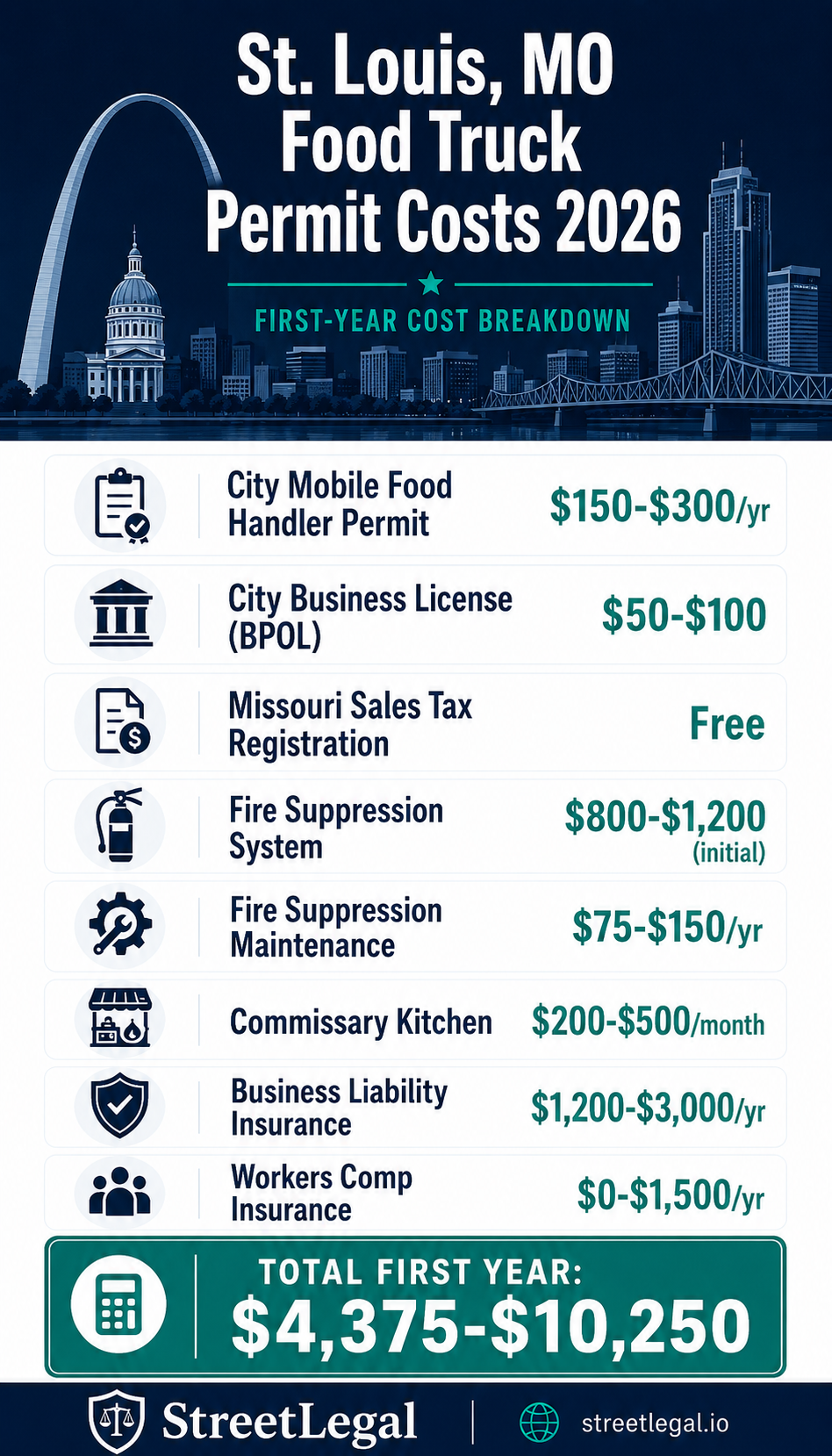
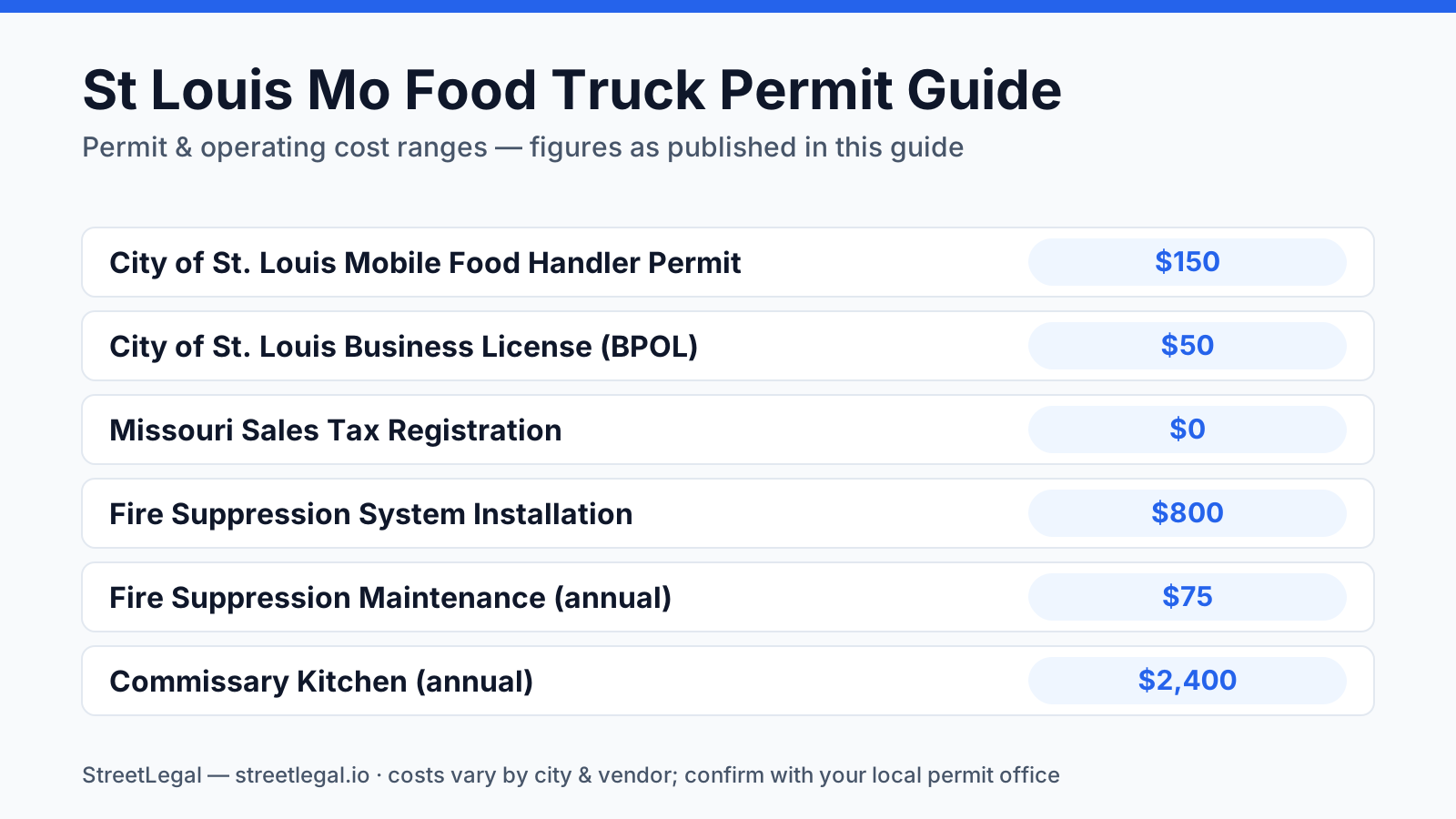
Full Cost Breakdown: Starting a Food Truck in St. Louis
| Permit / Cost Item | Low | High |
|---|---|---|
| City of St. Louis Mobile Food Handler Permit | $150 | $300 |
| City of St. Louis Business License (BPOL) | $50 | $100 |
| Missouri Sales Tax Registration | $0 | $0 |
| Fire Suppression System Installation | $800 | $1,200 |
| Fire Suppression Maintenance (annual) | $75 | $150 |
| Commissary Kitchen (annual) | $2,400 | $6,000 |
| Business Liability Insurance | $900 | $2,500 |
| Total First-Year Estimate | $4,375 | $10,250 |
Excludes truck purchase/lease, equipment, and initial inventory. St. Louis is one of the most affordable major city markets for food truck licensing.
Timeline: St. Louis Food Truck Launch
- Week 1: Confirm operating location and jurisdiction (City vs. County)
- Week 1–2: Secure commissary agreement with licensed facility
- Week 2–3: Register for Missouri sales tax; apply for City business license
- Week 3–4: Install fire suppression system; arrange certification
- Week 4: Submit City Mobile Food Handler Permit application
- Week 4–5: City schedules health inspector
- Week 5–6: Pass inspection; receive permit
- Week 6–7: Pass fire inspection; finalize insurance
- Week 7: Ready to operate
5 St. Louis-Specific Tips
- Understand jurisdiction FIRST. Before you invest in a location, confirm whether it's City or County. Operating without the right permit is a violation. This is your biggest potential pitfall.
- Downtown and Midtown are your safest bets for City permits. Both areas have clear City jurisdiction, strong foot traffic, and food truck-friendly culture. Avoid boundary areas if you're not sure which jurisdiction applies.
- Cherokee Street is hip and growing. South City's Cherokee Street is a trendy neighborhood with young demographics and good event opportunities. Competition is lower than downtown, but foot traffic is solid.
- St. Louis commissions are extremely affordable. Your permit costs and commissary prices are among the lowest in major American markets. Use that advantage to launch quickly and scale.
- Gateway Arch events are seasonal but lucrative. If you can secure vending rights at Arch-area events, summer tourism is exceptional. Build these relationships early.
St. Louis vs. Other Midwest Cities
| City | Permit Cost | Timeline | Key Advantage |
|---|---|---|---|
| St. Louis, MO | $200 | 3–6 wks | Affordable, fast processing |
| Chicago, IL | $495 | 8–12 wks | Larger market, GPS required |
| Kansas City, MO | $250 | 4–8 wks | BBQ scene, growing market |
| Austin, TX | $500 | 3–6 wks | Food truck capital, largest market |
Need a quick reference? See the St. Louis, MO city permit guide for permit fees, renewal calendar, and key agency contacts.
People also ask about St. Louis food truck permits
How much does a food truck permit cost in St. Louis?
How long does it take to get a food truck permit in St. Louis?
Do I need a commissary kitchen to operate a food truck in St. Louis?
What documents do I need for a St. Louis food truck permit?
Answers to the most common permit questions — costs, timelines, commissary rules, and more.
Find city-level permit guides for every state we cover — compare costs and requirements.
More from the blog
Jefferson County, MO Food Truck Permit Guide
Complete guide to food truck permits, fees, and requirements in Jefferson County, MO.
City GuidesSt. Charles County, MO Food Truck Permit Guide
Complete guide to food truck permits, fees, and requirements in St. Charles County, MO.
City GuidesSt. Louis County, MO Food Truck Permit Guide
Complete guide to food truck permits, fees, and requirements in St. Louis County, MO.
Buyer's GuideFood Truck POS Systems 2026: Square, Toast, Clover & Avocado
Compare 2026 food truck POS systems by pricing, hardware costs, offline mode, and contract terms for Square, Toast, Clover, and Avocado.