· Updated · 10 min read · StreetLegal Team
Philadelphia Food Truck License Guide (2026): Permits, Costs & Where You Can Operate
Updated: June 29, 2026
Philadelphia is one of the biggest food truck opportunities in Pennsylvania, but it is also one of the hardest markets to launch cleanly. You are dealing with city licensing, public-health review, state food rules, sales-tax setup, commissary dependence, and a real gap between permit approval and usable vending locations.
This 2026 guide is built to help operators launch with fewer surprises: the full permit stack, realistic costs, inspection timing, best truck types for the market, and where food trucks can actually operate once the paperwork is approved.
In This Guide
Required Licenses and Permits for Philadelphia Food Trucks
1. Philadelphia mobile food vending license
This is the core L&I vending layer that lets the truck operate as a licensed mobile vendor inside Philadelphia.
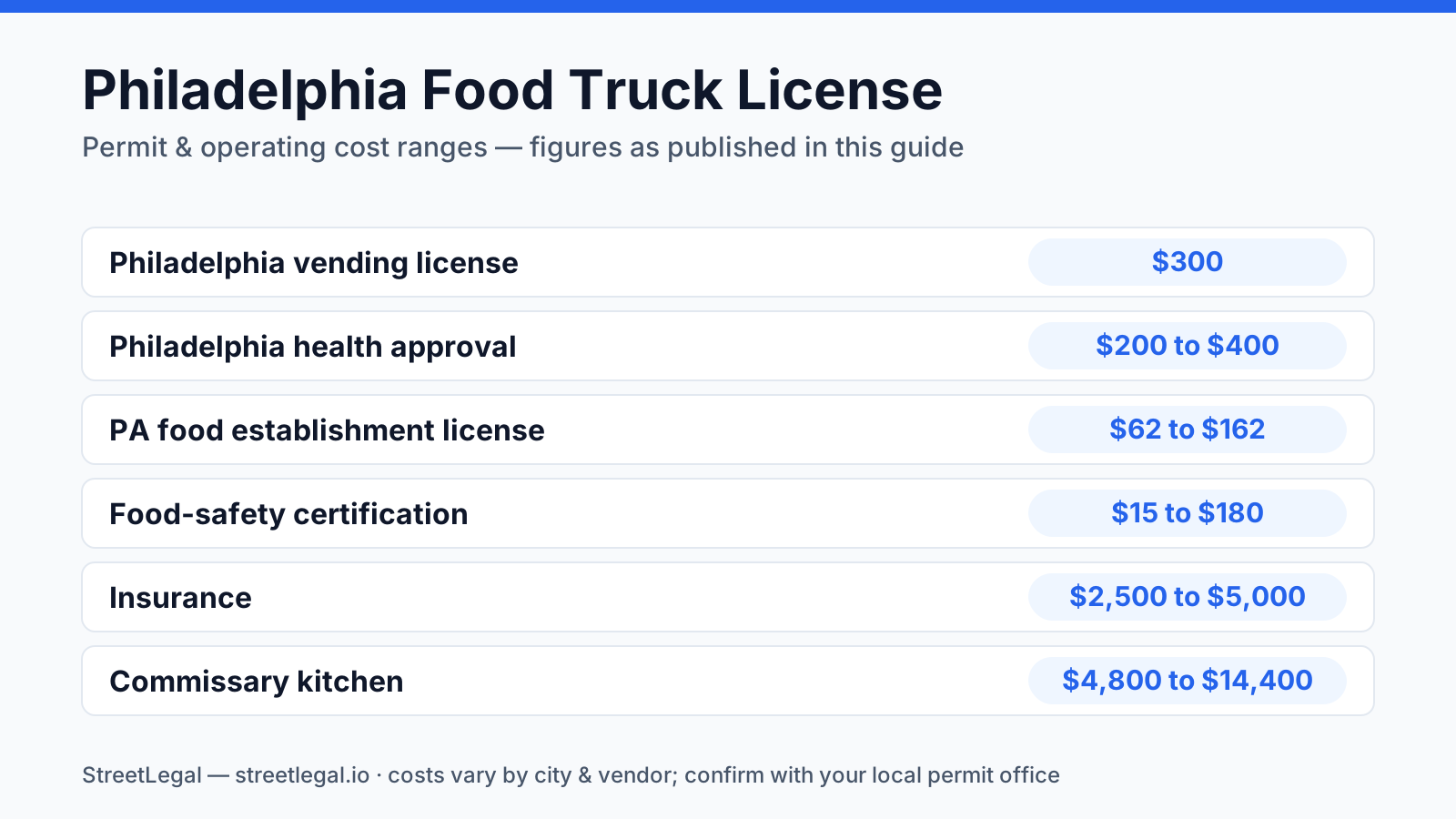
- Fee: about $300 per year
- Issued by: Philadelphia Department of Licenses & Inspections
- Typical timeline: 3 to 6 weeks if the packet is complete
- Main friction: mismatched business documents, incomplete support files, and location assumptions that do not match real vending conditions
2. Philadelphia Department of Public Health mobile food approval
Your truck must clear the city food-safety layer before launch. Inspectors care about sinks, food holding temperatures, cleaning routines, wastewater handling, and whether your truck setup matches your menu.
- Typical cost: roughly $200 to $400
- Typical timeline: 2 to 6 weeks depending on season
- Main friction: spring backlogs, sink layouts, grey-water sizing, and paperwork inconsistencies
3. Philadelphia business tax / commercial registration layer
Philadelphia food truck operators still need the local business-tax setup and annual filing discipline, including BIRT compliance where applicable.
- Registration cost: often low or free to set up
- Operational reality: filing compliance matters even if early revenue is light
4. Pennsylvania food establishment license
Philadelphia does not replace the Pennsylvania state food layer. Operators usually need both the state food approval and the city health layer working together.
- Typical cost: about $62 to $162 depending on volume and classification
- Timeline: commonly 2 to 3 weeks
5. Pennsylvania sales tax license
Philadelphia operators need the Pennsylvania sales-tax registration before collecting and remitting tax on sales.
- Fee: free
- Why it matters: Philadelphia food sales still sit inside a broader tax-compliance stack that should be set up before launch
6. Food safety certification
At least one active operator should hold current food-safety certification, and crews should be trained to run the truck the same way it was inspected.
- Typical cost: about $15 to $180
- Renewal cycle: usually every 3 to 5 years depending on the certification
7. Commissary kitchen agreement
Philadelphia is a commissary-dependent market for most operators. Your commissary is not just a formality; it shapes prep flow, cleaning, wastewater handling, storage, and daily labor efficiency.
- Typical cost: about $400 to $1,200 per month
- Main friction: finding a kitchen with the right hours, storage, parking, and geography for your route
- Helpful angle: compare kitchens based on access hours, parking ease, and how far they sit from your main lunch or event territory
8. Insurance
Commercial auto, general liability, and workers' compensation if you have staff are all part of the practical launch stack.
- Typical annual cost: about $2,500 to $5,000 total
- Main friction: event organizers and private sites may ask for extra insured certificates on short notice
Philadelphia food truck permit snapshot — 2026
The full Philadelphia permit stack runs across city and state layers. The table below shows each step in the order it typically needs to happen, with the issuing agency, fee range, expected timeline, and sequence position.
| Step | Agency | Permit / item | Fee | Timeline | Sequence |
|---|---|---|---|---|---|
| 1 | PA Department of State / IRS | Business formation + EIN | – | 1 week | Before any permit filing |
| 2 | PA Department of Revenue | Sales tax license | Free | 1–2 weeks | Before city applications |
| 3 | PA Department of Agriculture | Food establishment license | – | 2–3 weeks | Concurrent with city layer |
| 4 | Commissary kitchen | Signed commissary agreement | –,200/month | 1–3 weeks | Required before city inspection |
| 5 | Philadelphia L&I | Mobile food vending license | ~/yr | 3–6 weeks | After commissary and insurance are ready |
| 6 | Philadelphia Dept of Public Health | Mobile food approval / inspection | – | 2–6 weeks | Last city gate before launch |
| 7 | Insurance provider | Commercial auto + general liability | ,500–,000/yr | 1–2 weeks | Required before inspection submission |
Step-by-Step Process
- Week 1: form the business, get the EIN, open the bank account, and set up city/state tax registration.
- Week 1 to 2: bind insurance early so the certificate packet is ready when city forms ask for it.
- Week 2: file Pennsylvania sales-tax and food-facility layers.
- Week 2 to 3: lock the commissary agreement based on your actual route and storage needs, not just cheapest rent.
- Week 3: complete food-safety certification and make sure the truck build matches the menu you plan to sell.
- Week 3 to 4: submit city vending and public-health layers with matching support documents.
- Week 4 to 8: prepare for inspection, fix sink or wastewater details fast, and avoid changing the truck after inspection scheduling.
- Week 6 to 10: launch only after you have both approvals and a real operating-location plan.
Total realistic timeline: about 6 to 10 weeks in a clean run. During spring, inspection bottlenecks can push this longer.
Total Cost Summary
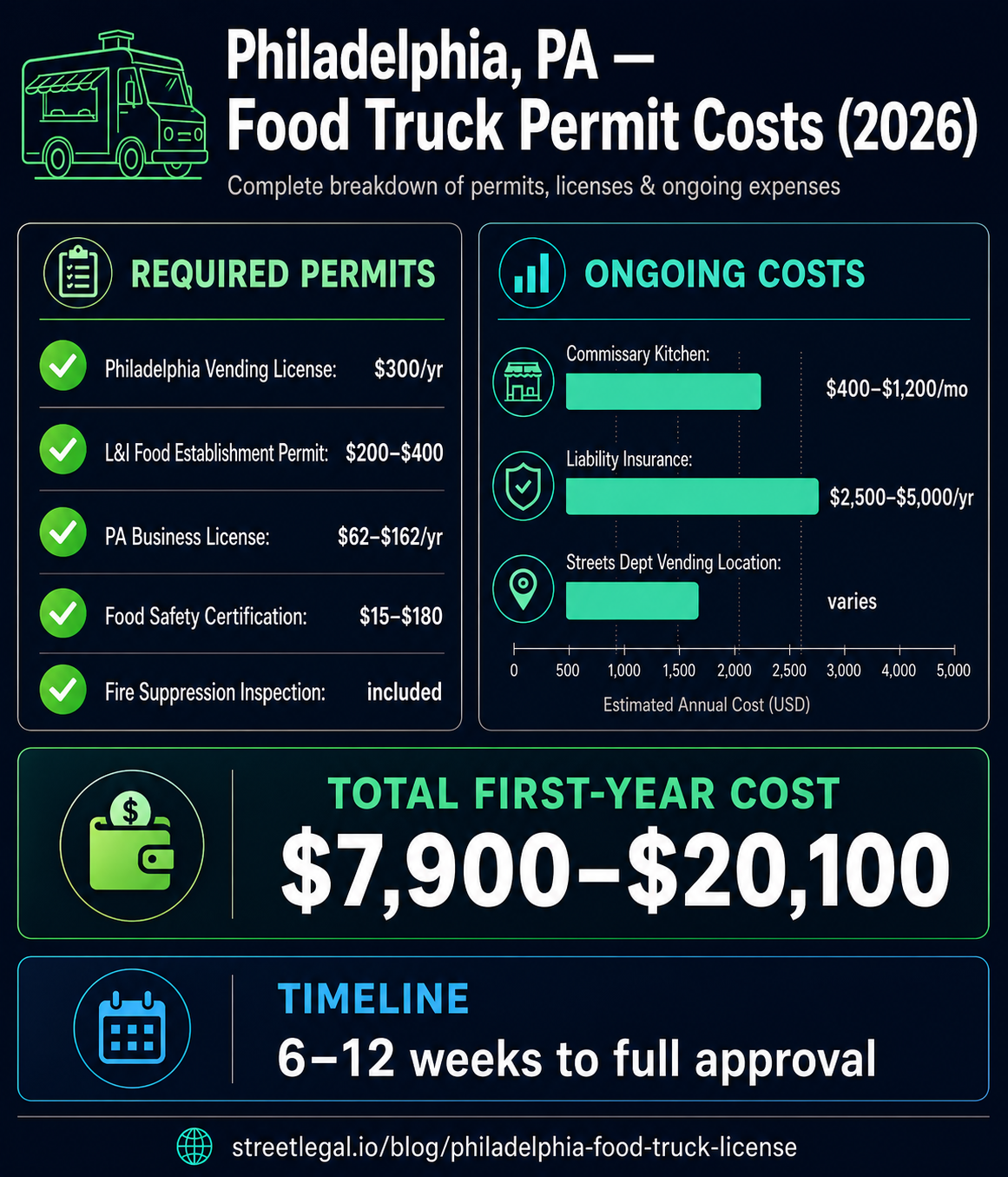
| Permit / expense | Typical cost | Frequency |
|---|---|---|
| Philadelphia vending license | $300 | Annual |
| Philadelphia health approval | $200 to $400 | Annual / recurring review |
| PA food establishment license | $62 to $162 | Annual |
| Food-safety certification | $15 to $180 | Every 3 to 5 years |
| Sales-tax registration | Free | One-time |
| Insurance | $2,500 to $5,000 | Annual |
| Commissary kitchen | $4,800 to $14,400 | Annual |
| Total first year | $7,900 to $20,100 |
Philadelphia is expensive mainly because commissary and insurance stay with you month after month. That makes truck design and operating model choices especially important.
Best Food Truck Types for Philadelphia
Philadelphia is a dense, high-friction urban market. The best truck is usually the one that balances parking agility, commissary practicality, and fast lunch or event service.
| Truck type | Best fit in Philadelphia | Why it works | Main caution |
|---|---|---|---|
| Compact step van | Best all-around launch choice | Easier to position near campuses, hospitals, and office corridors | Less room for a very broad menu |
| Mid-size catering-capable truck | Best blend of daily service and events | Works for office lunches, private sites, and higher-ticket catering | Needs disciplined routing and prep flow |
| Coffee / breakfast truck | Strong commuter and university fit | Fast service and lighter kitchen load help in tight urban conditions | Morning location access matters a lot |
| Trailer setup | Best only with private-site or event strategy | Can do well at breweries, weddings, and recurring venues | Weak fit for tight curbside repositioning |
| Large hood-heavy kitchen truck | Best for established operators with event demand | Supports a bigger menu and premium catering revenue | More fuel, more inspection burden, more location friction |
For most first-time Philadelphia operators, a compact step van or mid-size truck is the safest build. It preserves flexibility while keeping city maneuverability and commissary routines manageable.
Philadelphia-Specific Rules to Watch
- Restaurant setbacks matter. Being licensed does not erase local spacing or enforcement realities around brick-and-mortar businesses.
- Inspection readiness matters more than speed. Small sink, tank, or sanitation mismatches can slow the whole launch.
- Private-site relationships are a moat. Many of the best repeatable opportunities come from office properties, apartments, hospitals, schools, breweries, and event operators.
- Commissary geography matters. A cheap kitchen on the wrong side of your route can quietly kill labor efficiency.
Where You Can Actually Operate in Philadelphia
Permit approval and profitable vending access are two different things. Philadelphia operators win when they solve the second problem intentionally.
| Location type | Is permit approval alone enough? | Access reality | Main friction |
|---|---|---|---|
| University City / campus-adjacent lunch zones | No | Excellent demand, but the best spots depend on real local patterns and competition | Tight curb access and saturation |
| Center City office corridors | No | Strong lunch traffic if the spot is truly usable and service is fast | Restaurant setbacks, loading rules, and premium competition |
| Private lots at offices, hospitals, or apartments | No | Often the cleanest repeatable path for new operators | Need property-owner permission and recurring scheduling |
| Festivals and waterfront events | No | Can be some of the highest-revenue days in the market | Organizer approval, extra fees, and insurance requests |
| Breweries and neighborhood pop-ups | No | Great dinner and weekend lane for the right concept | Need venue relationships and local fit |
| Residential curbside vending | Rarely | Usually weak as a primary operating model | Parking, complaints, and low predictability |
The strongest Philadelphia launch plan usually includes 2 to 3 lanes: one office or campus-adjacent lunch lane, one private recurring site, and one event or catering lane.
Pennsylvania Comparison Layer
| Market | Launch speed | Commissary pressure | Best first model |
|---|---|---|---|
| Philadelphia | Moderate to slow | High | Compact truck plus private-site, campus, or catering mix |
| Pittsburgh | Moderate | Moderate | Event-first or neighborhood brewery / office model |
| Secondary Pennsylvania markets | Faster | Moderate | Trailer-first or event-first launch |
🏛️ Official Resources — Verify Current Requirements
- City of Philadelphia permits and licenses — city vending and business layers
- Philadelphia Department of Public Health — food safety and inspection layer
- Pennsylvania Department of Agriculture — state food facility requirements
- Pennsylvania Department of Revenue — sales-tax registration
Use this page as a 2026 launch guide, then verify current filing details before you submit.
People also ask about Philadelphia food truck permits
How much does a food truck permit cost in Philadelphia?
How long does it take to get a food truck permit in Philadelphia?
Do I need a commissary kitchen to operate a food truck in Philadelphia?
What documents do I need for a Philadelphia food truck permit?
Answers to the most common permit questions — costs, timelines, commissary rules, and more.
Find city-level permit guides for every state we cover — compare costs and requirements.
More from the blog
Jefferson County, MO Food Truck Permit Guide
Complete guide to food truck permits, fees, and requirements in Jefferson County, MO.
City GuidesSt. Charles County, MO Food Truck Permit Guide
Complete guide to food truck permits, fees, and requirements in St. Charles County, MO.
City GuidesSt. Louis County, MO Food Truck Permit Guide
Complete guide to food truck permits, fees, and requirements in St. Louis County, MO.
Buyer's GuideFood Truck POS Systems 2026: Square, Toast, Clover & Avocado
Compare 2026 food truck POS systems by pricing, hardware costs, offline mode, and contract terms for Square, Toast, Clover, and Avocado.