· 13 min read · Gibby, StreetLegal Editorial

How to Start a Food Truck in Memphis, TN: Complete Permit Guide 2026
Updated: June 11, 2026. Reviewed for Shelby County permit requirements, commissary rules, fire safety, and 2026 fee schedules.
Memphis Food Truck Permitting Overview
Operating a food truck in Memphis requires permits at both the state and county level. Tennessee sets the baseline standards for mobile food establishments, and the Shelby County Health Department (located at 1826 Sycamore View Road, Memphis, TN 38134) issues and enforces your local operating permit.
The permitting process here is documentation-heavy: the health department requires a signed and notarized commissary agreement, a wastewater disposal agreement, a floor plan of your vehicle, and a menu review — all before you can operate. Give yourself 8–10 weeks and get your paperwork organized early.
Tennessee State Requirements
Before engaging with the Shelby County Health Department, you'll need to address a few state-level requirements:
- Tennessee Business License — Register your business with the Tennessee Department of Revenue; standard business license required to operate commercially in TN
- Tennessee Sales Tax Permit — Required from the TN Department of Revenue to collect and remit sales tax on food sales; Tennessee's combined state + local rate is approximately 9.25–9.75% in Memphis
- Tennessee State Fire Permit — If your truck uses propane, fryers, or any open-flame cooking equipment, you need a state fire permit and inspection
- EIN — Free from the IRS; required for any business entity
State-level fees are approximately $210 total for the business license and associated registrations.
Shelby County Health Department Permit
The Shelby County Health Department is your primary food safety regulator for Memphis operations. All mobile food establishments must obtain a permit before operating, and must submit a complete documentation package.
Required Documentation
- Floor plan — Detailed drawing of your vehicle showing the location of all equipment, sinks, prep surfaces, and storage areas
- Notarized Commissary Agreement Form — Must be signed, dated, and notarized; identifies your commissary kitchen and the activities you'll perform there
- Wastewater Disposal Agreement Form — Designates where and how you'll dispose of gray water and wastewater
- Lease agreement (if applicable) — Signed, dated, and notarized if you're leasing any operational facility
- Proposed menu — Reviewed by the health department to verify proper handling procedures for all items
- Food handler certifications — All staff must complete an approved food handler course (ServSafe or equivalent) within 30 days of hire; at minimum one CFPM per operation is recommended
Shelby County Permit Fees
| Fee Item | Cost |
|---|---|
| Mobile food establishment permit (annual) | $57.50–$622.50 (based on sq footage) |
| State-level registration fees | ~$210 |
| Re-inspection fee (if failed) | [VERIFY: Shelby County Health Dept 901-222-2300] |
| Plan review (new operations) | [VERIFY: Shelby County Health Dept] |
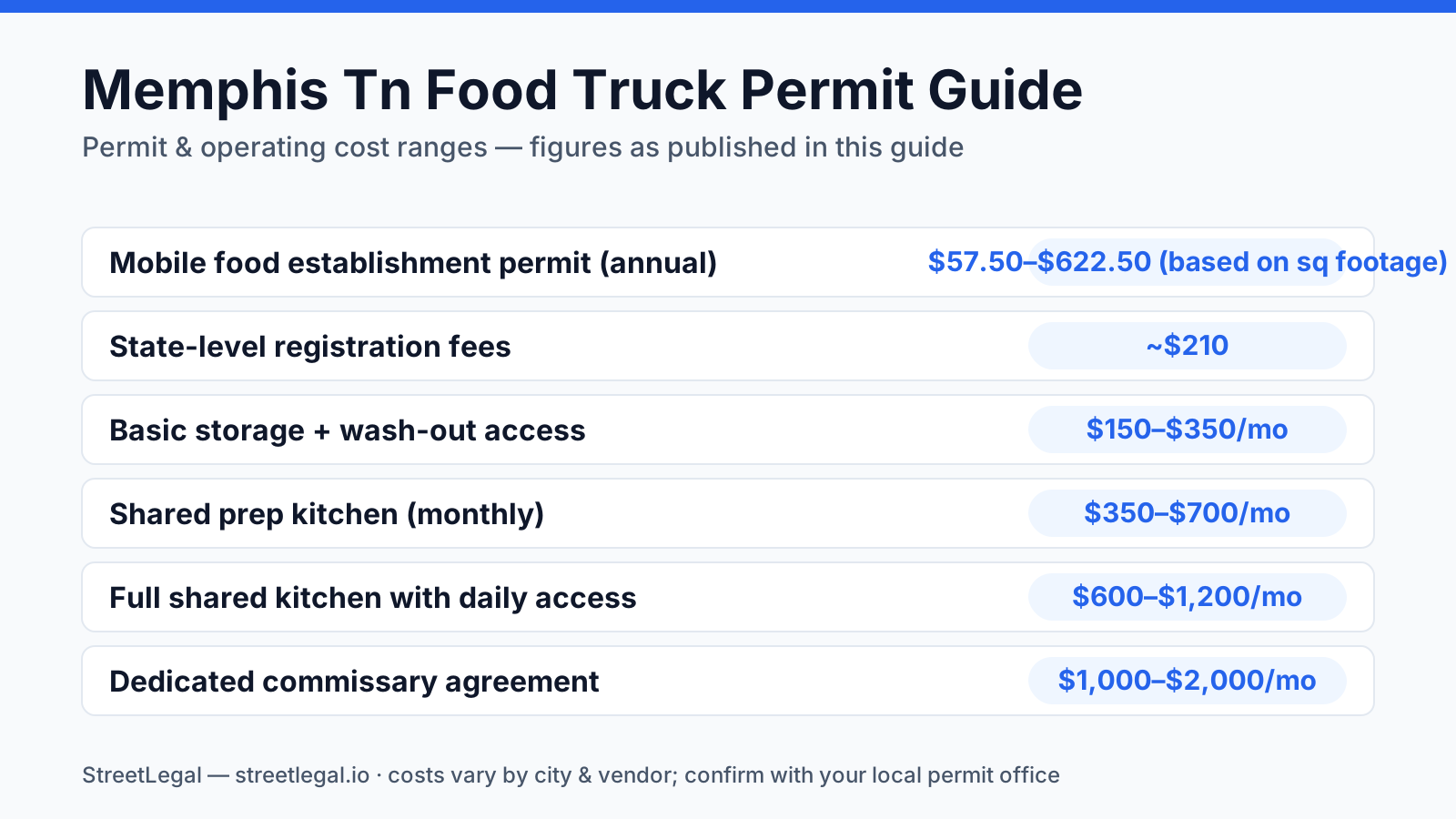
Permit fees are set by state and local statute and based on the square footage of your establishment. Verify current fee schedule directly with Shelby County Health Department at 901-222-2300.
Equipment Standards
Memphis health inspectors enforce these physical standards for all mobile food establishments:
- NSF-certified equipment — All commercial cooking and refrigeration equipment must be NSF-certified or equivalent
- Handwashing station — Dedicated sink with soap, paper towels, and warm water; must not be the same as the 3-compartment sink
- 3-compartment sink — For washing, rinsing, and sanitizing food-contact equipment; mandatory
- Permit display — Permit number and business information must be prominently displayed on the exterior of the vehicle, in lettering no less than 3 inches in height
- Temperature controls — Must maintain hot food ≥135°F and cold food ≤41°F
The No-Utilities Rule: Memphis-Specific
This is one of the most important rules for Memphis food truck operators and one of the most commonly missed: you cannot connect your food truck to permanent utilities (water, sewer, or electricity) while in service.
Under Shelby County regulations, a food truck or trailer that hooks up to permanent utilities or that remains stationary and does not move daily for cleaning and servicing is classified as a permanent food establishment — not a mobile one. This triggers a completely different (and significantly more expensive) permit category.
What this means in practice:
- You cannot run a water hose to your truck at your vending spot
- You cannot plug into a permanent electrical outlet as your primary power source in service
- Your truck must move regularly — daily to your commissary at minimum
- Generator power for your truck's own systems is fine; permanent utility hook-ups are not
Food truck pod operators and multi-truck lot managers in Memphis often run afoul of this rule. If you're operating at a permanent location 5 days a week, make sure you're moving the truck daily and relying on self-contained power and water rather than permanent utility connections.
Commissary Kitchen Requirements in Memphis
Every Memphis food truck must operate from a licensed commissary kitchen. The commissary agreement must be notarized — an unusual requirement compared to many other cities — and submitted with your health permit application.
Your commissary must:
- Hold a valid Shelby County health permit
- Provide food storage, prep space, equipment cleaning facilities, and wastewater disposal
- Be your regular base of operations for daily cleaning and servicing of the truck
- Be identified in the notarized commissary agreement submitted to the health department
Memphis Commissary Cost Ranges
| Type | Monthly Cost |
|---|---|
| Basic storage + wash-out access | $150–$350/mo |
| Shared prep kitchen (monthly) | $350–$700/mo |
| Full shared kitchen with daily access | $600–$1,200/mo |
| Dedicated commissary agreement | $1,000–$2,000/mo |
Fire Safety Requirements
Tennessee state law requires a fire permit for any mobile food establishment using propane, fryers, or open flame. The fire marshal inspects for:
- Fire suppression system — Required if you have a fryer or grill under a Type I hood (Ansul system or equivalent)
- K-class fire extinguisher — Required; must be within inspection date and accessible
- Propane tank compliance — Tanks must be properly secured, labeled, and have accessible shutoff valves
- Ventilation — Type I hood over all heat-producing commercial cooking equipment
- Semi-annual suppression service — Fire suppression systems require inspection every 6 months
Business Entity & Insurance
- Tennessee LLC — Register with the Tennessee Secretary of State; filing fee ~$300 for an LLC
- General liability insurance — Minimum $1,000,000 per occurrence recommended; required by most venues and events
- Commercial auto insurance — Required for vehicle operation; covers the truck as a commercial vehicle
- Workers' compensation — Required if you have employees in Tennessee
Required Permits Summary
| Permit / License | Issuing Agency | Fee | Renewal |
|---|---|---|---|
| Mobile Food Establishment Permit | Shelby County Health Dept | $57.50–$622.50 | Annual |
| TN Business License | TN Dept of Revenue | ~$15–$100 [VERIFY] | Annual |
| TN Sales Tax Permit | TN Dept of Revenue | Free | Ongoing |
| TN State Fire Permit | TN State Fire Marshal | Varies | Annual |
| TN LLC Registration | TN Secretary of State | ~$300 | Annual report $50 |
| Fire Suppression Inspection | Local fire marshal | $300–$700/yr | Semi-annual |
| Food Handler Certification (per employee) | ServSafe / approved provider | $15–$25 each | Every 3 years |
| CFPM Certification (ServSafe) | Accredited provider | $150–$200 | Every 5 years |
Full Memphis Food Truck Cost Breakdown (First Year)
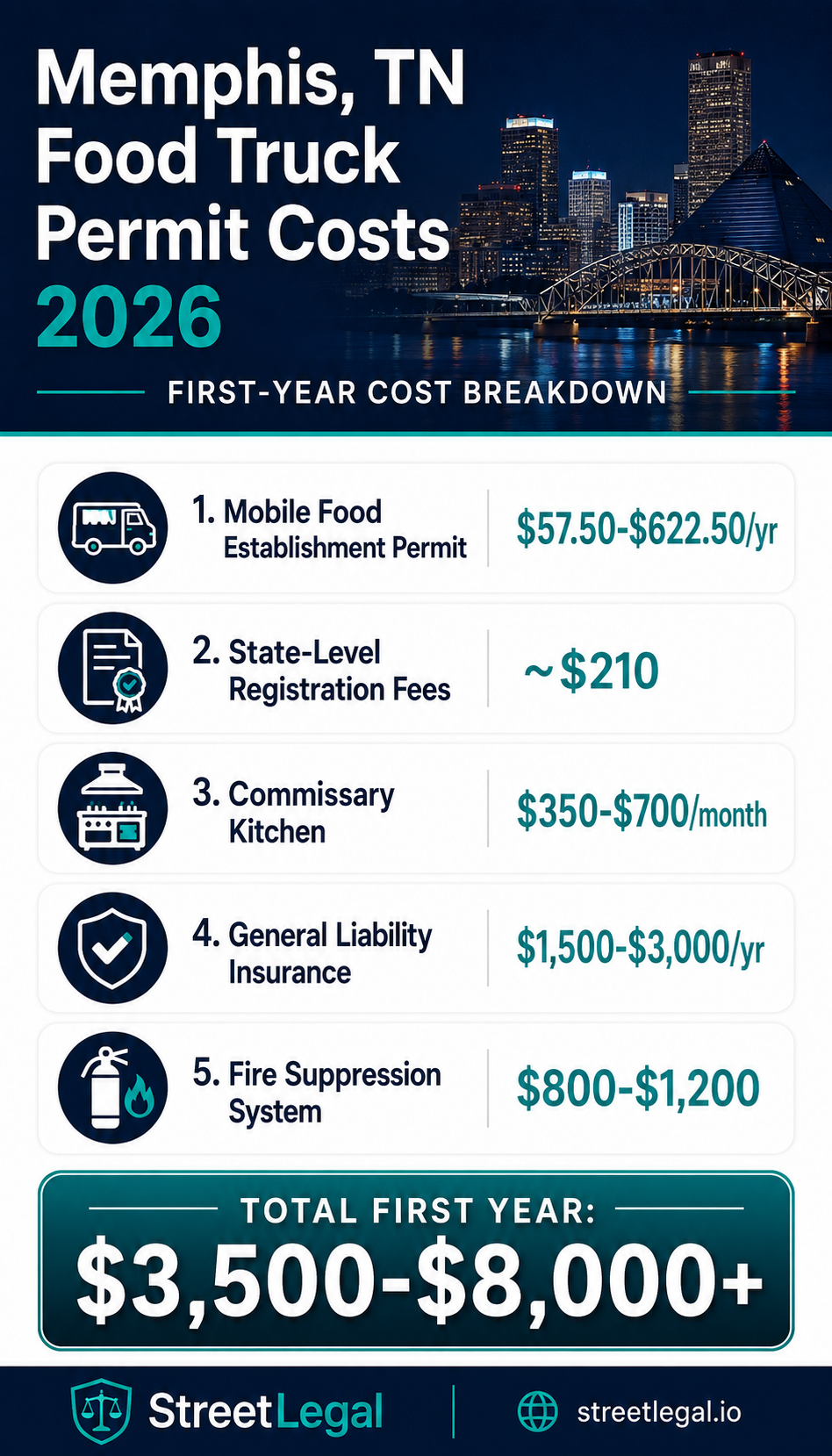
| Item | Low | High |
|---|---|---|
| Shelby County health permit | $58 | $623 |
| TN state-level fees (business + other) | $210 | $400 |
| TN LLC registration | $300 | $300 |
| Annual LLC report | $50 | $50 |
| Fire suppression inspection & service | $300 | $700 |
| ServSafe (CFPM) certification | $150 | $200 |
| Food handler certs (2–3 staff) | $30 | $75 |
| Commissary kitchen (annual) | $1,800 | $14,400 |
| General liability insurance (annual) | $1,000 | $2,000 |
| Commercial auto insurance (annual) | $800 | $2,000 |
| Vehicle registration | $100 | $300 |
| TOTAL (first year) | $4,798 | $21,048 |
The wide range is driven almost entirely by commissary cost. Memphis commissary rates are lower than coastal markets, making it a more affordable entry point.
Memphis Permitting Timeline
- Week 1–2: Form TN LLC, register for TN business license and sales tax permit, apply for EIN
- Week 2–3: Find a licensed commissary kitchen; get the commissary agreement signed and notarized
- Week 3–4: Get wastewater disposal agreement signed; complete ServSafe certification
- Week 4–5: Submit complete application package to Shelby County Health Department (1826 Sycamore View Road)
- Week 5–7: Health department reviews menu and documentation; schedules vehicle inspection
- Week 6–8: Vehicle inspection and any required corrections
- Week 7–9: State fire permit and fire marshal inspection (if applicable)
- Week 8–10: All permits issued; begin operations
Total: 8–10 weeks from start to first service. The notarization requirements for commissary and wastewater agreements add 1–2 extra days compared to most markets — plan accordingly.
Where to Operate in Memphis
- Beale Street / downtown — Heavy tourist traffic year-round; event permits required for street operations; high-revenue potential
- Overton Square / Midtown — Growing arts and dining district with strong evening and weekend demand; many private lot opportunities
- South Main Arts District — Walkable urban neighborhood with arts events and First Friday draws; food trucks welcome at private venues
- East Memphis / Germantown corridor — Affluent suburban market with strong corporate lunch demand
- Shelby Farms Park — One of the largest urban parks in the US; special event permits required; massive weekend crowds
- Breweries and event venues — Memphis's growing craft beer scene (Memphis Made, Wiseacre, etc.) regularly pairs with food trucks
5 Memphis-Specific Tips
- Get your commissary agreement notarized before anything else. The notarization requirement is unusual and easy to overlook. Finding a notary, scheduling signing, and getting the document back from the commissary operator can take a week. Don't let this be your bottleneck on permit day.
- Do not hook up to utilities — ever. The permanent utilities prohibition in Memphis is real and enforced. Inspectors check for utility connections. One violation can reclassify you as a permanent establishment and require a complete re-permitting under restaurant rules. Generator up and self-contained water is the safe approach.
- Memphis summers are brutal. July and August temperatures regularly exceed 95°F with high humidity. Generator overheating, refrigeration strain, and staff safety are operational risks. Size your generator and refrigeration for peak summer demand, not average conditions.
- Beale Street is a seasonal gold mine — plan around it. The Beale Street Entertainment District draws millions of visitors for Blues on the Half Shell, Memphis in May, and year-round tourism. Competition for vendor slots is fierce, but operators who secure a reliable Beale Street arrangement can do more revenue in one spring weekend than in a normal week.
- Stay on top of your permit renewal calendar. Tennessee's multi-agency permit structure — state business license, state fire permit, county health permit — means multiple renewal dates across the year. Missing a county health permit renewal results in an immediate stop-work order. StreetLegal tracks every deadline across all your Memphis permits in one dashboard.
Tennessee food truck operators
Memphis is one of Tennessee's primary food truck markets. See the full state hub for Nashville vs. Memphis comparisons, Tennessee DOA licensing, and all city guides.
Open Tennessee state hub →More Tennessee reading
Official Memphis & Tennessee Resources
- Shelby County Health Department — Mobile Food Units
- Tennessee Department of Agriculture — Mobile Food Establishments
- Tennessee Department of Revenue — Business Tax
- Tennessee Secretary of State — Business Registration Forms
Questions about Memphis food truck permits? Contact our support team — we help operators across Tennessee navigate Shelby County requirements.
Answers to the most common permit questions — costs, timelines, commissary rules, and more.
Find city-level permit guides for every state we cover — compare costs and requirements.
More from the blog
Jefferson County, MO Food Truck Permit Guide
Complete guide to food truck permits, fees, and requirements in Jefferson County, MO.
City GuidesSt. Charles County, MO Food Truck Permit Guide
Complete guide to food truck permits, fees, and requirements in St. Charles County, MO.
City GuidesSt. Louis County, MO Food Truck Permit Guide
Complete guide to food truck permits, fees, and requirements in St. Louis County, MO.
Buyer's GuideFood Truck POS Systems 2026: Square, Toast, Clover & Avocado
Compare 2026 food truck POS systems by pricing, hardware costs, offline mode, and contract terms for Square, Toast, Clover, and Avocado.