· Updated · 8 min read · StreetLegal Team
How to Get a Food Truck Permit in Baltimore (2026 Guide)
Baltimore is one of the Mid-Atlantic's most vibrant food truck cities, with a strong street food culture anchored by the Inner Harbor, Fells Point, and a growing roster of neighborhood markets. Operating legally requires navigating permits from Baltimore City, the Maryland Department of Health, and sometimes the Maryland State Department of Assessments and Taxation. This guide covers everything you need to get your Baltimore food truck on the street.
Core Permits & Licenses
1. Baltimore City Mobile Food Service Facility License
The Baltimore City Health Department (BCHD) issues Mobile Food Service Facility Licenses. This is your foundational permit to operate a food truck within city limits. You must apply through BCHD's Environmental Health division.
- Completed BCHD application form
- Maryland Food Manager Certification (at least one person per truck)
- Commissary agreement from a BCHD-approved facility
- Proof of vehicle registration and ownership/lease
- Commercial liability insurance certificate
- Health inspection of the truck (BCHD will schedule after application review)
Licenses are annual. Renewal deadline is typically the anniversary of issuance.
2. Maryland Trader's License
Maryland requires a Trader's License for any business selling tangible goods or food from a vehicle. Issued by the Clerk of the Circuit Court in the county/city where you primarily operate. For Baltimore City, apply at the Baltimore City Circuit Court Clerk's office.
- Fee: $15–$150 based on assessed value of inventory
- Annual renewal required
- Separate license may be needed if you operate frequently in Baltimore County (outside city limits)
3. Maryland Sales & Use Tax Registration
Register with the Maryland Comptroller's office to collect and remit Maryland sales tax (6%) on food sales. Food trucks selling prepared food (heated, assembled, or served for immediate consumption) are subject to sales tax. Raw, unheated grocery items are generally exempt.
4. Baltimore City Business License
Register your business with the City of Baltimore. If operating as an LLC or corporation, you must also register with the Maryland State Department of Assessments and Taxation (SDAT). Sole proprietors using a trade name must file a Trade Name registration with SDAT.
5. Commissary Agreement (Required)
BCHD requires all food trucks to operate from a licensed commissary kitchen for food prep, storage, and cleaning. Your commissary must hold a valid Maryland food service facility license. Submit the signed commissary agreement with your mobile food service application.
Health & Food Safety Requirements
- Food Manager Certification: Maryland requires a Certified Food Manager on staff. ServSafe and equivalent Maryland-approved certifications are accepted.
- Temperature control: Cold TCS foods ≤41°F, hot TCS foods ≥135°F. Temperature logs must be maintained and available during inspections.
- Handwashing station: Dedicated sink with hot/cold running water, soap, and paper towels required inside the truck.
- Three-compartment sink: Required for on-truck warewashing unless commissary handles all utensil cleaning.
- Potable water supply: Fresh water tank required; size depends on your menu volume. Gray water tank must be at least 15% larger than the fresh tank.
- Fire suppression: Ansul or equivalent fire suppression system required if operating any open-flame cooking. Class K extinguisher required for fryers.
- Grease waste management: Must have a plan for grease disposal — most Baltimore commissaries handle this. Street-side operations need portable containment for spills.
Where You Can Operate in Baltimore
- City streets: Baltimore does not maintain a fixed list of reserved food truck zones like some cities. You can generally park in legal metered or unmetered spots on public streets, subject to parking regulations and not blocking traffic or pedestrian paths. Some neighborhoods have specific enforcement periods.
- Inner Harbor area: High-visibility, high-traffic zone. The Waterfront Partnership and various Inner Harbor management groups sometimes coordinate vendor slots — check with them directly for programmed markets.
- Fells Point & Canton: Popular neighborhoods with strong foot traffic. Private lot partnerships with bars and breweries are common and permitted without additional city approval (owner permission + active license is sufficient).
- Private property: Landowner permission in writing is sufficient. No separate city location permit required for private lots.
- Baltimore County: A separate Baltimore County mobile food vendor permit is required if you regularly operate outside city limits. Baltimore City and Baltimore County are separate jurisdictions.
Events & Markets
- Baltimore Farmers Market & Bazaar: One of the largest farmers markets on the East Coast (Sunday mornings under the JFX). Competitive vendor application — apply through the Baltimore Office of Promotion and the Arts (BOPA).
- Charm City Night Market: A popular evening market series in rotating neighborhoods — apply through the organizers each season.
- Artscape & BOPA festivals: BOPA manages Baltimore's major public festivals (Artscape, etc.). Vendor applications open several months before each event.
- Special events & temporary permits: For street fairs, block parties, or one-off events, you may need a Temporary Food Service Permit from BCHD in addition to your regular license. Apply at least 2 weeks before the event.
- Ravens and Orioles game days: Stadium-adjacent vending near M&T Bank Stadium and Oriole Park can be high-volume. Permission from stadium management or the surrounding BID (Westside Partnership) is typically required for on-site or adjacent spots.
Fees & Timeline
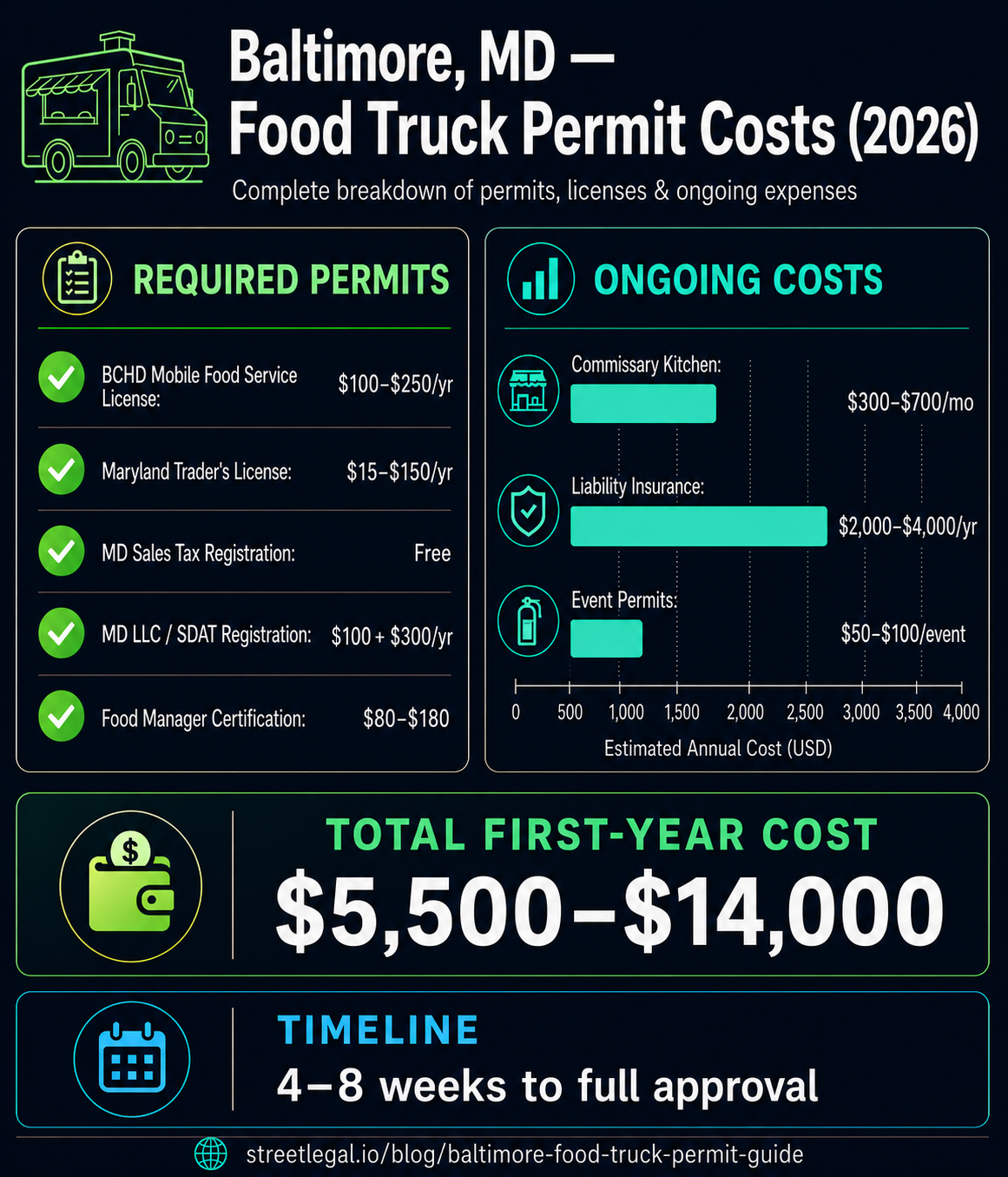
| Permit / License | Approx. Fee | Renewal |
|---|---|---|
| BCHD Mobile Food Service License | $100–$250 | Annual |
| Maryland Trader's License | $15–$150 | Annual |
| Maryland Sales Tax Registration | Free | Ongoing filing |
| MD LLC / SDAT Registration | $100 | $300/yr annual report |
| Temporary Food Service Permit | $50–$100 | Per event |
| Commissary kitchen | $300–$700/mo | Monthly |
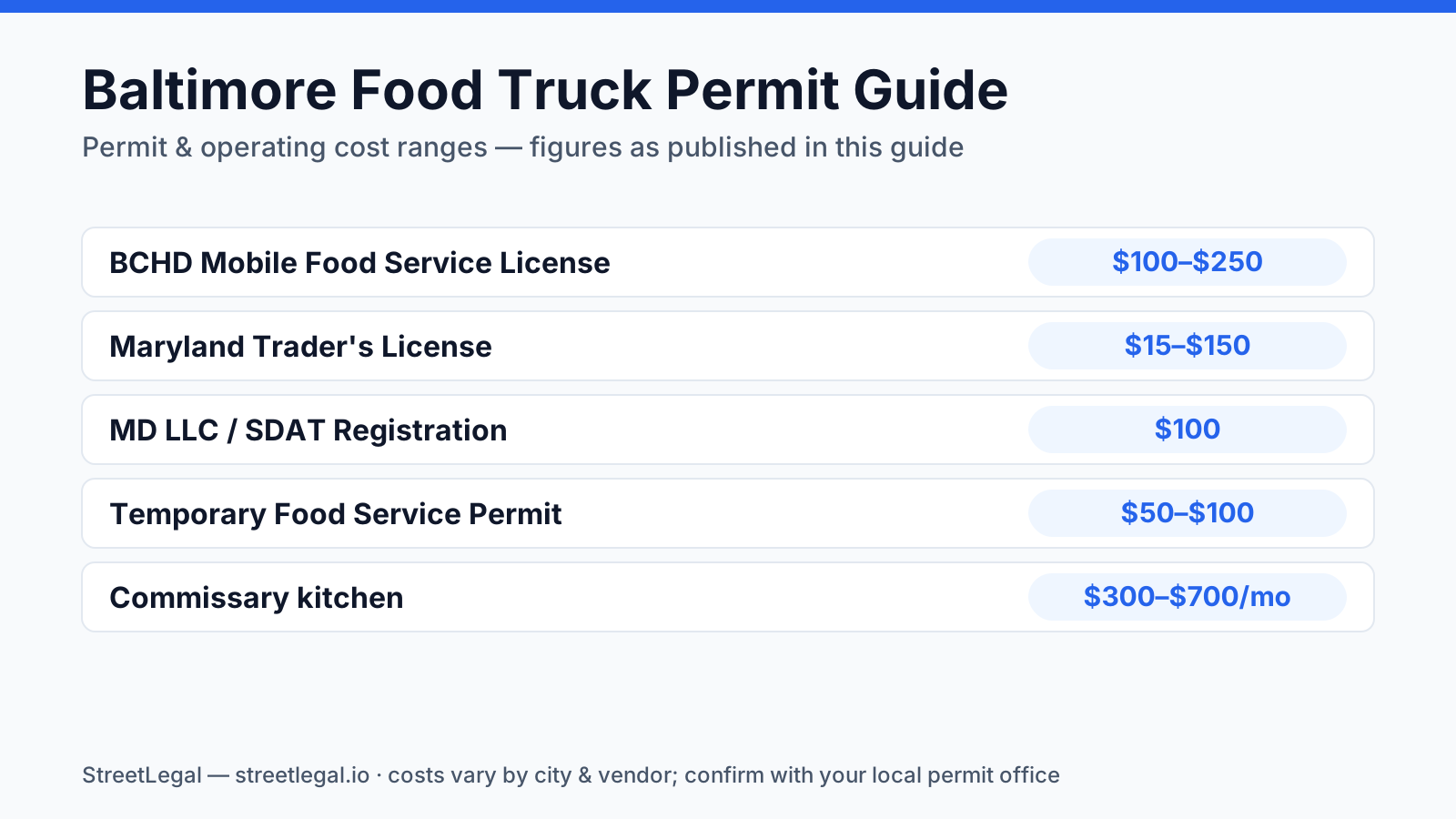
Timeline: Budget 4–8 weeks from application start to first day of operations. BCHD inspections are scheduled after application review — turnaround is typically 2–4 weeks. Trader's License and business registration can usually be obtained within a few business days.
Operator Tips
- City vs. County is a hard line: Baltimore City and Baltimore County are completely separate jurisdictions. If you plan to park in Towson, Catonsville, or other county areas, budget for a separate county permit.
- Brewery partnerships are popular: Many Baltimore craft breweries welcome food truck partnerships (they often can't serve food on their own). These are great private-lot arrangements that don't require any additional city permits beyond your active license.
- Football game days are high-volume: Ravens home games at M&T Bank Stadium drive significant adjacent foot traffic. Coordinate with the stadium and surrounding BIDs early in the season.
- Keep your commissary logs: BCHD inspectors ask for commissary records — your signed agreement, dates of use, and cleaning logs. Gaps cause violations.
- Fells Point food truck scene: Fells Point Broadway Square and Thames Street are popular evening spots. The area is busy year-round, not just in summer — Baltimore winters are milder than Boston's, and the bar district keeps demand up.
- Connect with local vendors: Baltimore Food Truck Association and the Maryland Restaurant Association are resources for event leads, commissary recommendations, and regulatory updates.
People also ask about Baltimore food truck permits
How much does a food truck permit cost in Baltimore?
How long does it take to get a food truck permit in Baltimore?
Do I need a commissary kitchen to operate a food truck in Baltimore?
What documents do I need for a Baltimore food truck permit?
Answers to the most common permit questions — costs, timelines, commissary rules, and more.
Find city-level permit guides for every state we cover — compare costs and requirements.
More from the blog
Food Truck POS Systems: Square vs. Toast vs. Clover vs. Avocado (2026)
Real 2026 pricing, hardware costs, offline mode, and contract terms for Square, Toast, Clover, and Avocado — compared specifically for food truck operators.
City GuidesEagan, MN Food Truck Permit Guide
Eagan MN food truck permit guide: MDH mobile food licensing, Dakota County food safety, city peddler rules, commissary records, costs, and launch timeline.
City GuidesBentonville, AR Food Truck Permit Guide
Complete guide to food truck permits, fees, and requirements in Bentonville, AR.
City GuidesBiloxi, MS Food Truck Permit Guide
Biloxi food truck permit guide 2026: licenses, health permit steps, commissary records, inspections, costs, renewal timing, and launch checklist.