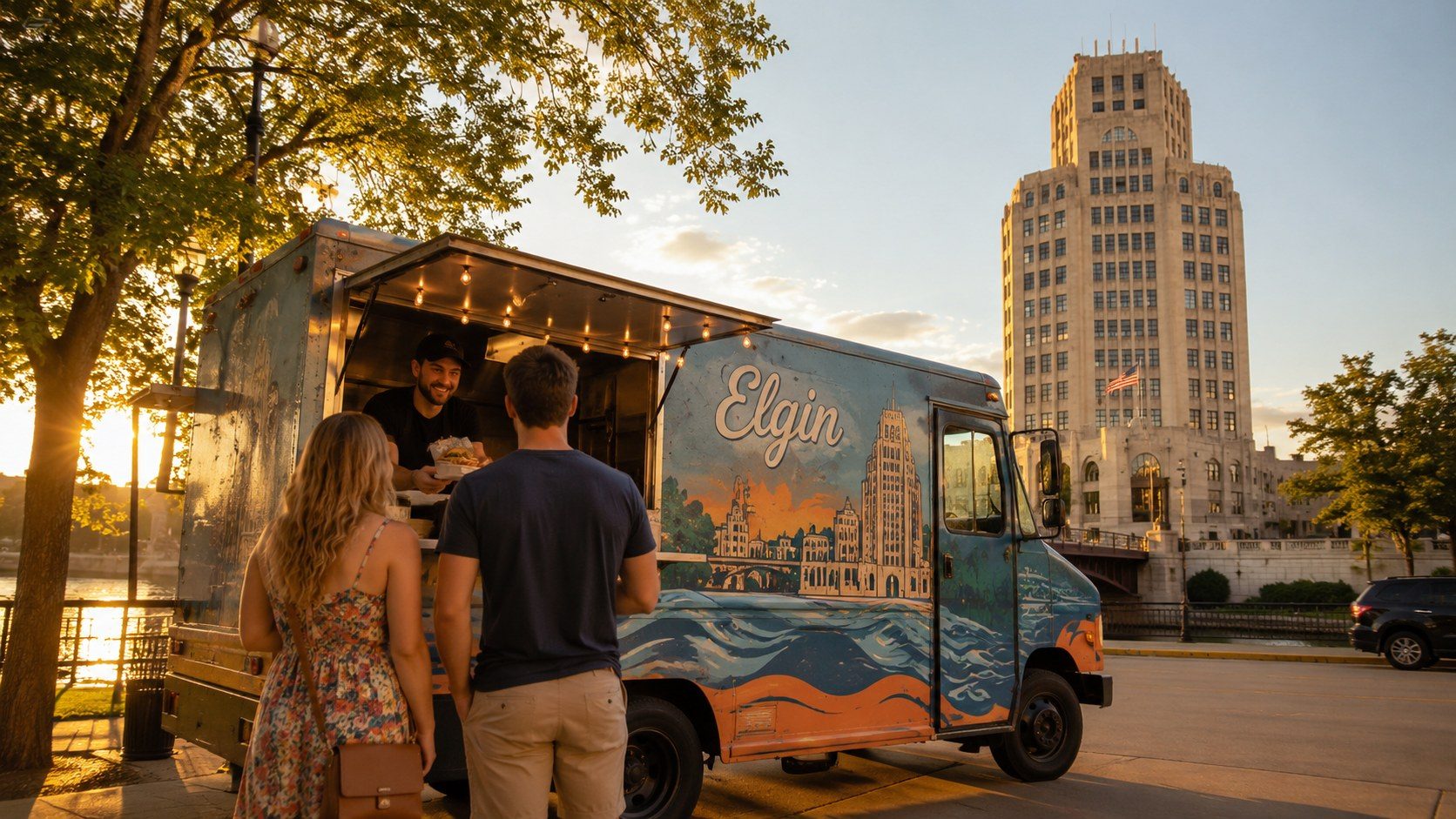
Elgin Food Truck Permit Guide 2026
Launching a food truck in Elgin means coordinating two layers of approval: the City of Elgin business and location rules, and Kane County Health Department mobile food requirements. The process is manageable, but it is easy to lose time if your commissary agreement, menu, insurance certificate, and inspection plan do not line up before you file.
2026 update
Kane County lists separate 2026 mobile vendor categories and fees, while Elgin requires food businesses to work through local licensing and inspection channels. Confirm the latest forms and location permissions before you commit to an event or private site.
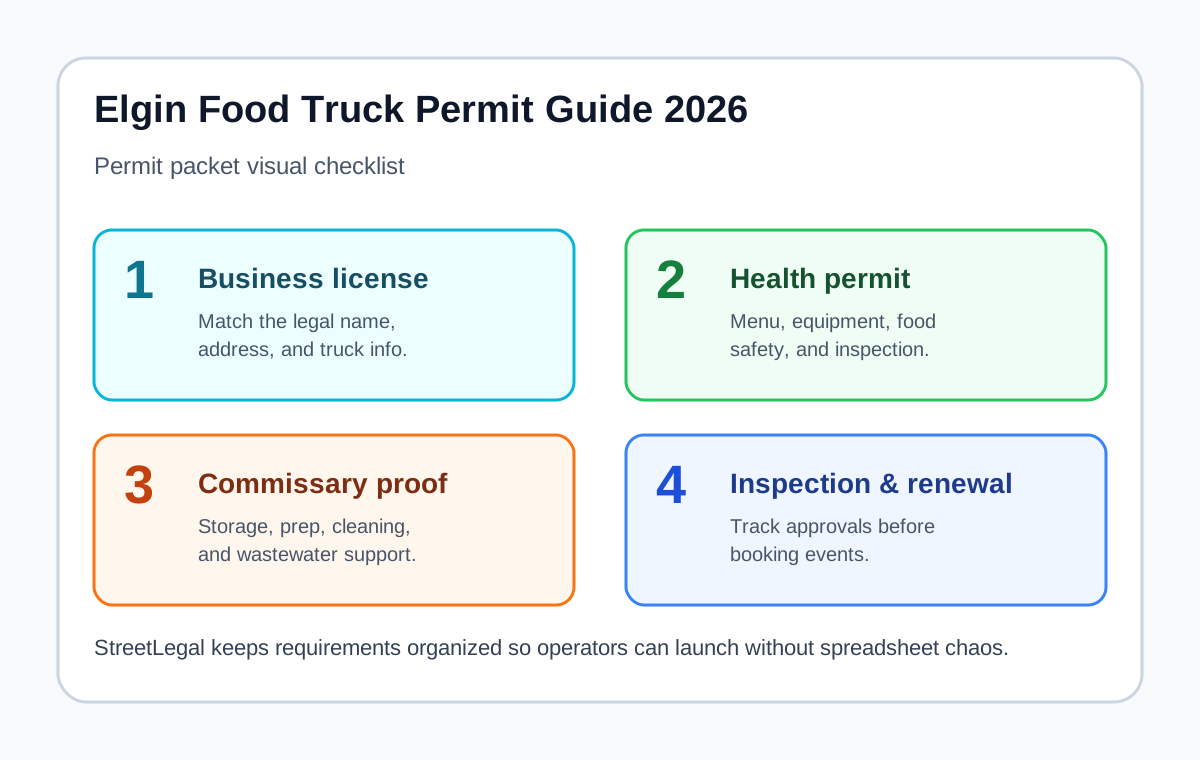
Permit packet checklist
Line up the Elgin approval packet before you book service.
Use one clean packet for the local license, health review, commissary, and inspection steps.
Local business license
Match the legal name, address, insurance, and truck details across every form.
Health permit
Prepare the menu, equipment list, food-safety credentials, and inspection plan.
Commissary proof
Show where storage, prep, dishwashing, wastewater, and overnight servicing happen.
Inspection and renewal
Track corrections, approval dates, renewal deadlines, and event-specific permissions.
StreetLegal keeps these requirements organized so operators can launch without spreadsheet chaos.
Elgin Food Truck Permit Snapshot
Most Elgin operators need a city business license or local business approval, a food handling or mobile vendor permit through the appropriate health authority, a commissary agreement, proof of insurance, vehicle and equipment details, and event or property approval for each place they serve. If you cook with propane, fryers, generators, or hood equipment, plan for fire-safety documentation before your first service.
Elgin sits in Kane County, so many mobile food units work through Kane County Health Department for annual or seasonal mobile vendor approval. Elgin also has its own food handling and business licensing process, so do not treat county approval as automatic permission to vend anywhere in the city.
Who Approves What in Elgin
- City of Elgin: business license, local food handling coordination, temporary use or event-related permissions, and location restrictions.
- Kane County Health Department: mobile vendor classification, food safety review, commissary proof, health inspection, and annual or seasonal food permit fees.
- Property owner or event organizer: written permission to operate at a private lot, market, festival, brewery, office park, or catered public event.
- Fire or building officials: review of propane, generator, suppression, ventilation, and cooking equipment when required.
2026 Cost Breakdown
| Item | Typical 2026 cost | Notes |
|---|---|---|
| Kane County Category II mobile vendor | $590 | Common for more complex food handling. |
| Kane County Category III mobile vendor | $530 | Usually limited handling, packaged foods, or beverages. |
| City business license | Varies by business type | Confirm with Elgin before filing. |
| Commissary or shared kitchen | $250-$1,000+/mo | Depends on storage, prep access, cleaning, and parking. |
| Insurance, equipment, and inspection prep | Varies | Budget extra if propane, hood, or suppression work is needed. |
Documents to Prepare Before You Apply
Build a clean packet before you start submitting forms: business entity records, photo ID, vehicle registration, menu, equipment list, commissary agreement, food manager certificate, insurance certificate, site permissions, and fire-safety documentation. Use the same legal business name, mailing address, and truck description on every document.
If your menu includes cooling, reheating, raw proteins, dairy, or time-temperature controlled foods, expect more review than a beverage or prepackaged-food unit. Explain where food is stored, where dishes are washed, where wastewater goes, and how the truck returns to the commissary.
Commissary Requirement
Kane County mobile unit guidance points operators toward an inspected and approved commissary for storage, cleaning, wastewater disposal, and servicing. That agreement should be more than a name on a form; it needs to support the way your truck actually works. If you need overnight cold storage, dry storage, grease disposal, or prep space, make sure the agreement says so.
Operators often get delayed because the commissary is approved for one type of work but the menu needs another. Before inspection, walk through your daily route from food receiving to overnight shutdown and make sure every step has a legal place to happen.
Where You Can Operate in Elgin
A health permit does not automatically give you permission to park and sell anywhere in Elgin. Private lots, breweries, office parks, farmers markets, festivals, and catered events each need location-specific approval from the owner or organizer. Elgin also flags restrictions around certain temporary and seasonal sales from parks, streets, or moving vehicles, so confirm the site before advertising service.
For private property, get written permission that names the date, address, service hours, access plan, and any restroom, trash, or traffic requirements. For public events, ask the organizer whether vendors file individually or under an event-level permit.
Realistic Launch Timeline
| Week | Workstream |
|---|---|
| Week 1 | Confirm menu, commissary, business license needs, insurance, and truck equipment list. |
| Week 2 | Submit health and local license paperwork; schedule inspection windows. |
| Weeks 3-4 | Clear corrections, finalize site permissions, and confirm fire-safety documentation. |
| Weeks 5-6 | Book first events only after approvals, inspection sign-offs, and commissary access are in place. |
Common Reasons Elgin Applications Slow Down
- The menu describes cooking or cooling steps that the truck and commissary cannot support.
- The insurance certificate, business license, and health permit application use different names.
- The operator has county approval but no written permission for the actual Elgin service location.
- Propane, generator, hood, or suppression documentation is incomplete at inspection time.
- The application is filed close to a festival or market date with no room for corrections.
Nearby Markets to Plan For
Elgin operators often look beyond one city because the Fox Valley event circuit crosses municipal lines. Nearby places such as Aurora, Schaumburg, Hoffman Estates, St. Charles, and Chicago-area private events may each require separate approvals or organizer rules. Keep a city-by-city tracker instead of assuming one permit follows the truck everywhere.
StreetLegal helps multi-city operators reuse the stable parts of the packet while tracking the local differences: forms, fees, renewal dates, commissary language, inspection contacts, and location permissions.
Elgin Food Truck Permit FAQ
Do I apply with Elgin or Kane County first?
Start by confirming both tracks. Kane County commonly handles mobile vendor health approval, while Elgin controls local business and location requirements. The fastest path is to build one packet that satisfies both instead of waiting for one office to redirect you.
What Kane County category applies to my truck?
It depends on food handling. A truck cooking or handling higher-risk foods usually faces a different review than a truck selling packaged foods or beverages. Match the category to your real menu, not the cheapest fee line.
Do I need a separate permit for every event?
Sometimes. Some events operate under organizer-level paperwork, while others require each vendor to file. Always ask the organizer what Elgin and Kane County expect before you pay a vendor fee.
What should I track after approval?
Track health permit expiration, business license renewal, commissary agreement dates, insurance renewal, fire-safety service dates, and each event or location approval. Put them on one calendar so a missed renewal does not cost you a booking.
Keep Your Elgin Permit Packet Organized
StreetLegal tracks forms, renewal dates, inspection tasks, and city-by-city requirements so your truck can launch without a spreadsheet maze.
Get Started FreeNearest locations to vend
Markets, spots where food trucks already set up, and parking around Elgin, IL.
These are leads, not permission. Private lots need the owner's OK and street spots follow Elgin vending rules.
Map: what's around Elgin
Commissary kitchens in Elgin, IL

Guides for Elgin, IL


People also ask about Elgin food truck permits
How much does a food truck permit cost in Elgin?
How long does it take to get a food truck permit in Elgin?
Do I need a commissary kitchen to operate a food truck in Elgin?
What documents do I need for a Elgin food truck permit?
Answers to the most common permit questions — costs, timelines, commissary rules, and more.
Find city-level permit guides for every state we cover — compare costs and requirements.
More from the blog
Jefferson County, MO Food Truck Permit Guide
Complete guide to food truck permits, fees, and requirements in Jefferson County, MO.
City GuidesSt. Charles County, MO Food Truck Permit Guide
Complete guide to food truck permits, fees, and requirements in St. Charles County, MO.
City GuidesSt. Louis County, MO Food Truck Permit Guide
Complete guide to food truck permits, fees, and requirements in St. Louis County, MO.
Buyer's GuideFood Truck POS Systems 2026: Square, Toast, Clover & Avocado
Compare 2026 food truck POS systems by pricing, hardware costs, offline mode, and contract terms for Square, Toast, Clover, and Avocado.