· Updated · 7 min read · StreetLegal Team
Ghost-Kitchen-Style Delivery-Only Service for Food Trucks (2026): Does It Make Sense?
Updated August 13, 2026
"Ghost kitchen" usually gets pitched as a restaurant-industry term, but the underlying model, running a kitchen for delivery and pickup with little or no walk-up service, is one some truck operators already run through their commissary during slow seasons or off-hours. Here's what it actually costs compared to a full restaurant build-out, the real commission math, and when it's worth trying versus when it just adds complexity.
What this model actually looks like for a truck operator
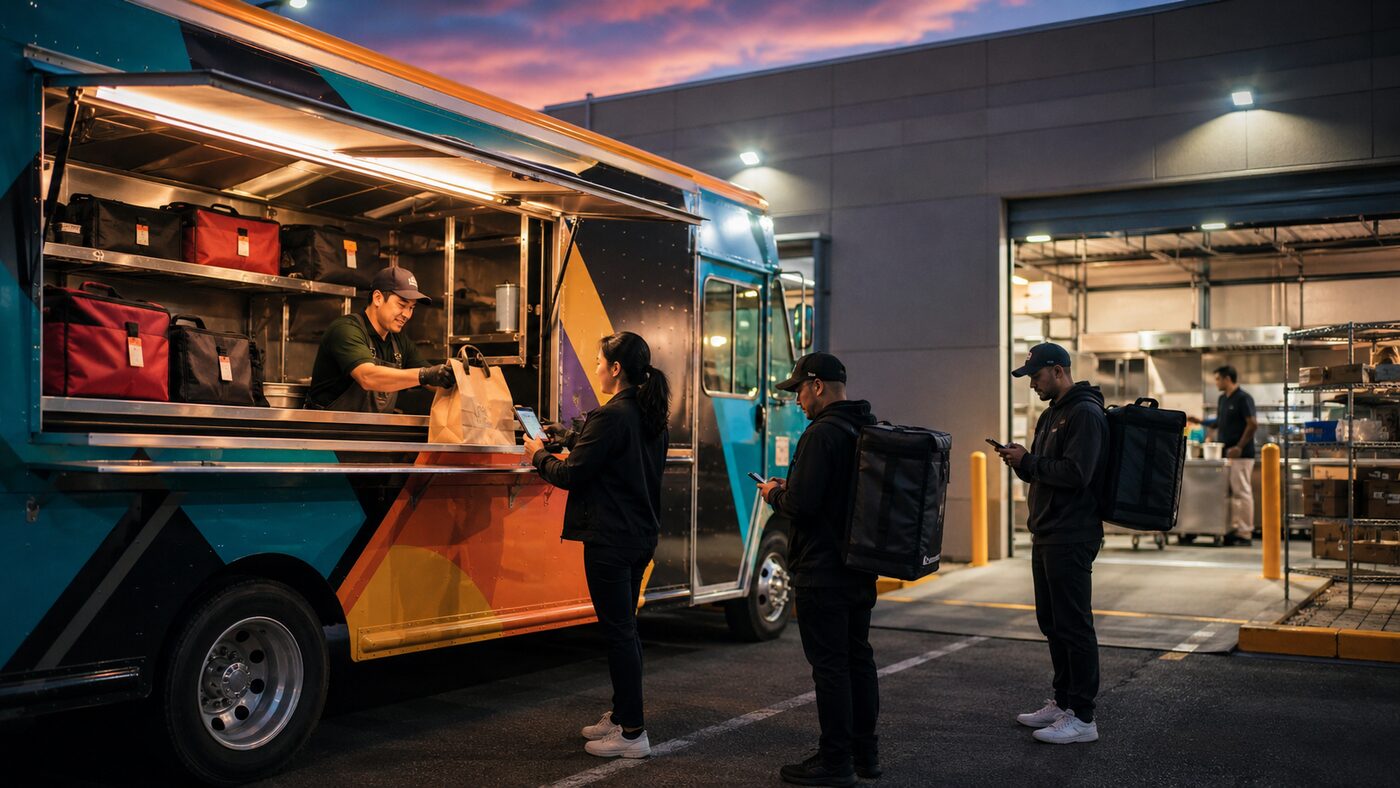
For a food truck, going "ghost-kitchen-style" rarely means leasing a separate, dedicated ghost-kitchen unit from scratch. More often it means using your existing commissary kitchen as a delivery-and-pickup base during hours or seasons when the truck itself isn't out on the street, running orders mainly through delivery apps and a direct ordering site instead of a walk-up service window. It's a hybrid: you keep the mobile side of the business for events, festivals, and regular spots, and add a delivery-first channel on top, using the same licensed kitchen you already report to for health permitting.
Ghost kitchen costs vs. a traditional restaurant
The appeal of the delivery-only model, industry-wide, is a much lower upfront and fixed cost compared to a full-service restaurant, since there's no dining room, host stand, or front-of-house staff to build or pay for:
| Cost category | Ghost kitchen / delivery-only | Traditional restaurant |
|---|---|---|
| Total startup investment | $75,000-$200,000 | $275,000-$425,000 |
| Kitchen space | $1,000-$3,000/month (shared kitchen) | $5,000-$15,000/month (prime retail lease) |
| Equipment | $15,000-$25,000 (kitchen-only) | $75,000+ (full front + back of house) |
| Typical operating margin | 15-20% (marketplace + direct-order mix) | 3-6% |
For a truck operator, the "kitchen space" and "equipment" lines are usually costs you've already absorbed as part of your commissary agreement, which is a real advantage over a restaurant operator starting from zero. See Commissary Kitchen Rental Costs: A Multi-City Comparison for what commissary access runs in specific markets, since that number is effectively your fixed base cost for running this model.
The commission math: marketplace vs. direct orders
The margin advantage above only holds if you're not sending every order through a high-commission marketplace app. Delivery-app marketplace orders typically run 15-30% commission depending on platform and service tier, while orders through your own direct ordering site cost roughly 3% in card processing and nothing else. The two-channel approach, marketplace apps for discovery and new customers, direct ordering for repeat business, is what actually protects the margin: use the app to get found, then move repeat customers toward ordering directly once they know your name. See Is Uber Eats Worth It for Food Trucks? for the specific Uber Eats commission tiers, and Self-Delivery vs. Marketplace Delivery on Uber Eats for how self-delivery changes that math further.
Menu strategy: what actually travels well
Delivery-only volume punishes menus built for immediate, plated service. Bowls, sandwiches, tacos, wings, and rice-based dishes hold their texture and temperature far better across a 15-30 minute delivery window than anything delicate, sauced-at-the-last-second, or meant to be eaten within a minute of being handed over. If you're building a delivery-first menu on top of your regular truck menu, it's worth trimming to a smaller subset that travels well rather than offering your full walk-up menu through the app.
When it makes sense, and when it doesn't
This model tends to work when your commissary sits in a dense residential or office area with real delivery demand, when you have a slow season where the truck itself isn't generating enough event or street volume, or when you want to test a second concept without buying a second truck. It tends not to work when your commissary is in an industrial or low-density area with little delivery demand nearby, when your margins are already thin on food cost, since a 15-30% marketplace commission on top of thin margins can erase profit fast, or when running two channels (truck service plus delivery orders) stretches a small crew past what it can handle without service quality slipping on both sides.
Frequently asked questions
What is a ghost kitchen for a food truck operator?
A delivery-first setup, often run out of the truck's existing commissary, that takes most orders through delivery apps and direct ordering rather than a walk-up window.
How much cheaper is a ghost kitchen than a traditional restaurant?
Roughly $75,000-$200,000 in startup investment versus $275,000-$425,000 for a full restaurant, with proportionally lower kitchen-space and equipment costs.
What commission do delivery apps take from a ghost-kitchen-style operation?
15-30% for marketplace orders, versus roughly 3% processing on orders through your own direct ordering site.
Does a delivery-only model still need a commissary?
Yes, it still needs a licensed kitchen for prep, storage, and order staging — it shifts order volume, not the commissary requirement.
What kind of menu works best for a delivery-only food truck concept?
Menus that travel well — bowls, sandwiches, tacos, wings, rice dishes — hold up far better over a delivery window than delicate plated food.
Running delivery out of your commissary still means keeping that agreement and your permits current.
StreetLegal helps food truck operators track commissary agreements, health permits, and licenses in one place, so a delivery-first push through your commissary doesn't hit a paperwork snag with the health department or a delivery platform's address check.
Answers to the most common permit questions — costs, timelines, commissary rules, and more.
Find city-level permit guides for every state we cover — compare costs and requirements.
More from the blog
Jefferson County, MO Food Truck Permit Guide
Complete guide to food truck permits, fees, and requirements in Jefferson County, MO.
City GuidesSt. Charles County, MO Food Truck Permit Guide
Complete guide to food truck permits, fees, and requirements in St. Charles County, MO.
City GuidesSt. Louis County, MO Food Truck Permit Guide
Complete guide to food truck permits, fees, and requirements in St. Louis County, MO.
Buyer's GuideFood Truck POS Systems 2026: Square, Toast, Clover & Avocado
Compare 2026 food truck POS systems by pricing, hardware costs, offline mode, and contract terms for Square, Toast, Clover, and Avocado.