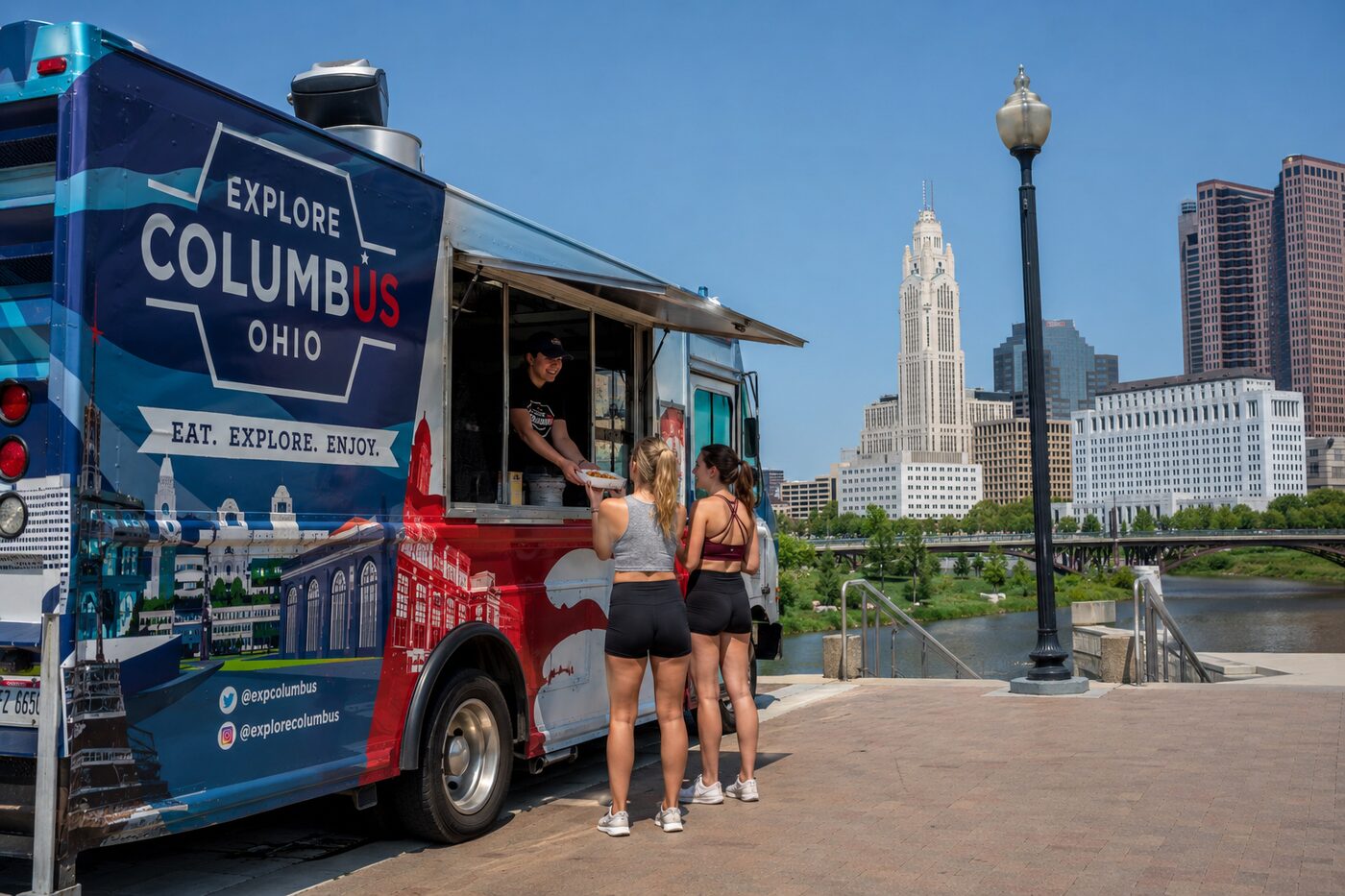
Columbus Commissary Kitchen Guide (2026)
Updated August 25, 2026
Every food truck operator in Columbus needs a signed commissary agreement before Columbus Public Health will issue a Mobile Food Service License. This guide covers the real, currently operating shared-use kitchens in the Columbus market, what a commissary agreement actually has to include, what it costs, and how the address you register there follows you onto delivery apps like Uber Eats.
Why Columbus food trucks need a commissary
A commissary is a licensed commercial kitchen that serves as a mobile food unit's home base: food storage, prep work that can't legally happen on board a truck, potable water fill-up, wastewater dumping, and vehicle cleaning. Columbus Public Health won't issue a Mobile Food Service License without a signed commissary agreement on file, and the commissary owner has to confirm they'll actually let you use the facility whenever your operation needs it. We cover the full Columbus permitting sequence, including how the commissary agreement fits alongside your health license, fire inspection, and peddler's license, in our Columbus food truck permit guide. This post focuses specifically on where to actually get commissary access in the Columbus metro.
What Columbus Public Health requires in the agreement
Ohio food trucks operate under the Ohio Uniform Food Safety Code (Ohio Revised Code Chapter 3717), which is enforced locally by Columbus Public Health. The commissary agreement is a yearly, signed document between the mobile operator and the commissary owner, and it has to be renewed and resubmitted for each licensing cycle, not just filed once. Columbus Public Health reserves the right to inspect the commissary facility itself as part of your license review, so an informal arrangement with a friend's restaurant kitchen that isn't itself licensed and prepared to be inspected won't satisfy the requirement. Prep, cold and dry storage, and vehicle servicing all have to happen at the commissary, not at a home kitchen, even if you're only running a pushcart rather than a full truck.
Real commissary kitchens operating in Columbus
Two shared-use commercial kitchens with an established track record of serving food trucks operate inside Columbus proper. Both are set up specifically for mobile food operators, not just caterers and packaged-goods makers, and both offer truck or cart storage on top of kitchen time.
| Facility | Address | Model | Truck parking |
|---|---|---|---|
| 1400 Food Lab | 1400 Dublin Road, Columbus, OH 43215 | For-profit, $150/yr membership + hourly/monthly kitchen rates | Secured lot, powered and unpowered spaces |
| ECDI Food Fort | 737 Parkwood Ave, Columbus, OH 43219 | Nonprofit, hourly kitchen rental, no long-term contract | Gated storage with water, electricity, discounted propane |
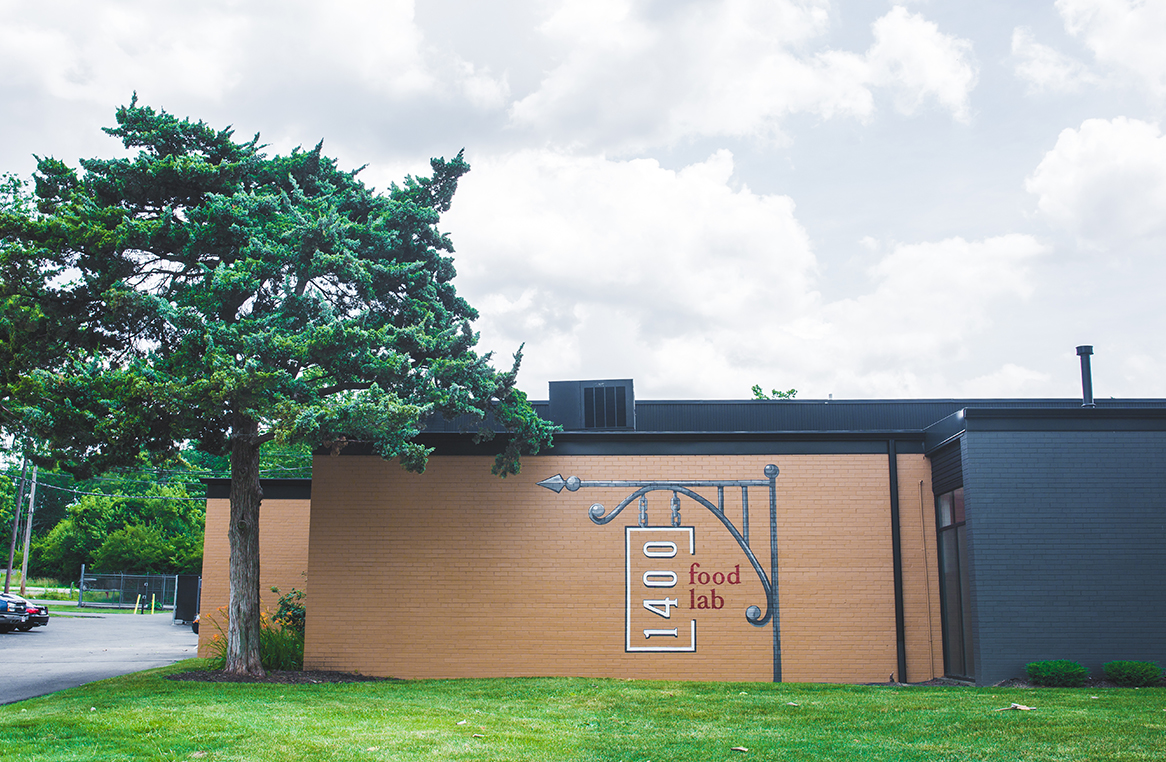
1400 Food Lab (formerly The Commissary)
1400 Food Lab occupies 16,000 square feet at 1400 Dublin Road in the Marble Cliff area, just northwest of downtown. The space opened in 2014 as The Commissary and was rebranded to 1400 Food Lab in 2017, but it's the same building and the same long-running commissary program that has hosted Columbus food truck operators for over a decade. Members pay a $150 annual membership fee, then choose from hourly and monthly kitchen packages depending on how much prep time they need. The facility runs a secured food truck base camp lot with both powered (utility) and unpowered parking spaces, plus separate cold and dry storage options for carts and trucks that aren't parked on-site full time. Because pricing depends on how much kitchen and storage access your specific menu requires, 1400 Food Lab quotes a full fee structure after a facility tour rather than publishing flat rates.
ECDI Food Fort
Food Fort, at 737 Parkwood Ave on the near east side, is run by the Economic and Community Development Institute (ECDI), a Columbus-based nonprofit lender. It's structured as a lower-barrier entry point for newer operators: kitchen time is booked by the hour with no long-term lease commitment, and the facility includes three rentable kitchens, two prep spaces, dish-washing areas, and dry, cold, and frozen storage. For food trucks specifically, Food Fort offers mobile cart and truck storage with water and electricity hookups, gated security, and discounted propane refills. Because ECDI is also a Community Development Financial Institution, Food Fort members get a path to the organization's small-business lending and ServSafe manager training as part of onboarding, which can matter if you're financing your build-out. Contact Food Fort directly at (614) 559-0115 or foodfort@ecdi.org for current rates and open kitchen slots.
What a Columbus commissary actually costs
Commissary space in the Columbus market typically runs $250 to $600 per month, depending on how much kitchen time, cold storage, and truck parking your operation needs, which is notably cheaper than commissary access in larger metros like Chicago or the California markets. Membership-based facilities like 1400 Food Lab layer a small annual membership fee ($150) on top of that usage-based rate, while nonprofit-run Food Fort keeps entry cost lower by billing kitchen time hourly instead of requiring a monthly commitment. Either way, budget for the commissary agreement as a recurring operating cost, not a one-time fee, since Columbus Public Health requires it to be renewed annually alongside your Mobile Food Service License.
- Get your commissary agreement signed before you apply for your Mobile Food Service License, not after — Columbus Public Health won't approve the license without it on file.
- Confirm the facility is itself properly licensed and open to inspection; an informal arrangement with an unlicensed kitchen doesn't satisfy the requirement.
- Ask each facility what's included in the base rate versus billed separately, since propane, storage, and parking are sometimes priced apart from kitchen hours.
How your commissary address affects Uber Eats
Your commissary choice does more than satisfy your health license. Uber requires the legal entity name and address on your Uber Eats listing to match the address on your business license and health permit. Since a truck's actual location changes daily, most operators register their fixed commissary address as their Uber Eats storefront and delivery radius center point rather than trying to update it every time the truck moves. That means the commissary you sign with in Columbus effectively becomes your delivery-app home base too, so it's worth checking that a facility's address works as a reasonable center point for the neighborhoods you actually want delivery orders from before you sign. We go deeper on the address-matching requirement and whether delivery apps are worth it for trucks in our Uber Eats for food trucks breakdown.
Frequently asked questions
Does Columbus require food trucks to use a commissary kitchen?
Yes. Columbus Public Health requires every mobile food service operation to have a signed commissary agreement with a licensed commercial kitchen before it will issue a Mobile Food Service License. The commissary is where a truck stores food, does prep work it can't legally do on board, and cleans and drains the vehicle.
Where are the commissary kitchens in Columbus, Ohio?
Two established shared-use commercial kitchens operate in Columbus proper: 1400 Food Lab at 1400 Dublin Road (formerly known as The Commissary) and ECDI's Food Fort at 737 Parkwood Ave. Both accept food truck and cart operators as commissary clients.
How much does a commissary agreement cost in Columbus?
Commissary space in the Columbus market generally runs $250 to $600 per month depending on how much kitchen time, storage, and truck parking you need. Membership-model kitchens like 1400 Food Lab also charge a separate small annual membership fee on top of usage rates.
Can I prep food at home and just park at a commissary in Columbus?
No. Columbus Public Health requires that food prep, storage, and vehicle servicing happen at the licensed commissary itself, not at a private residence. A home kitchen does not satisfy the commissary agreement requirement for a Mobile Food Service License.
Do Columbus commissary kitchens offer food truck parking?
Yes. 1400 Food Lab operates a secured food truck base camp lot with both powered and unpowered spaces, and ECDI's Food Fort offers mobile cart and truck storage with water, electricity, gated security, and discounted propane.
Can I use my Columbus commissary address to list on Uber Eats?
Yes, and most Columbus operators do. Uber requires the address on your Uber Eats listing to match the address on your business license and health permit. Since a food truck's location changes daily, operators typically register their commissary kitchen as the fixed storefront address instead.
Keep your Columbus commissary agreement from becoming a licensing bottleneck
StreetLegal helps food truck operators keep permits, health department documents, and commissary agreements current and in one place, so the requirements a Columbus commissary or health department asks for don't hold up your launch.
Map: what's around Columbus
Food trucks near Columbus, OH
Browse every food truck →
Upcoming events in Columbus, OH


Commissary kitchens in Columbus, OH

Guides for Columbus, OH

People also ask about Columbus food truck permits
How much does a food truck permit cost in Columbus?
How long does it take to get a food truck permit in Columbus?
Do I need a commissary kitchen to operate a food truck in Columbus?
What documents do I need for a Columbus food truck permit?
Answers to the most common permit questions — costs, timelines, commissary rules, and more.
Find city-level permit guides for every state we cover — compare costs and requirements.
More from the blog
Jefferson County, MO Food Truck Permit Guide
Complete guide to food truck permits, fees, and requirements in Jefferson County, MO.
City GuidesSt. Charles County, MO Food Truck Permit Guide
Complete guide to food truck permits, fees, and requirements in St. Charles County, MO.
City GuidesSt. Louis County, MO Food Truck Permit Guide
Complete guide to food truck permits, fees, and requirements in St. Louis County, MO.
Buyer's GuideFood Truck POS Systems 2026: Square, Toast, Clover & Avocado
Compare 2026 food truck POS systems by pricing, hardware costs, offline mode, and contract terms for Square, Toast, Clover, and Avocado.