· Updated · 9 min read · StreetLegal Team
How to Get a Food Truck Permit in Aurora, CO (2026 Guide)
Aurora is Colorado's third-largest city and one of the most diverse communities in the state — which makes it a strong market for food trucks, especially ethnic cuisines that are underserved by brick-and-mortar restaurants. Getting permitted takes 4–8 weeks and costs significantly less than neighboring Denver.
Updated June 16, 2026
Aurora Permit Snapshot
| Step | Agency / Permit | Fee | Timeline |
|---|---|---|---|
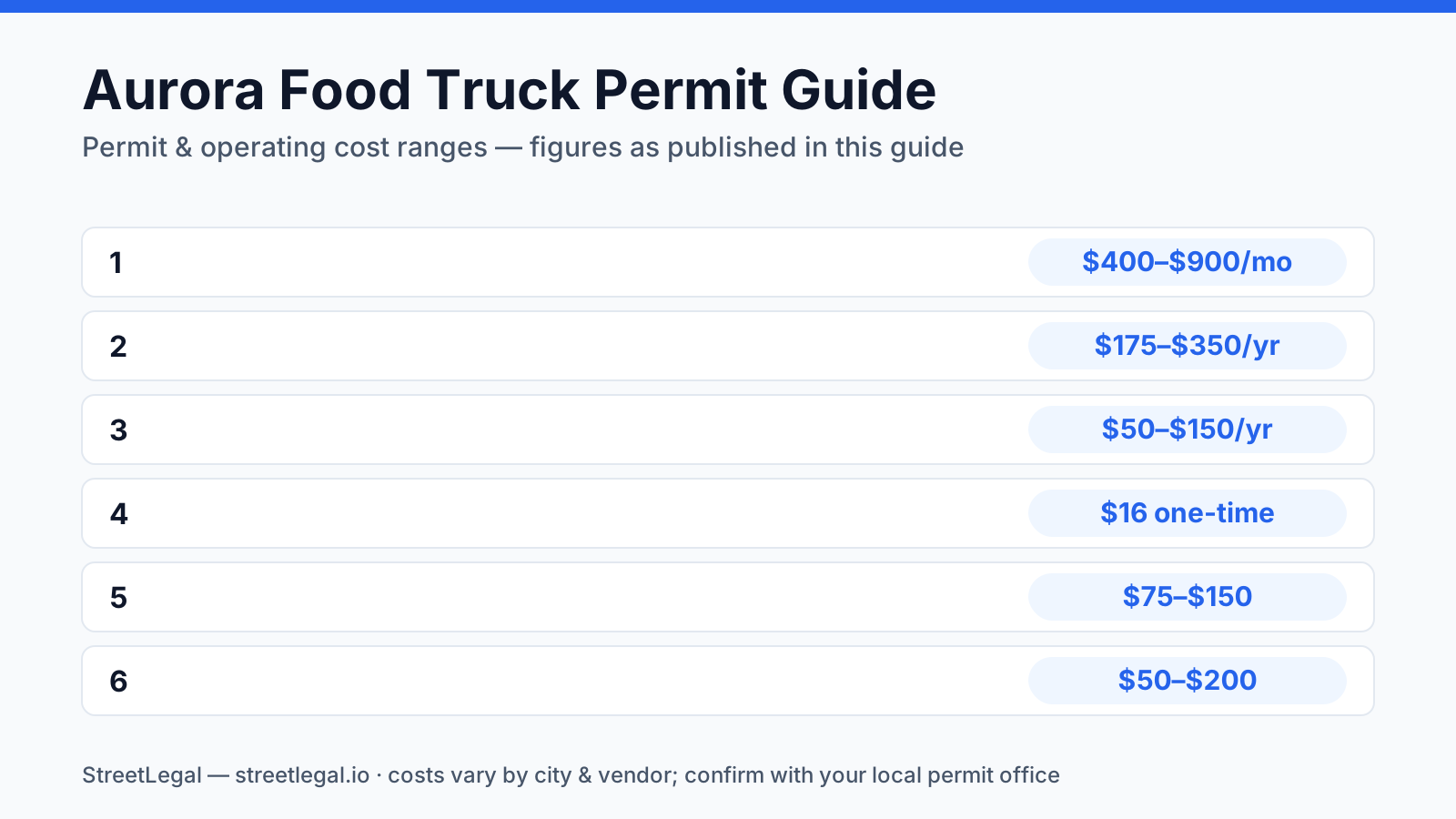
| 1 | Commissary agreement | $400–$900/mo | 1–2 weeks |
| 2 | TCHD Mobile Food License | $175–$350/yr | 3–6 weeks |
| 3 | Aurora Business License | $50–$150/yr | 1–2 weeks |
| 4 | CO Sales Tax License (CDOR) | $16 one-time | Instant online |
| 5 | Food Manager Certification (ServSafe) | $75–$150 | 1 day (online) |
| 6 | Fire extinguisher (Class K + ABC) | $50–$200 | Same day |
Aurora vs Other Colorado Markets
| Market | First-Year Cost | Timeline | Best Revenue Lane | Why It Matters |
|---|---|---|---|---|
| Aurora | $6,000–$14,000 | 4–8 weeks | Stanley Marketplace / DIA district / events | Most diverse CO city; ethnic cuisines underserved; lower costs than Denver |
| Denver | $10,000–$18,000 | 6–10 weeks | RiNo / Civic Center / brewery pop-ups | Largest CO market; highest foot traffic but higher permit costs and competition |
| Colorado Springs | $5,500–$12,000 | 4–8 weeks | Military bases / downtown / Garden of the Gods events | Strong military community; lower costs; growing food truck scene |
| Fort Collins | $6,000–$13,000 | 4–8 weeks | CSU campus / Old Town / brewery partnerships | College town demand; strong craft brewery scene |
| Boulder | $8,000–$16,000 | 6–10 weeks | Pearl Street / CU campus / farmers markets | Premium pricing market; health-conscious customers willing to pay more |
Core Permits & Licenses
1. Mobile Food License (Tri-County Health Department)
The Tri-County Health Department (TCHD) serves Arapahoe, Adams, and Douglas Counties — which includes Aurora. This is your primary operating credential. One TCHD license covers operation across all three counties, making multi-city operation easy if you also serve in Centennial, Littleton, or Castle Rock.
- Submit application with signed commissary agreement, menu, and equipment list
- TCHD conducts plan review and schedules pre-opening inspection
- Annual renewal fee: $175–$350 depending on truck size and menu complexity
2. Aurora Business License
All businesses operating in Aurora must hold a City of Aurora Business License. Apply through the Aurora Finance Department. Fee: $50–$150/year based on business type and projected revenue.
3. Colorado Sales Tax License
Register with the Colorado Department of Revenue to collect state and local sales tax. Apply online at MyColorado.gov. One-time $16 fee — required before your first sale.
4. Commissary Agreement
Colorado requires all mobile food units to base from a licensed commissary for daily prep, cleaning, wastewater disposal, and food storage. Your commissary must hold its own health permit from the relevant county health department. Budget $400–$900/month in the Aurora metro area.
Health & Food Safety
- Food Manager Certification: At least one Certified Food Protection Manager per truck (ServSafe or equivalent). Fee: $75–$150, valid for 5 years.
- Temperature control: Cold hold ≤41°F, hot hold ≥135°F. Digital thermometer logging recommended for TCHD inspections.
- Altitude adjustment: Aurora sits at ~5,400 ft. Boiling point is about 203°F instead of 212°F — adjust cooking times and temperatures for food safety compliance.
- Handwashing station: Required with hot running water, soap, and paper towels. TCHD verifies functionality at every inspection.
- Fire safety: Class K extinguisher required for fryers and open-flame cooking. ABC extinguisher required in all trucks regardless of menu.
- Three-compartment sink: Required for all trucks that wash dishes or utensils on-site. Separate from handwashing station.
Where You Can Operate in Aurora
| Location | Access | Best Fit | Notes |
|---|---|---|---|
| Stanley Marketplace | Vendor application through Stanley | Any high-quality truck | Aurora's premier food destination; consistent foot traffic; competitive application but highest revenue potential in the city |
| Gaylord Rockies district | Event permits + private lot deals | BBQ, taco, comfort food | Convention center area with growing hotel/event calendar; strong catering potential |
| Colfax Ave / Arts District | Private property permission | Specialty, ethnic, fusion | Active arts scene; brewery partnerships; evening and weekend events |
| DIA area / airport hotels | Private lot deals with hotels | Breakfast, lunch, comfort food | Airport worker shifts create consistent weekday demand; hotel lots offer parking access |
| Buckley Space Force Base | Military base vendor application | Taco, BBQ, comfort food | Captive lunch audience; requires base access approval |
| Office parks / business districts | Property manager relationships | Lunch trucks of any type | Strong weekday lunch demand; build regular rotation schedules |
Fees & Timeline
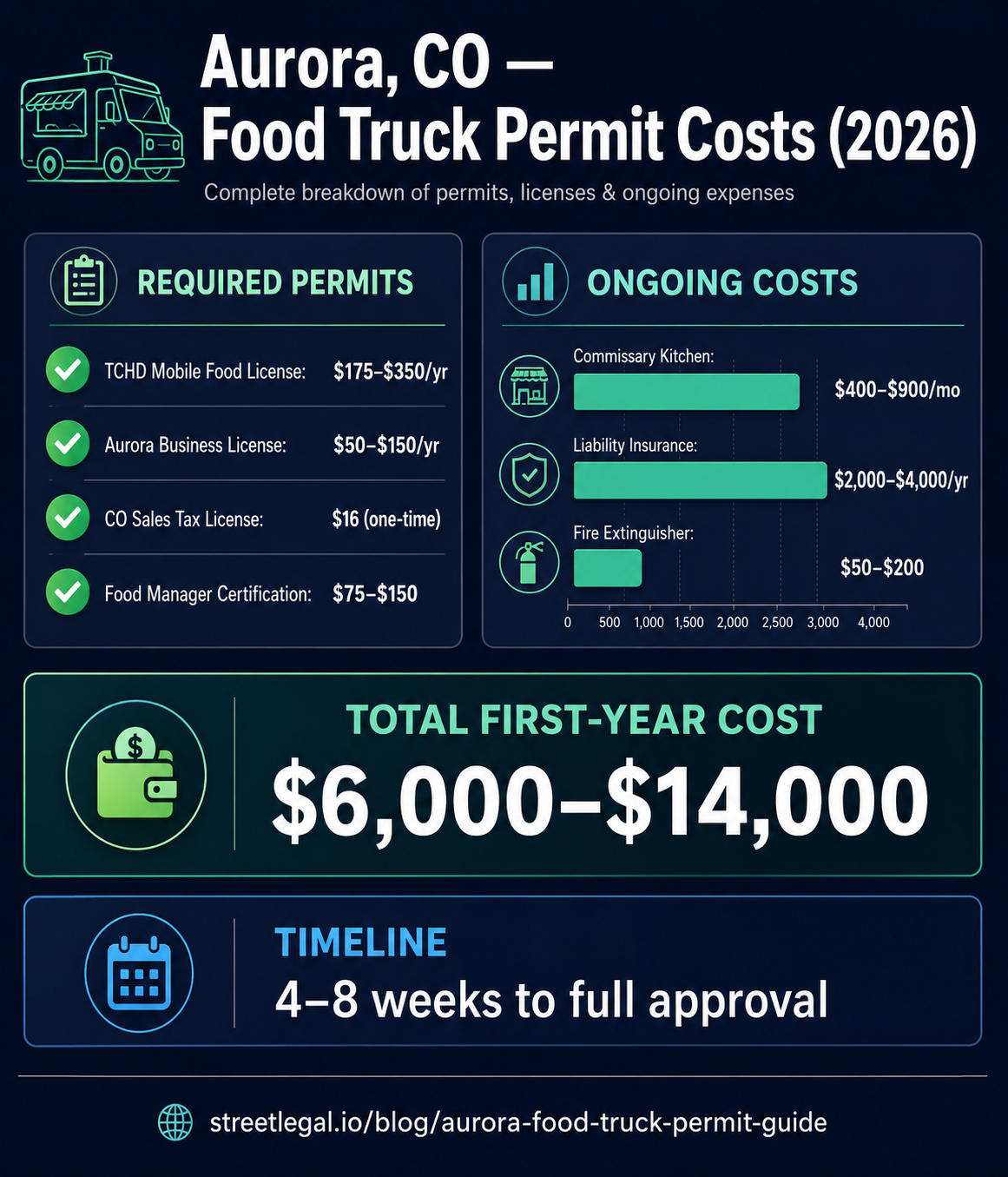
| Permit / License | Approx. Fee | Renewal |
|---|---|---|
| TCHD Mobile Food License | $175–$350 | Annual |
| Aurora Business License | $50–$150 | Annual |
| CO Sales Tax License | $16 initial | Ongoing |
| Food Manager Certification | $75–$150 | Every 5 years |
| Fire extinguisher (Class K + ABC) | $50–$200 | Annual inspection |
| Commissary kitchen | $400–$900/mo | Monthly |
| Liability insurance | $2,000–$4,000/yr | Annual |
This includes permits, commissary, insurance, and certifications. Aurora is one of the more affordable Colorado markets — significantly cheaper than Denver ($10,000–$18,000) and Boulder ($8,000–$16,000).
Timeline: 4–8 weeks total. TCHD processes applications faster than Denver's DDPHE, making Aurora one of the quickest Colorado cities to get permitted in.
Operator Tips
- Stanley Marketplace is the destination: Getting into the Stanley rotation is the fastest path to consistent revenue in Aurora. Apply early — vendor spots are competitive.
- Diversity is your advantage: Aurora is one of Colorado's most diverse cities with large Ethiopian, Vietnamese, Korean, and Mexican communities. Authentic ethnic cuisines are underserved by brick-and-mortar restaurants and well-received by the local market.
- DIA proximity: Denver International Airport is in Aurora's metro area. Airport hotel districts, conference centers, and logistics hubs create consistent weekday demand for breakfast and lunch trucks.
- Buckley SFB: Military base catering is a reliable revenue stream — captive lunch audience with predictable schedules. Requires base access vendor approval.
- TCHD = regional passport: One TCHD Mobile Food License covers Arapahoe, Adams, and Douglas Counties. That means you can also operate in Centennial, Littleton, Castle Rock, and other TCHD-area cities with just an additional city business license — no separate health permit needed.
- Denver requires separate permits: Aurora borders Denver, but Denver uses DDPHE (Denver Department of Public Health & Environment) instead of TCHD. If you plan to operate in both cities, budget for a second health permit.
- Altitude matters: At 5,400 feet, water boils at ~203°F. This affects cooking times, especially for boiled/steamed items. Adjust recipes and verify internal temperatures during TCHD inspections.
Need help tracking permits across cities?
StreetLegal helps food truck owners manage permits, fees, renewals, and city-specific requirements in one dashboard.
Colorado Food Truck Guides
Related Guides
Compare Colorado markets, permit stacks, and operating lanes across the state.
Have more questions about food truck permits?
Check out our complete FAQ for answers on costs, timelines, commissary requirements, and how StreetLegal can help.
People also ask about Aurora food truck permits
How much does a food truck permit cost in Aurora?
How long does it take to get a food truck permit in Aurora?
Do I need a commissary kitchen to operate a food truck in Aurora?
What documents do I need for a Aurora food truck permit?
Answers to the most common permit questions — costs, timelines, commissary rules, and more.
Find city-level permit guides for every state we cover — compare costs and requirements.
More from the blog
Food Truck POS Systems: Square vs. Toast vs. Clover vs. Avocado (2026)
Real 2026 pricing, hardware costs, offline mode, and contract terms for Square, Toast, Clover, and Avocado — compared specifically for food truck operators.
City GuidesEagan, MN Food Truck Permit Guide
Eagan MN food truck permit guide: MDH mobile food licensing, Dakota County food safety, city peddler rules, commissary records, costs, and launch timeline.
City GuidesBentonville, AR Food Truck Permit Guide
Complete guide to food truck permits, fees, and requirements in Bentonville, AR.
City GuidesBiloxi, MS Food Truck Permit Guide
Biloxi food truck permit guide 2026: licenses, health permit steps, commissary records, inspections, costs, renewal timing, and launch checklist.