· 11 min read · Gibby, StreetLegal Editorial
Informational only — not legal advice. Confirm requirements with the city before you apply. See our Disclaimer.
Municipal reply evidence
StreetLegal updated this guide from official city, county, or health-department replies received by info@streetlegal.io.
EH Apps <EHApps@cdh.idaho.gov> · Fri, 4 Sep 2026 18:45:37 +0000
Gibby, The information you are requesting is not something that we keep records on. Thanks, Luke [cid:cdh-logo-final-200-113small_a1b7c14d-9900-4f11-8cb4-a8aac1e710b5.png] [cid:facebook_32x32_396c2e94-c02e-478b-b1da-7b13c6429016.png] <https://www.facebook.com/cdhidaho> [cid:linkedin_32x32_8ff8bc46-2e1c-4d7e-8b83-75da80c69f9c.png] <https://www.linkedin.com/company/central-district-health-cdh> [cid:youtube_32x32_6e67d8b3-abf6-4de8-af65-557c94cbe620.png] <https://www.youtube.com/channel/UC4LJ1BM5Jv3zczecnYkXarw> [cid:instagram_32x32_b3532757-a95e-4c22-bf81-38986f9991c9.png] <https://www.instagram.com/cdhidaho/?hl=en> [cid:whatsapp_52997316-f057-4f6e-b8d3-0af9211f6c83.png] <https://whatsapp.com/channel/0029Vb6S1L5ATRSetBvPur0t> Environmental Health Applications P. 208-327-7499 | F. 208-327-8553 EHApps@cdh.idaho.gov<mailto:EHApps@cdh.idaho.gov> | cdh.idaho.gov<https://cdh.idaho.gov/> Excellen
Source links: official link 1, official link 2, official link 3
Central District Health replied that it does not keep the requested records; no structured requirement update to badge yet.
How to Start a Food Truck in Boise, ID: Complete Permit Guide 2026
Boise Food Truck Permitting Overview
Starting a food truck in Boise requires two primary permits working in tandem: a health permit from Central District Health (CDH) and a Mobile Food Preparation Vehicle (MFPV) Permit from the Boise Fire Department (if your truck uses cooking equipment). You'll also need Idaho business registration and a sales tax permit.
The good news: Boise has some of the lowest health permit fees in any major Western market. CDH charges $80–$100 for the annual health permit plus a $100 plan review fee — significantly less than California, Oregon, or Washington. The permit and inspection process is also relatively streamlined, with CDH asking operators to submit applications at least 30 days before opening.
Central District Health (CDH) Health Permit
CDH Environmental Health Specialists permit and inspect all food establishments in Ada, Boise, Elmore, and Valley counties. This is your foundational operating permit — you cannot legally serve food in Boise without it.
What You Need to Apply
- Completed CDH application — Submit at least 30 days before your intended opening date or ownership change
- Operational plan — Describing your menu, food sources, preparation methods, and procedures; subject to plan review ($100 fee)
- Commissary agreement (if applicable) — Required if you're operating with a commissary; must specify which activities you perform there and on what schedule
- Floor plan / equipment layout — Showing placement of all cooking, refrigeration, sink, and storage equipment
- Food Safety Certification — Must complete an Idaho-approved Food Safety Certification course before applying; required before permit issuance
CDH Health Permit Fees
| Permit Item | Fee |
|---|---|
| Full-service food truck permit (with commissary) | $100/year |
| Full-service food truck permit (without commissary) | $80/year |
| Plan review fee | $100 (one-time for new operations) |
| Late fee (Jan 1–15) | $35 |
| Late fee (after Jan 15) | $70 |
| License reinstatement | $18 |
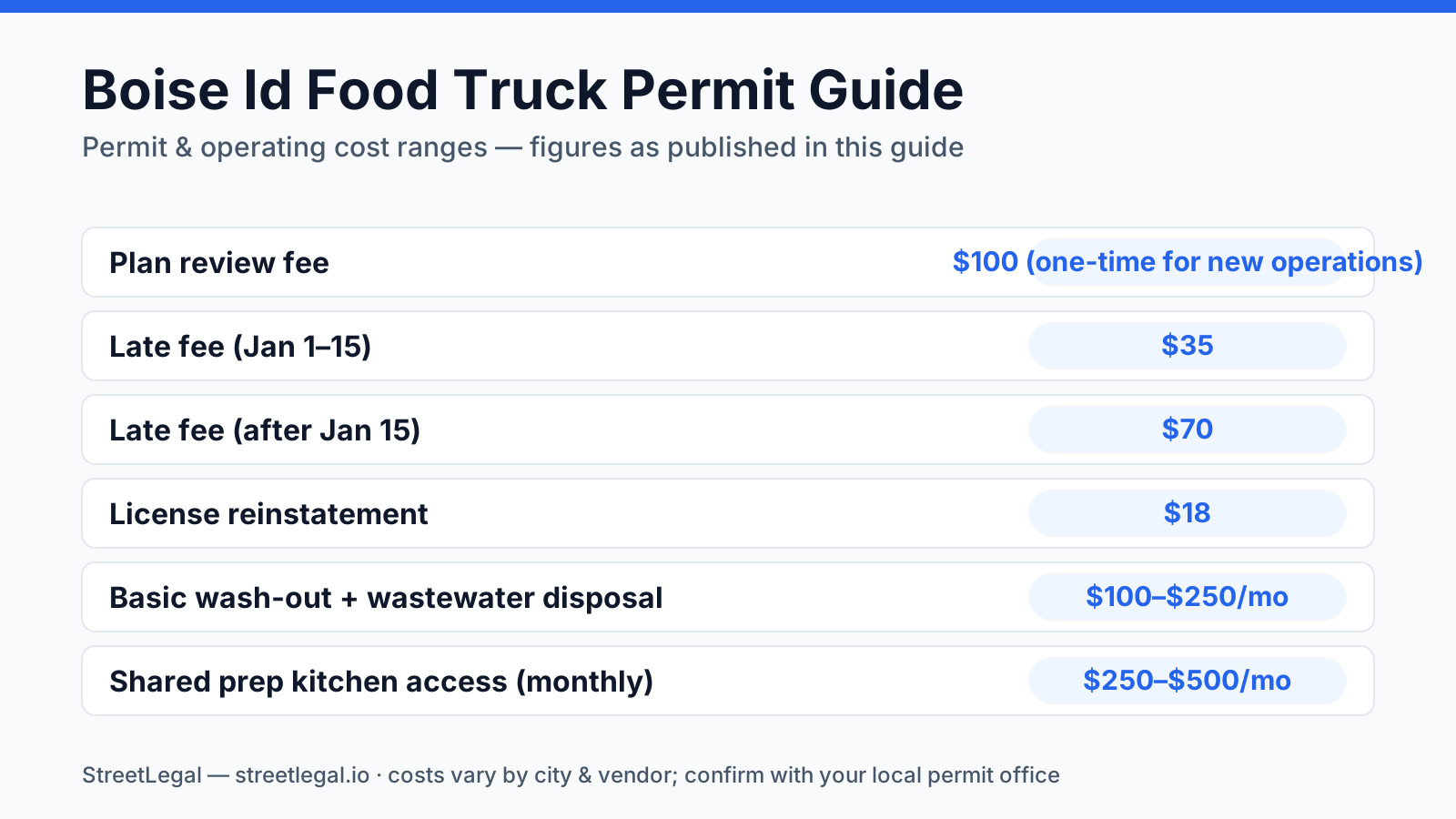
Annual renewal: CDH permits renew annually. Renewals submitted on time have no late fee; those submitted after January 15 incur the $70 late fee. With some of the lowest permit fees in the Mountain West, staying current costs almost nothing — missing a renewal is an easy way to waste goodwill with the health district.
What CDH Inspectors Check
CDH conducts annual inspections of all permitted food establishments. Inspectors verify:
- Food temperature control (hot ≥135°F, cold ≤41°F)
- Handwashing station with warm water, soap, and paper towels
- 3-compartment sink for washing, rinsing, and sanitizing
- Valid Food Safety Certification for at least one operator
- Proper wastewater containment (gray water tank at least 15% larger than fresh water tank)
- Commissary records if operating with a commissary
- Clean, pest-free equipment and food storage areas
- Refrigeration and cooking equipment in good working order
Boise Fire Department: Mobile Food Preparation Vehicle Permit
If your food truck uses any cooking equipment — grills, fryers, ovens, griddles, propane burners — you need a Mobile Food Preparation Vehicle (MFPV) Permit from the Boise Fire Department Fire Prevention Division. This is separate from your CDH health permit.
MFPV Permit Requirements
- Completed MFPV application — Submit to the Boise Fire Department Fire Prevention Division
- Proof of insurance — Minimum $1,000,000 general liability coverage
- Vehicle registration — Copy of current Idaho vehicle registration
- Commissary agreement — If applicable
- Fire safety inspection — Boise Fire Department inspectors will evaluate your truck's ventilation, fire suppression, fuel storage, and equipment safety
What the Fire Inspection Covers
- Ventilation system — Type I hood required over all heat-producing commercial cooking equipment
- Fire suppression system — If you operate a fryer or open grill under a Type I hood, an Ansul-type fire suppression system is required; must be serviced semi-annually
- K-class fire extinguisher — Required and must be within inspection date
- Fuel storage safety — LPG (propane) tanks must be properly secured, labeled, and have accessible shutoff valves
- Electrical safety — Generator wiring and onboard electrical systems must be safe
Commissary Kitchen Requirements in Boise
Most Boise food trucks are required to operate from a licensed commissary kitchen. While CDH does offer a permit category for trucks operating without a commissary ($80/year), most full-service food trucks preparing food on the truck will benefit from — and often require — a commissary arrangement for:
- Daily cleaning and sanitizing of the truck's interior and equipment
- Gray water and wastewater disposal (gray water cannot be dumped on-site)
- Food prep that exceeds what can be done on the truck itself
- Resupply and cold storage access between service periods
Gray water rule: Idaho requires food trucks to have a wastewater holding tank that is at least 15% larger than the fresh water tank. Gray water cannot be dumped on-site; it must be emptied at approved disposal facilities — typically at your commissary or a licensed wastewater dump station.
Boise Commissary Cost Ranges
| Type | Monthly Cost |
|---|---|
| Basic wash-out + wastewater disposal | $100–$250/mo |
| Shared prep kitchen access (monthly) | $250–$500/mo |
| Full shared kitchen (daily access) | $400–$800/mo |
| Dedicated commissary agreement | $700–$1,500/mo |
Food Safety Certification Requirements
Idaho requires at least one operator to complete an Idaho-approved Food Safety Certification course before the CDH permit is issued. This is different from a food handler card — it's a more comprehensive certification (like ServSafe Manager) that covers advanced food safety principles.
- Course options: ServSafe Manager, National Registry of Food Safety Professionals (NRFSP), or other Idaho Department of Health and Welfare-approved programs
- Cost: $150–$200 for the course and exam
- Validity: Typically 5 years
- Additional staff: While only one certified operator is required, Idaho recommends (and best practice supports) having all food handlers complete a basic food handler card as well
Business Registration & Other Requirements
- Idaho LLC — Register with the Idaho Secretary of State at sos.idaho.gov; LLC filing fee ~$100
- Idaho Business License — The City of Boise requires a general business license for commercial operations within city limits [VERIFY: current fee at cityofboise.org]
- Idaho Sales Tax Permit — Free from the Idaho State Tax Commission (tax.idaho.gov); required to collect Idaho's 6% state sales tax on prepared food sales
- EIN — Free from the IRS
- Idaho vehicle registration — Register your truck as a commercial vehicle with the Idaho DMV
- Zoning verification — For specific event or fixed-location operations, verify zoning with the City of Boise Planning Division
Operating Hours & Location Rules
Food trucks in Boise can generally operate from 6:00 a.m. to 3:00 a.m. under standard operating permits. Special event permits may authorize extended hours for specific occasions.
Location rules:
- Private property — With written owner permission, you can operate on most private lots. This is the dominant model in Boise.
- Public right-of-way / streets — Limited and subject to City of Boise permitting; contact Planning at 208-384-3830
- Special events — Boise has a robust outdoor events calendar (Alive After Five, Treefort Music Fest, Boise Farmers Market). Event organizers typically manage vendor permits.
- High-zoning areas — Certain locations in residential zones may require additional zoning approval
Required Permits Summary
| Permit / License | Issuing Agency | Fee | Renewal |
|---|---|---|---|
| CDH Health Permit | Central District Health | $80–$100/yr + $100 plan review | Annual |
| MFPV Fire Permit | Boise Fire Dept | [VERIFY: cityofboise.org/fire] | Annual |
| City Business License | City of Boise | [VERIFY: cityofboise.org] | Annual |
| Idaho Sales Tax Permit | Idaho State Tax Commission | Free | Ongoing |
| Idaho LLC Registration | Idaho Secretary of State | ~$100 | Annual report $0–$30 |
| Fire Suppression Inspection | Boise Fire Dept / certified tech | $200–$600/yr | Semi-annual |
| Food Safety Certification | ServSafe / approved provider | $150–$200 | Every 5 years |
Full Boise Food Truck Cost Breakdown (First Year)
| Item | Low | High |
|---|---|---|
| CDH health permit (with commissary) | $100 | $100 |
| CDH plan review fee | $100 | $100 |
| Boise Fire MFPV permit | $50 | $200 |
| City business license | $30 | $100 |
| Idaho LLC registration | $100 | $100 |
| Fire suppression inspection & service | $200 | $600 |
| Food Safety Certification | $150 | $200 |
| Food handler cards (2–3 staff) | $30 | $90 |
| Commissary kitchen (annual) | $1,200 | $9,600 |
| General liability insurance (annual) | $1,000 | $2,000 |
| Commercial auto insurance (annual) | $800 | $1,800 |
| Vehicle registration | $100 | $300 |
| TOTAL (first year) | $3,860 | $15,190 |
Boise has among the lowest regulatory entry costs of any Western market. The wide range is driven by commissary type and insurance tier.
Boise Permitting Timeline
- Week 1–2: Form Idaho LLC, register for Idaho sales tax permit, apply for EIN
- Week 2–3: Complete Idaho Food Safety Certification course (required before CDH permit can be issued)
- Week 3–4: Find and sign commissary agreement; prepare floor plan and operational plan
- Week 4–5: Submit complete CDH health permit application (at least 30 days before opening)
- Week 5–6: CDH plan review; apply for Boise Fire MFPV permit
- Week 6–7: CDH and Boise Fire inspections of your truck
- Week 7–8: Obtain City of Boise business license
- Week 8–9: All permits issued; begin operations
Total: 8–9 weeks from start to first service. Boise's streamlined CDH process can sometimes run faster — 6 weeks is achievable if you move quickly and have your commissary locked in before applying.
5 Boise-Specific Tips
- Submit your CDH application 30+ days out — not 30 days. CDH requires applications "at least 30 days before opening." That's a minimum, not a target. Given inspector schedules and the time needed to correct any plan review feedback, budget 6–8 weeks for a smooth process, especially if your truck needs any equipment modifications.
- The gray water tank rule is strictly enforced. Your wastewater tank must be at least 15% larger than your fresh water tank. This is a construction spec, not a guideline. Inspectors measure it. Get it right during the build — retrofitting a gray water tank on a finished truck is expensive and time-consuming.
- Alive After Five is the highest-ROI event on the Boise calendar. This weekly summer outdoor event in downtown Boise draws thousands of people every Thursday from May through September. Vendor spots are competitive, but operators who secure a recurring slot often report it as their most reliable weekly revenue. Apply early in the year — spring slots fill fast.
- The downtown and Bown Crossing corridors are growing fast. Boise's rapid growth has created new mixed-use developments with underserved lunch and dinner demand. Private agreements with new apartment complexes, office parks, and breweries (Payette, Crooked Fence, Powderhaus) are the fastest path to consistent revenue outside of events.
- Idaho winters require operational planning. Unlike Southern markets, Boise gets real winters — snow, freezing temperatures, and slow foot traffic from November through February. Build your financial model to account for a 3–4 month reduced-revenue season, or proactively develop indoor venue relationships (corporate cafeteria agreements, event catering contracts) to bridge the winter months.
Related City Guides
Researching other Mountain West and Pacific Northwest markets? These guides cover similar regulatory frameworks:
- Denver, CO Food Truck Permit Guide — Colorado's largest market, Tri-County Health permit + Denver Business License
- Portland, OR Food Truck Permit Guide — Oregon's commissary-heavy framework, Multnomah County EH permit
- Seattle, WA Food Truck Permit Guide — King County Public Health permit, Seattle MFE license, Seattle Fire inspection
Official Boise & Idaho Resources
- Central District Health — Food Fees, Forms, and Applications
- City of Boise Fire Department — Mobile Food Preparation Vehicle Permit
- Idaho Secretary of State — Business Registration
- Idaho State Tax Commission — Sales Tax
- Idaho Dept of Health and Welfare — Food Safety
Questions about Boise food truck permits? Contact our support team — we help operators across Idaho navigate CDH and local permit requirements.
Last updated: June 11, 2026. Permit fees and requirements verified against Central District Health and City of Boise sources.
People also ask about Boise food truck permits
How much does a food truck permit cost in Boise?
How long does it take to get a food truck permit in Boise?
Do I need a commissary kitchen to operate a food truck in Boise?
What documents do I need for a Boise food truck permit?
Answers to the most common permit questions — costs, timelines, commissary rules, and more.
Find city-level permit guides for every state we cover — compare costs and requirements.
More from the blog
Jefferson County, MO Food Truck Permit Guide
Complete guide to food truck permits, fees, and requirements in Jefferson County, MO.
City GuidesSt. Charles County, MO Food Truck Permit Guide
Complete guide to food truck permits, fees, and requirements in St. Charles County, MO.
City GuidesSt. Louis County, MO Food Truck Permit Guide
Complete guide to food truck permits, fees, and requirements in St. Louis County, MO.
Buyer's GuideFood Truck POS Systems 2026: Square, Toast, Clover & Avocado
Compare 2026 food truck POS systems by pricing, hardware costs, offline mode, and contract terms for Square, Toast, Clover, and Avocado.