· Updated · 8 min read · StreetLegal Team

Informational only — not legal advice. Confirm requirements with the city before you apply. See our Disclaimer.
How to Start a Food Truck in Albuquerque, NM: Complete Permit Guide 2026
Albuquerque is one of the most underrated food truck markets in the Southwest — strong event demand, 310+ days of sunshine, a distinctive local food culture built on green chile and New Mexican cuisine, and a permitting stack that's lighter than most major cities. But lighter doesn't mean casual. The City of Albuquerque Environmental Health Department (EHD) requires a real Mobile Food Unit (MFU) permit, a signed commissary agreement, and a pre-opening inspection before you serve your first plate.
This guide covers everything: the MFU permit process, commissary requirements, EHD inspection checklist, New Mexico Gross Receipts Tax registration, full first-year costs, where you can actually park, and the event-driven operating strategy that separates profitable Albuquerque trucks from the ones that struggle.
New Mexico Disclaimer
Albuquerque food truck rules involve city practice, Bernalillo County environmental health enforcement, private-property requirements, and event-specific vendor agreements. New Mexico uses Gross Receipts Tax (not traditional sales tax), which affects how you price and file. Always verify current requirements with the City of Albuquerque Environmental Health Department and NM Taxation and Revenue before filing.
The Albuquerque Food Truck Licensing Landscape
Albuquerque is easier than the hardest big-city permit markets (NYC, Chicago, LA), but it still has a real operating stack: health department approval, commissary proof, tax registration, food safety certification, and site-by-site operating realities. Three agencies matter:
- City of Albuquerque Environmental Health Department (EHD) — Issues the Mobile Food Unit (MFU) permit, conducts inspections, enforces food safety standards
- City of Albuquerque Finance Department — Business registration and local operating authority
- New Mexico Taxation and Revenue Department — Gross Receipts Tax (GRT) registration and ongoing compliance
The good news: Albuquerque doesn't cap food truck permits (unlike NYC's 3,100-permit cap with a 10-year waitlist). The event calendar — anchored by Balloon Fiesta — gives operators real revenue opportunities that many mid-size cities can't match. And 310+ sunny days means weather rarely kills a service day.
What Permits Do You Actually Need in Albuquerque?
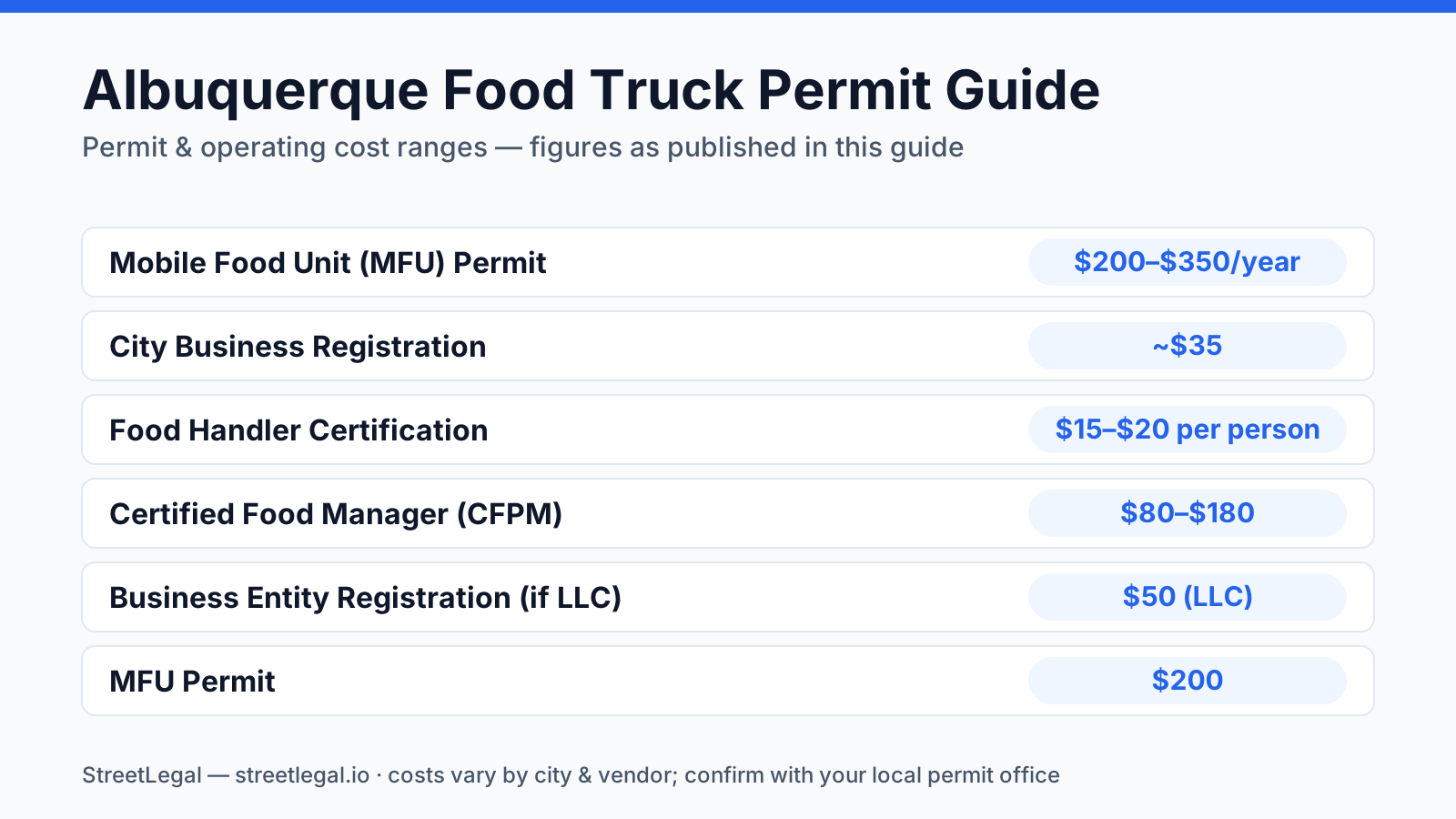
| License / Permit | Issuing Authority | Fee | Renewal |
|---|---|---|---|
| Mobile Food Unit (MFU) Permit | City of Albuquerque EHD | $200–$350/year | Annually |
| City Business Registration | City of Albuquerque Finance Dept | ~$35 | Annually |
| Food Handler Certification | NM-approved provider | $15–$20 per person | Every 2–3 years |
| Certified Food Manager (CFPM) | ServSafe / NRFSP / Prometric | $80–$180 | Every 5 years |
| NM Gross Receipts Tax (GRT) Registration | NM Taxation & Revenue Dept | Free | Permanent (file returns) |
| Business Entity Registration (if LLC) | NM Secretary of State | $50 (LLC) | Biennial report |
Step 1: The Mobile Food Unit (MFU) Permit
The MFU permit is the primary permit required to operate a food truck in Albuquerque. It's issued by the City of Albuquerque Environmental Health Department and covers trucks that prepare and serve food on-site. Without it, you cannot legally vend anywhere in the city.
What You Need to Apply
- Completed MFU application form (available from City of Albuquerque EHD)
- Proof of commissary kitchen agreement (signed, with commissary's EHD permit number)
- Vehicle information (VIN, license plate, proof of ownership or lease)
- Certified Food Manager certificate (at least one person on the truck)
- Food handler certifications for all employees
- Equipment list with manufacturer specs for all cooking and holding equipment
- Proposed menu (must match your truck's equipment capabilities)
- Three-compartment sink or NSF-certified equivalent documentation
- Proof of commercial liability insurance
The EHD Inspection Process
After submitting your application and fee, an EHD inspector will schedule a pre-opening site visit. They'll check:
- Water supply: fresh water tank (minimum capacity for your operation), wastewater tank (must exceed fresh water capacity)
- Handwashing: dedicated handwash sink with hot water, soap dispenser, and paper towels
- Three-compartment sink: wash, rinse, sanitize — separate from handwash station
- Temperature controls: thermometers, hot-holding equipment (≥135°F), refrigeration (≤41°F)
- Food storage: off-floor shelving, covered containers, date labels
- Commissary agreement: inspector will verify you have a valid, signed agreement on the truck
- Pest prevention: no gaps, sealed storage compartments, screened openings
- Menu-to-equipment match: your equipment must safely produce every item on your submitted menu
Bring Everything to the Inspection
Bring your commissary agreement, food handler certs, manager cert, vehicle registration, and insurance documentation even if not explicitly requested. Inspectors can only evaluate what they see, and missing documentation is the most common cause of re-inspection delays.
Pro Tip: Schedule Early
EHD inspection slots fill up 2–3 weeks out, especially in spring (before event season) and early fall (before Balloon Fiesta). Submit your application and schedule the inspection immediately. Don't wait until your equipment is "perfect" — you can reschedule if needed, but you can't recover a 3-week wait.
Step 2: The Commissary Requirement
The City of Albuquerque requires every food truck to have a licensed commissary kitchen. This is where you prep food before hitting the road, clean and sanitize equipment, and manage wastewater disposal at the end of each day. Without a signed commissary agreement, your MFU application will not be processed.
What the Agreement Must Include
- Name and address of the commissary kitchen
- Kitchen's current City of Albuquerque EHD permit number
- Signed by both the kitchen owner and food truck operator
- Statement of access hours and frequency of use
- Confirmation that wastewater disposal facilities are available
- Confirmation of prep space, cold storage, and cleaning facilities
Albuquerque Commissary Kitchen Costs
Albuquerque has a smaller commissary market than Houston or LA, but several licensed facilities serve the food truck community:
- Storage-only access: $200–$400/month
- Hourly kitchen rental: $15–$25/hour
- Monthly membership: $300–$800/month
- Full-service with storage: $500–$1,000/month
Commissary Availability Is Tighter Than You Think
Albuquerque has fewer licensed commissary kitchens than larger cities. Start your commissary search early — ideally before you even submit your MFU application. A signed agreement is a prerequisite for application processing, and finding the right facility can take 2–4 weeks in a tight market.
Health & Food Safety Rules That Matter in Albuquerque
Albuquerque's EHD enforces food safety standards aligned with the FDA Food Code. These are the requirements that trip up first-time operators most often:
- Certified Food Protection Manager (CFPM): At least one New Mexico-approved CFPM per truck at all times during operation. ServSafe, NRFSP, or Prometric certification accepted.
- Food handler certification: All food employees must hold a valid NM food handler card ($15–$20 each)
- Temperature control: Cold holding ≤41°F, hot holding ≥135°F — inspectors will take spot readings from your holding units
- Handwashing station: Dedicated sink (separate from food prep) with hot water, soap, and single-use paper towels
- Three-compartment sink: Required for on-truck utensil washing — wash, rinse, sanitize with correct sanitizer concentration
- UV/sun exposure protection: Albuquerque averages 310+ sunny days at 5,312 ft elevation — shade structures and UV protection for food storage and service windows are critical. Direct sun at altitude accelerates food temperature changes faster than sea-level cities.
- Water system: Fresh water tank of adequate capacity; wastewater tank must exceed fresh water capacity
Where Can You Actually Operate in Albuquerque?
Albuquerque's food truck scene is heavily event-driven and private-property based. Unlike Houston (which has no traditional zoning), Albuquerque has zoning rules that affect where you can set up. Here's what works:
Best Operating Locations
- Brewery lots: Marble Brewery, Tractor Brewing, La Cumbre Brewing, and other local breweries actively partner with food trucks. This is the bread-and-butter of Albuquerque food truck operations — reliable traffic, existing infrastructure, and built-in customer base.
- Old Town Albuquerque: Major tourist destination with heavy foot traffic in summer and fall. Requires location-specific permissions.
- Nob Hill / Central Ave: Active arts and dining corridor with strong local community traffic — especially on weekends.
- Downtown: Government and office worker lunch traffic on weekdays. Best Monday–Friday, 11am–2pm.
- UNM campus area: University of New Mexico generates consistent student lunch and event traffic throughout the academic year.
- Private property: Written landowner permission required. Shopping center lots, office parks, and church parking lots are common setups.
- Events and festivals: Balloon Fiesta (800,000+ visitors), state fair, local farmers markets — high revenue but require event-specific vendor agreements.
What to Avoid
- Public rights-of-way without specific city vending authorization
- Areas zoned exclusively residential without variance or special permit
- Within restricted distance of schools during school hours without special permission
- Event venues without a signed vendor agreement — Balloon Fiesta access is controlled and competitive
Full First-Year Cost Breakdown
| Cost Item | Low | High | Notes |
|---|---|---|---|
| MFU Permit | $200 | $350 | Annual EHD fee |
| City Business Registration | $35 | $35 | City of Albuquerque |
| Food Handler Certs (3 staff) | $45 | $60 | $15–$20 per person |
| Certified Food Manager Cert | $80 | $180 | ServSafe or equivalent |
| NM LLC Filing | $50 | $50 | NM Secretary of State |
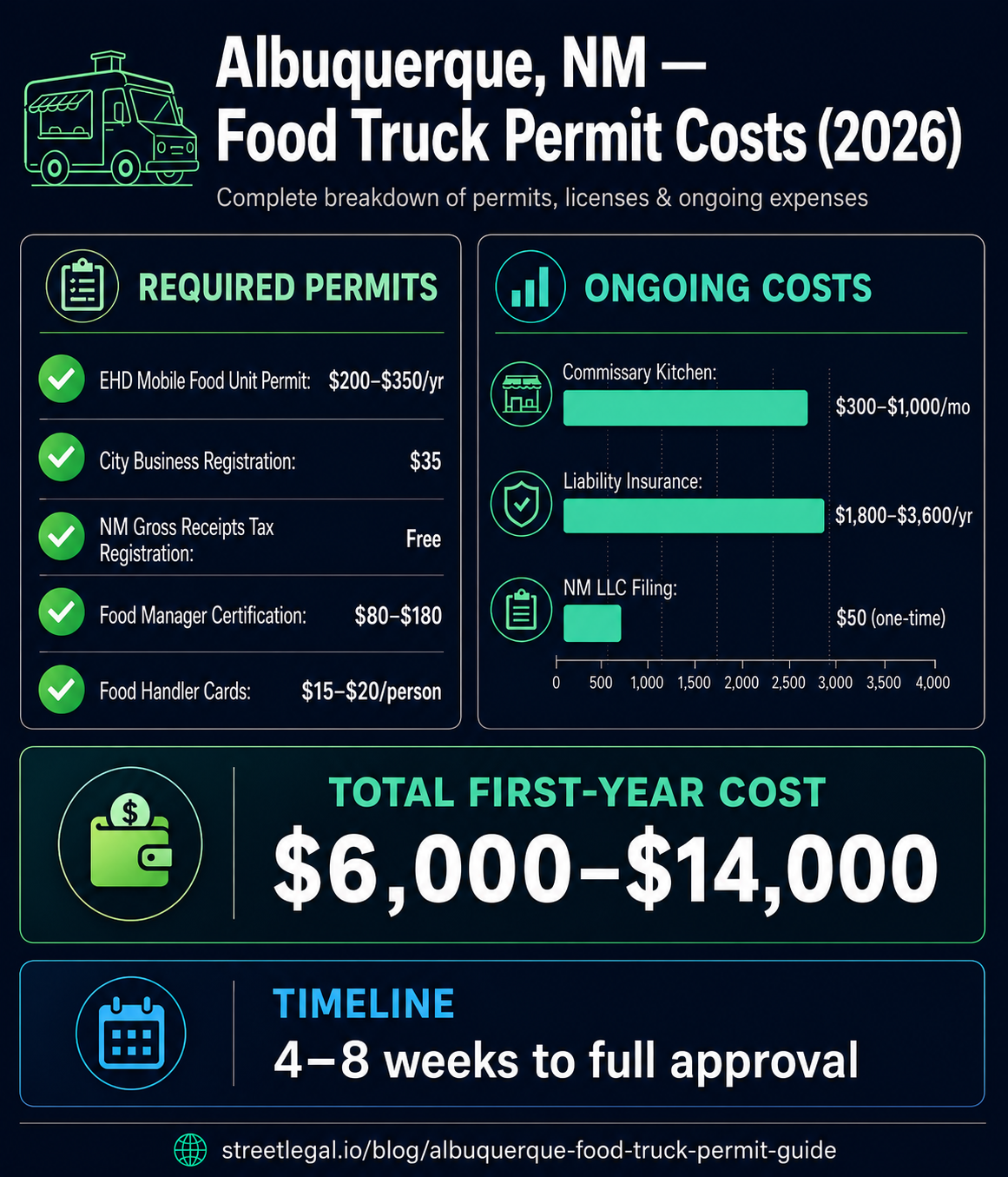
| Commissary Kitchen (12 months) | $3,600 | $9,600 | $300–$800/month depending on usage |
| Commercial Insurance | $1,800 | $3,600 | GL + vehicle + product liability |
| Fire Extinguisher / Suppression | $100 | $350 | Required if open-flame cooking |
| Total First Year | ~$5,910 | ~$14,225 | Varies widely by commissary choice |
The biggest cost variable is commissary access. A storage-only arrangement at $300/month keeps you near the low end; a full-service membership at $800/month pushes you higher. For most operators, the recurring commissary cost matters more operationally than the one-time filing fees.
Most Common Albuquerque MFU Application Mistakes
EHD delays or rejects applications for preventable reasons. These are the five that come up most:
Commissary agreement is missing required fields
Must include the commissary kitchen's EHD permit number, be signed by both parties, and specify access hours and wastewater disposal. A simple lease or informal letter won't pass review.
Menu doesn't match truck equipment
Listing raw proteins without adequate prep surfaces or temperature-controlled storage triggers a conditional fail. Only submit a menu your current equipment setup can fully support.
Treating Balloon Fiesta access as guaranteed
Balloon Fiesta vendor access is controlled by the event organization, not by your MFU permit. Having a permit doesn't mean you can vend at the event. Vendor applications are competitive and have separate deadlines — plan months ahead.
Not understanding New Mexico GRT
New Mexico's Gross Receipts Tax is not a simple sales tax — it applies to your gross receipts, not just food sales. The combined rate in Albuquerque is approximately 7.875%. Late or missed GRT filings can trigger penalties and put your business registration at risk.
Ignoring altitude and sun effects on food safety
Albuquerque sits at 5,312 ft elevation with intense UV. Direct sun heats truck surfaces and food faster than at sea level. Water boils at a lower temperature (about 202°F), which affects cooking times. Pre-chill ingredients aggressively and invest in shade structures for your service window.
Realistic Timeline to Launch in Albuquerque
Week 1–2: Formation & Food Safety
File LLC with NM Secretary of State ($50). Get your EIN from the IRS (free, online). Register for NM Gross Receipts Tax at tax.newmexico.gov (free). Everyone on the truck gets food handler certified ($15–$20 each). At least one person gets Certified Food Manager certification ($80–$180).
Week 2–3: Commissary Agreement
Find a licensed commissary kitchen, tour the facility, sign a formal agreement. Get a copy of their EHD permit number for your application. Start this early — Albuquerque has fewer commissary options than larger cities.
Week 3–4: MFU Application & Equipment Prep
Submit your MFU application to EHD with all documentation. Finalize your menu and equipment list. Ensure fire suppression system is serviced if you use open-flame cooking. Schedule your pre-opening inspection immediately — slots fill up 2–3 weeks out.
Week 4–6: EHD Inspection
EHD pre-opening inspection (bring all documentation to the truck). Allow 1–2 weeks for scheduling. If corrections are needed, address them promptly and schedule re-inspection. Register your business with the City of Albuquerque Finance Department (~$35).
Week 6–8: Licensed to Operate
Inspection passed, MFU permit issued, insurance active, GRT registration confirmed. You're legal. Secure your first operating locations — brewery partnerships, private lots, or event vendor applications — and start building your customer base.
5 Albuquerque-Specific Tips Most Guides Miss
1. Balloon Fiesta Is the Single Biggest Revenue Opportunity — Plan 6+ Months Ahead
The Albuquerque International Balloon Fiesta draws 800,000+ visitors over 9 days every October. It's one of the largest events in the Southwest. But vendor spots are competitive and applications close months before the event. If you're launching a truck in Albuquerque, your entire first-year timeline should account for Balloon Fiesta as a target. Missing the vendor application deadline means waiting a full year for the next shot.
2. Green Chile Isn't a Gimmick — It's a Competitive Advantage
New Mexico's culinary identity is built on Hatch green chile. Trucks that authentically source and use local green chile — especially during late-summer roasting season (August–September) — build brand loyalty that generic menus can't match. "Red or green?" is the state question. Have an answer.
3. Brewery Partnerships Are the Backbone of ABQ Food Truck Operations
Albuquerque has a thriving craft brewery scene — Marble, Tractor, La Cumbre, Bosque, Boxing Bear, and more. Most breweries actively want food trucks on their patios. This is often more reliable revenue than chasing random lot locations. Build these relationships early and treat them like key accounts.
4. Altitude Changes Your Cooking — Literally
At 5,312 ft elevation, water boils at about 202°F instead of 212°F. This affects cooking times for boiled, steamed, and braised items. Deep-frying behaves differently. Baking requires adjustments. If you're bringing recipes from a sea-level market, test and adjust before opening day. Experienced ABQ operators factor altitude into every menu item.
5. UNM and Sandia Base Create Consistent Weekday Demand
The University of New Mexico (25,000+ students) and Kirtland Air Force Base / Sandia National Laboratories (combined 30,000+ employees) provide consistent weekday lunch traffic that doesn't depend on tourism or events. Smart operators run weekday lunch at institutional locations and weekends/evenings at breweries and events.
Renewals: What to Track
Albuquerque permits renew annually. The MFU permit is not automatically renewed — you must proactively reapply and pay fees. Missing your renewal means operating without a valid permit, which can result in fines or shutdown.
- MFU Permit: Renew before expiration — EHD may require a renewal inspection
- City Business Registration: Annual renewal (~$35)
- Commissary agreement: Keep current and signed — a lapsed agreement can invalidate your MFU permit
- Food handler certs: Every 2–3 years (track per employee)
- CFPM certification: Every 5 years
- GRT filing compliance: Monthly or quarterly returns — keep filings current, not just registration status
- Commercial insurance: Renew before major event seasons (Balloon Fiesta, state fair)
- Fire suppression system: Service annually if required for your cooking equipment
Albuquerque Food Truck Permit FAQ
What permits do I need to operate a food truck in Albuquerque?
How long does it take to get a food truck permit in Albuquerque?
Do I need a commissary kitchen to operate in Albuquerque?
How much does it cost to get a food truck permit in Albuquerque?
What is New Mexico Gross Receipts Tax and how does it affect my food truck?
Can I vend at the Albuquerque International Balloon Fiesta?
Albuquerque vs. Other Food Truck Cities
Thinking about where to launch? Here's how Albuquerque stacks up:
| City | Main Permit Cost | Timeline | Notable Challenge |
|---|---|---|---|
| Albuquerque, NM | $200–$350 MFU | 4–8 weeks | Limited commissary market, GRT complexity |
| Houston, TX | $258 MHFD | 6–8 weeks | Ansul system, dual jurisdiction |
| Denver, CO | ~$500 combined | 6–10 weeks | Complex zoning, altitude cooking |
| Phoenix, AZ | ~$400 combined | 4–8 weeks | Extreme heat, seasonal revenue |
| Los Angeles, CA | $812 LA County | 6–10 weeks | 31 city jurisdictions in LA County |
Albuquerque is one of the more affordable and accessible food truck markets in the Southwest — lower fees than most major cities, no permit caps, and a faster timeline than Houston, Denver, or LA. The trade-offs are a smaller commissary market and the learning curve around NM Gross Receipts Tax.
Official Resources — Verify Current Requirements
- City of Albuquerque Environmental Health Dept — MFU permit application, inspection scheduling, food safety requirements
- City of Albuquerque Finance Department — Business registration for city operations
- NM Taxation & Revenue Department — Gross Receipts Tax registration and filing
- NM Secretary of State — LLC/Corp formation and annual reports
Fees and timelines shown above reflect 2026 figures. Always confirm current requirements before filing.
More New Mexico & Nearby City Guides
Operating across multiple cities? Each has its own permit requirements. Here are guides for cities near Albuquerque and across the region:
People also ask about Albuquerque food truck permits
How much does a food truck permit cost in Albuquerque?
How long does it take to get a food truck permit in Albuquerque?
Do I need a commissary kitchen to operate a food truck in Albuquerque?
What documents do I need for a Albuquerque food truck permit?
Answers to the most common permit questions — costs, timelines, commissary rules, and more.
Find city-level permit guides for every state we cover — compare costs and requirements.
More from the blog
Jefferson County, MO Food Truck Permit Guide
Complete guide to food truck permits, fees, and requirements in Jefferson County, MO.
City GuidesSt. Charles County, MO Food Truck Permit Guide
Complete guide to food truck permits, fees, and requirements in St. Charles County, MO.
City GuidesSt. Louis County, MO Food Truck Permit Guide
Complete guide to food truck permits, fees, and requirements in St. Louis County, MO.
Buyer's GuideFood Truck POS Systems 2026: Square, Toast, Clover & Avocado
Compare 2026 food truck POS systems by pricing, hardware costs, offline mode, and contract terms for Square, Toast, Clover, and Avocado.