· 12 min read · Gibby, StreetLegal Editorial

How to Start a Food Truck in Phoenix: Complete Permit Guide 2026
Phoenix is one of the fastest-growing food truck markets in the country — warm weather, sprawling suburbs, and a booming population make it ideal territory. But operating legally here means navigating permits from both Maricopa County and the City of Phoenix, plus Arizona state requirements. This guide covers everything: which permits you need, the real costs, commissary rules, and where you can actually set up.
Arizona Disclaimer
Food truck regulations in Phoenix are administered by Maricopa County Environmental Services, the City of Phoenix, and the Arizona Department of Health Services. Requirements and fees are subject to change. Always verify current rules directly with each agency before applying.
The Phoenix Food Truck Licensing Landscape
Phoenix food trucks operate within a two-tier regulatory system: county health authority and city business licensing. The good news is Arizona is relatively operator-friendly — there's no state-level food truck registration on top of county health permits.
- Maricopa County Environmental Services Department (MCESD) — Issues the Mobile Food Unit (MFU) permit, the core health permit for all food trucks operating in unincorporated Maricopa County and within Phoenix city limits
- City of Phoenix — Business license, vendor permits for operating on public property, and city-specific vending zone rules
- Arizona State Fire Marshal / Phoenix Fire Department — Fire safety inspections for cooking equipment with open flame or propane
- Arizona Department of Revenue — State Transaction Privilege Tax (TPT) license, Arizona's version of a sales tax permit
Note: If you operate in other Maricopa County cities like Scottsdale, Tempe, Mesa, or Chandler, each city may have its own business license requirements on top of the county MFU permit.
What Licenses Do You Actually Need?
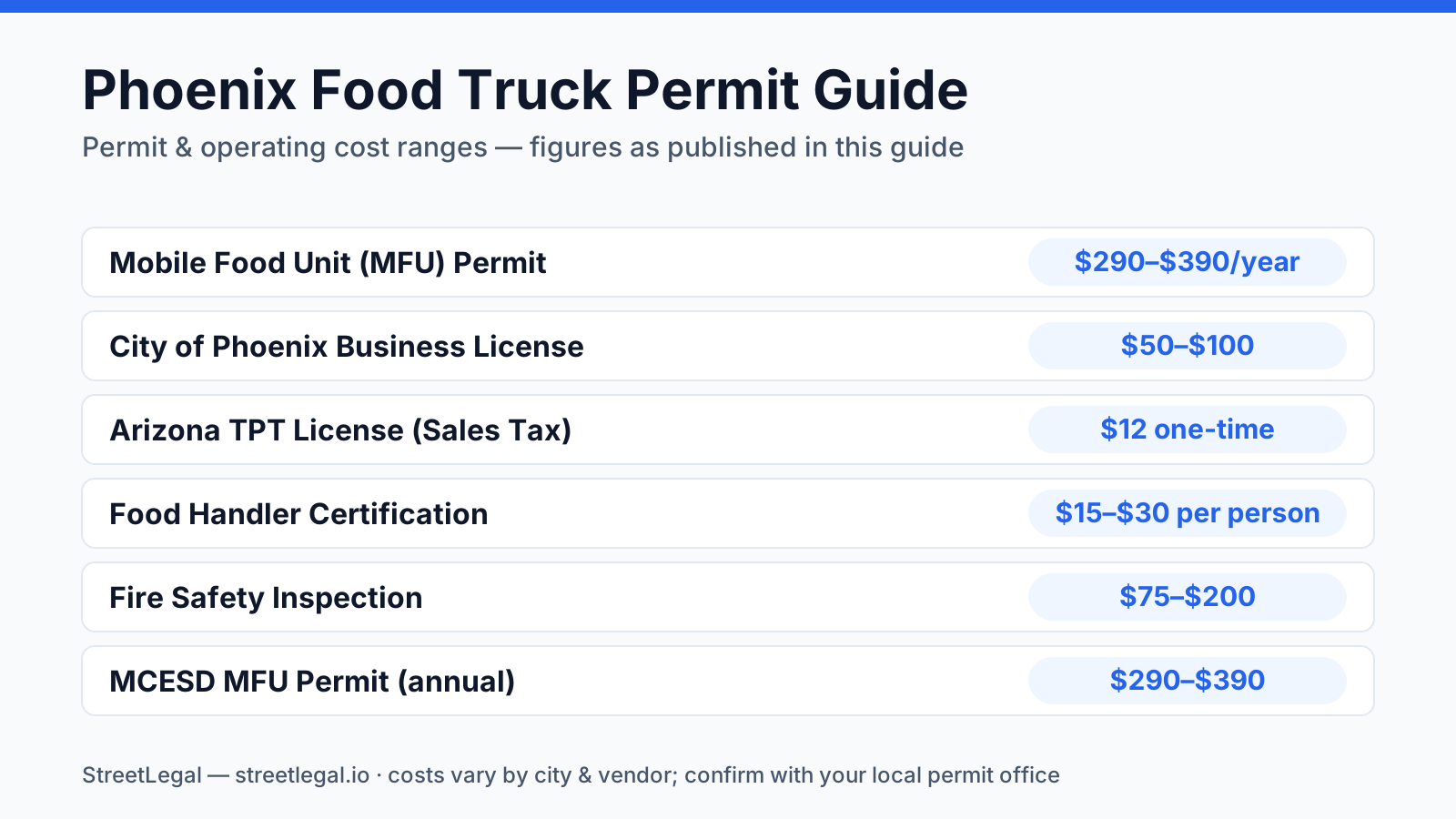
| License / Permit | Issuing Authority | Fee | Renewal |
|---|---|---|---|
| Mobile Food Unit (MFU) Permit | Maricopa County Environmental Services | $290–$390/year | Annually (Jan. 1) |
| City of Phoenix Business License | City of Phoenix | $50–$100 | Annually |
| Arizona TPT License (Sales Tax) | Arizona Dept. of Revenue (AZTaxes.gov) | $12 one-time | Permanent (file returns) |
| Food Handler Certification | ADHS-approved provider | $15–$30 per person | Every 3 years |
| Fire Safety Inspection | Phoenix Fire Department | $75–$200 | Required before MFU approval |
| Public Property Vendor Permit | City of Phoenix Street Transportation Dept. | Varies by location/event | Per event or annually |
The Maricopa County MFU Permit — Your Core Permit
The Maricopa County Mobile Food Unit permit is the foundation of your Phoenix food truck operation. Without it, you cannot legally sell food anywhere in the county. Here's what the process looks like:
Step 1: Secure a Commissary
Arizona requires all food trucks to operate from a licensed commissary kitchen. Your commissary must be:
- A licensed commercial kitchen or food facility with its own MCESD permit
- Where you store all food, clean equipment, refill water tanks, and dump wastewater
- Where you report to daily if operating a full-service food truck
You'll need a signed commissary agreement letter from your commissary operator to submit with your MFU application.
Step 2: Get Your Truck Inspected
Before MCESD approves your MFU permit, an environmental health specialist must physically inspect your truck. The inspection checks:
- Food storage temperatures and refrigeration equipment
- Handwashing sink with hot/cold water supply
- Three-compartment sink for washing, rinsing, sanitizing
- Fresh water tank capacity (minimum 30 gallons for most operations)
- Wastewater tank (must be 15% larger than freshwater capacity)
- Sneeze guards and food protection barriers
- Proper labeling of all food storage containers
Step 3: Fire Department Inspection
If your truck uses propane, natural gas, or open-flame cooking equipment, the Phoenix Fire Department must inspect your vehicle. They check:
- Type K fire suppression system (required for deep fryers and high-heat cooking)
- Propane tank mounting, connections, and shutoff valves
- Exhaust hood clearances and ventilation
- CO2 and dry-chemical fire extinguishers
- Proper separation of cooking surfaces from truck walls
Some operators choose to have the fire inspection done before the MCESD inspection to avoid scheduling two separate trips.
Step 4: Submit Your Application
Apply through the MCESD Environmental Health portal (environmental.maricopa.gov). Required documents:
- Completed MFU permit application
- Signed commissary agreement letter
- Menu with all food and beverage items listed
- Food handler certifications for all employees
- Fire inspection approval (if applicable)
- Vehicle registration / proof of ownership
Commissary Requirements in Phoenix
Phoenix has a healthy commissary kitchen market. Options include dedicated commissary facilities, shared commercial kitchen spaces, and restaurant kitchens that rent overnight access. Key rules:
What your commissary agreement must cover:
- Daily access for food prep, storage, and restocking
- Hot and cold water access for tank refill
- Grease disposal and wastewater dumping station
- Refrigerated and dry storage space for food inventory
- Space to clean and sanitize equipment
Monthly commissary costs in Phoenix typically run $300–$800/month depending on your usage level and storage needs. Some higher-volume commissaries that handle wastewater and grease disposal charge on the higher end.
Where Can You Operate in Phoenix?
Phoenix's food truck-friendly reputation is mostly earned, but there are meaningful restrictions on public property and near brick-and-mortar restaurants:
Private Property
The most common and hassle-free setup. Operating on private property (parking lots, business campuses, breweries, etc.) only requires your MCESD MFU permit and business license — no additional city vending permit needed. Get written permission from the property owner.
Public Property / Street Vending
Vending on public streets, sidewalks, and city-owned property requires a Street Use permit from the Phoenix Street Transportation Department. Key restrictions:
- Cannot operate within 300 feet of a licensed brick-and-mortar restaurant of the same food type (in some zones)
- No parking in fire lanes, bus zones, or within 15 feet of an intersection
- Maximum consecutive hours on a single street spot varies by permit type
- Downtown Phoenix has additional guidelines from the Downtown Phoenix Partnership
Food Truck Parks and Lots
Phoenix has a growing food truck park scene. Venues like the Yard PHX, Uptown Farmers Market, and various brewery lots host rotating trucks. These locations handle the property permit side — you just need your MCESD MFU permit and business license to participate.
Events and Festivals
Special events in Phoenix typically require a Temporary Food Establishment (TFE) permit from MCESD in addition to your MFU permit. Event organizers usually coordinate permitting, but confirm before you commit to a spot.

Total First-Year Cost Estimate
| Cost Item | Estimated Range |
|---|---|
| MCESD MFU Permit (annual) | $290–$390 |
| Phoenix Business License | $50–$100 |
| Arizona TPT License | $12 |
| Fire Department Inspection | $75–$200 |
| Food Handler Certifications (2 staff) | $30–$60 |
| Commissary (monthly × 12) | $3,600–$9,600 |
| Total First-Year Compliance Cost | ~$4,057–$10,362 |
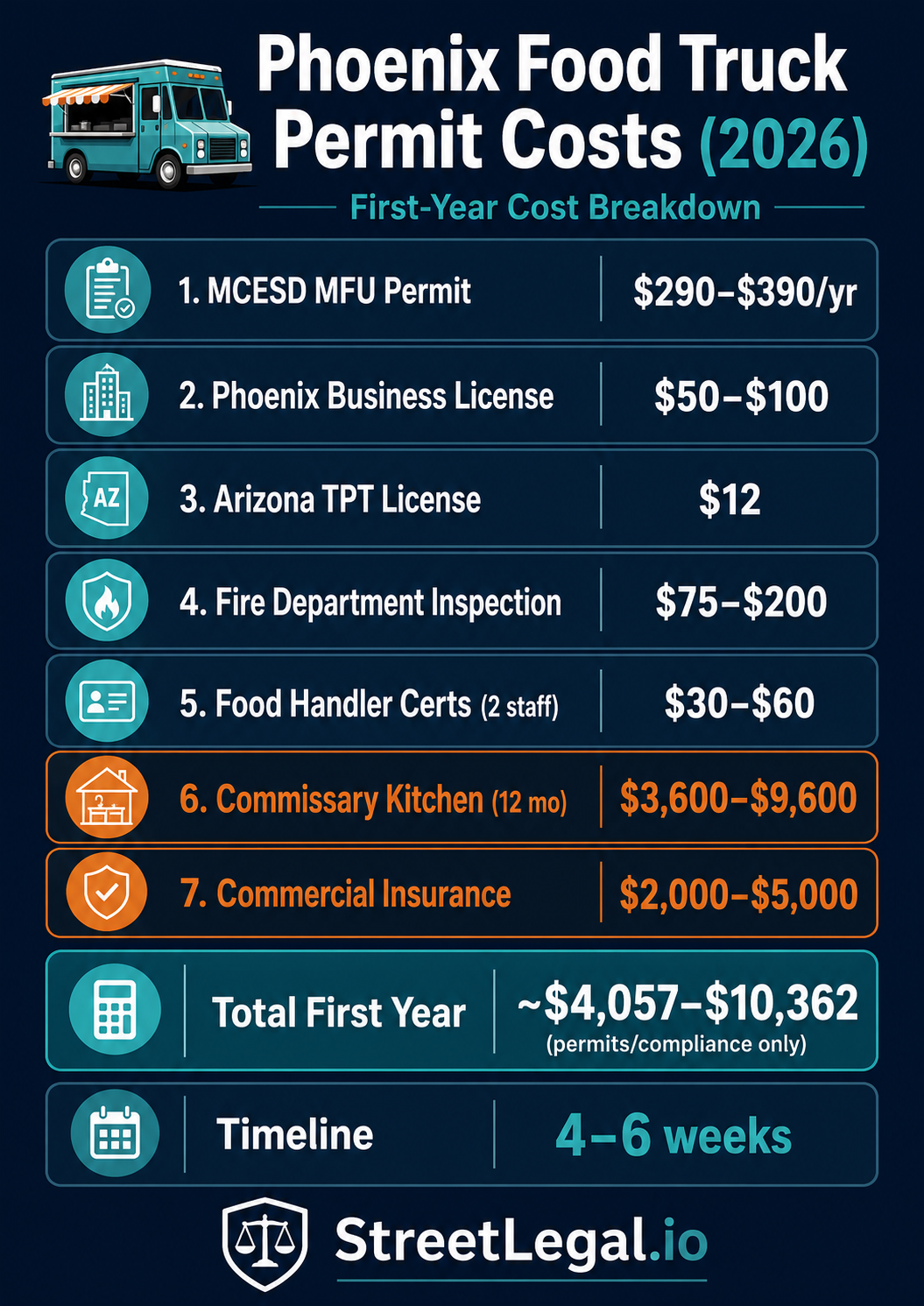
Excludes truck purchase/wrap, equipment, inventory, and insurance. Note: truck purchase/conversion, wrap, and commercial insurance (typically $2,000–$5,000/year) are separate major costs.
Realistic Permitting Timeline
Weeks 1–2: Entity setup and commissary search
Register your LLC with Arizona Corporation Commission ($50 online). Find and sign your commissary agreement. Apply for your Arizona TPT license at AZTaxes.gov.
Weeks 3–4: Equipment and truck readiness
Ensure your truck has all required sinks, tanks, and food safety equipment. Install or verify fire suppression system if cooking with open flame.
Week 5: Fire inspection
Schedule and complete Phoenix Fire Department inspection. Allow 1–2 weeks for scheduling a slot.
Week 6: MFU application and MCESD inspection
Submit your MFU permit application online. MCESD typically schedules the physical truck inspection within 2–3 weeks of application.
Week 7–8: City business license and final approvals
Apply for your Phoenix business license (phoenixbizlink.phoenix.gov). Permit typically processes in 1–2 weeks. You're ready to operate.
Phoenix Operator Tips
Heat strategy is real
Phoenix summers (June–September) regularly hit 110°F+. Most successful food truck operators shift to early morning, evening, and night service in summer, and breakfast/lunch rushes at office parks and construction sites. Plan your seasonal calendar early.
Multi-city operations require each city's license
If you operate in Scottsdale, Tempe, Mesa, or Chandler — common moves for truck routes — each municipality requires its own business license on top of your county MFU permit. Budget $50–$100 per city.
TPT is tricky for food trucks
Arizona's Transaction Privilege Tax applies to food truck sales differently depending on what you sell (prepared food vs. groceries) and whether you operate in city limits vs. unincorporated areas. Work with a CPA familiar with Arizona food service tax from day one.
Water tank sizing matters
Phoenix inspectors are strict about water tank compliance. Many operators underestimate their wastewater tank needs. Inspect your truck's tank sizes before applying — upgrading tanks after the fact is expensive and time-consuming.
Annual Renewal Checklist
- MCESD MFU Permit renewal — due January 1 each year. Apply online through the MCESD portal in November–December
- Phoenix Business License renewal — annual renewal, usually tied to your registration anniversary date
- Food handler certifications — check expiration dates for all staff (every 3 years)
- Commissary agreement renewal — ensure your agreement is current and includes all required services
- Fire suppression system service — annual service required for Type K systems; keep service records with your truck
- Arizona TPT returns — file monthly or quarterly depending on your sales volume; penalties for late filing
Related City Guides
People also ask about Phoenix food truck permits
How much does a food truck permit cost in Phoenix?
How long does it take to get a food truck permit in Phoenix?
Do I need a commissary kitchen to operate a food truck in Phoenix?
What documents do I need for a Phoenix food truck permit?
Answers to the most common permit questions — costs, timelines, commissary rules, and more.
Find city-level permit guides for every state we cover — compare costs and requirements.
More from the blog
Food Truck POS Systems: Square vs. Toast vs. Clover vs. Avocado (2026)
Real 2026 pricing, hardware costs, offline mode, and contract terms for Square, Toast, Clover, and Avocado — compared specifically for food truck operators.
City GuidesEagan, MN Food Truck Permit Guide
Eagan MN food truck permit guide: MDH mobile food licensing, Dakota County food safety, city peddler rules, commissary records, costs, and launch timeline.
City GuidesBentonville, AR Food Truck Permit Guide
Complete guide to food truck permits, fees, and requirements in Bentonville, AR.
City GuidesBiloxi, MS Food Truck Permit Guide
Biloxi food truck permit guide 2026: licenses, health permit steps, commissary records, inspections, costs, renewal timing, and launch checklist.