· 6 min read · StreetLegal Team
Madison Food Truck Permit Guide (2026)
Madison is Wisconsin's capital and second-largest city, home to the University of Wisconsin-Madison's 50,000+ students and a downtown food culture built around the Capitol Square, State Street, and the nationally recognized Dane County Farmers' Market. The city has a well-established mobile food vending program with designated street vending locations, a structured allocation process, and active enforcement. Here is what you need to know to get permitted and operating in Madison.
Permits and Licenses Required in Madison
Madison's mobile food vendor program is administered jointly by Public Health Madison and Dane County (PHMDC) and the City of Madison Clerk's Office. The required permit stack includes:
- Mobile Food Establishment License — Issued by Public Health Madison and Dane County. Apply at the PHMDC office at 2705 E. Washington Avenue, Madison. The annual license fee is $280. A pre-operational inspection of your truck is required before the license is issued. Applications open in January for the upcoming season.
- City of Madison Vending License — If you plan to operate on city streets or in designated public vending sites, you need a separate vending license from the City Clerk's Office at 210 Martin Luther King Jr. Blvd, Room 103. The vending license fee is $70 annually. Vending site assignments are made through a lottery and allocation process — more on this below.
- Wisconsin Seller's Permit — Required for all retail food sales in Wisconsin. Apply free through the Wisconsin Department of Revenue at tap.revenue.wi.gov.
- Food Manager Certification — At least one certified food protection manager per shift is required. Wisconsin accepts ServSafe and other ANSI-approved certifications. All other food handlers need basic food safety training.
Fee Schedule
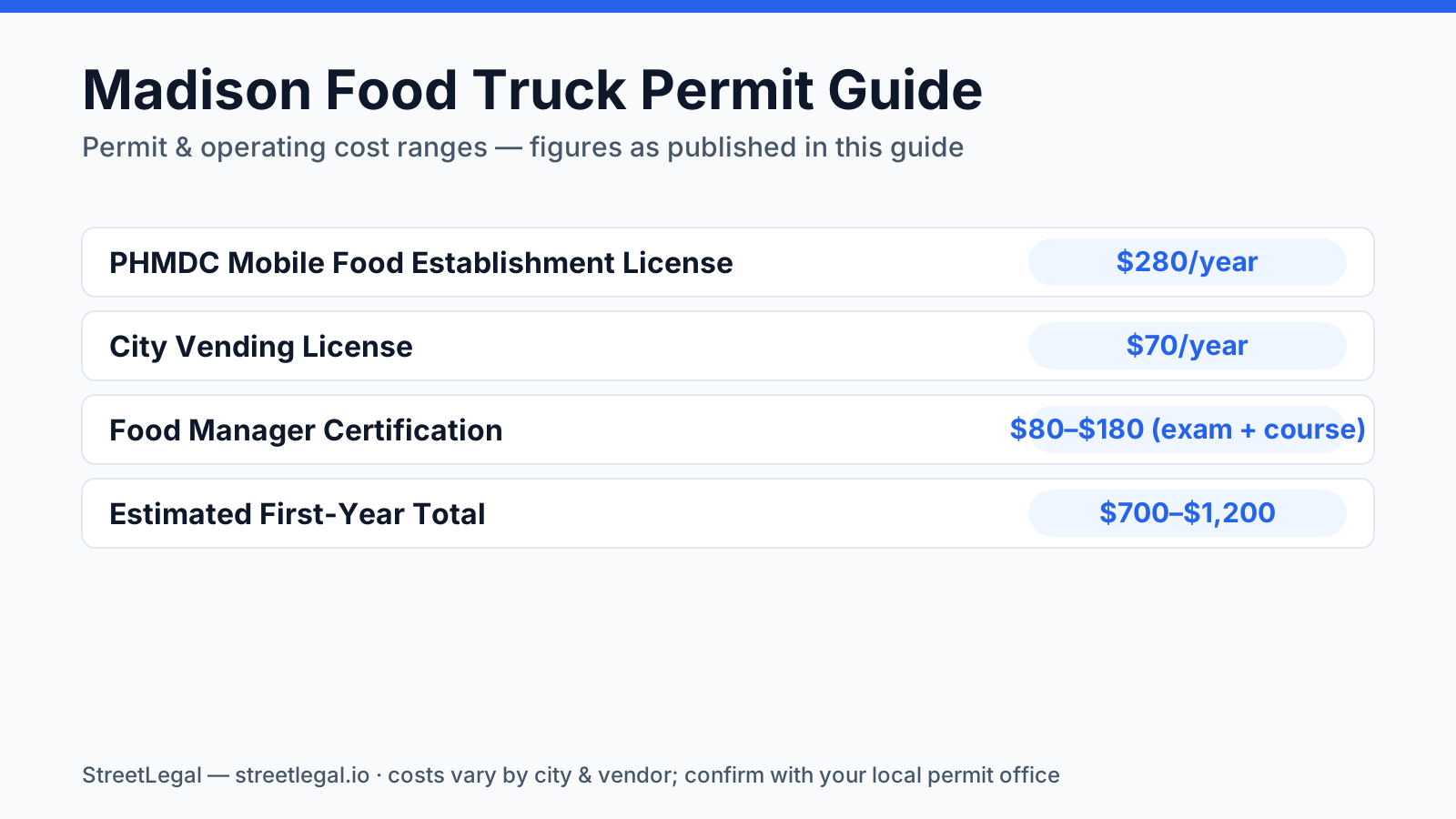
| Permit / Fee Type | Amount |
|---|---|
| PHMDC Mobile Food Establishment License | $280/year |
| City Vending License | $70/year |
| Wisconsin Seller's Permit | Free |
| Pre-Operational Inspection | Included in license fee |
| Food Manager Certification | $80–$180 (exam + course) |
| Estimated First-Year Total | $700–$1,200 |
| Renewal Period | Annual (license year runs April 1–March 31) |
The Commissary Requirement
PHMDC requires all mobile food vendors to operate from an approved commissary kitchen. Your commissary must hold a valid Dane County food establishment license and provide space for food prep, food storage, wastewater disposal, and vehicle cleaning. The signed commissary agreement must be submitted with your license application. Madison has several shared commercial kitchens that serve mobile food operators, including the FEED Kitchens facility at 1219 N. Sherman Avenue — a purpose-built shared kitchen space that is popular with Madison food truck operators and offers both licensed kitchen rental and cold storage.
Madison's Vending Site System
Madison's public vending program is more structured than most cities. The city designates specific on-street locations where food trucks and carts can operate, concentrated around the UW-Madison campus, Library Mall, and State Street corridor. Vending sites are allocated through an annual process overseen by the City Clerk's Office — this typically involves a combination of lottery and seniority. Key details:
- Library Mall — The most coveted food vending location in Madison, adjacent to the UW campus. Sites here fill quickly and returning vendors often get priority. Lunch traffic from students and university staff is extremely consistent during the academic year (September through May).
- State Street corridor — The pedestrian-oriented street between the Capitol Square and UW campus hosts designated vending spots. Foot traffic peaks during evenings and weekends, especially on Badger football game days.
- Capitol Square — On-street vending around the square is limited and regulated. The Dane County Farmers' Market, held on Saturday mornings around the Capitol Square from April through November, is a separate program with its own vendor application through the Dane County Farmers' Market board.
If you cannot secure a public vending site, you can still operate on private commercial property with the owner's written consent. This is the route many newer operators take while building their reputation.
Where Food Trucks Operate in Madison
Beyond the public vending sites, food trucks in Madison find business in these areas:
- East Washington Avenue corridor — The Yahara River District and Capitol East neighborhood have seen significant development. Breweries like Karben4, Working Draft, and Giant Jones regularly host food trucks on their patios and parking areas.
- Monroe Street / Vilas neighborhood — Near the UW campus and Henry Vilas Zoo, this area draws weekend family traffic.
- Hilldale area and West Side — Commercial districts near Hilldale Mall and along University Avenue west of campus are reliable weekday lunch areas.
- Epic Systems campus area (Verona) — Just outside Madison in neighboring Verona, the Epic Systems corporate campus employs over 10,000 people. Lunch vending near Epic and along the Verona commercial strip (note: requires a separate Village of Verona license) is a significant revenue lane.
Madison-Specific Rules and Tips
Madison's mobile food vending ordinance (Madison General Ordinances, Chapter 9.13) includes several provisions worth knowing. Food trucks must not operate within 75 feet of a restaurant's main entrance, but this restriction is reduced for trucks operating on private property with the property owner's consent. Generators must comply with the city's noise ordinance — many operators in Madison use inverter generators or rely on shore power connections to avoid noise complaints, especially in the dense campus-adjacent neighborhoods.
Madison's license year runs April 1 through March 31, which is different from many cities that use a calendar year. Plan your application timing accordingly — PHMDC begins accepting applications in January, and the pre-operational inspection must be completed before your license is issued. If you are starting mid-season, you may still apply but you will pay the full annual fee.
Wisconsin's cottage food law (Wisconsin Statute 97.30) allows some direct-to-consumer food sales without a license, but this does not apply to mobile food trucks. If you are operating a truck with cooking or hot-holding equipment, you need the full PHMDC mobile food establishment license.
Events and Seasonal Opportunities
Madison's event calendar is driven by UW-Madison's academic and athletics schedule. Badger football game days (7 home games per season at Camp Randall Stadium) are premium vending events — operators often report their highest single-day revenue on game days. Beyond athletics, Taste of Madison (typically held in September on the Capitol Square) is the city's largest food festival, and food trucks can apply for vendor spots. The Dane County Farmers' Market (April–November, Saturday mornings) draws 20,000+ weekly visitors. Madison's Isthmus Beer & Cheese Fest, Concerts on the Square at the Capitol, and the Willy Street Fair are all events where food trucks are actively recruited.
What operators in Madison should do before they apply
Before you submit anything, make sure your truck setup, menu, certifications, and support documents all match each other. PHMDC is thorough — they will inspect your truck against your submitted equipment list and menu before issuing your license.
Contact Public Health Madison and Dane County at (608) 266-4821 and the City Clerk's Office at (608) 266-4601 before treating any checklist as final. StreetLegal organizes the full permit stack, but operators should always confirm the latest official instructions right before filing.
The licensing and inspection process typically takes 3-5 weeks. Since the license year starts April 1 and the season ramps in May, plan to apply in January or February to be ready for the start of the outdoor season. If you are targeting a public vending site, the allocation process happens even earlier.
How to use this guide well
Use this guide as a preparation tool, not just a reading piece. Build your own permit packet, note which documents you already have, and flag every dependency that still needs a real owner. The fastest operators do not just gather information — they turn it into a sequence: business setup, permit application, inspections, venue approvals, and renewal tracking.
If you plan to expand beyond Madison, the surrounding communities of Middleton, Fitchburg, Sun Prairie, and Verona each require their own licenses but operate under the same Dane County health authority. That shared county health framework is exactly where a tracked permit system becomes more valuable than a one-off checklist.
Auto-fill your Madison permit application
StreetLegal can pre-fill your permit forms using your truck profile and uploaded documents.
Get Started FreePeople also ask about Madison food truck permits
How much does a food truck permit cost in Madison?
How long does it take to get a food truck permit in Madison?
Do I need a commissary kitchen to operate a food truck in Madison?
What documents do I need for a Madison food truck permit?
Answers to the most common permit questions — costs, timelines, commissary rules, and more.
Find city-level permit guides for every state we cover — compare costs and requirements.
More from the blog
Elgin Food Truck Permit Guide 2026 | StreetLegal
Elgin, IL food truck permit guide 2026: Kane County mobile vendor fees, Elgin business license, commissary rules, inspections, parking limits, and launch checklist.
City GuidesElk Grove Food Truck Permit Guide 2026 | StreetLegal
Elk Grove food truck permits in 2026: Sacramento County health permit, city business license, fire review, commissary paperwork, costs, timeline, and launch checklist.
City GuidesColumbus, OH Food Truck Permit Guide
Complete guide to food truck permits, fees, and requirements in Columbus, OH.
City GuidesColumbus, GA Food Truck Permit Guide
Complete guide to food truck permits, fees, and requirements in Columbus, GA.