· 7 min read · StreetLegal Team
Hidden Costs of Running a Food Truck Nobody Tells You About (2026)
Updated August 1, 2026
The obvious costs of running a food truck are easy to name: food, labor, commissary, fuel, insurance, permits, and repairs. The hidden costs are quieter. They show up as missed service days, duplicate paperwork, spoiled prep, event requirements you did not price into the fee, or a renewal that blocks a profitable weekend. This guide focuses on those operational leaks, not another broad annual budget list.
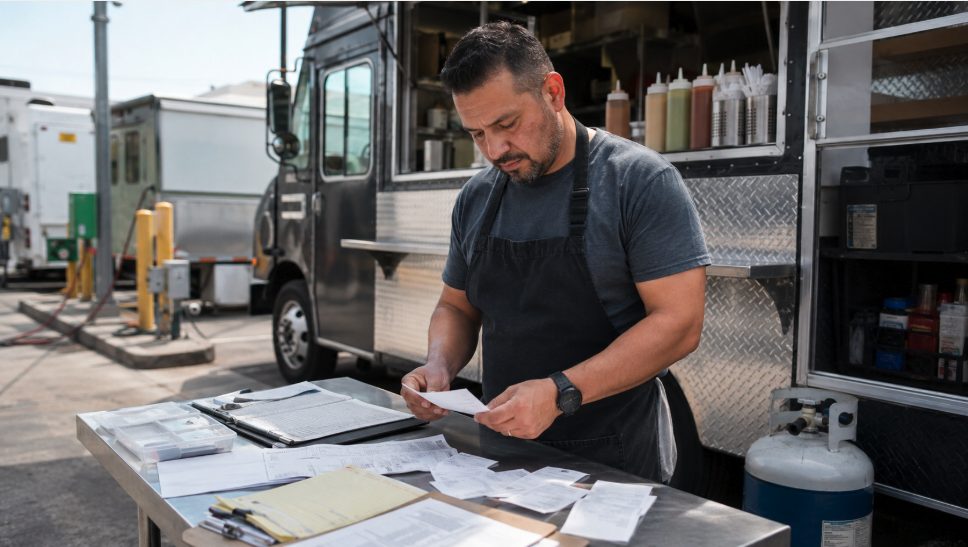
Paperwork drift
The Small Business Administration tells business owners to stay legally compliant by keeping licenses, permits, and tax obligations current. For food trucks, that general advice becomes a day-to-day operating risk because one missing renewal can block an inspection, an event application, a commissary agreement, or a delivery-platform listing.
The hidden cost is not just the renewal fee. It is the time spent finding the certificate, calling the agency, rescheduling the inspection, or losing a weekend because the organizer asked for an updated insurance certificate and you could not produce it quickly.
Downtime and rush repairs
Food truck maintenance is expensive in two ways: the invoice and the lost selling time. A generator failure, refrigeration issue, tire problem, hood system issue, or water-pump problem can turn a normal repair into a missed lunch service. If the repair has to happen before a booked event, rush work can also force you into whatever vendor is available.
The practical fix is a maintenance calendar tied to service intervals and seasonality. Check refrigeration before summer events, generator load before festival season, tires before long-distance weekends, and fire-suppression service before renewals or event deadlines.
Event friction
Event costs are not only booth fees. Operators often need extra insurance language, temporary food paperwork, fire inspection proof, generator restrictions, load-in timing, parking instructions, staff badges, menu approval, or proof that the truck is tied to an approved commissary. Each requirement is manageable alone. Together, they become a real admin cost.
Before accepting an event, ask for the full vendor packet and build an event-specific checklist. If the event requires extra staffing, special packaging, a different menu, overnight prep, or a long deadhead drive, price that into the decision instead of comparing only the vendor fee to expected sales.
Waste and menu creep
A truck menu can quietly get too wide. Every extra garnish, sauce, protein, packaging size, and special-order variation adds prep, storage, spoilage risk, and service complexity. Waste is not only food thrown away at the end of service; it is labor spent prepping items that slow the line or sell only at one stop.
Review the menu by contribution, not popularity alone. A popular item that requires a separate prep process, special packaging, or slow assembly may be less valuable than a simpler item with steadier throughput.
Payment and ordering friction
Payment problems create hidden costs because they happen during the rush. A bad cellular connection, failed reader, confusing QR page, stale online menu, or printer issue can slow the window and make staff rebuild orders by hand. Direct online ordering and POS tools can help, but only if they are tested at the actual service location, not just at the commissary.
Keep a backup payment plan, a printed short menu, and a clear rule for pausing online orders when the truck is overwhelmed. A temporary pause is cheaper than refunds, angry customers, and a line that stops moving.
How to control hidden costs
| Hidden cost | Monthly control |
|---|---|
| Renewal and permit drift | One calendar with health, fire, business, insurance, vehicle, and commissary dates. |
| Repair downtime | Preventive maintenance checklist and pre-event inspection routine. |
| Event admin | Standard vendor packet folder with permits, W-9, insurance, menu, photos, and commissary agreement. |
| Food waste | Weekly prep-vs-sales review by menu item and location. |
| Payment friction | Backup reader, offline plan, and a rule for pausing online orders. |
Frequently asked questions
What hidden cost do food trucks miss most often?
Paperwork time. Renewals, insurance certificates, commissary letters, event forms, and inspection scheduling can quietly consume hours and block revenue if they are not organized.
Is this different from annual food truck expenses?
Yes. Annual expenses are the big budget categories. Hidden costs are the operational leaks that make those categories worse: downtime, waste, duplicate paperwork, missed events, and rushed decisions.
How often should operators audit hidden costs?
Monthly is enough for most trucks: review renewals, repair notes, refunds, waste, event performance, and ordering problems before they become expensive patterns.
Keep your food truck permits, insurance, and renewal dates in one place.
StreetLegal keeps food truck permits, insurance, commissary records, and renewal dates organized so operators spend less time chasing documents and more time selling.
Answers to the most common permit questions — costs, timelines, commissary rules, and more.
Find city-level permit guides for every state we cover — compare costs and requirements.
More from the blog
Jefferson County, MO Food Truck Permit Guide
Complete guide to food truck permits, fees, and requirements in Jefferson County, MO.
City GuidesSt. Charles County, MO Food Truck Permit Guide
Complete guide to food truck permits, fees, and requirements in St. Charles County, MO.
City GuidesSt. Louis County, MO Food Truck Permit Guide
Complete guide to food truck permits, fees, and requirements in St. Louis County, MO.
Buyer's GuideFood Truck POS Systems 2026: Square, Toast, Clover & Avocado
Compare 2026 food truck POS systems by pricing, hardware costs, offline mode, and contract terms for Square, Toast, Clover, and Avocado.