· Updated · 7 min read · StreetLegal Team
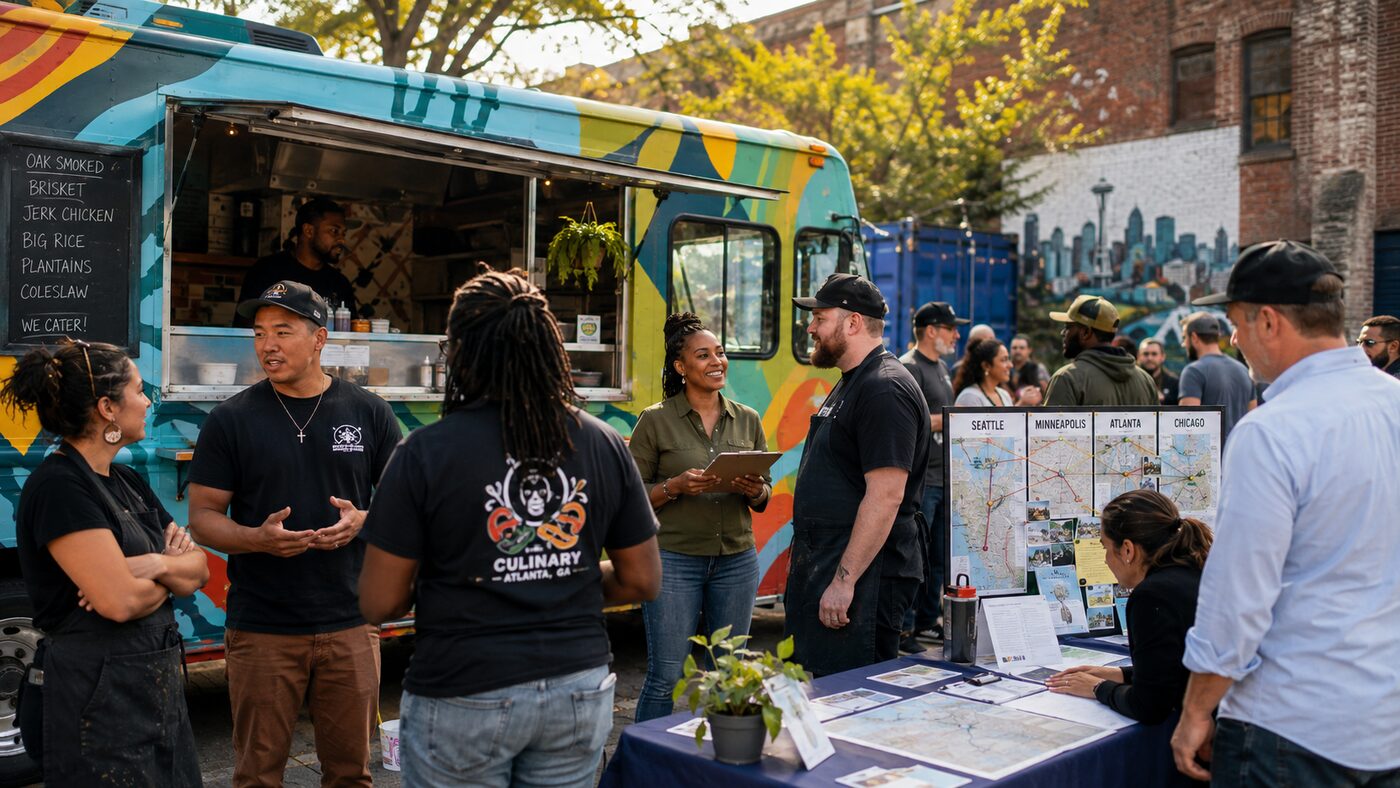
What Food Truck Support Looks Like City by City: Seattle, Minneapolis, Atlanta and Chicago Compared
Updated August 4, 2026
Food truck operators rarely struggle because one permit page is impossible to find. They struggle because support is scattered: a health license over here, city business licensing somewhere else, vending rules in another department, and economic-development help on a page that does not mention trucks at all.
Side-by-side comparison
| Market | Official resources surfaced | What the operator still has to connect |
|---|---|---|
| Seattle | Start a Business, city business licenses, consulting services, grants and funding, Seattle Restored. | How general small-business help connects to mobile food vending, health approvals, and real operating locations. |
| Minnesota / Minneapolis | Minnesota Department of Agriculture food licenses, cottage food registration, license lookup. | State food licensing versus local city vending, parking, commissary, and event rules. |
| Atlanta | City vending program, private-property vending page, ATLBIZ business portal. | Where the truck can vend, how property permission works, and which approvals apply outside the vending-program lane. |
| Chicago | Chicago Business Licensing portal. | Health, vehicle, parking, route, and operating details that are not solved by a portal link alone. |
Seattle: broad small-business support
Seattle's official resource stack is the most built out of this group. The Office of Economic Development points businesses toward start-a-business guidance, consulting services, grants and funding, and Seattle Restored. City Finance separately maintains business-license resources. For a food truck operator, that means Seattle offers more than a licensing portal: there are business-support and funding pathways worth checking before launch.
The catch is that broad support is not the same as a mobile-vending checklist. A truck still has to connect business guidance to health permits, commissary requirements, parking/location rules, and event or private-property permissions.
Minnesota and Minneapolis: state food-license clarity, local layers still matter
The Minnesota Department of Agriculture's Food and Feed Safety Division maintains food-license resources, cottage food producer registration, and a license/registration lookup tool. That is useful for operators because it gives a state-level place to verify food-business licensing and registration concepts.
For Minneapolis-area mobile food vendors, the state resource is only one layer. City vending, parking, event access, commissary fit, fire review, and private-property permissions can still live outside the state food-license page.
Atlanta: vending program plus private-property path
Atlanta's official material points operators toward the City Vending Program, a Private Property Vending page, and the ATLBIZ business portal. That is valuable because it separates public vending from private-property vending instead of treating every truck stop as the same kind of approval.
The operator still has homework: property-owner permission, food-safety approval, business registration, event-specific rules, water/waste logistics, and the practical question of where the truck can actually serve customers without blocking traffic or violating site rules.
Chicago: a portal is a start, not a launch plan
Chicago's Business Affairs and Consumer Protection resource path points businesses to the city's Business Licensing portal. A portal is helpful for starting the licensing search, but it is not the same thing as a complete truck launch plan.
Food truck operators still need to map licensing to health rules, equipment, commissary paperwork, parking and service-location limits, insurance, fire or propane questions, and event organizer requirements. The city link starts the process; it does not replace a compliance checklist.
The operator lesson
The best city resource is not always the longest page. It is the resource stack that helps an operator answer five practical questions: can I license the food operation, can I register the business, can I vend at the location I want, can I get help if I am stuck, and can I prove everything before an event asks for documents?
Seattle is strongest on broad small-business support. Minnesota is clearer on state food-license resources. Atlanta is useful because it names public and private-property vending paths. Chicago shows the minimum viable starting point: a business-licensing portal that still requires the operator to assemble the rest.
Frequently asked questions
Which city has the most complete support stack here?
Seattle stands out because its official pages include business startup guidance, licensing, consulting, grants and funding, and Seattle Restored.
Does a business portal mean a food truck is ready to launch?
No. A portal is only the start. Mobile food vendors still need health, commissary, insurance, fire, parking, vending, and event-location checks.
Why does this matter for StreetLegal?
Because the real work is consolidating scattered agency links into one launch path a food truck operator can actually follow.
Scattered resources should not become scattered operations.
StreetLegal helps food truck operators organize permits, renewal dates, commissary documents, insurance, and city-specific launch steps in one place.
Answers to the most common permit questions — costs, timelines, commissary rules, and more.
Find city-level permit guides for every state we cover — compare costs and requirements.
More from the blog
Jefferson County, MO Food Truck Permit Guide
Complete guide to food truck permits, fees, and requirements in Jefferson County, MO.
City GuidesSt. Charles County, MO Food Truck Permit Guide
Complete guide to food truck permits, fees, and requirements in St. Charles County, MO.
City GuidesSt. Louis County, MO Food Truck Permit Guide
Complete guide to food truck permits, fees, and requirements in St. Louis County, MO.
Buyer's GuideFood Truck POS Systems 2026: Square, Toast, Clover & Avocado
Compare 2026 food truck POS systems by pricing, hardware costs, offline mode, and contract terms for Square, Toast, Clover, and Avocado.