· 12 min read · Gibby, StreetLegal Editorial
How to Start a Food Truck in Detroit, MI: Complete Permit Guide 2026
Updated June 19, 2026 — Wayne County Health Department permit process, BSEED mobile vending rules, commissary requirements, and Detroit operating locations reviewed for 2026.
Detroit's food truck scene has transformed alongside the city's revival — Eastern Market weekends, Midtown lunch crowds, Corktown breweries, and a festival calendar that runs hot from May through October. Getting licensed here means working through the Wayne County Health Department, Detroit BSEED, the Fire Marshal's office, and Michigan's Department of Treasury. This guide covers every permit you need, actual fee ranges, the step-by-step sequence, and where Detroit operators are actually making money in 2026.
Permit Snapshot — Every Agency, Fee, and Sequence
Detroit food truck permitting touches four separate agencies. Here's every requirement in the order you need to complete it.
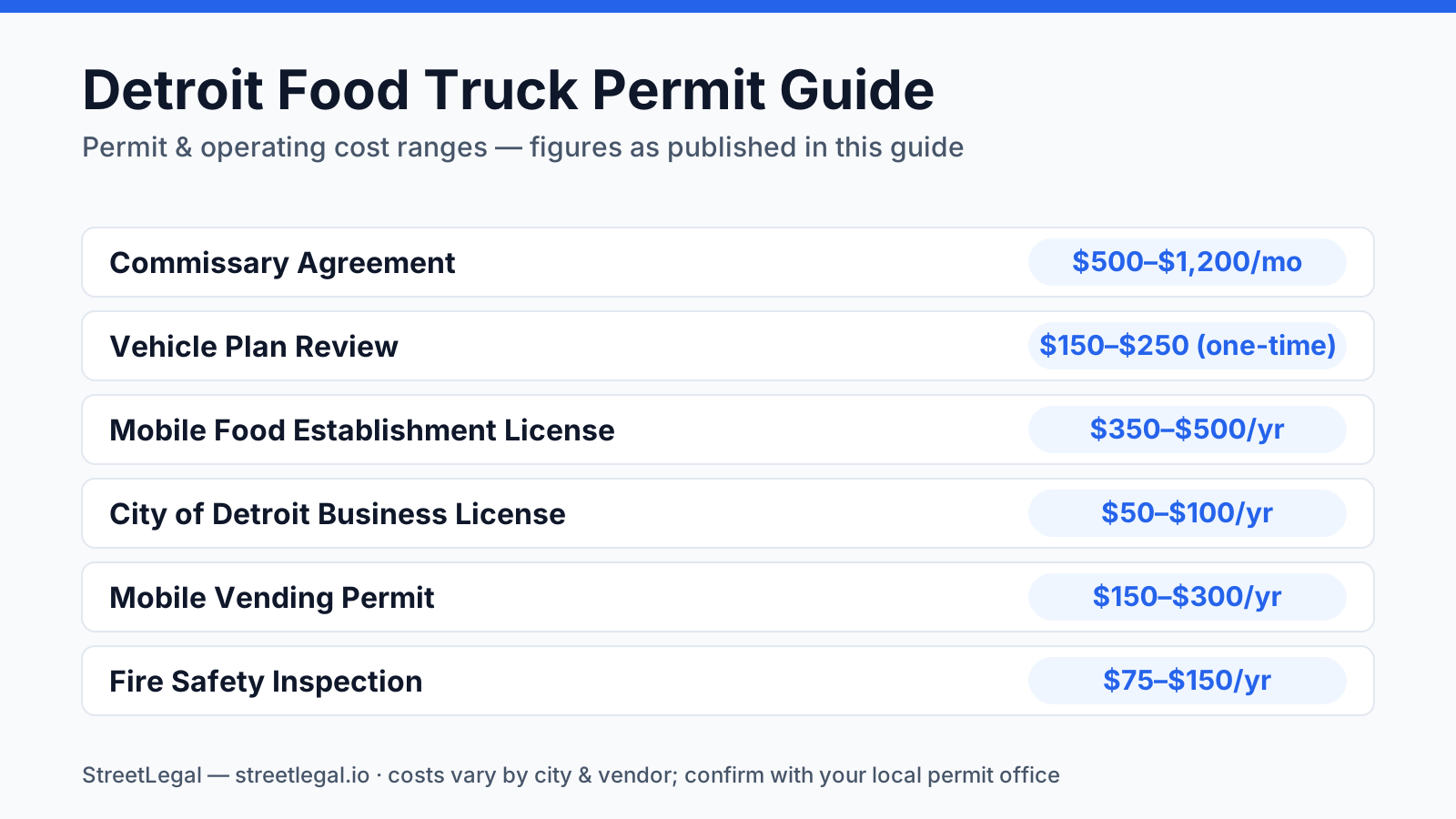
| Permit / License | Agency | Annual Fee | Notes |
|---|---|---|---|
| Commissary Agreement | Wayne County–approved kitchen | $500–$1,200/mo | Required before health permit application; get this first |
| Vehicle Plan Review | Wayne County Health Dept | $150–$250 (one-time) | Submit equipment layout, menu, water/waste specs |
| Mobile Food Establishment License | Wayne County Health Dept | $350–$500/yr | Core health permit; requires plan review approval + commissary letter |
| City of Detroit Business License | Detroit BSEED | $50–$100/yr | Required for all commercial activity in Detroit |
| Mobile Vending Permit | Detroit BSEED | $150–$300/yr | Required only for public street / sidewalk vending |
| Fire Safety Inspection | Detroit Fire Marshal | $75–$150/yr | Covers suppression system, propane, extinguishers |
| Michigan Sales Tax License | Michigan Dept of Treasury | Free | Apply via Michigan Treasury Online (MTO); 6% state sales tax on prepared food |
| Food Manager Certification | ServSafe or ANSI-approved | $100–$175 (every 5 yrs) | Required for at least one person on the truck at all times |
Step-by-Step: How to Get Licensed in Detroit
The order matters — some applications require documents from prior steps. Work through these sequentially to avoid delays.
-
1
Secure a Commissary Kitchen Agreement
Find a Wayne County–approved commissary kitchen and sign a written agreement. Detroit has several established options: Prep Detroit in Eastern Market and Kitchen Connect on Michigan Avenue both serve food truck operators well. Expect to pay $500–$1,200/month depending on hours and storage. You need a signed commissary letter before your health permit application is accepted — get this first.
-
2
Complete Vehicle Plan Review ($150–$250)
Submit your equipment layout, menu, and water/waste system specs to the Wayne County Health Department. Inspectors review that your truck meets Michigan Food Law requirements — proper handwash sink, three-compartment wash station or approved alternative, adequate refrigeration, and a fire suppression system. Plan review approval is required before your license application is accepted.
-
3
Apply for Mobile Food Establishment License ($350–$500/yr)
Apply through the Wayne County Health Department with your commissary agreement, plan review approval, vehicle registration, and a current Michigan Food Manager Certification (ServSafe or ANSI-equivalent). An inspector will visit your truck before the license is issued. Budget 2–4 weeks for this step — inspector availability varies.
-
4
Register with City of Detroit BSEED
File for a City of Detroit Business License through BSEED (~$50–$100/yr). If you plan to vend on public streets or sidewalks, also apply for a Mobile Vending Permit at the same time (~$150–$300/yr). Private lots — brewery patios, office parking lots, event venues — don't require the Mobile Vending Permit, but you still need written permission from the property owner.
-
5
Obtain Michigan Sales Tax License (Free)
Register with the Michigan Department of Treasury via Michigan Treasury Online (MTO). This is free and fast. Michigan's state sales tax rate is 6%, and prepared food is taxable. You'll need this before your first transaction.
-
6
Pass Detroit Fire Marshal Inspection ($75–$150)
Contact the Detroit Fire Marshal's office to schedule an annual inspection. Inspectors check your fire suppression system (must have a current service tag — serviced within the last 6 months), propane tank mounting and connections, exhaust ventilation, and K-class extinguisher placement. Run this in parallel with your health inspection to save time.
Commissary Requirements in Detroit
Wayne County requires all mobile food units to operate from a licensed commissary — there's no exception for fully self-contained trucks. Your commissary is where you legally store food, wash equipment, and dispose of wastewater and grease. You must provide a signed agreement from the commissary owner with your health permit application.
What Your Commissary Agreement Must Confirm
- • The commissary holds a valid Wayne County food establishment permit
- • You have designated access hours and storage space
- • They will provide wastewater disposal and grease trap access
- • The owner's signature and contact info appear on the letter
If your commissary loses its license or closes, your Mobile Food Establishment License becomes invalid until you secure a new agreement and notify Wayne County. Visit your commissary in person before signing — check refrigerator capacity, available storage shelves, hours of access, and proximity to your primary vending areas.
Detroit commissary costs typically run $500–$1,200/month depending on the facility and how many hours of kitchen access you need. Some commissaries offer daytime-only packages at the lower end; operators who need early-morning prep access pay more.
Total First-Year Cost Estimate
First-Year Budget Breakdown
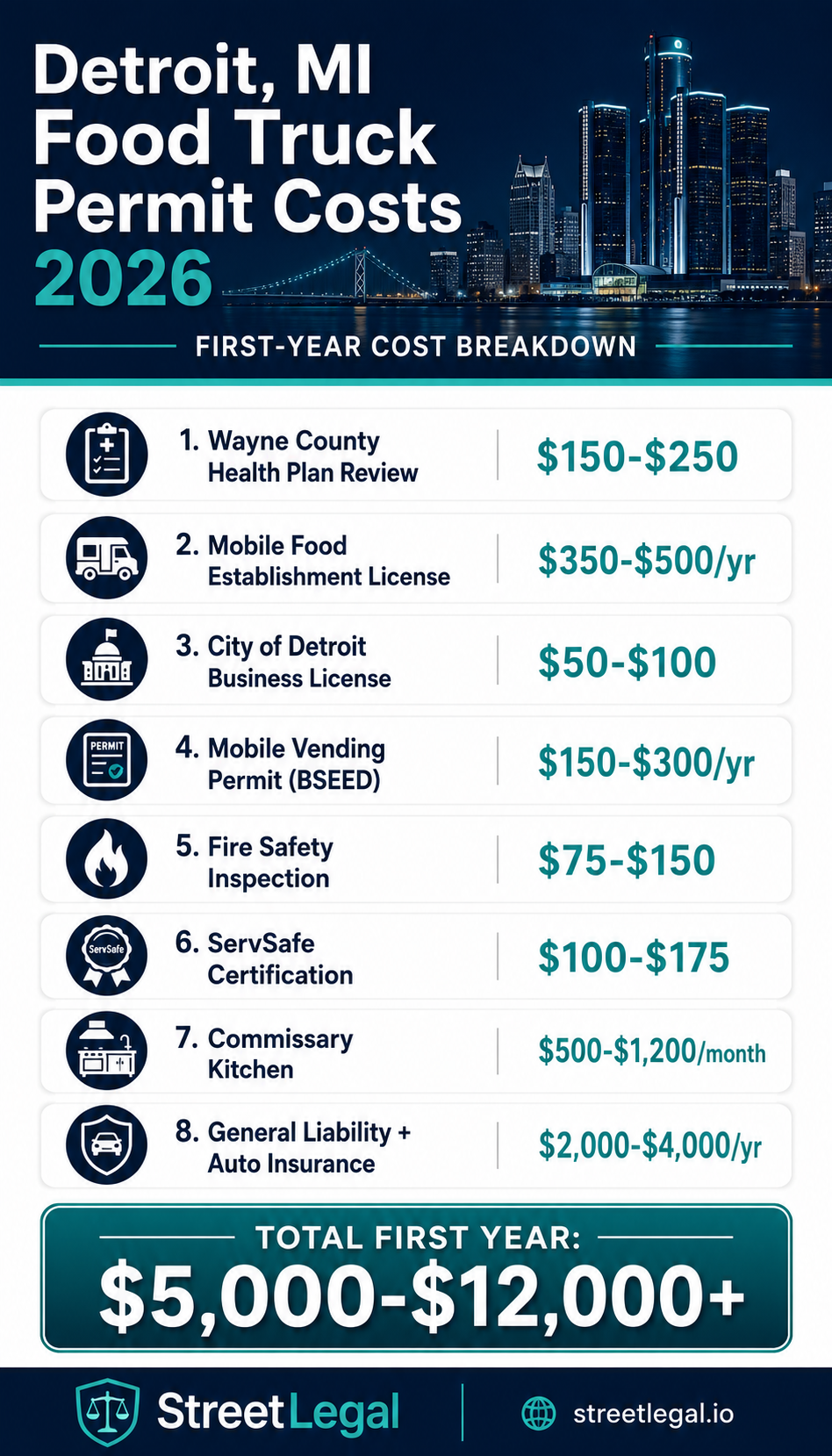
- Health Dept Plan Review (one-time)$150–$250
- Mobile Food Establishment License$350–$500
- City of Detroit Business License$50–$100
- Mobile Vending Permit (if operating public streets)$150–$300
- Fire Safety Inspection$75–$150
- ServSafe Food Manager Certification$100–$175
- Total Permit Costs$875–$1,475
Add to that your operating overhead: commissary rent ($6,000–$14,400/year), general liability plus commercial auto insurance ($2,000–$4,000/year), and your Michigan Sales Tax License (free). Total first-year compliance spend typically lands between $9,000–$20,000 when you include commissary and insurance — lower than most coastal markets.
Year-two costs drop significantly: no plan review fee, lower permit renewal rates, and you'll have your ServSafe cert locked in for five years. Most operators find their recurring annual permit overhead around $700–$1,100 after the first year.
Where You Can Actually Operate in Detroit 2026
Detroit's BSEED regulates where mobile vendors can operate on public property. Downtown and Midtown have designated vending zones, and some blocks are restricted during certain hours. Private lots don't require a Mobile Vending Permit, but you still need written permission from the property owner. Here's where Detroit operators are making real money:
Eastern Market
The biggest single opportunity in Detroit. Saturday Market draws enormous crowds year-round, and specialty Sundays (Flower Day, Eastern Market After Dark, Shed 5 events) add lucrative bonus dates. Vendor spots fill up — apply well in advance and build relationships with the Eastern Market Corporation.
Downtown — Campus Martius and Hart Plaza
The strongest weekday lunch corridor in Detroit. High-density office workers and hotel guests. Hart Plaza hosts major events (Movement, Detroit Grand Prix, River Days) that can generate more revenue in a weekend than a month of regular spots. Lock in event vendor applications by February.
Midtown — Wayne State and Detroit Medical Center
Consistent demand from students, hospital workers, and residents. The Wayne State campus generates reliable lunch traffic, and the medical district runs year-round. Lower event peaks than Downtown but steadier daily volume.
Corktown — Brewery and Bar Circuit
Corktown's craft brewery scene (Batch Brewing, Craft Work) regularly partners with food trucks for Thursday–Saturday dinner service. Private lot placement means no Mobile Vending Permit required — just coordinate directly with the venue. Strong weekend nights and Tiger/Lion game days at nearby Michigan and Trumbull.
New Center and North End
Growing neighborhood with lower competition than Downtown and Midtown. Fisher Building and General Motors HQ area generate consistent lunch traffic. Underserved relative to its daytime population — good territory for operators who want less competition.
Seasonal Reality Check
Detroit's festival season runs hot May through October — that's when most food truck revenue is made. November through March is genuinely difficult: outdoor crowds drop dramatically, events are scarce, and commissary costs don't pause. Most successful Detroit operators budget accordingly, shifting to catering and private events in winter to keep margins positive.
Best Food Truck Types for Detroit
Detroit's diverse food culture and specific neighborhood mix favor certain concepts. What works here:
- ✓Mexican and Latin street food — Mexicantown is one of the strongest Mexican food communities in the Midwest. There's high demand for authentic tacos, tortas, and street corn throughout the city, especially at events.
- ✓BBQ and smoked meat — Strong year-round demand in Detroit, especially at Eastern Market, festivals, and catering for private events and corporate accounts.
- ✓Global fusion and Southeast Asian — Detroit's international communities (Hamtramck has one of the highest immigrant population densities in the US) create demand for bold, international flavors that stand out from standard American fare.
- ✓Upscale comfort food and burgers — Midtown and Downtown lunch crowds respond well to elevated takes on comfort classics. Higher price points are sustainable in these zones.
- ✓Breakfast and coffee trucks — Morning demand around Downtown office corridors and medical district is underserved. Breakfast burritos, sandwiches, and specialty coffee pair well with commuter timing.
- —Dessert-only concepts — Viable at events and festivals but difficult to sustain as a primary model given Detroit's winters. Better as a secondary revenue stream.
Detroit vs Other Michigan Markets
| City | Health Permit | Market Size | Key Advantage |
|---|---|---|---|
| Detroit | Wayne County ($350–$500/yr) | Largest in MI | Festival circuit, Eastern Market, Midtown density, diverse food culture |
| Grand Rapids | Kent County | Strong secondary | Massive craft beer scene, ArtPrize, growing downtown, less competition |
| Lansing | Ingham County | Smaller, steady | Government + MSU community; lower commissary costs; less saturation |
Detroit is the strongest Michigan market by volume but also the most competitive and most affected by seasonal swings. Grand Rapids has seen explosive food truck growth driven by its brewery scene and ArtPrize events. Lansing is smaller but stable — good for operators who want predictable volume without Detroit's winter revenue drop-off. Each Michigan county issues its own health permit, so operating across markets requires separate county licenses.
Common Mistakes and Operator Tips
Don't wait on your commissary
The commissary agreement has to come first — Wayne County won't accept your health permit application without it. Operators who line up commissaries early consistently launch 2–3 weeks faster than those who try to parallel-track this step.
Festival vendor applications close months early
Movement, Grand Prix, Detroit River Days, and Eastern Market special events fill vendor rosters by February or March. If you're launching in spring and plan to hit the summer festival circuit, your health permit and insurance need to be in hand well before your target start date.
Build a winter revenue plan before you launch
Detroit's outdoor food truck season is roughly May–October. Operators who succeed long-term have a winter plan: catering contracts, office lunch routes, ghost kitchen production, or a scaled-back event schedule. Build this into your business model from the start — don't assume you can improvise it when temperatures drop.
Check BSEED zone maps before committing to a spot
Detroit's BSEED mobile vending map changes. Some Downtown blocks are restricted during certain hours or have limited permit slots. Verify current rules directly with BSEED before you commit to a daily vending location or sign a spot lease.
Ready to Get Licensed in Detroit?
StreetLegal tracks permit deadlines, renewal dates, and compliance requirements so Detroit operators can focus on running their business — not chasing paperwork.
Get Started with StreetLegal →Frequently Asked Questions
What permit do I need to operate a food truck in Detroit?
Do I need a commissary kitchen to operate a food truck in Detroit?
How much does a Detroit food truck permit cost?
How long does it take to get a food truck license in Detroit?
Is Detroit a good market for food trucks?
Answers to the most common permit questions — costs, timelines, commissary rules, and more.
Find city-level permit guides for every state we cover — compare costs and requirements.
More from the blog
Jefferson County, MO Food Truck Permit Guide
Complete guide to food truck permits, fees, and requirements in Jefferson County, MO.
City GuidesSt. Charles County, MO Food Truck Permit Guide
Complete guide to food truck permits, fees, and requirements in St. Charles County, MO.
City GuidesSt. Louis County, MO Food Truck Permit Guide
Complete guide to food truck permits, fees, and requirements in St. Louis County, MO.
Buyer's GuideFood Truck POS Systems 2026: Square, Toast, Clover & Avocado
Compare 2026 food truck POS systems by pricing, hardware costs, offline mode, and contract terms for Square, Toast, Clover, and Avocado.