· Updated · 11 min read · Gibby, StreetLegal Editorial
How to Start a Food Truck in Atlanta: Complete Permit Guide 2026
Atlanta Quick Stats
- 🏛️ Primary permit: Fulton County Board of Health Mobile Food Service Permit
- 💰 Permit cost: $250–$400/yr via Fulton County
- 📋 Mandatory requirement: Commissary agreement (signed, verified by county)
- 🏭 Commissary required: Yes — Georgia law requires all food trucks to use licensed commissary
- ⏱️ Timeline: 3–8 weeks (after commissary agreement secured)
- 📍 Unique advantage: Fast-growing food truck market with diverse neighborhoods and event opportunities
Updated June 13, 2026
Atlanta's Food Truck Regulatory Structure
Atlanta operates under Fulton County Board of Health for food safety licensing, with the City of Atlanta handling business licensing and zoning. Georgia state law is straightforward about commissary requirements — all food trucks must operate from a licensed commissary kitchen. The city itself is food truck-friendly with growing acceptance in Midtown, Downtown, East Atlanta, and along the BeltLine.
Unlike some cities, Atlanta doesn't require you to have certification before applying for permits, but you must have a commissary agreement in place. This makes Atlanta relatively fast to launch in compared to more stringent markets.
Atlanta Permit Snapshot
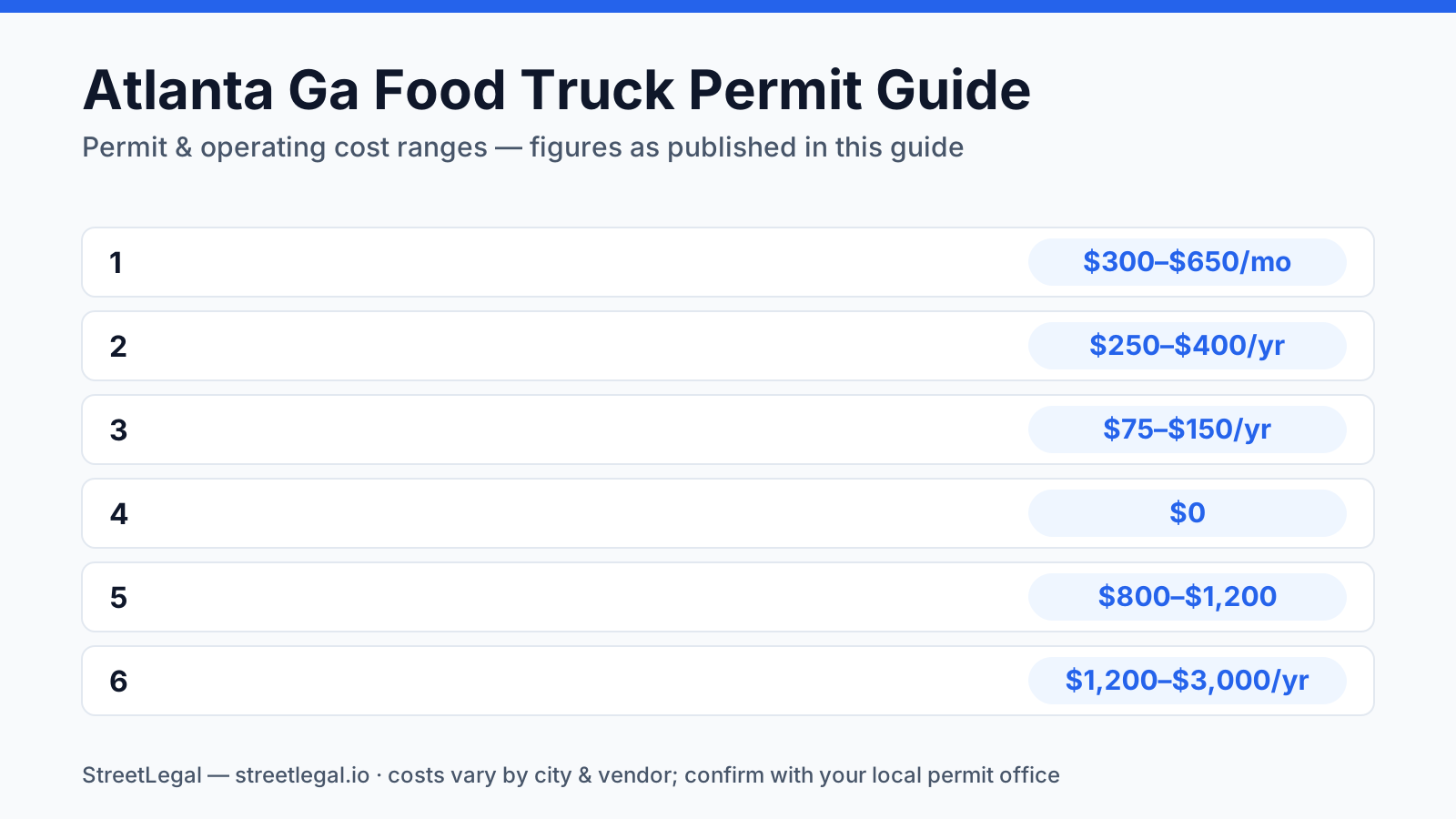
| Step | Agency | Permit | Fee | Timeline | Sequence |
|---|---|---|---|---|---|
| 1 | Commissary | Commissary agreement | $300–$650/mo | 1–2 weeks | Start here |
| 2 | Fulton County Board of Health | Mobile Food Service Permit | $250–$400/yr | 3–8 weeks | After commissary |
| 3 | City of Atlanta | Business License (OTC) | $75–$150/yr | 3–5 days | Parallel to county |
| 4 | Georgia DOR | Sales & Use Tax Number | $0 | Immediate | Early |
| 5 | GA Fire Marshal | Fire suppression install + cert | $800–$1,200 | 1–2 weeks | Before operating |
| 6 | Insurance broker | General liability | $1,200–$3,000/yr | 1–3 days | Before launch |
Step 1: Secure Commissary Agreement
Start here. Georgia law mandates that all food trucks operate from a licensed commissary kitchen. Fulton County Board of Health will not issue your mobile food permit without proof of a commissary agreement. This is your bottleneck, so secure it early.
Commissary Requirements
- Must be licensed: The commissary must hold a current Fulton County food service establishment license
- Written agreement: You need a signed agreement specifying access hours, services, and support
- County verification: Fulton County may contact the commissary to verify the arrangement
- Inspection ready: The commissary will be inspected as part of your permit approval
Atlanta Commissary Costs (2026)
- Shared commercial kitchen: $300–$650/month (varies by location and access hours)
- Daily access option: $40–$70/day if available
- Hourly rental: $18–$28/hour (if commissary offers hourly slots)
East Atlanta, Westside, and South Atlanta have several commissary options. Get your agreement signed and ready before submitting your Fulton County application.
Step 2: Fulton County Mobile Food Service Permit
Once you have your commissary agreement, apply for the Fulton County Board of Health Mobile Food Service Establishment Permit. This is your primary operational license for food safety.
Application Requirements
- Commissary agreement (signed and ready to submit)
- Menu and cooking equipment list
- Truck inspection certificate (if required by county)
- Completed application form (available from Fulton County Board of Health)
- Permit fee ($250–$400)
Permit Fees (2026)
- Mobile Food Service Permit: $250–$400/yr (based on menu complexity)
- Annual renewal: Same fee structure
Processing Timeline
- Submit application with all documents and commissary agreement
- County reviews within 3–5 business days
- Schedule health inspector visit (1–2 weeks)
- Pass initial inspection
- Receive Mobile Food Permit (total: 3–8 weeks from submission)
Step 3: City of Atlanta Business License
Fulton County permits the food truck; Atlanta licenses the business. You need both. Apply for the City of Atlanta Business License after your Fulton County permit is approved or in parallel.
Atlanta Business License Details
- Fee: $75–$150 depending on business type (food service)
- Processing time: 3–5 business days
- Apply at: City of Atlanta Department of Business Licensing
- Required documents: Fulton County permit, EIN/SSN, proof of address
- Renewal: Annual
⚠️ Business License Does Not Authorize Food Sales
The City of Atlanta business license shows you're operating a legal business, but it does NOT authorize food sales. The Fulton County mobile food permit is what allows you to cook and serve food. You need both.
Step 4: Georgia State Fire Inspection & Fire Suppression System
Georgia requires food trucks with cooking equipment (griddles, fryers, open flames) to have commercial-grade fire suppression systems. Your truck must pass fire inspection.
Fire Suppression Requirements
- System type: Commercial-grade K-class fire suppression (Ansul or equivalent) required for any cooking equipment
- Installation: Must be professionally installed and certified
- Annual maintenance: Required by law
- Cost: ~$800–$1,200 for initial installation + $75–$150/yr maintenance
Fire Inspection Process
- Install fire suppression system with professional certification
- Request fire inspection from Atlanta Fire Rescue Department or county fire authority
- Pass inspection before operating
- Keep annual maintenance records on file
Step 5: Sales & Use Tax Registration
Georgia requires all food service businesses to register for sales tax.
Georgia Department of Revenue Registration
- Registration: Free (apply at dor.georgia.gov)
- Sales & Use Tax Number: Issued immediately or within a few business days
- Required to: Collect and remit sales tax on all food sales
- Filing: Monthly or quarterly depending on sales volume
Best Food Truck Types for Atlanta
| Truck Type | Atlanta Market Fit | Commissary Pressure | Event Flexibility | Rationale |
|---|---|---|---|---|
| BBQ / Southern comfort food trailer | Excellent | High (smokers, prep) | High | Georgia BBQ culture strong; events + BeltLine + sports venues |
| International / fusion truck | Excellent | Medium | High | Diverse city; East Atlanta + Midtown young professional demand |
| Taco / Mexican truck | Strong | Medium | High | High foot traffic zones; quick service model fits lunch/event rush |
| Dessert / ice cream truck | Strong | Low–Medium | Very High | Humid climate year-round; BeltLine + festivals + corporate events |
| Coffee / espresso cart | Good | Low | Medium | Midtown morning demand; corporate catering opportunities |
| Upscale / farm-to-truck | Good | High | Medium | Event catering market strong; BeltLine upscale events + weddings |
Where You Can Operate in Atlanta
| Operating Lane | Permit Alone Enough? | Access Reality | Best Truck Fit |
|---|---|---|---|
| Midtown business district | No | Need property owner approval + zoning clearance | Lunch trucks, coffee carts |
| East Atlanta neighborhood | No | Private lots common; verify zoning per location | BBQ, fusion, dessert |
| BeltLine events / designated zones | No | Event organizer contracts required; curated vendor selection | All types, upscale strong |
| Private parking lots / office parks | No | Owner permission + lease agreements | Lunch trucks, coffee |
| Downtown Atlanta street vending | No | City vending permits + designated zones only | Quick service, tacos, lunch |
| Festivals / sports events | No | Event vendor contracts; high revenue but seasonal | BBQ, specialty, dessert |
| Food truck parks / pods | No | Park operator approval + revenue share agreements | All types |
Step 6: Zoning & Location Approval
Before you park your truck anywhere, check zoning approval with the City of Atlanta and/or Fulton County.
Operating Zones in Atlanta
- Midtown: Business-friendly, high foot traffic, allows food trucks
- Downtown Atlanta: Permitted zones near park spaces and street vending areas
- East Atlanta: Hip neighborhood, growing food truck scene, mostly private property
- BeltLine: Park-based events and designated vending areas
- Private property: Parking lots, business campuses (requires owner permission)
Restricted Zones (Verify First)
- Residential neighborhoods: Limited food truck operation
- School zones: Check school proximity rules
- Protected restaurant corridors: Some areas limit food truck proximity to established restaurants
Step 7: Workers Compensation Insurance (If Employees)
If you hire employees, Georgia requires workers compensation insurance.
- Coverage: Required for all employees (even part-time)
- Cost: Varies based on payroll and risk (typically $500–$1,500/yr)
- Provider: Georgia Department of Insurance-regulated carriers
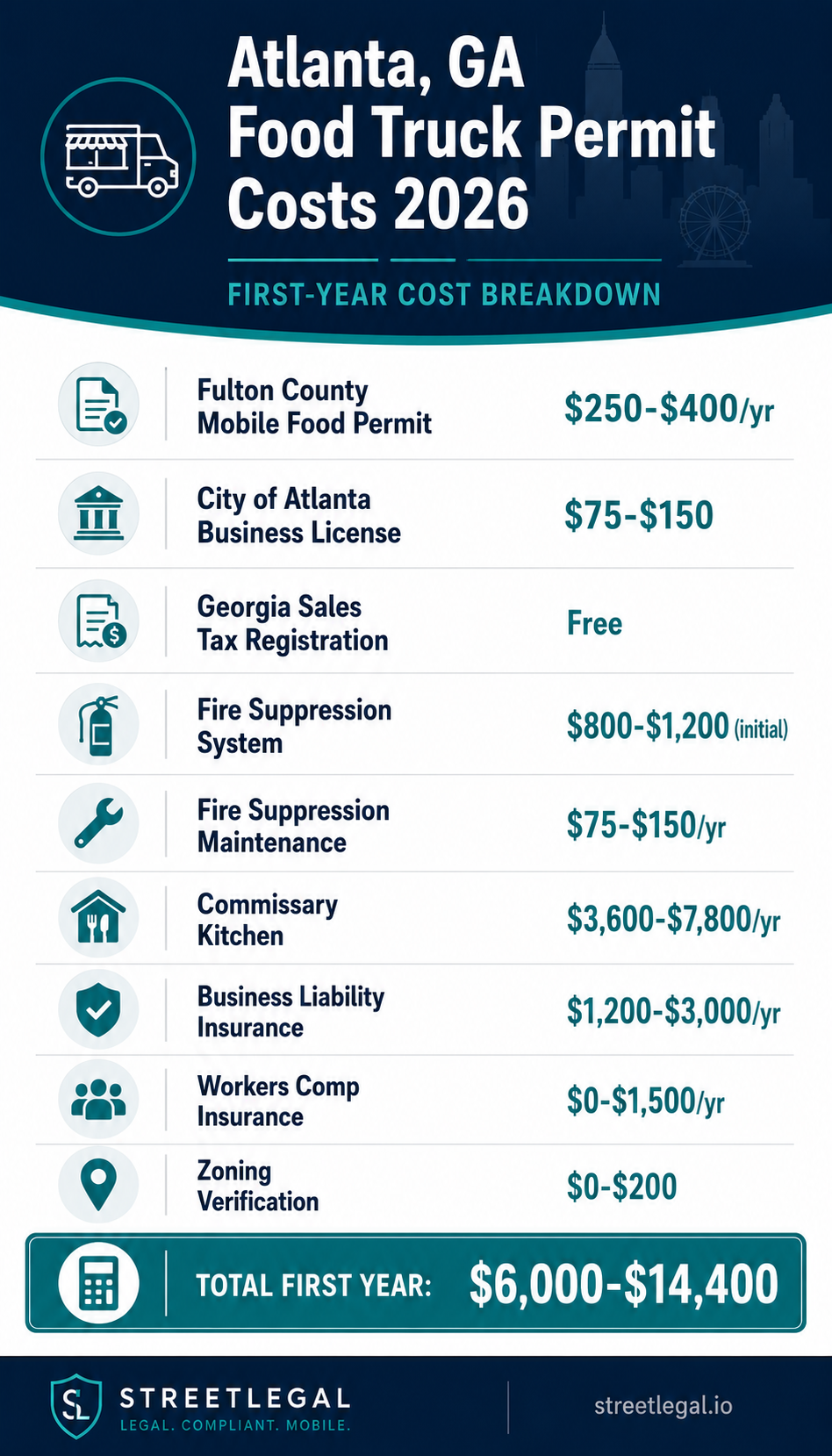
Full Cost Breakdown: Starting a Food Truck in Atlanta
| Permit / Cost Item | Low | High |
|---|---|---|
| Fulton County Mobile Food Permit | $250 | $400 |
| City of Atlanta Business License | $75 | $150 |
| Georgia Sales & Use Tax Registration | $0 | $0 |
| Fire Suppression System Installation | $800 | $1,200 |
| Fire Suppression Maintenance (annual) | $75 | $150 |
| Commissary Kitchen (annual) | $3,600 | $7,800 |
| Business Liability Insurance | $1,200 | $3,000 |
| Workers Comp Insurance (if employees) | $0 | $1,500 |
| Zoning Verification / Permits | $0 | $200 |
| Total First-Year Estimate | $6,000 | $14,400 |
Excludes truck purchase/lease, equipment, and initial inventory.
Timeline: Atlanta Food Truck Launch
- Week 1–2: Secure commissary agreement and sign contract
- Week 2–3: Register for Georgia sales tax; apply for City of Atlanta business license
- Week 3–4: Install fire suppression system; get certified
- Week 4–5: Submit Fulton County Mobile Food Permit application
- Week 5–6: Fulton County schedules health inspector visit
- Week 6–7: Pass health inspection; receive mobile food permit
- Week 7–8: Pass fire inspection; finalize insurance
- Week 8: Ready to operate — select location and begin sales
5 Atlanta-Specific Tips
- Start your commissary search early. This is your biggest bottleneck. Many commissaries in Atlanta are busy and may have limited hours. Scout multiple options before you commit — you want flexibility in prep schedules.
- Midtown and East Atlanta are your best bets for foot traffic. Both neighborhoods welcome food trucks and have high density of young professionals and students. Avoid trying to compete in strictly protected restaurant zones.
- Check zoning before committing to a location. The City of Atlanta has evolved its zoning rules over the past few years. Some areas require special permits or have operating hour restrictions. Always confirm with City of Atlanta before you park regularly.
- Connect with the Atlanta food truck community. Atlanta has a well-organized food truck network. Networking events and social media groups can help you find the best commissaries, highest-traffic spots, and insider tips.
- BeltLine events are lucrative but seasonal. If you can secure vending rights at BeltLine-affiliated events, it's excellent supplementary revenue. But don't rely on it as your primary income — regular street/parking lot locations are more stable.
Atlanta vs. Other Southeast Cities
| City | License Cost | Timeline | Key Advantage |
|---|---|---|---|
| Atlanta, GA | $325 | 3–8 wks | Fast-growing market, diverse neighborhoods |
| Nashville, TN | $705 | 4–10 wks | Music scene, booming food culture |
| Memphis, TN | $550 | 3–7 wks | BBQ market, lower costs |
| Austin, TX | $500 | 3–6 wks | Food truck capital, most permissive |
Related City Guides
Answers to the most common permit questions — costs, timelines, commissary rules, and more.
Find city-level permit guides for every state we cover — compare costs and requirements.
More from the blog
Jefferson County, MO Food Truck Permit Guide
Complete guide to food truck permits, fees, and requirements in Jefferson County, MO.
City GuidesSt. Charles County, MO Food Truck Permit Guide
Complete guide to food truck permits, fees, and requirements in St. Charles County, MO.
City GuidesSt. Louis County, MO Food Truck Permit Guide
Complete guide to food truck permits, fees, and requirements in St. Louis County, MO.
Buyer's GuideFood Truck POS Systems 2026: Square, Toast, Clover & Avocado
Compare 2026 food truck POS systems by pricing, hardware costs, offline mode, and contract terms for Square, Toast, Clover, and Avocado.